Unethical Quote Of The Week: SunTrust Bank

pop weasel2

“SunTrust supports the rights of all Americans to fully exercise their freedoms granted under the Constitution, including those with respect to free speech and freedom of religion.”

—-SunTrust Bank, doing its best Cracker Barrel imitation by reversing its decision, announced  earlier in the day, to pull all of its listed properties with the Benham brothers’ bank-owned property business.

SunTrust was following the lead of craven, political correctness bully-enabling HGTV, which a week ago announced it was canceling a planned home renovation show hosted by the Benhams as punishment for their conservative views on same-sex marriage, because, as we all know, gays are the heart and soul of the home renovation business. Thus emboldened, the bank decided that citizens opposing same-sex marriage as taught by the faith they had been raised to embrace deserved to have their business harmed, since that’s what the SunTrust suits’ moistened fingers in the wind told them their sensitive, right-thinking customers wanted.

But the announcement turned that wind into a roaring hurricane of protest from conservatives, and, we can at least hope, some actual liberals among Democrats who comprehend that banks should not be enforcers of the growing, un-American movement to make life nasty, brutish and short for anyone who dares to see the world differently from the news media, the universities, and the rest of the thought-crime legislators among us. Thus the quick reversal, and the noble words above.

So why is SunTrust’s impeccable affirmation of their iron-clad support for our precious freedom unethical? Continue reading

Michael Sam Flunks Trailblazer Ethics, And Many Will Suffer Because Of It

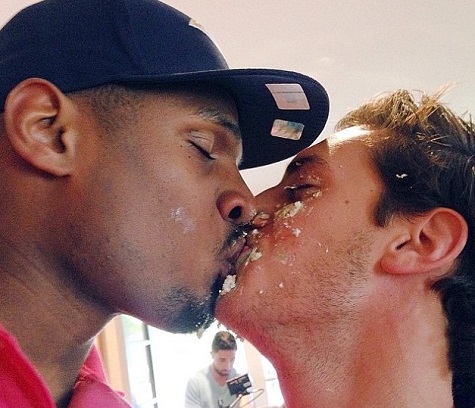
Sam kiss

The most charitable explanation for Michael Sam’s disastrous performance in the wake of the NFL draft is that he’s a young man who got terrible advice. A less charitable theory is that he’s an idiot. The worst theory of all is that Michael Sam is less interested in being the first openly gay pro-football player who blazes a clear path for those who follow him, and more concerned about becoming a gay icon, or worse, a martyr. Whatever the reason, Sam accepted the massive responsibility of being a cultural trailblazer, and fumbled the ball.

Sam wasn’t the best player in the NFL draft, but everyone knew, including Sam, that he would be the most closely watched. He had “come out” as gay soon after the college football season, and in light of his prominence and recognition as a stand-out athlete, his honesty and openness about his sexual orientation was hailed as a cultural turning point, an advance for gay Americans, and a test for the macho NFL. Would he be drafted? If he wasn’t (or was?), would it be because he was gay? ESPN’s cameras were in the Missouri defensive end’s home Saturday as the drafts neared its final stages with Sam name still uncalled. When St. Louis Rams coach Jeff Fisher called Sam at his agent’s house in San Diego to tell the former University of Missouri defensive lineman that they had selected him in the seventh and last round of the draft, it was instant drama.

There was more drama, in fact, than ESPN and viewers probably expected. Sam burst into tears while receiving the call, and then received an emotional, mouth-t0-mouth kiss from his boyfriend, Vito Cammisano.

Not that there’s anything wrong with that.

Actually, there is; several, in fact. To begin with, Sam had violated the Second Niggardly Principle, which states,

“When an individual or group can accomplish its legitimate objectives without engaging in speech or conduct that will offend individuals whose basis for the supposed offense is emotional, mistaken or ignorant, but is not malicious and is based on well-established impulses of human nature, it is unethical to intentionally engage in such speech or conduct.”

A clearer example of the SNP would be hard to find. No doubt about it, most heterosexual Americans, which means most of the public, are not used to seeing adult men kissing each other on the lips. There is no question that Sam knows this: of course he does. Even now, popular culture uses the image for shock value; it was only the 90’s when an impulsive lip-lock from Kramer on Jerry drove the studio audience to screams of laughter. No, there’s nothing “wrong” with two men kissing each other, but an awful lot of people were raised to think it is unnatural, and it is wrong to intentionally or negligently offend or upset them gratuitously. It is the flip side of tolerance: consideration and etiquette. Causing discomfort just because you can, or because your targets “deserve” or “need” to feel uncomfortable is just trouble-making for the hell of it. “Deal with it!” is confrontational and aimed at creating rancor, not comity. Continue reading

HGTV And Corporate Cowardice: Hold Companies Accountable For Stifling Speech, Opinion, And Thought

"Remodeling Homes, and Wrecking Democracy"

“HGTV: Remodeling Homes, and Wrecking Democracy”

Once again,  a company that is in effect punishing an American for his or her views on a complex social or political issue is being excused as simply “watching out for the bottom line.” This time, it is cable network HGTV, which cancelled a planned cable show about home repair because one of the prospective stars expressed an opinion adverse to gay activists. Last week, it was the NBA; before that, the agent of activist vengeance was Mozilla, and before that, A&E, until it decided that it was more profitable to do one “right thing” (not punish the duck call eccentrics for being open about who the network and its viewers always knew they were) rather than what it had decided earlier was the “right thing” (“STONE THE BIGOTS!!!”). None of these profit-making organizations are the least bit interested in what is right or wrong, of course, and probably don’t give the ethical implications of their acts a moment’s thought. All they are worried about is money, and what they will grandstand as their “principled decision” will always, amazingly, coincide with whose bullying tactics are more likely to succeed. Continue reading

A Brief Ethics and Culture Lesson For First Amendment Pedants

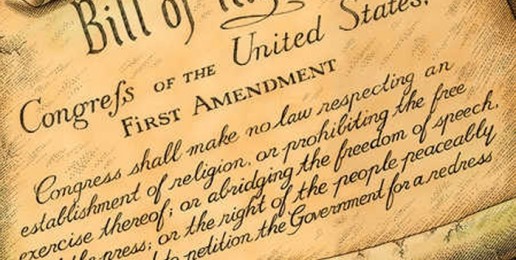
First-Amendment-on-scroll1

Thousands or pundits and web commenters, perhaps hundreds of thousands, in their concerted effort to justify the speech and thought police, (at least as long as the Enforcers are not likely to disapprove of their thoughts and speech), are mocking those who cite the First Amendment as authority for the proposition that the treatment of Donald Sterling, and others, are harmful, sinister, and un-American. The pedants are technically correct, of course. When someone who is fired for posting something offensive on Facebook screams, “My First Amendment right of free speech has been violated!”, that typically speaks of a poor civic education. The Bill of Rights only constrains government action, not private transactions. No rights, which are enumerated and protected from government incursions by the Constitution, have been lost or affected when only private action is involved.

That does not mean, however, that when private action opposes an individual’s Constitutional rights, it is necessarily acceptable, fair, harmless, reasonable or right. Indeed, the government and law serves a crucial function by delineating and encouraging cultural and ethical values. The principles articulated in the Declaration of Independence, the Constitution and the Bill of Rights do not merely constrain government. They form the basis of the ethical values that make the United States a unique culture, and point the way to what Americans, as Americans, regard as right and wrong.

Thus, while searching though a friend’s private e-mail account isn’t a violation of one’s right to privacy under the 10th Amendment, violating a fellow citizen’s privacy is wrong, and the Bill of Rights stands as authority that it is something important to each individual that should be respected. The Constitution and the 13th, 14th, and 15th Amendments won’t and can’t stop Americans like Sterling from being bigots in their private dealings, but they send a clear message that bigotry is not approved by the United States and was not by those who have charted our ethical course. Privately interfering with someone’s right to worship as they please is wrong, and the fact that the government is prevented from doing it tells us so. The First Amendment’s existence also tells us that preserving free speech—open, fearless, speech—is essential to core American values, because it also supports free thought, that which tyrants and dictators fear. Yes, we all have the right to make free speech, thought and discourse costly, difficult and painful, but we should not. We have the right to punish severely the non-conformist, the iconoclast, the rebel, or the citizen who may be a little late, or slow, or reluctant, to accept the conventional wisdom of the moment. We have the right to do it, but it is wrong. It is un-American. The Constitution tells us so.

Addendum: After I wrote the post, I encountered this.


Ethics Alarms On NPR: The Sterling Ethics Train Wreck

V.-Stiviano-Donald-Sterling

You are welcome to read the transcript and/or  listen to my interview on NPR yesterday with Michel Martin, both of which can be found here.

It’s too bad, really. They seem like such a nice couple…

Pineda-Pine Tar, Part II: Baseball Clarifies Its Bizarro Ethics Culture

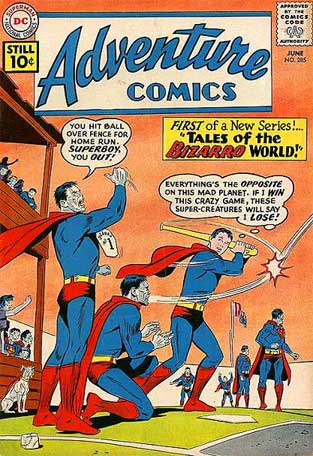
bizarro_world-baseballYou shouldn’t have to appreciate, care about or even understand baseball to find illumination in its latest ethics controversy, which shows how cultures can go horribly wrong, precluding exactly the values that any functioning entity must embrace to remain viable and healthy. For someone like me, to whom Baseball is Life, the whole thing just makes me want to jump out the window.

You will recall that a couple weeks ago, the sport embarrassed itself by making excuses and accepting lies regarding New York Yankees pitcher Michael Pineda being allowed to break the game’s rules against pitchers applying foreign substances (in this case, pine tar) on the baseball while pitching to the Boston Red Sox. I wrote about it here. I interpreted the post-incident consensus of the game and its pundits as “everybody does it, so let’s not make a big deal over a little infraction on a night when it was abnormally cold and hard to grip the ball.”  That’s unethical enough, but the truth, as revealed in Part II, is far worse.

Last night, fate had Pineda on the mound against the Red Sox again. Baseball’s ethics had already begun falling apart in chunks when Sox manager John Farrell, asked about whether he expected Pineda to cheat again (for that is what using pine tar on baseballs is—cheating. Official Rule 8.02 states: “The pitcher shall not apply a foreign substance of any kind to the ball.” ) answered that hopefully, if he did, he would be more discreet about it. Huh?

But Pineda was not discrete; in fact, he could not have been more obvious, or ridiculously so. After a rough first inning in which he gave up two runs, Pineda emerged from the dugout with a large, brown, greasy gob of pine tar on his neck. On TV. In nationally broadcast game. Against the same team that he was caught using pine tar against before. In that team’s home park.

In the Red Sox dugout, Manager Farrell and the team were laughing and rolling their eyes. Farrell finally shrugged, and walked out to complain to the home plate umpire, for it is an automatic ejection for a pitcher to be caught doctoring the ball. The umpire dutifully walked out to the mound—he had to have seen the offending gob before Farrell complained—and to add to the foolishness, checked Pineda’s glove, cap and jock strap before looking at the huge brown smear on his neck. Finally he did so, said, “That’s pine tar!” (in the previous game, Pineda told the press it was “dirt”) and threw him out of the game.

In subsequent interviews with Farrell and others, the explanation that emerged was this gibberish: “everybody” uses something to grip the ball better when it is cold (and often when it isn’t); hitters don’t mind because they don’t want to get hit. Pineda’s offense wasn’t that he used pine tar, but that, as Farrell suggested before the game, that he was “blatant” about it. That gave Farrell no choice, you see….even though his own pitchers also use foreign substances to grip the ball (in unequivocal violation of a baseball rule), and this sets his team up for “retaliation.”

I feel like I’m going crazy. Continue reading

The Cruelest Month And The Duty To Remember

sultana-ablaze

If we have the education, curiosity, perspective and respect for our origins and those who have gone before us, the calendar is a source of constant reminders of what matters in life, and how we can be better citizens and human beings. It is a common belief among Millennials, and a lot of older Americans too, that history is irrelevant to their lives, and this is both a fallacy and a self-inflicted handicap. Not that keeping history in mind is easy: in this month, which T.S. Elliot dubbed “the cruelest,” paying appropriate respect by remembering is especially difficult.

Still, respecting history is our duty. It won’t be remembered, perhaps, but in April, 2012, a 23-year-old drunken fool named Daniel Athens was arrested for climbing over a barrier to urinate on a wall at the Alamo. Monday, a Texas judge threw the book at him, sentencing him to 18 months in state prison for vandalizing a National Monument and a shrine. The sentence seems extreme, and is a good example of how the law is a blunt weapon with which to enforce ethics. The Alamo has near religious significance in Texas, brave men died there, and the ruins serve as a symbol of critical virtues like loyalty, sacrifice, dedication, courage and patriotism. Athens, himself a Texan, defiled the memory of the fallen and symbolically rejected the values and heritage of his community and fellow citizens. Unfortunately, the harshness of the sentence will create sympathy for him: 18 months for peeing? But how else does a culture reinforce the importance of respect for the past? I don’t have an answer. Perhaps I would have sentenced him to take an exam on the lives of Travis, Crockett, Bowie, Seguin and the rest, as well as the siege itself, and imposed the jail term only if he flunked.

Yesterday, Major League Baseball celebrated the heroism and transformative life of Jackie Robinson, who broke baseball’s color barrier on April 15, 1947 by becoming baseball’s first black player, setting in motion powerful forces that propelled the cause of civil rights. Every player wore Robinson’s now retired uniform number 42, and there were commemorative ceremonies in the ball parks where it wasn’t too cold and wet to play ball. This remembrance had a difficult time competing with tax day, as history usually does when our immediate life concerns beckon.

Other important historical events deserving reflection, however, were more or less ignored entirely, for April 15 is a historically awful day: Continue reading

The Abysmal Quality of Ethical Reasoning in Baseball: A Depressing Case Study

"Dirt."

“Dirt.”

The first bona fide ethics controversy of the 2014 baseball season has erupted, and it involves the team of my youth, the Boston Red Sox. It is not the controversy itself that is so noteworthy, for it is an old, old one: pitchers using foreign substances to doctor the balls so they dip, curve, and sing “Take Me Out To The Ball Game.” What is noteworthy is the reaction to the incident by players and the sports media, which has me feeling that as an ethicist, I need to think about following another sport. The ethics reasoning, or lack of it, is truly depressing.

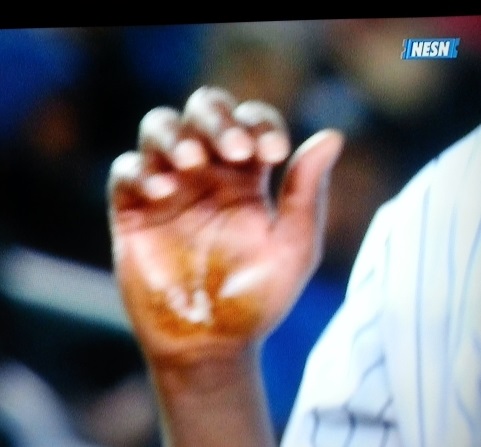
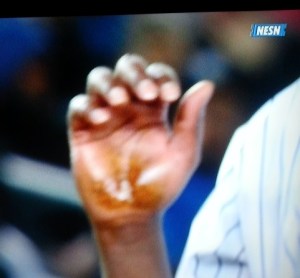
What happened was this: During last night’s Red Sox-Yankee game in Yankee Stadium, the Boston broadcasting team of Don Orsillo and Jerry Remy noticed a glossy brown substance on New York starting pitcher Michael Pineda’s pitching hand. It was very obvious, especially once the NESN cameras started zooming in on it.   “There’s that substance, that absolutely looks like pine tar,” play-by-play man Don Orsillo said. “Yeah, that’s not legal,” color commentator and former player Jerry Remy replied.

Indeed it isn’t.  According to rule 8.02(a)(2), (4) and (5), the pitcher shall not expectorate on the ball, either hand or his glove; apply a foreign substance of any kind to the ball; [or]  deface the ball in any manner.

The Red Sox, who probably knew about the gunk on Pineda’s hand, didn’t complain to the umpires, and just went about their merry way, losing the game. Asked about the stuff on his hand, Pineda demonstrated the full range of body language indicating that he was lying his head off. “It was dirt,’ he said. Later, when the ick appeared to be gone,  Pineda explained, he had just sweated his hand clean. Right. Whatever was on his hand—beef gravy, crankcase oil, chocolate syrup…the majority of pundits think pine tar—it wasn’t “dirt.” Pineda’s manager, Joe Girardi, was brazenly evasive.

The Yankee pitcher was cheating. This isn’t a major scandal, but cheating is cheating: sports shouldn’t allow cheating of any kind, because if a sport allows some cheating, however minor, it will encourage cynical, unscrupulous and unethical individuals on the field, in the stands, and behind keyboard to excuse all other forms of cheating, from corked bats to performance enhancing drugs. Cheating is wrong. Cheating unfairly warps the results of games, and rewards dishonesty rather than skill. Cheating undermines the enjoyment of any game among serious fans who devote energy and passion to it. Any cheating is a form of rigging, a variety of lying.

And yet, this clear instance of cheating, caught on video, primarily sparked the sports commentariat, including most fans, to cite one rationalization and logical fallacy after another to justify doing nothing, and not just doing nothing, but accepting the form of cheating as “part of the game.” I’ve been reading columns and listening to the MLB channel on Sirius-XM and watch the MLB channel on Direct TV since this episode occurred. Here are the reactions, my comments in bold:

  • This isn’t a new phenomenon. Show me the statute of limitations on ongoing misconduct, please. Also not new: torture, rape, adultery, incest, bribery and embezzlement. So what? That makes these things all right? Excuses society from trying to reduce their occurrence?

Continue reading

Hope Lives! D.C. Votes For Ethics

Time for a new fish head in the District of Columbia.

Time for a new fish head in the District of Columbia.

A continuing battle on Ethics Alarms, one that bursts into flame when elections loom, is whether it is responsible to vote for an unethical candidate for office because he or she supports policies the voter favors. I resolutely vote “no” on that proposition, believing that in the long run, government and society are better served by plodding but trustworthy public servants than wily and corrupt ones. The ideal, of course, is to find candidates who are competent, trustworthy, dedicated and who pursue effective policies. Good luck.

Few cities have embraced the opposite of the Ethics Alarms approach more consistently than the District of Columbia. The nation’s most liberal region has traditionally chosen to ignore corrupt city officials, and has paid a high price. A culture of corruption has been festering in the District for decades, spear-headed by the smug, machine-politics reign of Marion Barry, elected both before and after a prison sentence for possessing crack (in the midst of an anti-drug campaign for schoolchildren, naturally). Barry still pollutes D.C. government as a city councilman, but his legacy is complete: the whole government is an ethics sewer.

In 2013, more than thirty D.C. employees were arrested, indicted, pleaded guilty or were sent to jail from  such diverse cesspools as the D.C. Department of Employment Services, the Department of Human Services, the Children and Youth Investment Trust Corp., a city-owned hospital, the Office of Campaign Finance, D.C. Medicaid, the Corrections Department, a charter school and Medicare. The tally of money embezzled, accepted in bribes, defrauded or spent on illegal political campaign contributions was about $19 million. Former D.C. Council member Harry Thomas Jr. pleaded guilty to stealing $350,000 in taxpayer money meant to benefit children. Former council chairman Kwame Brown pleaded guilty to a felony bank fraud charge; and former council member Michael A. Brown confessed to an illegal bribery scheme. Colbert King, the Washington Post’s city beat columnist who tirelessly urges the city to clean up its act cataloged the extent of D.C.’s corruption last year. He pointed out:

Continue reading

I Repeat: April Fools Day Is Not For Ethical Professionals

april-fools-day-banner

In a much attacked post here way back in 2010, I offered some ethical guidelines for April Fool’s Day, which was just beginning to get out of hand. I was right, my critics were wrong, and maybe some of the mockers who are now trying to figure out when their favorite news organization is lying to them today for fun, as opposed to the rest of the year when it lies to them out of bias or incompetence, are beginning to appreciate my position.

I just watched three different morning news shows that contained fake news or commentary that the reporters and anchors, at least, seemed to think was hilarious. In one case, on Fox, conservative talk-show host Laura Ingraham dead-panned a remarkably even-handed and fair explanation for HHS Secretary Sibelius’s much-maligned TV silence when asked about the Affordable Care Act’s unpopularity.  April Fool! Laura wasn’t being fair or objective, she was just tricking Fox’s audience into being angry at her for being fair and objective, or, in my case, admiring her integrity for pointing out that the incident had more than one plausible interpretation. Got me, Laura. I just heard an NPR host plead with the audience not to regard the upcoming segment as a hoax because of the date, an especially difficult plea since NPR springs virtual hoaxes on its audience all year.

The first and most important of my April Fools guidelines was this:

1. April Fools’ Day tricks are not for professionals to play on those who depend on them, trust them, or otherwise rely on them for information or services, unless there is a special relationship as well. The risks of harm and abuse are too great.

The succeeding four years have validated my position. Journalism, government and politics are the prime examples. CNN played a video that showed Jay Carney crowing yesterday about the Affordable Care Act’s success even as the Healthcare.gov website had crashed. Wait..is this a joke? Did the Obama White House film this for fun and games? They wouldn’t do this, you say? Government officials don’t use their high office for jokes and hoaxes? Really?

Sen. Ted Cruz, also on Fox, showed his new tattoo, apparently an April Fools’ joke, but also said he was certain that the Affordable Care Act would be repealed. Which is more likely, that the AFA will be repealed, or that wacky Ted Cruz would get a tattoo? Slate has a post up by someone called Rehan Salan, which is, clearly, a clever anagram for “En Anal Rash” or something, arguing that adults without children should be forced to pay extra taxes to support parents. Hah! Good one, Slate! That should turn the “pro choice” crowd on its head: lets; punish the choice not to have children via a penalty—I’m sorry, Chief Justice Roberts, a tax, wink-wink. Wait…that isn’t a joke? Ok, well, I’m sure about this, then: that fake video showing famous tough guy Don Baylor, a record holder for being hit by pitches when he played and now a coach for the Los Angeles Angels, “breaking his leg” catching the ceremonial first pitch of the baseball season. April Fools, right ESPN? No????

Continue reading