Thanking Dick Williams…Finally

The late Dick Williams, doing what great leaders do

If you are not a baseball fan, or under the age of thirty, you probably never heard of Hall of Fame manager Dick Williams, who died yesterday at the age of 84. I never met Williams myself, but I have been indebted to him for four decades. I never told him the immense difference he made in my life, just by doing his job.

In the winter of 1967, I was a devoted fan of my home town team, the Boston Red Sox, and had been since 1962.  Over that period I had listened to every single baseball game on my transistor radio when a game wasn’t on TV, which was most of the time, or when I wasn’t at the game, which was almost always the case. I was the only person I knew who followed the team, and for good reason: it was torture. The Red Sox were hopelessly mediocre on the way to awful, and hadn’t had a winning season in more than ten years.

It is a great character builder to follow the fortunes of a terrible baseball team. Almost every day, for six months, you are let down, and yet return to the scene of your despair the next, attempting to muster hope while steeling yourself against likely disappointment. You find yourself finding things to appreciate other than winning: the gallant veteran player who “plays the right way” (Eddie Bressoud, shortstop, 1962-1965); the exciting rookie who gives promise of a better future (Tony Conigliaro, right fielder—rest in peace, Tony); the unique talent who is worth watching for his own sake (Dick Radatz, relief pitcher, 1962-1966). These things help, but following a perennial losing team and caring about them is like being punched in the gut four or five days a week without knowing which day you’re getting it.

Since 1965, I had always reserved seats for the first day of the season and one of the last two home games, just in case those last games would be crucial to a (hahahaha!) Red Sox pennant drive. This was especially pathetic, since the team was getting worse. They had finished in a tie for 9th place in 1966, and as the 1967 season loomed, Vegas had them installed as 100-1 underdogs to win the American League pennant. In truth, the odds should have been longer. Nonetheless, I wrote the Red Sox and got my tickets, this time for the next to last day of the season.

The team was full of rookies and near rookies, and appropriately had hired a minor league manager, Dick Williams, to be the new skipper. Williams was something else, however: he was a gifted leader. One day, in the middle of Spring Training, a Boston scribe asked the new manager what the prospects were for the upcoming season. Would the team escape the cellar? Would there be forward progress? Williams’ answer was instant front page news:

“We’ll win more than we lose.” Continue reading
Buck Foston’s Ethics

News Item:

“A New Brunswick businessman has filed suit in federal court, charging New Brunswick Mayor James Cahill is holding up approval of his liquor license for a new high end sports bar because he doesn’t like the bar’s proposed name — Buck Foston’s. Larry Blatterfein, who has owned the Knight Club, a bar on Easton Avenue, for 30 years, charges Cahill is violating his first amendment constitutional right to free speech by holding up the transfer of a second liquor license to Blatterfein from another restaurant in town.”

The story goes on to say that the mayor denies the accusation, that the name has nothing to do with the planned establishment’s problems. Maybe not. Continue reading

Andy Murray, Tennis Corrupter

That's nice, Andy: rub his nose in it.

Once upon a time, like, oh, a few years ago, tennis was a sport in which the ancient values of mutual respect between adversaries, honesty, fairness, and sportsmanship were paramount.  The periodic talented boors  like Connors, Nastase and McEnroe were aberrations, and their conduct was derided, colorful though it might be.

I am pretty sure that Scottish tennis star Andy Murray has put an end to this, unless the international tennis body or a public uproar puts an end instead to his bringing the tennis equivilent of NFL taunting and NBA showboating onto the court. Murray is a trick shot specialist, and at the London Queens Club tournament leading up to Wimbledon, he created a viral YouTube moment  when he hit a winner against opponent Wilfried Tsonga by swinging his racket under his leg. It was spectacular, flashy and fun. It was also rude, disrespectful and obnoxious.

Guess which the public cares about. Continue reading

Comment of the Day: “The Death of Ryamond Zack”

The story about the Alameda firefighters and police, as well as many citizens, standing useless on the shore as a suicidal man slowly drowned continues to receive  outstanding commentary. Here is the most recent, from Peter, doing some follow-up and pointedly critical analysis: 

“ABC asked Alameda Fire Division Chief Ricci Zombeck  whether he would save a drowning child and he said: “Well, if I was off duty I would know what I would do, but I think you’re asking me my on-duty response and I would have to stay within our policies and procedures because that’s what’s required by our department to do.”

“This quote essentially makes any indefensible defenses, or apologetics for how big and scary the victim was, moot. Perhaps they should make off-duty the new on-duty by assigning first responders to permanent off-duty roles. At least then they would go in after a drowning child. Continue reading

Comment of the Day: “The Death of Raymond Zack”

Raymond Zack

Buck Best, a Northern Virginia firefighter and supervisor, weighs in with his expert perspective and nuanced insight regarding my post on the Alameda, Cal. incident involving a suicide by drowning. His wife Lianne had another Comment of the Day earlier this week; if this keeps up, I will have to call the feature “Best Comment of the Day.”

“As an 18 year veteran of the Fire Dept. and the last ten years as the Officer of a Technical Rescue team that would be responsible for just such a rescue, let me offer another perspective to this ethical question. The Fire service much like many other organizations in recent history are governed by politics and litigation. The management of the organizations are always looking to the risk analysis of any potential situation based of the money that is available. The risk analysis is not based as much on the physical risk as it is on the financial or political risk. Continue reading

Flashback: “What Hugo Alfredo Tale-Yax Can Teach America”

The Late Hugo Alfredo Tale-Yax

[Not many people were checking in on Ethics Alarms when I wrote this post in response to yet another example of bystanders choosing to do nothing when a human being was in peril. Some of the comments to the Alameda post, those making excuses for the 75 faint-hearted or apathetic citizens in that city who would rather gawk at a tragedy than try to stop it,  caused me to recall the essay, which explores related issues.  I wrote it, but I had nearly forgotten about the story; when I re-read it today, I got upset all over again.Here, for the second time, is “What Hugo Alfredo Tale-Yax Can Teach America.”]

The one with the premium-grade ethics alarms bled to death on the sidewalk. The people who never had theirs installed at all took pictures. Is this the way it’s going to be? Continue reading

The Death of Raymond Zack: No Heroes, Only Bystanders

50-year-old Raymond Zack waded into the surf on an Alameda, California beach and stood calmly in the 54-degree water, apparently waiting to die. His suicide took nearly an hour, but eventually he drowned, with no rescue attempts from any of the 75 San Franciscans who gathered on the shore to watch the entire tragedy.

Why didn’t anyone try to rescue the man?

Apparently it was because nobody was paid to do it. You see, stopping Zack from killing himself wasn’t anyone’s job.

The media’s focus in reporting yet another disturbing incident with echoes of the murder of Kitty Genovese has been exclusively on the inert Alameda police and firemen who witnessed Zack’s suicide. “Fire crews and police could only watch,” wrote the Associate Press.

What does the AP mean, “they could only watch”?  Were they shackled? Held at gunpoint? Were all of them unable to swim? They didn’t have to watch and do nothing, they chose to watch and do nothing, just like every one of the bystanders who weren’t police or firemen chose to be passive and apathetic when saving a life required action and risk. Continue reading

Is Corporate Philanthropy Unethical? No, But It’s Important to Ask the Question

I gather not very many readers sample the links on Ethics Alarms, which is a shame. They contain a lot of different approaches to ethical issues, from many philosophical approaches. Well, heck…I use them , which is really what they are here for. One of the more original thinkers represented among the various sites is Jason Christopher Cockrell, author of The Worst-Case Scenario. It appears that he has abandoned blogging, which is a shame, but his last post, at the end of 2010, was full of surprises. In it, he offered an argument against corporate charity, something I have never heard anyone criticize on any level, except to say that there isn’t enough of it.

The theory behind corporate philanthropy is that it is a win-win for everyone involved. The corporation enhances its public reputation and visibility, improving employee moral and making investors proud to hold stock. Society benefits from substantial contributions that support everything from cancer research to Sesame Street to regional theater. It is hard to imagine what the charitable landscape would look like without corporate philanthropy, but the thought of eliminating it is sufficient to give any professional fundraiser hives. I know—both I and my wife were development officers for many years. Continue reading

Sending Teenagers To Prison Forever

He's only 14. Could he really be irredeemable?

The Wisconsin Supreme Court has upheld a life sentence for a man who helped throw a boy off a parking ramp when the prisoner was only 14 years old. At issue was whether sentencing someone to life imprisonment without parole for a crime committed at such a young age was prohibited by either the U.S. or the Wisconsin Constitution. The Court ruled not, finding that no national consensus has formed against such sentences.

I can accept that this is the proper legal standard, and that the decision may be correct regarding the law. It is also ethically wrong.

All such problems involve line-drawing and its well-known slippery slopes: if a 19-year old can be sentenced to jail forever, how different is an 18-year-old? 17? 16? Before you know it, we are sentencing 6-year-olds to life imprisonment. We do not have to fall into that trap, however, to declare that it is unethical, though legal, to sentence a 14-year-old boy to an endless jail term. Why? The sentence lacks compassion, mercy, proportion and common sense.

Certainly the crime was a horrible one. Omer Ninham was convicted of first-degree intentional homicide for his role in the death of 13-year-old Zong Vang  in 1998. Ninham and four others between the ages of 13 and 14 accosted the boy  as he was riding his bike home from the grocery store. Ninham and another member of the group teased Vang, punched him, and when Vang ran into a nearby hospital parking ramp, assaulted him on the top floor. Ninham and a friend seized Vang by the wrists and ankles, and as Vang screamed for help, threw him over the edge. He fell five stories, and hit the ground “like a wet bag of cement hitting the pavement,” as a witness put it. Two years later, when Ninham was 16, a judge sentenced him to life without parole. Continue reading

Death Photo Ethics

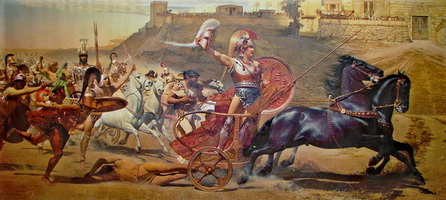
Even before Achilles dragged the corpse of Hector behind his chariot through the dust around the walled city of Troy, the tradition of demoralizing the enemy by degrading and displaying the bodies of its dead heroes was well-established. The United States was horrified when this was done to our fallen servicemen in Somalia, and it is one of the most barbaric and unnecessary practices of war.  While the Geneva Convention doesn’t mention the displaying of enemy corpses, a 2005 publication by the Red Cross called Customary International Humanitarian Law does. It was written to address issues that international treaties omitted, and its Rule 113 reads:

“Each party to the conflict must take all possible measures to prevent the dead from being despoiled. Mutilation of dead bodies is prohibited. Continue reading