Ethics Quote Of The Month: The French Anti-#MeToo Letter

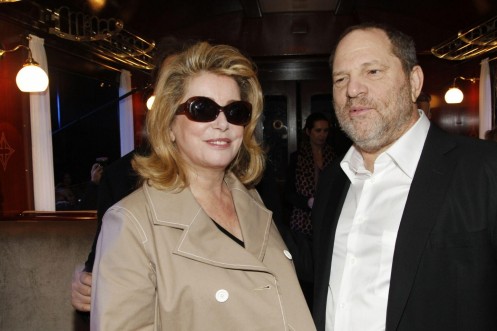
This translated open letter received a lot of publicity last week, in part because the famous French actress Catherine Deneuve signed it (that’s her, above, with Harvey Weinstein) , along with writer/psychoanalyst Sarah Chiche,  author/art critic Catherine Millet, actress/writer Catherine Robbe-Grillet, journalist  Peggy Sastre (author/journalist) and writer/journalist Abnousse Shalmani. It was signed by over a hundred other women.

The entire letter is important, and should be read by anyone interested in this issue—and everyone should be interested. All of the letter is ethically dead on, except one crucial element: workplace harassment is not trivial, as the letter mistakenly suggests. The letter states near the beginning:

“This summary justice has already had its victims: men who’ve been disciplined in the workplace, forced to resign, and so on., when their only crime was to touch a woman’s knee, try to steal a kiss, talk about “intimate” things during a work meal, or send sexually-charged messages to women who did not return their interest.”

The French just do not get this. I have seen it, fought it, and trained companies about it: supervisors using the workplace as a dating bar harms women, even when the particular target is receptive. It is a crucial component of the glass ceiling and fuels sexual discrimination, every one of those behaviors mentioned above can create a hostile workplace. Men who engage in such conduct, if the conduct can be proven, should be disciplined, as a matter of policy and ethics.

The rest of the letter is excellent.

Rape is a crime. But trying to pick up someone, however persistently or clumsily, is not — nor is gallantry an attack of machismo.

The Harvey Weinstein scandal sparked a legitimate awakening about the sexual violence that women are subjected to, particularly in their professional lives, where some men abuse their power. This was necessary. But what was supposed to liberate voices has now been turned on its head: We are being told what is proper to say and what we must stay silent about — and the women who refuse to fall into line are considered traitors, accomplices!

Just like in the good old witch-hunt days, what we are once again witnessing here is puritanism in the name of a so-called greater good, claiming to promote the liberation and protection of women, only to enslave them to a status of eternal victim and reduce them to the defenseless prey of male chauvinist demons.

Ratting out and calling out Continue reading

I Worry About Cary Grant [Updated]

…and James Cagney. And Kirk Douglas. And Bette Davis. And Rita Hayworth.

Seeing Kirk Douglas at the Golden Globes revived the concern that every Christmas season intensifies for me, when I realize that it is only Christmas that keeps such giants of entertainment past as Gene Autry, Bing Crosby and Dean Martin from fading into permanent obscurity.  The cultural figures who we remember are mostly the beneficiaries of moral luck, not a fair merit-based calculation. It is a random process, and culture, which is significantly defined by who and what we remember and who and what we forget, should not be shaped by coincidence, chance, and random amnesia.

It should not be, but it is. A classic example outside the realm of entertainment is the strange case of  Col. Joshua Lawrence Chamberlain, the hero of Little Round Top in the Battle of Gettysburg, and by some assessments the savior of the Union itself. When the story of Gettysburg was assembled by the battlefield commission, plaques erected and statues placed. Chamberlain’s desperate stand protecting the Union army’s flanks on Day Two of the battle didn’t make the cut. Despite as remarkable a career as anyone from Maine could have, and more than one shining moment of distinction during the Civil War, he was forgotten for more than a century. Then a brilliant, best-selling historical novel, “The Killer Angels,” recounted his heroics leading the 20th Maine so vividly that Chamberlain memory was re-animated, and began receiving the attention from historians that it deserved from the start.

In popular culture, whether a performer’s unique talents and contributions are remembered after more than a generation is now almost entirely dependent on whether there is a film featuring them that is regularly presented on television. Only a handful of performers who have permanently entered iconic status avoid that standard: I’d include Charlie Chaplin, Marilyn Monroe, Fred Astaire, Judy Garland, Shirley Temple and John Wayne in this category, with a few debatable others. (And even the Little Tramp, MM, Fred, Judy and The Duke aren’t necessarily  safe: once Rudolf Valentino, Laurel and Hardy, Lon Cheney, Greta Garbo, Boris Karloff and James Dean could be safely called icons. I doubt one Millennial in a hundred could identify any of them. Marlene Dietrich has a thumb-hold on her iconic status only because of  Madeline Kahn’s film-long send-up of her in “Blazing Saddles.”) Continue reading

The Three Circles, Prime Directives, And President Trump [With Addendum]

I can’t believe I have never written about this diagram before, but apparently I haven’t. That’s my fault, and a major one.

The diagram, the creation of my friend, attorney John May, shows the inter-relationship of the three ethical systems professionals must employ when they face ethics problems. For although we tend to think about making decisions in one context, there are several, and which sphere—these are circles after all—we choose will often determine what balance of values, principles and outcomes dictates the ultimate course.

Here are what the circles represent:

The Big Circle, in yellow, includes the ethics culture that we all live in. It includes our nation, society, community, family, and friends, and is a messy, inconsistent, multi-faceted, often contradictory melange of traditions, religion, customs, literature, history, heroes, fables, family influences, teachers, peers, laws, and more. This the largest system of all, the sun to the planet-sized influence of the other two systems. within it are not only the often competing ethics theories of Reciprocity, Absolutism, and Utilitarianism, but also all the variations in between and beyond–Ayn Rand, Nietzsche, Marx, and many others. In his invaluable book “The Science of Good and Evil,” Michael Shermer posits that despite all the internal inconsistencies, the Big Circle is remarkably functional, agreeing on what is right and wrong perhaps 97% of the time. The disagreements are in the realm Shermer calls provisional ethics,  akin to what Ethics Alarms is referring to when it cites The Ethics Incompleteness Principle. These are the troublesome problems where the usual principles don’t always work.


The Core Circle, in green, represents the values, principles, beliefs and the priority of these for an individual–you. It comprises all of those, plus such core qualities as conscience, self-esteem and courage. It’s location in the Big Circle varies with the individual. A section of it even may protrude outside Big Circle, representing the degree to which a person does not embrace the values of his or her community or culture.

Finally, there is the Compliance Circle, in red. That circle defines the special ethics of a profession, and includes ethics codes, traditions, aspirational values and professional obligations and duties.

Notice that part of the Red Circle is outside the Yellow one. These are the values about which a profession is bound to adhere to at all costs, even though the society at large often and even usually does not have the same ethical priorities. Quoting Star Trek, this is Prime Directive territory. In Gene Roddenberry’s fictional Star Fleet, it was forbidden to use the immense power a starship could muster to interfere with a planet’s inhabitants and their conduct, even to prevent what appeared to be a horrible wrong.  This principle would be repugnant to the the public at large. For example, if a starship had an opportunity to stop a genocidal race from wiping out another race on its planet, the Prime Directive would make it a crime to do so. The Big Circle would certainly view this as monstrous, but the Prime Directive wisely holds that interference must be avoided. Continue reading

It’s Thanksgiving, And Time For The Complete “It’s A Wonderful Life” Ethics Guide [Updated And With A New Introduction For 2017 ]


Last year (to the day) when I posted the Ethics Alarms ethics guide to Frank Capra’s 1946 masterpiece “It’s A Wonderful Life,” one of the great ethics movies of all time, as this blog’s official welcome to the holiday season, I wrote, “I suspect we need it more in 2016 than usual.”  As it turned out, we need it even more in 2017.

Multiple forces have been hard at work for a full year now, roiling the nation, painting the future as dire and the present as unbearable, trying to divide us and even to encourage discord and conflict during this special time when we are supposed to remember what is most important in life. In case you have been infected, it’s not politics and not partisan agendas, but love, family, community, kindness, and friends. The simple message of Frank Capra’s masterpiece—it has aged far better than his other films, including, and maybe especially, “Mister Smith Goes To Washington”—that no one is a failure who has friends, is vital to recall when so many are rejecting friends because they don’t conform to some ideological talking point. This is madness, and watching and heeding “It’s A Wonderful Life” is a better remedy than Thorazine.

Senate Minority Leader Chuck Schumer actually told his Twitter followers this week to bring a chart prepared by a  think tank to attack the Republican tax plan during Thanksgiving dinner. This is part of the effort to politicize everything in our lives, by zealots who value power over humanity, country, and spirituality. They belong with Mr. Potter, not George and Clarence.

I need this movie more in 2017 than usual for other reasons. It has been a year in which I have lost many peers and cherished friends, and listened to too many of the living bemoan the passage of time and looming mortality.  I don’t think like that—a lifetime gift from my brave and fatalist father—but I can’t pretend that the game clock isn’t running out, or not face the fact that I have not sunk anywhere near the baskets I could have and should have. Fortunately, what I wrote in an earlier year introducing this post still resonates…

Everyone’s life does touch many others, and everyone has played a part in the chaotic ordering of random occurrences for good. Think about the children who have been born because you somehow were involved in the chain of events that linked their parents. And if you can’t think of something in your life that has a positive impact on someone–although there has to have been one, and probably many—then do something now. It doesn’t take much; sometimes a smile and a kind word is enough. Remembering the lessons of “It’s a Wonderful Life” really can make life more wonderful, and not just for you.

Have a terrific Thanksgiving, everyone.

And here we go:

1. “If It’s About Ethics, God Must Be Involved”

The movie begins in heaven, represented by twinkling stars. There is no way around this, as divine intervention is at the core of the fantasy. Heaven and angels were big in Hollywood in the Forties. The framing of the tale seems to advance the anti-ethical idea, central to many religions, that good behavior on earth will be rewarded in the hereafter, bolstering the theory that without God and eternal rewards, doing good is pointless.

Yet in the end, it is an ethics movie, not a religious one. George lives an ethical live, not out of any religious conviction, but because step by step, crisis after crisis, he chooses to place the welfare of others, especially his community and family, above his own needs and desires. No reward is promised to him, and he momentarily forgets why we act ethically, until he is reminded. Living ethically is its own reward.

We are introduced to George Bailey, who, we are told, is in trouble and has prayed for help. One has to wonder about people like George, who resort to prayer as a last resort, but they don’t seem to hold it against him in Heaven. The heavenly authorities assign an Angel 2nd Class, Clarence Oddbody, to handle the case..He is, we learn later, something of a second rate angel as well as a 2nd Class one, so it is interesting that whether or not George is in fact saved will be entrusted to less than Heaven’s best. Some lack of commitment, there— perhaps because George has not been “a praying man.” This will teach him—sub-par service!

2. Extra Credit for Moral Luck

George’s first ethical act is saving his brother, Harry, from drowning, an early exhibition of courage, caring and sacrifice. The sacrifice part is that the childhood episode costs George the hearing in one ear. He doesn’t really deserve extra credit for this, as it was not a conscious trade of his hearing for Harry’s young life, but he gets it anyway, just as soldiers who are wounded in battle receive more admiration and accolades than those who are not. Yet this is only moral luck. A wounded hero is no more heroic than a unwounded one, and may be less competent as well as less lucky.

3.  The Confusing Drug Store Incident

George Bailey’s next ethical act is when he saves the life of another child by not delivering a bottle of pills that had been inadvertently poisoned by his boss, the druggist, Mr. Gower. This is nothing to get too excited over, really—if George had knowingly delivered poisoned pills, he would have been more guilty than the druggist, who was only careless. What do we call someone who intentionally delivers poison that he knows will be mistaken for medication? A murderer, that’s what.  We’re supposed to admire George for not committing murder.

Mr. Gower, at worst, would be guilty of negligent homicide. George saves him from that fate when he saves the child, but if he really wanted to show exemplary ethics, he should have reported the incident to authorities. Mr. Gower is not a trustworthy pharmacist—he was also the beneficiary of moral luck. He poisoned a child’s pills through inattentiveness. If his customers knew that, would they keep getting their drugs from him? Should they? A professional whose errors are potentially deadly must not dare the fates by working when his or her faculties are impaired by illness, sleeplessness or, in Gower’s case, grief and alcohol.

4. The Uncle Billy Problem

As George grows up, we see that he is loyal and respectful to his father. That’s admirable. What is not admirable is that George’s father, who has fiduciary duties as the head of a Building and Loan, has placed his brother Billy in a position of responsibility. As we soon learn, Billy is a souse, a fool and an incompetent. This is a breach of fiscal and business ethics by the elder Bailey, and one that George engages in as well, to his eventual sorrow.

5. George’s Speech

Continue reading

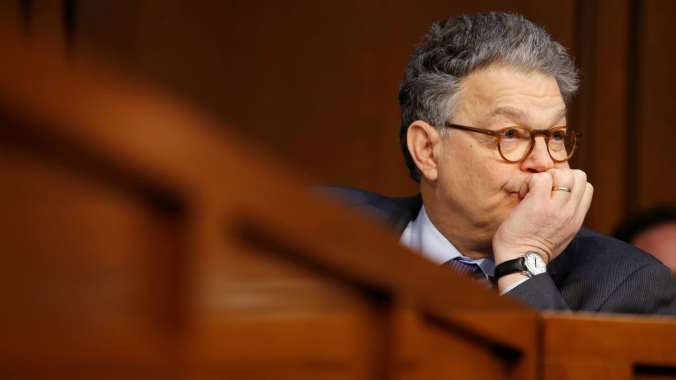
It’s Too Late Now, But Here Is The Apology Senator Franken Should Have Made…

The hypocritical Left is discrediting itself for the foreseeable future by contriving ways to pretend that what Al Franken was credibly accused of doing to a fellow performer during a 2006 USO tour wasn’t so bad, and what about Roy Moore and Donald Trump? As Ed Driscoll wrote today,

The media’s ability to pivot on a dime in the same week from throwing a dissipated Bill Clinton overboard and attacking Roy Moore to granting Franken a very ‘90s-era one free grope rule is amazing to watch. Decades of these sort of power politics by the left (see also: supporters of Kennedy, Ted) explain why many continue to circle the wagons around Moore. Or as Sean Trende of Real Clear Politics tweeted on Tuesday, “I don’t think you can underestimate the degree to which many conservatives have this attitude: (a) we fought a battle over whether character counts, and got our asses handed to us and (b) liberal leaders always circle the wagons around their guys, and ours always cave.”

Franken was in a position to make such embarrassments unnecessary, and to show how responsible elected officials expected to be role models should conduct themselves when accountability knocks. Instead, he made not one but two unethical apologies, the second worse than the first. The fact that his enablers in his party and the media rushed to accept them doesn’t make either less awful. As I explained, in his ultimate apology he 1) never specifically apologized to Ms Tweeden, lumping her into a mass apology to thousands 2) simultaneously said that women should be believed when they accuse men of sexual misconduct, and undermined Tweeden’s account by saying that he didn’t recall it as she described, and 3) said there was no excuse for his conduct while excusing it as just another joke that misfired, an occupational hazard of being a comedian—remember folks, I was a comedian then!

At the risk of repeating myself, I designated Franken Apology Take Two as a #10 on the Apology Scale, and I am convinced that was fair. (The final straw? Asking for a Senate ethics investigation that could only prove Tweeden’s account unsupported, or simply confirm what we were already told. Why couldn’t Franken just accept the account of his accuser? The reason is that he wants to discredit her without appearing “not to believe the victim of sexual misconduct.” Yechhh.) This is the description of a #10, the bottom of the barrel:

10. An insincere and dishonest apology designed to allow the wrongdoer to escape accountability cheaply, and to deceive his or her victims into forgiveness and trust, so they are vulnerable to future wrongdoing.

It didn’t have to be this way. Senator Franken could and should have delivered a Level 1 apology, and would have been better served by it, as would our culture, political system and all of us:

1. An apology motivated by the realization that one’s past conduct was unjust, unfair, and wrong, constituting an unequivocal admission of wrongdoing as well as regret, remorse and contrition, as part of a sincere effort to make amends and seek forgiveness.

Here is the statement he should have issued. Continue reading

Comment Of The Day: “Weeping And Screaming At The Sky: Dear Democrats…”

Well, I stand corrected!  The anti-Trump response of  “screaming helplessly at the sky” wasn’t as worthless as I opined. At least the prospect of it inspired this Comment of the Day by Ryan Harkins in which he postulates the infantilization of America.

Here it is, on the post, Weeping And Screaming At The Sky: Dear Democrats, Progressives, And “The Resistance,” Are You Embarrassed Yet? Why Not?:

What came to mind when I read this is the notion of the “infantilization of America”, which actually came up second in the Google search by the time I typed in “infanti”.

When I stop and question, not necessarily the ethics of the “aaargh!!!” resistance, but the motivation and the appeal to such tactics, I admit that my conclusions might be a bit biases. But when my 3-year-old wants something and doesn’t get it, she throws a tantrum. Sometimes she throws the tantrum before I say no, in anticipation of that very event. Other than the profanity, the “aaargh!!!” event very closely resembles my daughter’s tantrums.

I am looking forward to the day, hopefully not far off, when my daughter and I might have a conversation like this:

“Dad, may I have a cookie?”

“No, it is past 4 o’clock, and the rules are no snacks after 4.”

“Yes, Dad, I respect that. However, you admitted that dinner is going to be late, and the reason behind the 4 o’clock rule is so that I don’t spoil my appetite for dinner. I am, admittedly, very hungry, and think one cookie now, with two hours yet until dinner, won’t impact my capacity to eat my entire meal.”

“That is very good reasoning, but spoiling your appetite is not the only reason not to have a snack at this point. Another reason is discipline, and training your capacity to resist indulging every desire the moment it appears. A little hunger is not going to hurt you, and your ability to withstand a little hunger now will help you withstand other temptations as you go through life.”

“Wow, Dad, I hadn’t thought of that. So, can I have a stalk of celery instead, since it isn’t very filling?”

“All right, you can have a stalk of celery. Hey, wait, why are you getting out the peanut butter?!?”

“Dad, you can’t have celery without peanut butter, and you said I could have a stalk of celery.”

“…grumble, grumble…

I think anyone who is a parent will quickly assure me that such a conversation is pure fantasy. However, who wouldn’t want to deal with his children in such a fashion? Who wouldn’t want to deal with other adults in such a reasonable fashion? Why then are we getting the “aaargh!!!” treatment? I think it is because we have, as a culture, infantilized ourselves. Continue reading

Comment Of The Day: The 87th And 88th Rationalizations: The Reverse 15 And The Psychic Historian

Jeff H. (aka King Kool), Glenn Logan and Tim Levier are, I believe, the longest-serving contributors here, all of them getting extra credit for following me from the days of the Ethics Scoreboard (still dead in cyberspace, but it will rise again!). Jeff has the extra distinction of being the blog’s resident cartoonist, and his contribution to “Everybody Draw Muhammad Day,” a teddy bear, can occasionally be glimpsed in the Ethics Alarms header.

This is not his first Comment of the Day. This time, he reflects on the folly of ever trying to guess where history is going, not to mention assuming that it will validate contemporary conduct.

Here is Jeff H’s Comment of the Day on the post, The 87th And 88th Rationalizations: The Reverse 15 And The Psychic Historian.

Is there anyone so young or devoid of baseball lore that they don’t get the Ted Williams reference? Jeff probably should have given a heads up…

I’ve had a complicated history of feelings about the anthem protests. I start from a place where I dislike most celebrity protests. But when Trump shot his mouth off about it, whether he was factually right about that they could lose their jobs over it… I suddenly became a lot less comfortable with my opposition. I probably would’ve done it myself just to say, “hey, I have this right to toss my job away for something stupid and inane, but I’m not going to have anyone say that I didn’t do it because YOU said not to.” Just like Obama talking about the Zimmerman-Martin incident, right or wrong, the President talking about something like this never seems to make it better. This is adding to the knot, not cutting it.

I’ve got more to say about this, but I really only bring this up to give this statement context: I’ve seen people say that Kaepernick’s contributions will be seen as a landmark in civil rights. And I think they are absolute loony fortune tellers. I’m not saying their prediction is right or wrong. I just think they’re fools for trying to make it. Continue reading

Morning Ethic Warm-Up, 10/3/2017: The Las Vegas Strip Shooting.

Not a good morning.

Not good at all.

I was preparing the notes for two business ethics seminars I’ll be running today when the news of the mass shooting in Las Vegas came on HLN. There are several items I had planned for today’s Warm-Up, but they all  seem trivial right now. 50+ dead, and over 200 wounded, the worst mass shooting in U.S. history.

Random thoughts, as I simultaneously watch reports:

1 The shooter has been killed. His name is Stephen Paddock. Are you relieved that he doesn’t have a Muslim name?

2. It sounds like the gun used was no ordinary automatic weapon, but possibly a belt-fed machine gun. I wonder if that fact will restrain the inevitable politicization of this tragedy, as it once again sets off the anti-gun ownership activists.

3. President Trump tweeted out the obligatory condolences. I assume he will make public statement in person. Twitter has the advantage of being quick, but there is something off about tweets as official reactions to such deadly national disasters.

4. I have believed for some time that the relentless escalation of 24-7 anger, political hate, fear-mongering and vicious partisan rhetoric in the news media and social media are creating an environment that risks driving the weak, the ill, the stressed and the vulnerable over the edge. Of course, this shooter may have had a brain tumor like Charles Whitman; the shooting may have no political connection whatsoever. Still, this is not a healthy culture right now. It can’t have helped.

Morning Ethics Warm-Up, 9/23/2017: Special “Love Him, Hate Him Or Tolerate Him, Ya Gotta Admit President Trump Isn’t Boring” Edition

I don’t know about you, but I was getting mighty sick of those “morning” shots…

GOOD MORNING!

1 Peggy Noonan, the former Reagan speechwriter who writes powerfully and is not afraid to take unpopular positions, has been as critical of Trump as any rational pundit. She writes in her latest column, that the news media has misrepresented Trump’s U.N. speech, which, she says further,  was what the U.N. “needed to hear clearly and unequivocally.” She adds,

A great line—because it spoke a great truth—was this: “The problem in Venezuela is not that socialism has been poorly implemented, but that socialism has been faithfully implemented.” Mr. Trump then paused and looked at the audience. It struck some as a “please clap” moment. It struck me as a stare-down: I’m saying something a lot of you need to hear. You’re not going to like it, and I’m going to watch you not like it.

… Mr. Trump is on a roll, a sustained one the past few weeks, and this is new. All levels of government performed well in the hurricanes. Mr. Trump showed competence, focus and warmth. His bipartisan outreach, however it ends, went over well with core supporters and others. He had a strong speech at the U.N., in fact a successful U.N. week, beginning to end. His poll numbers are inching toward 40%.

Noonan meets the ethical standard that the mainstream news media, critical pundits and “the resistance” have relentlessly breached: give the President credit when it’s due, and subdue bias to engage in objective analysis for the public;s enlightenment.

2. Ann Althouse, also noting that the President’s poll numbers have been creeping up (a. Not that much b. Who trusts polls? c. So what?), polled her readers regarding why they thought this was happening. Her options were mostly the right ones, though Peggy’s “bi-partisan outreach” was conspicuously missing…

“Hurricanes”—these sorts of natural disasters are usually opportunities for Presidents to play President, and that seldom is anything but enhancing to a POTUS’s image. Ronald Reagan’s speech after the Challenger disaster was a perfect example. Trump gets less credit than he deserves because the news media works hard to represent anything he does in a negative light.

“Kim Jong Un”—Since so many progressives believe that we should keep allowing North Korea to extort the West by endlessly appeasing it, it is hard to see Trump’s hard-line stance moving the needle.

“U.N. Speech”—unless American read it, which few have, I assume the (false) mainstream narrative that it was a disaster prevails.

“Normalization happened”—THAT’s certainly wrong. If it means that General Kelly has made a big and positive difference, then OK. The Wite House is certainly more normal than it was, but far from normal.

“Russia collusion story fading”: “The resistance” is still certain that Trump bartered to win the election and will be impeached for it. Facts, evidence and reality are irrelevant to them.

“Successful policies have been implemented”—In fact this is true, but again, the only ones who know it are pro-Trump partisans,  the small number of citizens who dig through the static and fog of mainstream media Trump Hate, and those who don’t think any retreat from the inexorable progression to open borders, socialism and Big Brother is a tragedy.

“Nothing’s gone horribly wrong (yet)”: The Trump Deranged think that everything has already gone horribly wrong, and that we’re all going to die. Here is a typical Facebook post from a good friend this week:

Trump IS deranged. And we’re all going to pay for it. Am I surpised that a hermetic totalitarian proto-monarchy has created a Kim Jong Un? No, it’s completely predictable and logical. That the US of A has elected someone who is NO better whatsoever than Kim, and in some ways quite worse, is the unforgivable aspect of this whole equation.

“Bad things like The Wall and repealing Obamacare seem to have been merely campaign bluster”Nah. Lots of other things were bluster; these were just impossible.

But I voted for this one, also supported by my friend’s crazy post: “Trump haters are tiresome.” “Tiresome” is professorial nice-speak for “So vile, un-American and unhinged that if they want one thing, sane and fair and rational citizens will increasingly prefer the opposite.”  The category includes “tiresome” public figures like the Late night “comedy” show hosts, Bill Maher, Samantha Bee, Hollywood, MSNBC, Maxine Waters, the New York Times, CNN, Black Lives Matter, Tom Perez, Elizabeth Warren, and, of course, Hillary Clinton. It’s pure cognitive dissonance.

Naturally that choice is also leading in votes, followed by hurricanes, North Korea, and the UN speech.

3. As always, when the President is feeling cocky, he lets loose with dumb tweets and inflammatory comments just to remind us that he’s not going to change. This morning he reacted to San Francisco Warriors super-star Steph Curry saying that he “didn’t want to go” to the White House when the President hosts the traditional visit from championship sports teams, tweeting,

“Going to the White House is considered a great honor for a championship team.Stephen Curry is hesitating, therefore invitation is withdrawn!”

Stipulated: this is petty, and beneath the President’s office, like 99% of his tweets. It shows thin skin and vindictiveness, and is punching down in the sense that any attack on a citizen from the White House is punching down.

And yet, and yet…I have to say I smiled when I read it. It is damaging for athletes and cultural role models to be disrespectful to the President, the Office, and the country. Curry was gratuitously rude, and deserves a rebuke…just not from the President of the United States.

(I still hope Trump retracts the invitation to the whole team.)

The other outburst, also involving sports, is indefensible.

At a Huntsville, Alabama rally for Republican Senator Luther Strange, who is running in a special GOP primary election to remain in the seat vacated by Attorney General Jeff Sessions, Trump went off script and said,

“Wouldn’t you love to see one of these NFL owners, when somebody disrespects our flag, to say, ‘Get that son of a bitch off the field right now. Out! He’s fired. He’s fired!’” Trump said. “You know, some owner is going to do that. He’s going to say, ‘That guy that disrespects our flag, he’s fired.’ And that owner, they don’t know it [but] they’ll be the most popular person in this country…But do you know what’s hurting the game more than that? When people like yourselves turn on television and you see those people taking the knee when they’re playing our great national anthem. The only thing you could do better is if you see it, even if it’s one player, leave the stadium. I guarantee things will stop. Things will stop. Just pick up and leave. Pick up and leave. Not the same game anymore, anyway.”

Ugh. Owners have a right to discipline players for bringing politics onto the field. When a President tells them to, that  edges too close to government action, chilling speech, and a First Amendment violation.

On the other hand, one does not have to be a conspiracy theorist to detect an uncoordinated but pervasive effort in the news media, academia, the tech sector, show business and Hollywood, and now sports, to flood the culture with so much progressive propaganda and anti-Trump bile that government becomes impossible. The effort has to be countered, but the President is not the proper one to counter it. Still, the integrity and functioning of our democracy is at stake.

4. In Ann’s “Successful policies have been implemented” category, except I would call it “essential polices,” was the expected withdrawal of the Obama Education Department’s infamous “Dear Colleague” letter that prompted universities to dispense with due process and fair standards when finding male students guilty of sexual assault and rape. Blogger Amy Alkon, another rational Trump critic, nonetheless enthusiastically and definitively slapped down an awful, ethics-devoid Times op-ed that, as the Left is wont to do these days, argued that the innocent until proven guilty standards and equal justice should be re-calibrated for the greater good, which is to say, for the benefit of favored groups. Alkon writes of the feminist authors,

[T]hey clearly aren’t looking for justice for all, but just justice for some: typically, the woman. They continue:

The preponderance of evidence standard is also survivor-centered. When judging whether someone has been raped, it’s almost impossible to assert that a sex act constituted violence “beyond a reasonable doubt.”

Our justice system in this country involves erring on the side of freeing a possibly guilty person in hopes of seeing that innocent people are not imprisoned. The fact that it is sometimes hard to judge a “he said”/”she said” case does not change that.

On the other side, and in Althouse’s  “Trump haters are tiresome” ( “tiresome”= frequently biased, ignorant, dishonest, undemocratic, unfair, vicious and hypocritical, as well as dumb as bricks) category, we have this tweet from snarky female comic Chelsea Handler:

“Thank you @betsydevos for making it easier for rapists going to college to get away with raping innocent women. What a role model…”

Anyone who thinks that is clever or true needs to—quickly— read the Constitution, perhaps with a literate translator, maybe a U.S. history book or two, and get at least a rudimentary understanding of the principles underlying the United States and its values.

_____________________________

Graphic: heartist


Morning Ethics Warm-Up, 9/2/17: Keith Olbermann Tweet, The Rifleman On The Melting Pot, and What The Editors Of the New York Sun REALLY Wanted to Tell Little Virginia…

GOOOOOD MORNING!

1. For some strange reason AMC and the Sundance movie channel alternate showing multiple episodes of “The Rifleman” every Saturday morning. Like most of the old TV Westerns, but even more than the rest, the Chuck Connors half-hour drama about a single-father rancher who doubled as part-time lawman was about ethics, despite the fact that Chuck as Lucas McCain killed over almost tw0-hundred men over the course of the show. In one of today’s episodes, young Mark, Rifleman Jr., played by the excellent child star Johnny Crawford, fought off some bullies who were abusing a young Chinese boy who was dressed in his native clothes and wearing long hair. As the boy’s father thanked Lucas and  Mark, the Rifelman pointed out that the boy would be tormented as long as he wore his hair “like that.” “His hair is worn in the manner accepted in my country,” the father replied.

“Yes, but you’re not living in China, you’re living in the United States,” Chuck said, wrinkling his brow.

That message was not a controversial one in 1880, or in 1960, but it would be today. Still, The Rifleman was right. There is cultural pressure on immigrants to accept and adapt to U.S. culture and values, and that is for the benefit of everyone involved.  Mark made it clear that he would keep fighting for the right of the young Chinese boy to wear his hair as he chose and Chuck endorsed that, because it’s another American core value. Still, being an American citizen should mean more than just an address. Our culture used to send that message powerfully and regularly, in TV dramas and elsewhere. Now it sends the opposite message most of the time. That’s a tragic change, and the results are becoming apparent.

2. Now THIS is an uncivil tweet: The degree to which the unhinging of the Trump-hating left has reached frightening proportions was illustrated last week by a tweetstorm meltdown by onetime MSNBC star Keith Olbermann, who is still anchoring a public affairs commentary show somewhere, I think. It reached its apotheosis with this masterpiece or reason, nuance, and civility:


Olbermann finally took down the tweet, but the rest remained:

I don’t think Olbermann is significantly more addled by blind rage at Trump’s election than a large number of prominent journalists, editors, academics, professionals and others, or more emotional in his hate.  He  just has less restraint than most in giving vent to it, that’s all. Continue reading