McAfee And Me: An Ethics Rant

I have written here before about my theory that the needless complexity of life, especially involving daily interactions with technology, are driving normal people crazy, and sometimes homicidally crazy. While activists and justly alarmed citizens point to guns and mental health policies to explain murderous rampages by citizens previously regarded as quite and law abiding, insufficient attention is being paid to the ratcheting-up of daily stresses caused by the private and public sectors gratuitously making  daily life unbearably frustrating to navigate, particularly for the less skilled navigators among us.

I don’t expect to snap, but you never know. It is said, I assume apocryphally, that there was a sick drawing New Yorker black humor cartoonist Charles Addams would send to his editor when he was about to have one of his periodic breakdowns, and the magazine would see that he was deposited in his favorite sanitarium in a timely fashion. If you read the message  “AGGGGGGGGGGGGGGGGGGGGGGGGZZZZZKKKKKAAAAARHHHHHYY!”-and nothing else--in a future post, you will know that I have gone full Sweeney Todd (Sweeney in his fury and grief determined that half the human race were so cruel and corrupt that they deserved to die, and that they made the other half so miserable that it was merciful to murder them too) and my immediate neighborhood is in mortal danger. Call the police. I don’t have a gun, but I don’t need one: I’m pretty good with a baseball bat.

If and when that happens, something like my experience yesterday will be the cause.

I have a new netbook, and it included a free 30 day trial subscription to McAfee’s virus protection service. For a week I had been getting obtrusive pop-up ads from McAfee telling me that my protection was about to lapse and my opportunity to purchase a special discounted continuation of the service (Just $39.99, marked down from $89.99!) would soon evaporate. Yesterday was the expiration date, so I decided to accept the offer and sign up online.

I checked the appropriate boxes and filled in all the information, including the credit card data. The attempt to pay was rejected, the screen told me, for my security code, that little three digit number on the back of the card, was incorrect. So I reentered it, after checking it carefully. After much churning and two “preparing your order” screens, I again got the error message. Huh. I tried again. Same thing.

This provoked a mature explosion quite familiar to my wife and dog (the dog hid under the bed), in which I cursed all online purchase, subscription and registration procedures, which inevitably take far longer than they are supposed to, are so complicated that they invite human error, and appear to have been designed by Joseph Mengele as some kind of sadistic experiment. My wife sagely suggested that I try another credit card, since the one I was using had recently been the object of a bank screw-up that ate another several hours of my rapidly dwindling life span. This I did…four times. Every time, the security code was flagged as entered wrongly, which it was not. Finally, I used a third card. Again, no dice, “incorrect data.”

The attempt to pay McAfee $39.99 had now taken about a half an hour. Continue reading

Oddly, Though Ethics Alarms Had Already Named Comcast “Corporate Asshole Of The Year,” The Company Felt It Had Something Left To Prove…

ernestine

I really don’t understand this at all. In October, when the viral story of how Comcast managed to get a customer fired from his job for insisting that the communications giant address his legitimate complaints, I wrote:

I have never heard of even one customer of any company losing his job as a consequence of that company’s refusal to address legitimate complaints. That is why Comcast gets its Corporate Asshole of the Year award early. Nobody’s going to top this.

Yet amazingly, Comcast has managed to have yet another tale of atrocious service and customer abuse get widespread publicity. This video, by YouTube exhibitor Sweetlethargy, tells the whole  jaw-dropping story:

In any normal consumer setting, a customer able to prove that he was  induced by a company representative to purchase a service under false pretenses would immediately receive an apology, and the service promised for the price offered. In this case, however, as you can see in the excruciating video, Comcast’s reaction is, “Sorry, we won’t honor what you were told.” Translation: Screw you. Sue us. Good luck with that.

The is reminiscent of the running gag that was once famous on “Rowan and Martin’s Laugh-In,” the chaotic Sixties comedy show, in which comic Lily Tomlin would play a cruel, smug, nasal-voiced and snorting Bell telephone operator named Ernestine (above). Her specialty was telling infuriated customers who were receiving rotten telephone service that their complaints were futile. “We don’t care. We don’t have to care. We’re the telephone company!” she’d say.

Apparently this is Comcast’s attitude. Horror stories about Comcast service are all over the internet and social media, and heads aren’t rolling, the Board isn’t screaming, press releases aren’t issuing, and documented customer abuse keeps turning up. The company has nurtured a culture of carelessness, callousness and arrogance, and apparently believes that its services are too essential to suffer significant consequences.

What have you heard about Bell lately?

__________________

Pointer: Fark

Early Ethics Alarms 2014 Award: The Corporate Asshole Of The Year Is….Comcast

Yeah, just try getting Comcast to fix your service issues, and you may find out exactly what it cares about, when you get your severance paycheck...just ask Conal O"Roarke.

Yeah, just try getting Comcast to fix your service issues, and you may find out exactly what it cares about when you get your severance paycheck…just ask Conal O”Roarke.

I don’t want to spoil the suspense or anything, but when a company gives a customer horrible service, keeps botching its attempts to address it, and then calls the customer’s employer about the persistence of his complaints, getting him fired as a direct result, attention, as Mrs. Willy Loman memorably said, must be paid.

Here is the whole awful story, as first described in Consumerist.

Conal O’Rourke  subscribed to Comcast in early 2013.  The company charged him, he says, for set-top boxes that hadn’t been activated; some of his bills were not being delivered as well, because they had his name wrong on the account. He met with a Comcast rep in May who said all would be resolved. It wasn’t. The problems got worse. In addition to still being charged for unactivated devices in his house, Comcast charged him twice for an additional  modem he did not have.

He decided to to cancel his service from these bozos in Oct. 2013,  but says a Comcast rep convinced him that the billing issues would be resolved and that he would get free DVR service and The Movie Channel for three months as compensation. I’ve been there, with DirecTV…except that my satellite service actually did what it said it would. Not Comcast, apparently. It sent Conal O’Rourke about a dozen pieces of equipment that he never ordered and didn’t want–DVRs, modem, standard boxes other stuff—and billed him $1,820 for it. Continue reading

Self-Webshaming At Dunkin’ Donuts

(Watch this after you’ve read the post. Kind of like dessert..)

The ethical considerations one should review when pondering whether to engage in webshaming nicely evaporate when the subject has chosen, though unwittingly, to webshame herself. Thus Ethics Alarms has no qualms about presenting for your consideration, revulsion, and rejection if she ever applies for a job from you, one Taylor Chapman, a 27-year-old woman who lives in the vicinity of Fort Lauderdale. She eagerly and proudly posted to her Facebook page the phone-video above, of her abusing an impeccable Dunkin’ Donuts employee, annoying a customer, and making serial statements with signature significance—no decent human being would utter even one of these appalling comments in public unless suffering from a brain trauma or extreme intoxication.

Chapman was angry because she and her friends had not received a receipt along with their large drive-thru order, and angrily (and abusively, based on Chapman’s manner, but we can only guess) demanded to receive their order free of charge, as Dunkin’ Donuts now promises as part of a service pledge. The employee handling the order apparently did not know how to proceed, and told the group that they would have to come by the store and see her manager the next day.

[An aside: That’s not good customer service, DD. If you make a guarantee that is supposed to mean anything, you have an obligation to train employees how to deliver on it. Telling customers who have not received the promised service that they have to come back to the establishment another day to receive what they are owed is unreasonable and a bait-and switch. I would have said to forget it. I would have written a letter. I would not have done what Chapman did, and I don’t know anyone who would.]

What Chapman did was to return the next day and demand her free order, tossing obscenities at the extraordinarily polite and unflappable employee (his name is Abid Adar, and you should send him flowers) on duty while she recorded the encounter as if it were a health department sting. Continue reading

Predatory Service: A Tale

Hardware

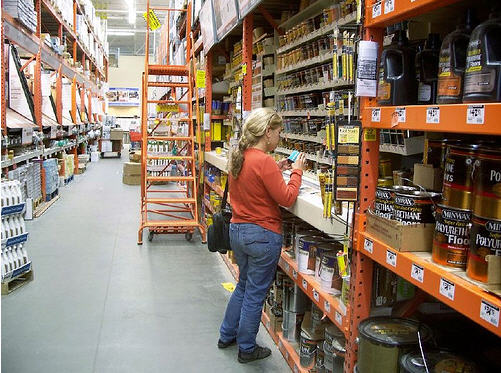
Once upon a time in Greater Washington, D.C., there was a family-owned hardware, home remodeling and garden store chain. They were big warehouse stores, and pretty much synonymous with hardware, flowers, lawns, leaky pipes, Sunday shopping excursions, and earnest, if not always rapid, service, for decades. The old chain was pretty much the only game in town too, except for a few small stores scattered around in various town squares.

Then, seemingly over-night, several new, big, warehouse hardware, home remodeling and garden stores appeared across the area. They seemed a little cheaper, but not much; what they had, however, was this fantastic service model. The place was crawling with eager young experts who not only helped you find what you needed, but who also knew how you should build it, cultivate it, paint it, or tear it down. The usual “what the hell am I doing and where is that stuff?” anxiety of a visit to the old hardware chain was replaced by a feeling of confidence and being in the hands of friendly masters of their trade. It was wonderful. Continue reading

A Frightened Little Girl, and a Frightening Culture Of Incompetence At United Airlines

Ernestine works for United now! Heck, maybe she RUNS United now….

Bob Sutton’s blog post is titled “United Airlines Lost My Friend’s 10 Year Old Daughter And Didn’t Care”  and I believe every bit of it. I also believe this was not an isolated occurrence, because my own experience with United indicates that the airline doesn’t care, or at least allows its employees to adopt that attitude.

First, I’ll  summarize Sutton’s horror story (and then on to mine): Continue reading

The Bank of America Teller and the Thumbless Customer

You may have heard the story: a branch of the Bank of America in Tampa refused to cash a check for Hillsborough County public works employee Steve Valdez, because the bank required a thumbprint from non-account holders, and Valdez has no arms. No arms, no hands; no hands, no thumbs; no thumbs, no prints; no prints, no cash.

“Sorry sir; it’s bank policy!”

The various news accounts of this classic tale of bureaucratic idiocy concentrated on the fact that the bank was violating the American with Disabilities Act. Voila! This is how law obscures ethics. Would the bank’s actions have been any more reasonable, fair, caring, kind and responsible if there was no law? Why should anyone with a brain, a heart and a sense of humanity require a law to look at a man with no arms and decide, “Gee, I guess the thumbprint requirement doesn’t apply in this case.”  This isn’t a legal matter. It’s an ethics question, and a really easy one, because the Golden Rule was invented for situations like this. If you were in the place of the thumbless man, Mr. Teller, what would you want someone in your position to do?This isn’t a legal matter. It’s an ethics question, and a really easy one, because the Golden Rule was invented for situations like this. If you were in the place of the thumbless man, Mr. Teller, what would you want someone in your position to do?

Nobody’s suggesting that the Bank of America should have suspended its policy out of pity or sympathy. This isn’t a bleeding heart argument: “Oh, the poor guy: he can’t hitch-hike or signal to a gladiator that he wants him to kill his opponent. I’ll cash his check to be a nice guy.” It has nothing to do with being nice. It has to do with recognizing when a policy is absurd in application, unjustly causing inconvenience and humiliation to another human being. Consider these dilemmas:

  • An attendant at a movie theater allows a patron to leave briefly to deal with an emergency. He returns to get back into the movie theater and join his family, but has somehow misplaced his ticket.  Should the attendant, who recognizes him, refuse to let him enter?
  • A driver enters a parking garage, then has to leave a few seconds later because of a medical problem. Should the parking attendant insist that he still pay the full-day minimum fee? (This one got an attendant shot by Steve Buscemi in “Fargo,” you’ll recall.)
  • A woman, obviously ill, staggers into a restaurant and begs to use the rest room. The establishment has a “patrons only” policy for its use. Should it refuse her?A student finds a knife in the hallway of a school, and immediately hands it over to the teacher. The school has a strict “no tolerance” policy on weapons, and the student is technically in possession of the knife: policy dictated that he not touch it, but alert an administrator. The teacher is certain that the student did not own the knife. Should the student be punished?
  • An adult dwarf on the Olympic riding team wants to buy a ticket on the carnival horse back ride to be with his child, but he doesn’t come up to the height mark on the sign designed to screen out young children. Should the operator tell him he can’t ride?

Answers to the above: “No way,” “Certainly not,” “Never”, “No,” and “Don’t be silly!”

Policies can’t be perfect. Human beings have an ethical obligation not to stick to them when they result in outrageous consequences to others, and there is no counterbalancing benefit to be gained by doing so, other than not varying from the policy.The teller should have asked for sufficient identification to satisfy himself that Valdez has a valid check. Valdez had it: he had his driver’s license with an address matching his wife’s on the check. That’s what the would have wanted, reasonably, if he was the one with no arms. And there was absolutely no reason not to bend the rules. The ADA wasn’t necessary to solve this. People need to know when to consider the impact of their conduct on others when there are no laws involved.

Any individual, and any bank, that needs a law to remind them not to insist on a thumbprint from a man with no thumbs is ethically impaired, and has no common sense. And having no common sense is a much greater handicap than having no thumbs.