Comment of the Day: “Unethical Quote of the Month: Patriots Quarterback Tom Brady”

––New England Quarterback Tom Brady, in the course of denying culpability in the latest New England Patriots cheating scandal.
Tom Brady now joins the Ethics Alarms Rationalization Spouter’s Hall of Fame, which I just started. You just can’t embody Rationalization #22, Comparative Virtue, or “It’s not the worst thing” any better than this obnoxious attempt to minimize the significance of Deflategate.
That’s the way to teach the kids to be fair competitors and good citizens, Tom! And does a star athlete whose attitude regarding cheating in his profession amounts to this fill you with trust in his integrity, honesty, and sportsmanship?
Not me.

It is slowly dawning on me that Christmas music, one of the annual joys of my childhood and perhaps yours, is in a perilous state, both culturally and aesthetically. The best of the songs musically are religious in nature, which means that schools won’t pass them along to their charges as happened routinely when I was a child, and even playing them on the radio is likely to be regarded as a religious statement. I just loved the music, as I think most kids would if they ever got the chance before they were brainwashed into believing the ancient songs were subversive.
A full court cultural press is underway to make those songs as rarely heard outside of church as hymns, and I don’t see the trend as reversible. One obvious bar to a comeback: current pop stars don’t have the pipes to sing most of them without causing a sound pollution emergency. Or, if one of the few singers who could actually hit the notes dared to cover a carol like “O Holy Night,” he or she would feel required to apply flourishes of the sort that make every rendition of “The Star Spangled Banner” at a major sports event an invitation to PTSD.
Even for the more secular Christmas repertoire, the clock is running out. The most listenable versions, and the definitive ones in most cases, are by performers of the past who are not just dead, but also long forgotten by the current culture. An hour of classic Christmas recordings on the radio is now a reminder of how old I am and close to joining great singers like Bing Crosby, Judy Garland, Andy Williams, Nat King Cole, Jo Stafford, Burl Ives, Gene Autry, Frank Sinatra, Dean Martin, Elvis—dead, dead, dead. I guess Brenda Lee is still alive, so “Rockin’ Around The Christmas Tree” is a little less depressing, but it’s a minor classic at best. It’s gotten so bad that when I hear “The Little Drummer Boy,” I find myself wondering if the whole Harry Simeone Chorale is dead too—Harry died in 2005, and the recording is 56 years old, after all.
Meanwhile, our post-modern culture is sneering at the whole idea of Christmas songs, and Christmas itself. Most modern Christmas songs either are making fun of Christmas, about sex, or just lousy. The tradition is being undermined in more creative ways, too: this week I watched a 2012 straight-to-video movie called “12 Disasters of Christmas,” based on the loopy premise that “The Twelve Days of Christmas” was really a coded recipe for stopping the 2012 apocalypse predicted by the Mayan calendar. “The Mayans knew that the knowledge would have to be preserved for centuries, so they devised a song that would carry the secret and would be passed on and learned by children for generations,” explains the old codger who’s figured it all out. (But why would they choose such a monotonous and stupid song?) Come on, guess: How does the “Chosen One” stop the end of the world? [Answer below.]*
The movie is on to something, though. The Christmas songs that have the best chance of persevering though this age of cynicism and cultural illiteracy may be those that either tell a story or that have an interesting one related to their creation. The simple and beautiful tune of “Silent Night,” for example, as one of those films they used to show in school assemblies every year before some anti-religious hysteric sued, was composed for guitar in response to a Christmas Eve crisis for a small church in the Austrian alps in 1818: the church organ wasn’t working. I have found that Irving Berlin’s “White Christmas” affects me far more deeply since I learned that the Berlins’ infant son died on Christmas day, and that while his children celebrated Christmas as a cultural holiday, Berlin and his wife did not. They spent each Christmas after their son’s death in mourning. The song is a wistful remembrance of a happier time that the composer will never experience again.
Maybe another Christmas song will persevere if its origins are remembered; I was reminded of its history this week as a result of the thaw in U.S. relations with Cuba. Though my wife hates it, the song is one of my favorites, perhaps because it brings back warm memories: I watched the song’s first national broadcast with my sister and parents, and the Marshalls bought the recording the next day.
It was 1962. Noel Regney and Gloria Shayne were a husband and wife songwriting team of modest success. They were saddened by the lack of any spiritual content in popular Christmas songs then; imagine what they would think today.
Like all Americans, they were petrified during the thirteen days of the Cuban Missile Crisis, when the world stood on the brink of nuclear annihilation. As the crisis intensified, Regney found himself inspired to write down a simple poem with a Christmas theme. (Later, the couple would say that neither of them could ever sing the song through, because of the strong emotions it recalled.) When the nation could finally take a deep breath of relief as the threat ended, Gloria devised a melody for her husband’s words, though he had always been the composer when he and wife wrote songs together.
The result of this unique variation on their collaboration was recorded before the end of 1962, but it wasn’t until the following year, when Bing Crosby sang the team’s creation live on ABC’s “Hollywood Palace,” that it became widely known. The song written during the Cuban Missile Crisis became a best-seller, Crosby’s last hit Christmas record, and also the last popular Christmas song to have a religious theme.
It was, and remains, a prayer for peace.
____________________________
* By finding and wearing FIVE GOLDEN RINGS, of course!

“Agreed, then: you can call us racist murderers, as long as you keep the donations coming….”
Let us be undiplomaticly clear about what the five St. Louis Rams players did when they came onto the field at the start of a Monday Night Football games with their hands in the air like the fictional, idealized, sanitized, imaginary and politically useful version of Michael Brown—you know: the angelic young college-bound African-American male who did nothing whatsoever to cause the circumstances of his own death.
The players were saying, on national television, with millions of people watching, that Officer Darren Wilson executed Mike Brown in cold blood; that the St. Louis police do such things, want to do such things, and will do such things, because they routinely target young black men for harm; and that police generally, around the nation, are virulent racists. That’s what the gesture meant, and that is what it was devised to convey. Continue reading
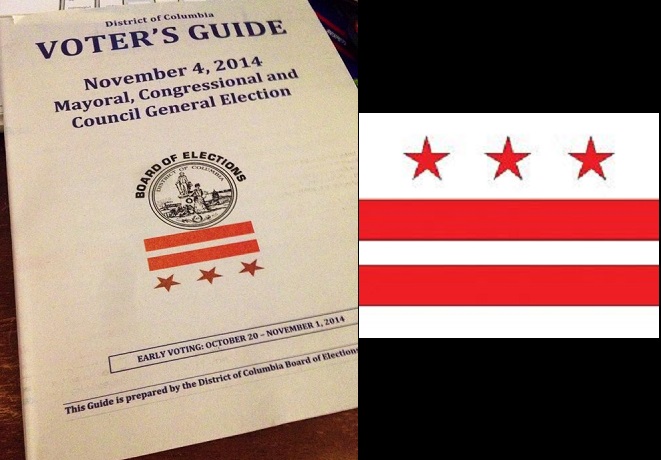
That’s the real D.C. flag on the right. I think it looks better upside down too…
[Jumbo: a Jumbo is a special Ethics Alarms award for conduct that emulates the gag from the Broadway musical and film “Jumbo,” in which Jimmy Durante, as a circus clown trying to steal an elephant, is caught red-handed by a sheriff, and asked, “Where are you going with that elephant?” “Elephant? What elephant?,” Jimmy replied.]
As readers who travel here often know, I really hate, hate, hate obvious lies. They are cowardly, they are insulting, and when they are authored by public officials, they recklessly foster public cynicism and distrust. You can’t do your job right, and you don’t even know when it’s pointless to lie? Why should we trust you to be able to do anything right?
Of course, we shouldn’t.
You will seldom see a more blatant and embarrassing example of the desperate, immediately apparent lie than this one from the District of Columbia Board of Elections after it mailed out 305,164 copies of the official D.C. voter guide with the D.C. flag on the front cover printed upside-down. This immediately provoked much local media, pundit and social media hilarity and mockery, but no, announced the Board. This was no lazy clerical error from the government famous for them. This was intentional! A devilishly clever strategy!
The election board’s spokeswoman, Denise Tolliver explained that the upside-down flag was a deliberate move—an upside-down flag is a distress signal, after all—to grab the attention of voters and “see how many clicks we can get.” “People are responding, aren’t they?” Tolliver said. “They’re paying attention. It’s working!”
Nobody believed it, of course, because the only idiot in the conversation was her, and, by proxy, her superiors. Eventually the board’s executive director, Clifford Tatum, confessed. “No, this is an error,” he e-mailed a D.C. Council member. Continue reading
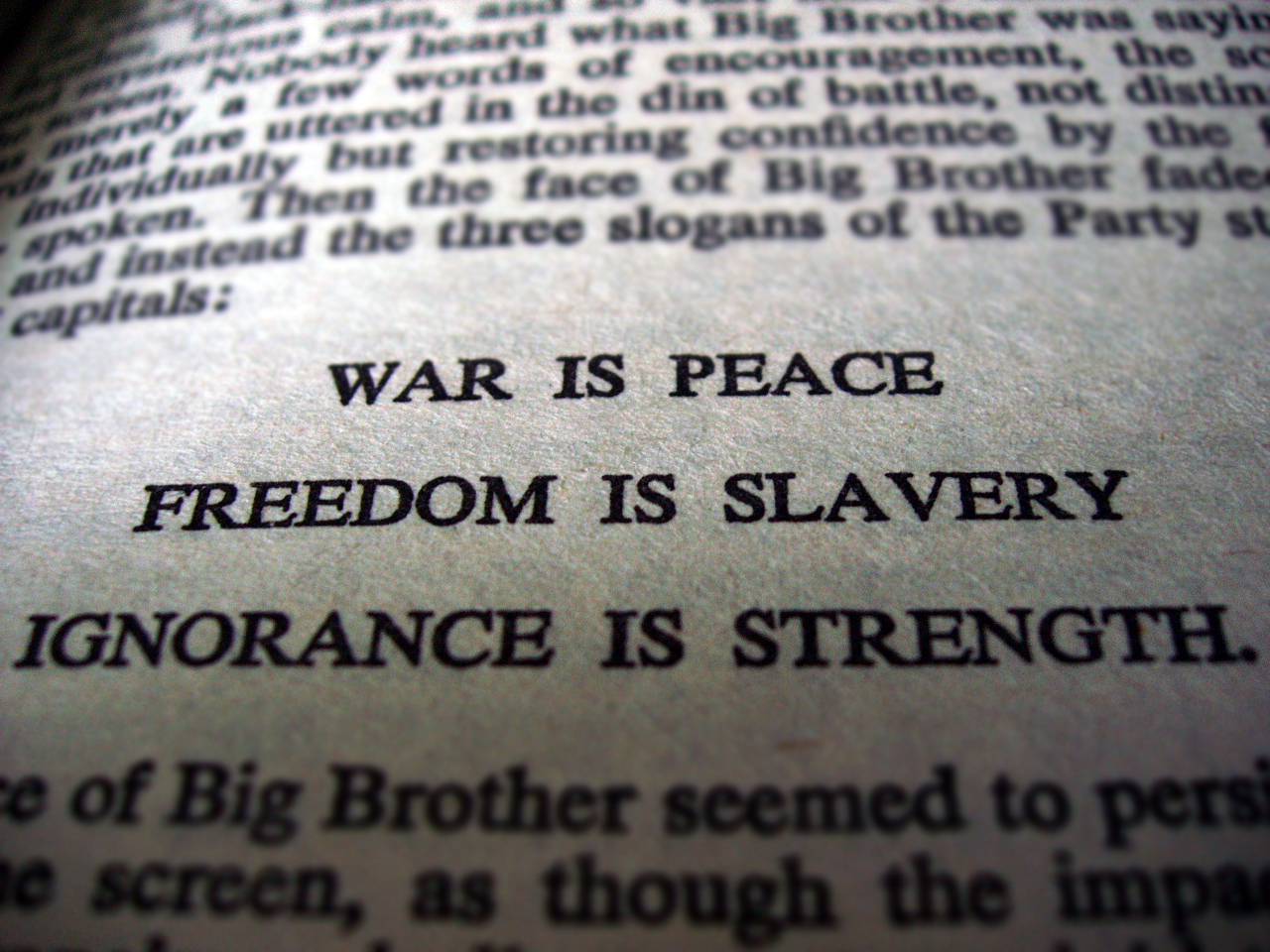
I recognize that President Obama and his entire administration feel they are hostage to an infantile, irresponsible, pacifist “base” that cringes at the concept of the kind of combat that might occasionally be necessary to preserve our liberty and keep the evil in the world at bay. (I also recognize that the Paul faction in the Republican Party is similarly addled.) That our leaders cater to such confusion is regrettable, indeed, frightening, since it means that they value the welfare of the nation and the world less than the objective of keeping their most naive and ignorant supporters happy. (The alternative, that they feel the same way as this historically unschooled mass is too horrible to contemplate, and I just refuse to believe it.) But when kowtowing to the delusion causes our leaders to embrace Orwellian language designed to declare the opposite of truth in pursuit of political advantage, even those cheered by the fantasy have an obligation, as citizens and as responsible human beings with brains, to protest.
Secretary of State John Kerry just denied that dropping bombs on a state constitutes warfare. WAR IS PEACE, you see. Continue reading
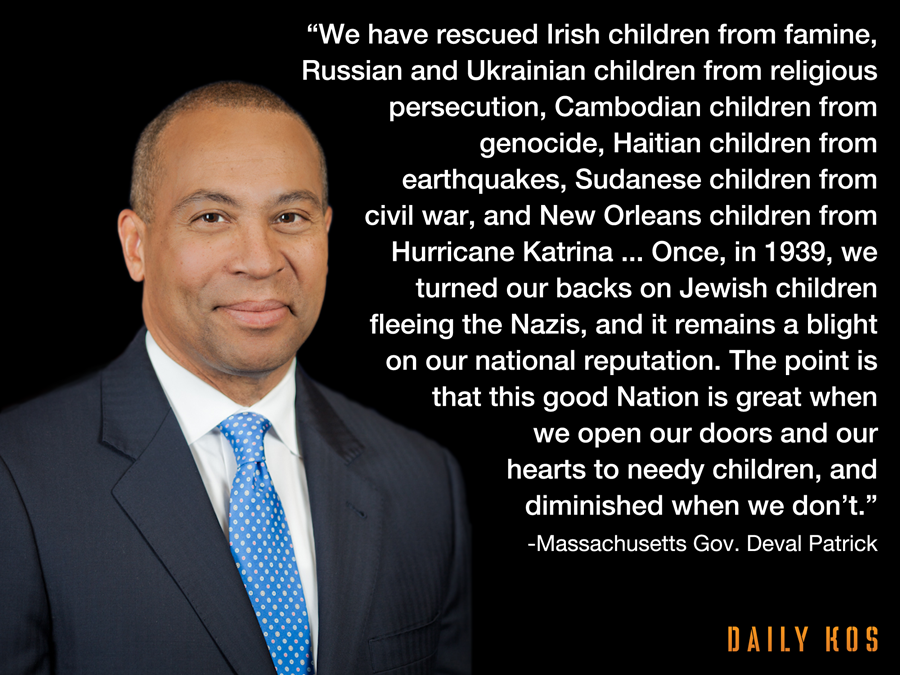
I thought I might run an ethics quiz asking whether this current and mind-bogglingly stupid argument that keeps popping up from my sentiment-addled Facebook friends is more unethical than the pro-Hamas hashtags being appended to twitter comments by the “Think of the children!” saps led by celebrities like Jon Stewart, Selena Gomez, and John Cusack. Pondering on it, however, I realized that as ethically misguided as Stewart at al. are, the above quote and its ilk are worse….especially since state governors and U.S. Senators have more credibility than comedians and Disney pop tarts. Not that they should, mind you.
If I really have to make a detailed argument explaining why Deval’s quote and Leahy’s ( “Think of all those Jews that went to the ovens because we forgot our principles. Let’s not turn our backs now.”) are unforgivably irresponsible, we are just as dim-witted as those demagogues (or, more likely, as dim-witted as they hope and think we are.) The statements are no more nor less than an invitation to every parent of every child in every poor, war-torn, politically foul, culturally poisoned, dangerous, corrupt nation in the world to somehow get them to the U.S. border, paying shady and often treacherous agents to do so, because the United States will not “turn its back,” and turn them back. The question isn’t whether this is a legitimate, responsible or sane position worthy of debate and serious consideration: of course it isn’t. The question is how anyone can think it is. Continue reading

“Children make us stupid” is but a corollary to the law often stated here, “Bias makes you stupid.” Our natural bias in favor of caring for, protecting and seeking happiness for children is genetically wired into our being. Thus, in action movie after action movie, when the villain puts a gun to a child’s head, the hero invariably drops his weapon, apparently giving the world over to dictatorship, pestilence or death to save one rosy-cheeked kid. (Well, except for Dirty Harry, who picks off the creep holding the gun to the kid’s head with one well-aimed shot.) The trade-off is really, really stupid, and not ethical either: sacrificing the welfare of the many for a single child is simply illogical and wrong. But to those sentimentalists who don’t strain themselves by thinking, and to cynical politicians who know better but also know that convincing morons is all it takes to win “a majority” ( “…if even one child’s life can be saved…“—President Obama, 2013 State of the Union Message), the human bias that gives irrational priority to children is pure gold.
Obama’s use of the false ethic was his call for gun control in the wake of the Sandy Hook tragedy, in which an anomalous attack on a grade school was used to make it seem like children were being hunted down like rabbits. We are currently watching another classic demonstration of the “children trump everything” fallacy, and it is both a logical and an ethical fallacy: the emotional and irresponsible rhetoric over the fate of the unaccompanied South American children being sent to the United States as a predictable response to Democratic promises of a better life, a college education, and eventual citizenship. The fact is that child illegal immigrants are just as illegal and just as undesirable as any other variety: they are just cuter, sadder, less culpable and easier to use to demonize principled opposition.
It is not surprising that the Palestinians, who pioneered using children as suicide bombers, figured out that sacrificing their own kids might be a dandy way to turn public opinion against Israel in its long, mad, apparently endless quest to eliminate the Jewish state. Israel turned over control of Gaza to the Palestinians there, and the Palestinians elected Hamas, which seeks, as written policy, the elimination of Israel. Instead of using its resources to create a state and a stable infrastructure for society, Hamas spent millions importing and producing rockets, launchers, mortars, small arms, and even drones to do battle with Israel. It built a network of tunnels, and stockpiled the weapons in hospitals, religious sites, and crowded residential areas, using these locales to fire a barrage of rockets into Jerusalem and Tel Aviv. Continue reading

–—–Rep. John Lewis (D-GA), in a tweet that is part of a concerted Democratic effort to announce to the world that U.S. immigration laws will not be enforced.
“The doors are open.”
“The doors are open”???
How can any sensible, honest, objective American read this, from a leader of the Democratic Party, and not be appalled? This is an assertion of open borders, in defiance of U.S. sovereignty. This is an abdication of the rule of law. Go to twitter and search for #AskDems: Lewis’s tweet is the worst, but many of the Democratic leadership are making similar, and similarly irresponsible statements that undermine the effort to stop illegals, including the current torrent of illegal children, from streaming across the border. Continue reading
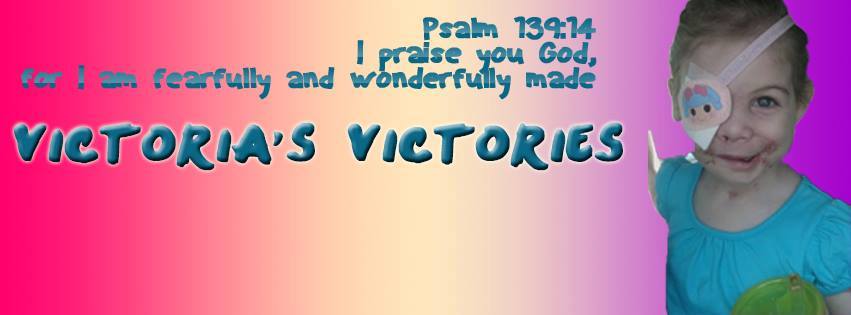
It appears that a family in Jackson, Mississippi has pulled off the perfect scam. Victoria Wilcher, 3, was mauled by her grandfather’s dogs, and needs extensive plastic surgery. A website, Victoria’s Victories, was put up the family to raise funds for her care, and really got a boost after the girl’s grandmother, Kelly Mullins, claimed that the child had been asked to leave a local Kentucky Fried Chicken franchise because, they were told, Victoria’s scarred face was upsetting patrons. The story went viral on the web, and more than $135,000 poured in from outraged and sympathetic Americans, including $30,000 from a frightened KFC.
Mission accomplished. Now it appears that a full-fledged hoax is unraveling. KFC, looking for someone to fire, can’t find any record of Victoria on surveillance footage for the day and time she was supposedly ejected. The girl’s grandmother and her aunt who runs the website can’t get their stories straight, citing varying dates and fingering various KFC stores, including one that has been shut down for months. The investigation is ongoing, but no confirming witnesses have come forward, and nobody can verify the socking tale of the cruelly-shunned little girl, who has already suffered so much.
Perfect! Since the object of the hoax is blameless, and the objective can be rationalized, and because the victim is just a mean old corporation that sells deadly fast food, the ends–getting money to repair a little girl’s damaged face–will certainly be regarded by many and perhaps most as justifying the means—lies, slander, libel, disparagement, and fraud. Continue reading
 Ethics Alarms
“Is this a deflated ball I see before me?”
“Inflategate”—-the developing NFL scandal about the New England Patriots’ under-inflated, more easily thrown footballs in the team’s last play-off win and perhaps others—is a big deal to 1) people who hate the Patriots; 2) football fans who care about whether their game has any integrity and 3) people like me, who think there is no justification for cheating, in sports, in business, or in life. Those who argue that it’s “much ado about nothing,” usually without being able to quote a line or explain a plot turn from the Shakespeare comedy they’re alluding to, do so because 1) they are Barry Bonds fans; 2) they don’t know the difference between a football and a plantain, and don’t care. except that they wouldn’t want to eat a football by mistake; 3) they are typical NFL football fans and want to “oh, pshaw!” anything that reflects badly on the sport that gives their brutal lives meaning, 4) they are John Edwards, or 5) they are members of the New England Patriots organization, and perhaps were involved in the ball deflation.
Pats quarterback Tom Brady (that’s how you know I’m from Boston: I call the team the “Pats”) gave a highly unconvincing press conference yesterday in which he maintained that he would never notice that the tool of his trade that he has plied approximately since he exited the womb felt different than usual, and, like his coach, the brilliant and soulless Bill Belichick, has no idea how the team’s balls got deflated. The credibility of that claim was severely undermined for me by Brady’s use (“This isn’t ISIS…”) of my least favorite rationalization of them all on the Ethics Alarms compendium, the infuriating #22:
(Or someone whose coach had the equipment guy deflate the footballs.)
Now comes blogger Windypundit to expand on my derision of Brady’s embrace of #22 from a different and useful perspective. Here is his Comment of the Day on the post, “Unethical Quote of the Month: Patriots Quarterback Tom Brady”: