debate
Comment Of The Day: Unethical Website Of The Month, “March For Our Lives” Edition: Change.Org [#1]

Here is JP’s Comment of the Day on the post, Unethical Website Of The Month, “March For Our Lives” Edition: Change.Org:
I have largely been silent on the issue this time around. I have seen nothing that contributes to the debate and thought I had nothing to add since the Vegas incident. Mostly, if someone asks, I just refer them to my earlier points on why banning bump stocks and strengthening the Brady Law not will not change anything. However, it seems today my more liberal and conservative friends have been posting quite a bit on the subject and I thought now might be a good time to tackle the issue again by looking at problems on both sides and finding a solution.
First, let’s start with some of the conservative talking points.
- “If someone is determined to hurt people and commit a felony, what’s to say that they won’t break a law to get their hands on a gun to do it?”
This may be true, but it is doesn’t move the dialogue forward and is often used deceptively. It is basically saying that since criminals don’t obey laws, anyway, why have a law? By this logic, we could apply the following to Trump’s desire to build a wall. Walls have not proven to be effective in stopping people wanting to come in, so why build a wall? I don’t understand why conservatives who use this logic don’t apply it elsewhere. Laws are largely there as deterrents. People will not do something because it is against the law regardless of how pointless they see it (I guess this is why I always get stuck behind that Kia doing 65 on the interstate). A psychologist found that most of the population is motivated to do things by one of two factors: sympathy and empathy. or law and order (I think this sums up the current gun debate).
Second,
- “Cars kill more people than guns do, yet we don’t ban cars.”
This is a strawman argument, and not even good one. Cars are highly regulated, require an age limit, require a permit of sorts, a registration, require training and safety ((things the left claim to want for guns) and are designed for transportation, not to kill. They can and have been used to kill people, but that is not their primary purpose. In fact, it is a gross misuse of their purpose. The argument falls further apart because while you have a right to a gun, you do not have a right to own a car. The government could decide to remove all cars (for whatever reason); this is an apples to oranges comparison.
Third, Continue reading
Comment Of The Day: Saturday Afternoon Ethics Warm-Up, 2/24/18: …#1 Welcome Student Commenters!

This is a unique Comment of the Day, self-explanatory and greatly appreciated.
Here is teacher Andrew Myette’s COTD on Item #1 of the post, Saturday Afternoon (Because I Was Up At 5 AM Writing About CNN’s Unethical “Town Hall”) Ethics Warm-Up, 2/24/18: Generic Packaging Scams, Goodbye Molly, Polls, And Welcome Student Commenters!:
Mr. Marshall and Ethics Alarms’ Commentators:
I am the (a?) teacher who has directed my students to Ethics Alarms. I teach an Expository Reading and Writing Course to 12th grade students. Part of the high school English curriculum, the course was developed by the California State University system in response to an influx of students who were not prepared for the rigors of college reading and writing, most notably the inability to recognize, respond, and develop argument.
I have directed them to Ethics Alarms because of the opportunity for them to engage in real world discourse on significant, relevant, and important issues, many of which challenge their world views.
I do not endorse nor do I condone inflammatory, immature, and inaccurate commentary. They know better – or, at least, I hope. As Mr. Marshall posted (under another post), I agree that their age should not excuse them from the challenges they encounter in this forum (“they will not be coddled”). I encourage it. But they must also handle the challenges of the forum with maturity, decorum, and respect. To do otherwise is a sad testament to their preparation for life after high school.
Here are the guidelines I have instructed my students to use when examining and writing argument:
When responding to argument, in writing or verbally, please keep in mind the following.
Be passionate! Reason originates in emotion, but must be tempered by logic and ethos.
Read (listen to) through the text you responding to, including comments, if any. Before you respond, consider the following aspects of rhetoric: Continue reading
Comment Of The Day: “What’s Going On Here?”: The 8th Grade’s Speaker Of The House Snub”

At 7:23 AM this morning, veteran commenter Pennagain was sufficiently lucid to Penn this helpful commentary and reminiscence regarding civics, education, debate, perspective and proportionality. I am duly impressed.
Here is Pennagain’s Comment of the Day on yesterday’s post on the significance of middle school students deliberately disrespecting the Speaker of the House, “What’s Going On Here?”: The 8th Grade’s Speaker Of The House Snub”:
I grew up in a thoroughly corrupt local political community (Jersey City, Hudson County, 1940s) where politicians mostly scared the hell out of us kids. They never hid their opinion of children as nuisances (non-voters, non-party-contributors, non-influential: period); as pawns to gain them applause (recipients of school awards or sponsored – not paid for – say, a week at summer camp or a trip to the carnival); as slaves (untipped or unpaid car washers, runners, leaf-rakers, lawn-mowers, paperboys etc.); or as flat out enemies (boys in particular who set off firecrackers or let their dogs loose at a rally or dared put their dirty, sticky hands on our officeholders’ bright black Buicks).
These refugees from Tammany Hall were no more considered respectable, responsible, worthy leaders than Dick Tracy’s B.O. Plenty and the school-age kids knew it. “Boss” (Mayor) Hague (“Listen, here is the law! I am the law!”), who ruled the city directly from 1917 to 1947 and indirectly for at least another 30 years, was universally hated and often feared, second to none in political corruption. Nonetheless, lip service and stiffly polite behavior was the rule in public, if only because parents were the greater examples; and they held the direct punishment power. Possibly, too, much as peer pressure obtained on the playground, children away from school lacked almost all the authority they would obtain in the next decade. We had an allowance if we were lucky, but no real buying power — we were a marketing force only in terms of breakfast cereal and comic books. Even toys and candy remained pretty much classics. Though we were a widely mixed group ethnically, in the classroom or the gym, we had no separate clubs or meeting places for our particular interests. We attended the afterschool activities, sports, religious observations and social functions dictated by our parents (I was treated to a few weeks of ballroom dancing classes one horrid Fall). Aside from running wild virtually unsupervised during any free time — and we found plenty of free time — we heard the opinions of our parents, ministers, teachers, newspaper-reading assignments, and listened with family around mealtimes to whatever was on the radio. Continue reading
Comment Of The Day: “Finally! A Complete List Of Argument Fallacies…”

Texagg04, who is a long-time asset on Ethics Alarms for refining the resources here, added to the recent post on Argument Fallacies with a useful compendium of 19th Century German philosopher Arthur Schopenhauer’s views on the subject, from the Great Pessimist’s “The Art of Controversy.” It also provides me with a welcome opportunity to display Art’s wonderful face, as he was one of those people who looked exactly like his writing would make you assume he looked.
Here is tex’s Comment of the Day on the post, Finally! A Complete List Of Argument Fallacies…
Another great resource is Arthur Schopenhauer’s “The Art of Controversy”, in which he lays out 38 common methods that debaters use to cheat their way to a “win”.
Here’s a list from this website: http://www.mnei.nl/schopenhauer/38-stratagems.htm,which seems like as good a summary as I’ve seen of the list.
1. Carry your opponent’s proposition beyond its natural limits; exaggerate it. The more general your opponent’s statement becomes, the more objections you can find against it. The more restricted and narrow his or her propositions remain, the easier they are to defend by him or her.
2. Use different meanings of your opponent’s words to refute his or her argument.
3. Ignore your opponent’s proposition, which was intended to refer to a particular thing. Rather, understand it in some quite different sense, and then refute it. Attack something different than that which was asserted.
4. Hide your conclusion from your opponent till the end. Mingle your premises here and there in your talk. Get your opponent to agree to them in no definite order. By this circuitious route you conceal your game until you have obtained all the admissions that are necessary to reach your goal.
5. Use your opponent’s beliefs against him. If the opponent refuses to accept your premises, use his own premises to your advantage.
6. Another plan is to confuse the issue by changing your opponent’s words or what he or she seeks to prove.
7. State your proposition and show the truth of it by asking the opponent many questions. By asking many wide-reaching questions at once, you may hide what you want to get admitted. Then you quickly propound the argument resulting from the opponent’s admissions.
8. Make your opponent angry. An angry person is less capable of using judgement or perceiving where his or her advantage lies.
9. Use your opponent’s answers to your questions to reach different or even opposite conclusions.
10. If your opponent answers all your questions negatively and refuses to grant any points, ask him or her to concede the opposite of your premises. This may confuse the opponent as to which point you actually seek them to concede.
11. If the opponent grants you the truth of some of your premises, refrain from asking him or her to agree to your conclusion. Later, introduce your conclusion as a settled and admitted fact. Your opponent may come to believe that your conclusion was admitted.
Look! A Good Ethics Result From The 2016 Campaign!

Donald Trump is making it clear that he isn’t going to study, prepare, prep or train seriously for Sunday’s presidential debate. Well, why not? After all, without substantive or appropriately focused preparation for the first debate, he was…oh, right, he was lousy. Donald doesn’t think so, however, and that’s what matters. He is now mocking Hillary Clinton for doing what anyone would do who understands the crucial mission at hand, and the importance of hard work. She is preparing, just as she would if she wasn’t going to be debating an ignorant buffoon.
One thing the Clintons cannot be criticized for is their determination and diligence. They both always work hard, and are thoroughly prepared for whatever they do. Trump, in contrast, has prospered his whole life by bluffing, bullying, posturing and faking. He had his career and a fortune handed to him by his father, and really is the embodiment of Ann Richards’ famous jibe at George H.W. Bush that he was someone who woke up on third base and thought he had hit a triple. Continue reading
Campus “Safe Spaces”= Free Speech Suppression And Intimidation: The Next Step
 Bad ideas take root when they are not immediately called what they are—bad—, then mocked, eviscerated, and destroyed with reason, logic and common sense. That is why fools should never be suffered gladly, and why their foolish inspirations should be dashed before they are allowed to draw a breath. Many factors, such as misplaced politeness, mistaking open-mindedness for lack of critical thought, laziness and cowardice allow these bad ideas to spread like weeds.
Who was it that shrugged when it was first suggested that the U.S. should ignore its own immigration laws? Who was it who failed to point and laugh when someone suggested that rape accusations in colleges should be decided without due process? Who neglected to say, “Whaat?” when a legislator suggested that workers be exempted from doing the duties required of their jobs when their religions disapproved of them? Good ideas can be defended against the attacks of those without imagination or daring. Bad ideas have to slip by, undetected and unrebutted, until they get out of control.
Some, indeed many, allowed the ridiculous “safe spaces” theory to live when it should have been strangled in its crib. Now it is strangling education and open discourse on campuses all over the nation. I’m proud to say that Ethics Alarms did its part deftly when the related argument was raised on various blogs, including this one, that places of debate should be “safe,” in the sense that no commenter risk a harsh rebuttal or an insulting retort no matter what that commenter wrote. We lost a couple of hardy and substantive participants over the issue.
The “safe places” theory is especially sinister, as it also creates places safe for more bad ideas to flourish and grow beyond the stage where they can be stamped out with ease. Of course, not every idea, even good ones, are welcome to all. “Safe spaces” means guaranteed safety from ideas that are unwelcome to the specific group constructing its safe zone, ideas like, say, “TRUMP 2016.” It is the culmination of the position that people should be guaranteed the right not to be confronted with opposing views. Now the University of Edinburgh, “influencing the world since 1583,” is showing us what happens when the weeds of “safe spaces” are allowed to spread. Continue reading
Look! “An Illustrated Book of Bad Arguments”!

As various thought fallacies and flawed arguments are constantly being exposed, used, debunked or otherwise referenced during our ethics discussions and debates—the Ethics Alarms compendium is here––this looked like something readers would enjoy. I probably should dedicate this post to former blog Commenter of the Year tgt, in appreciation for his ending—maybe just briefly, we shall see—his latest sabbatical with a flurry of 70 comments while I was lecturing in Newport last week. I didn’t have time to properly engage him or even read all the comments, but he seemed in characteristic form.
Tgt loves the fallacies and delights in slapping them down whenever they occur. His favorite is “No True Scotsman.” I immediately thought of him when I stumbled upon “An Illustrated Book of Bad Arguments” by the multi-talented Ali Almossawi. Tgt’s pet fallacy is here, as well as ad hominem, appeals to authority, the straw man, equivocation and others, some under different names than those I am used to. I haven’t read it carefully: there may be one or two that needs to be added to the Ethics Alarms list.
This is a well-researched and written exposition of some major fallacies with lovely illustrations, presented like a vintage children’s book. Someone should actually publish a children’s book like this: I would have been grateful for one when my son was a boy, or when I was a boy. I’m grateful for this now.
You can find this amazing work of art, ethics, rhetoric and logic here. I’ve already sent the link around to many friends, young and old, and you may want to do the same.
I Suppose It Is Comforting To Know That I Wasn’t Unfair To Starbucks And Howard Schultz
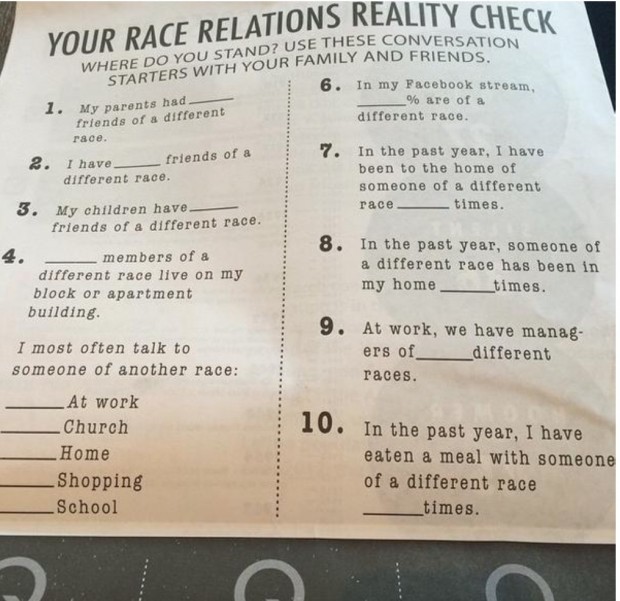
If the Starbucks “Race Together” campaign had turned out to be carefully thought out, intelligent, sophisticated and responsible, and not a facile, condescending and cynical effort to promote a brand while creating static and white noise in the midst of an important cultural discussion, I would be obligated to apologize for doubting CEO Howard Schultz’s wisdom and ethics. It would also have been an apology I would have enjoyed making.
Sadly, I was not only correct in my assessment that this was a fiasco in the making, I was more correct than I suspected. Above is the “Race Relations Reality Check ” quiz that Starbucks has reportedly been distributing. The questions indicate a bottom-of-the-well level of comprehension about race and racism, not to mention demographics, culture and the human species. It appears that Starbucks favors some kind of affirmative action program on personal friendships, and believes that one can measure racism or incipient bias by how many individuals of other races one has regular contact with. I don’t even want to have a discussion with someone this shallow. A whole corporation this shallow is a nauseating thing to contemplate. A corporation this shallow that presumes to lead a national discussion on race is, oh I don’t know—Risible? Sad? Dangerous?
Starbucks seems to be thinking like George Costanza, during the period where he was trying to acquire black friends and managed to annoy and insult every African-American he met. The presumptions here are staggering, and so directly contrary to life, logic and the realities of human existence that i get angry just reading them. I was at an ethics conference in Nigeria, and met some of the most intelligent, charming, passionate people I have ever encountered in my life. I would be honored and enriched to have any of them in my life, and would hope that I could develop close friendships with them—but I can’t, because I live in the U.S. and they live in about 15 African nations, and it’s just too darn expensive to dine at each others’ homes. I live in an area, Northern Virginia, that is overwhelmingly white, not because it is white, but because it is convenient to my work and we found a great deal on a house. I work in two fields, theater and ethics, that do not afford a lot of contact with African Americans. The last time we had anyone other than immediate family to dinner was a decade or more ago; the last time anyone other than family, black or white, had us to dinner was longer ago than that—and I am a delightful dinner companion. Continue reading
Musings On The “You Can’t Even Spell” On-Line Debate Tactic
 In a debate on a live thread here between two esteemed commentators, one of the contestants expressed vivid annoyance when the other derided the quality of his text in a retort. I’ve witnessed this many times online, as have you, I’m sure: someone registers an opinion while making a blatant typo, a bad misspelling, a misuse of a word, or a grammar gaffe and the opponent immediately focuses on it. What is this, exactly, and is it always wrong?
1. What is it? As I mentioned on the thread in question, it’s pretty close to an ad hominem attack once removed, right? The sense of such a comment is, “Why should I respect your opinion? You can’t even spell “inaugural!” which in turn suggests that the individual is an ignoramus rather than a worthy adversary. It needs a name though. Is there one?
2. Is the tactic ever justified? Clearly it is not fair and indeed an unethical deflection if the issue is a typo or two. Or, in my case, or six. Anyone who visits here often knows that I have a serious typo problem, paired with an even worse proof-reading problem. I have dinged job applicants for resumes and job letters that contain “your” for “you’re” and “recieve” for “receive”? Indeed I have. Is there a difference? I think so: if someone wants to make a good impression and still makes these mistakes, I am justified in concluding that this is really the best that applicant can do, or, in the alternative, that he or she doesn’t care very much.
I wasn’t blogging 2000 words a day then, however.
3. Mentioning a gaffe seems to be mandatory if the comment or text containing it was complaining about carelessness, illiteracy or stupidity generally. Again, though, what does this mean? Is it essentially another variation of an ad hominem attack: “Hey, you’re so dumb you make the same kind of error you’re bitching about! Your argument must be dumb too!”? I think it is, but it also falls in the category of “Boy, I asked for that!” In “Twelve Angry Men,” the bigoted Juror 10 derides the character of a witness, saying, “He’s an ignorant slob! He don’t even speak good English!” Whereupon the heavily-accented naturalized citizen in the group corrects him, saying, “He doesn’t even speak good English,” humiliating his fellow juror. Ethical? In that setting perhaps; generally, however, I would think that the Golden Rule should apply, but most of us can’t resist the hanging curve over the center of the plate. Continue reading
 Ethics Alarms
Here is the second of two Comments of the Day regarding the post-Parkland gun control freak-out, authored by recent addition to the commenter ranks, OhThatGuy, on the post, Unethical Website Of The Month, “March For Our Lives” Edition: Change.Org.
(The first is here.)
The real issue, at least from my perspective, isn’t guns and gun control. Yes, this is one of the big emotional triggers right now, has been for years, and will continue to be so as long as there exists a gulf between those who enjoy the rights and benefits granted by the 2nd Amendment and those who do not.
The underlying concern to me is the lack of independent thought. While this is somewhat excusable in kids, it’s not in what are supposed to be adults. Displays such as the walkouts and marches are nothing more than peer pressure or what I call the Bandwagon Principle or Bandwagon Effect– doing something simply because others (in my peer group) are doing the same thing without any actual thought put into the decision. I see this on a daily basis – I teach juniors and seniors in high school.
Growing up, my parents, especially my father, were as near as I can remember, completely objective about things. There were no passionate appeals to emotion regarding the hot topics of the day. I was encouraged to read and form my own opinions about things as none were supplied to me from Mom and Dad. We (my friends and I) read the two newspapers available each day as well as Time, Newsweek, and other publications. This was in the early to mid 80’s so we weren’t subject to the cacophony of modern media but were as well informed about current events as most teens could be. The short version is, if I was to have a publicly stated opinion about something, I’d better have some idea what I was talking about and some facts to back it up. Any discussion of an issue that started with “I feel that…” or “They need to do SOMETHING!” wouldn’t have lasted very long. I don’t remember ever being told anything about what to think on a subject or even led to a conclusion to fit what my parents thought I should think. It simply wasn’t how they operated. Continue reading →