Two Deceitful Non-Denial Denials And An Unethically Tardy Whistleblower

Francis

TV shows like “Lie to Me” and “The Mentalist” as well as all the profiling shows like “Criminal Minds” have done a public service by schooling viewers in the tell-tale signs of non-denial denials. Nonetheless, people continue to use them, apparently because they work. Bill Cosby’s lawyers just launched a lulu, responding to the inexplicably re-booted accusations that Cosby was a serial sexual predator in the 70’s. You can’t get more non-denial than this, from lawyer John P. Schmitt on Cosby’s website:

“Over the last several weeks, decade-old, discredited allegations against Mr. Cosby have resurfaced. The fact that they are being repeated does not make them true..Mr. Cosby does not intend to dignify these allegations with any comment.”

There is no denial of the alleged rapes to be found here. Yes, the accusations are “decades old”: So what?  So are questions about whether Lizzie Borden was guilty.  The fact that the allegation are decades old means Cosby can’t be prosecuted because of the statute of limitations, but they don’t change anything about the seriousness of the accusations against the erstwhile “America’s Dad.”

Discredited? How have they been discredited? Cosby paid a settlement in one of the cases: that generally makes the allegations look credible (See: Paula Jones/Bill Clinton; Michael Jackson). Sure: “The fact that they are being repeated does not make them true,” and it also doesn’t make them false. That Cosby doesn’t intend to “dignify” the matter with further comment is strategy and posturing. It is significant that the lawyer did not say “He didn’t do it.”

——————-

[UPDATE: Ah HA! Today that statement was taken down, with this taking its place, a joint statement from Dolores Troiani, counsel to Andrea Constand, and Schmitt:

‘The statement released by Mr. Cosby’s attorney over the weekend was not intended to refer in any way to Andrea Constand. As previously reported, differences between Mr. Cosby and Ms. Constand were resolved to the mutual satisfaction of Mr. Cosby and Ms. Constand years ago. Neither Mr. Cosby nor Ms. Constand intends to comment further on the matter.”

Translation: “Oops. That settlement with the first of Cosby’s accusers was predicated on neither party impugning or accusing the other once the money was paid, and that “discredited” comment risked getting Bill in even more hot water. Never mind!”]

                                                                                                                                  ——————-

Lawyers aren’t permitted to lie, though. Then again, they aren’t supposed to mislead the public with deceitful non-denials, either.

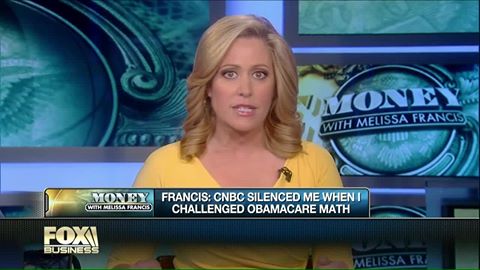
Then we have CNBC’s response to ex-CNBC reporter Melissa Francis, who followed Jonathan Gruber’s admissions of rigged math to get the Affordable Care Act past “stupid voters” with a relevant anecdote of her own. Francis, now a Fox Business anchor,  claims that the network “silenced” her when she questioned the merits and specifically the misleading numbers for the Affordable Care Act when it was being rammed through the legislative process. She told Fox News that she was called on the carpet by CNBC brass and told to stop, on the grounds that such criticism was “disrespectful to the President.”
A CNBC representative responded: Continue reading

The GOP’s Favorite Unethical Tactic: Deceptive Mailers

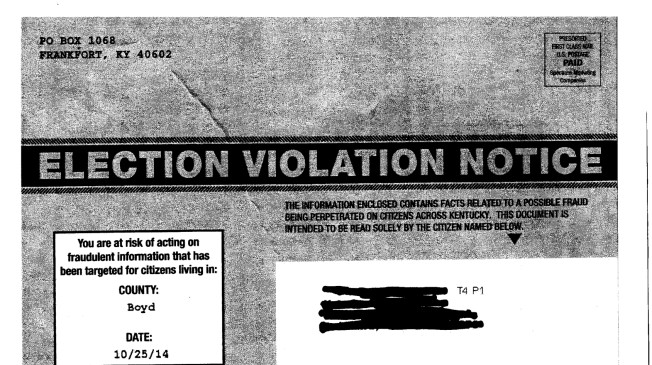
McConnell mailerIt’s not sufficient, apparently, that Senator Mitch McConnell’s (R-Ky) Democratic opponent Allison Grimes has thoroughly disgraced herself (See here and here, and that’s not all, but I didn’t want to pick on her with so many other unethical candidates running under the banner of either political party) and probably squandered any chance she had of unseating the GOP Minority Leader. So  the Republican campaign geniuses decided to attack this not-ready-for-prime-time politician using a tactic out of former Republican Chairman Michael Steele’s playbook. That means unethical, for those of you who didn’t follow Steele’s slimy reign.

In 2010, Steele approved the GOP sending out mailers disguised as official U.S. Census documents twice, the second time after the House of Representatives had rebuked the despicable tactic and voted unanimously to make them illegal. Since then, the GOP has hectored those citizens foolish enough to contribute to a Republican candidate with mailings deceptively designed as renewal notices, as if something would expire if you didn’t send in another check. This is a sleazy method of inducing someone to open junk mail, and it shows how thoroughly mass mailing is dependent on influencing the dim, timid and too forgiving that such dishonestly packaged appeals work. Continue reading

Ethics Observations On Wendy Davis’s Controversial “Wheelchair Ad” Attacking Greg Abbott

1. The campaign of Texas Democratic gubernatorial candidate Wendy Davis has issued an attack ad directly referencing gubernatorial rival Greg Abbott’s partial paralysis, and includes the image of an empty wheelchair. Davis could claim—and will, if she hasn’t already–that  the implication that his use of a wheelchair argues against his qualifications to be governor is inadvertent or imagined, except that her supporters were caught in a Project Veritas video mocking Abbott for his disability, and Davis has made gaffes relating to his handicap before, as when she said that he hadn’t “walked a day in her shoes.”

2. She is a member of a party with supporters in the media ready to pounce on any Republican who makes a similarly provocative reference to an opposing candidate’s race, religion, ethnicity, gender or “abled status.” The double standard is certainly a campaign boon to Democrats, but they have to take advantage of it a bit more subtly than this.

3. What is primarily wrong with the ad, however, isn’t the wheelchair, or the use of tactics that would called an appeal to bigotry if they were used by Republicans. It is that the arguments the ad seem to be making are stupid, unfair and wrong, and ones that Davis, who is a lawyer, must know are stupid and wrong, or she is stupid and wrong. Continue reading

Unethical Quote Of The Week: NFL Commissioner Roger Goodell

wait_what_logo

“We certainly didn’t know what was on the tape.”

Beleaguered NFL Commish Roger Goodell, telling CBS that although the league had suspended and fined Ray Rice for knocking out his now-wife in a hotel elevator, as he had admitted in court, it had no idea that a videotape of Rice knocking out Janay Palmer (now Rice) in the elevator would show him actually knocking her out in the elevator.

On the old Ethics Scoreboard, Goodell would be a slam dunk David Manning Liar of the Month, telling a lie that he can’t possibly think anyone with two IQ points to rub together could accept at face value. How else are we to take this idiotic, deceitful statement, other than as an idiotic, deceitful statement? If the NFL didn’t know that’s what the video would show, why did Goodell suspend Rice in the first place? If it accepted the fact that Rice cold-cocked a woman, what else could the tape have possibly shown?

I know I’ve already posted on this, but I feel like I’m losing my mind. The NFL reacts as if the video was a surprise. The media acts as if the video really added new information (“The NFL must have seen it!” Who cares? The NFL had to know what was on it, whether it saw the tape or not! What else could it possibly have shown? The tape, if anything, was arguably exculpatory, as it showed Palmer rushing him in an attempted assault.) And the argument suddenly becomes “Did the NFL know what was on the tape?” That’s ridiculous! Can’t everyone see how ridiculous that is? Can’t everyone see that the NFL isn’t reacting to new information, but only trying to repair its own image?


Knock-Out Punches, Murder and Political Correctness Bullying: Let’s Play “SPOT THAT DECEIT!”

Game show set

I am fascinated by deceit, and not just because I live near Washington, D.C., where it is the official tongue. It is fascinating because deceit is often the most effective kind of lie, tricking a listener or a reader  using their own assumptions, desires, misplaced trust or inattentiveness against them by stating a literal truth to imply an actual falsehood. Most of all, deceit is fascinating because so many people, including those who employ it habitually, think that it isn’t a lie at all.

This morning I found three wonderful examples of deceit, brought to our attention by three distinguished bloggers, so let’s play the challenging, exciting and never-ending game that’s sweeping the nation…

Spot That DECEIT!

Let’s warm up with something easy…

1. The NFL Deceit

Law prof-blogger Ann Althouse found it difficult to believe that the NFL hadn’t seen the videotape showing Baltimore Ravens stat Ray Rice knocking out his fiancee with a well-aimed punch before it gave him his first, absurdly light punishment, though the official spokesperson yesterday said…

“We requested from law enforcement any and all information about the incident, including the video from inside the elevator.That video was not made available to us and no one in our office has seen it until today.”

OK, audience…

Spot That DECEIT!

Continue reading

Law vs. Ethics: A Cautionary Tale From Texas

You fucked up

“You can’t worry forever about your mistakes. You fucked up. You trusted us. Make the best of it. ” —Otter (DuPont) to Flounder (Its former employees) in “Animal House”

Law and ethics are two different things, and courts are frequently forced to embrace unethical results in order to uphold a bad law or to deal with a messy fact pattern. It is seldom, however, that one sees as blatant an example of atrociously unethical behavior being ruled legal as in a recent case in Texas, decided this month. It is the kind of case that promotes distrust all around, as you will see. When that is the result, the ruling itself is unethical.

In the case of Sawyer, Kempf, et al. v DuPont and Company, an employer’s false promise not to exercise a legal right in order to induce its employees to forgo their negotiated rights was deemed unenforceable. The legal reasoning is solid. The ethics stinks, and is as good an example as you will ever find for the inspiration behind Charles Dickens’ (speaking through his creation Mr. Bumble, in “Oliver Twist”) statement, “The law is a ass.” Continue reading

More On The Perry Indictment: The Mark Of Hack Partisan Journalism

H

The unethical indictment of Republican Texas Governor Rick Perry in Travis County (Austin) for the “crime” of trying to force a drunk, power abusing, ethically corrupt district attorney from continuing to head the Public Integrity Unit—quick, now, Democrats…why is this a bad thing?—is a rare opportunity for otherwise incorrigibly biased journalists to show some token integrity and fairness. What is forfeited, after all, by admitting the obvious, that Perry is being railroaded by an abuse of prosecutorial power to derail him politically? Perry is no real threat to win the Presidency, no matter how high his stock is now. We all saw why in 2012.

So the liberal media has no need to play gotcha, and could, for a change, actually do its job: show the public why the indictment is nothing but a political hit job; why it’s a breach of legal ethics, how disgracefully Travis County DA Rosemary Lehmberg has conducted herself; why she is obligated to resign after breaking the law, trying to use her position to intimidate police officers on video, having her law license suspended, and apparently doing nothing about the fact that she is a raging drunk; why having such an individual heading up the agency responsible for public integrity is a threat to the public well-being and the public trust; and why a Governor of any political affiliation doing everything he can to pressure such a miserable and incompetent DA to resign as she had a professional obligation to do is, not merely not criminal, but admirable.

But most of them just can’t bring themselves to do it. So here is the Daily Beast partisan hack news commentary website, the yin on the left to the yang of Tucker Carlson’s partisan hack Daily Caller on the right, which wouldn’t be necessary if there weren’t a Daily Beast,  publishing this piece by its partisan hack staffer Mark McKinnon, implying that there may be validity to the indictment, suggesting that Perry did something wrong, and glossing over how disgusting it is that Lehmberg  still holds office. Continue reading

The “Ordinary People Who Are Struggling Within Gaza” Are Not Innocent

President Obama continued a pattern of declaring deceitful formal support of Israel while throwing coded support for Palestinians to the Democratic base, which is, disgracefully, largely siding with the anti-Israel forces in Europe. His reluctance to commit the moral weight of his office against the conduct of Hamas and behind Israel was embarrassingly clear when he said, “I also think it is important to remember that Hamas acts extraordinarily irresponsibly when it is deliberately siting rocket launchers in population centers, putting populations at risk because of that particular military strategy.” Intentionally placing its own citizens, including children, in harm’s way to maximize photo-ready casualties that can turn world opinion against Israel is not “irresponsible.” The President trying to play both ends against the middle in the Gaza crisis is irresponsible. Using Gazans as human shields when Hamas forces Israel to respond militarily to missiles and tunnels is indistinguishable from evil, and the President, were he responsible, would say so unequivocally. Instead, he resorts to weasel words, equivocations. Surely, this President extolled for his eloquence knows the meaning of the words he uses.

Then, this week, Obama gave us this:

“I have no sympathy for Hamas. I have great sympathy for ordinary people who are struggling within Gaza.”

Godwin’s Law be damned: a Nazi Germany analogy is instructive here. Continue reading

Jonathan Gruber, Bad Law Ethics, The Corruption Of Democracy, And The Affordable Care Act

"Oh what a tangled web we weave..." You know the rest of Sir Walter Scott's famous quote. So why doesn't the Obama Administration?

“Oh what a tangled web we weave…” You know the rest of Sir Walter Scott’s famous quote. So why doesn’t the Obama Administration?

There are important democratic lesson to be learned from the ongoing Obamacare Ethics Train Wreck, and we could discuss them objectively if the beleaguered supporters (enablers? excusers? rationalizers? propagandists?) of the law would just start accepting facts rather than resorting to dishonesty in all of its forms. The law is a mess. The law is a mess because its proponents in Congress passed it without reading it, because the public was deceived and misled in order to pass it, and because Congressional leaders and the President, in addition to not reading  major legislation that have massive consequences to the nation’s population, businesses, and budget, pushed it through without the usual two House scrutiny and amendment process.

Fixing the mess, or trying to fix it, has caused as many problems as the misbegotten law itself. (Please note that I am not discussing the intentions of the law, or what good things it might accomplish for Americans show needed help getting health insurance. That is beside the point. Good intentions don’t make a good law, or a bad law good. Look at the chaos at the border generated by the 2008 anti-human trafficking law, when it was mixed with irresponsible Democratic rhetoric and administration policies suggesting that illegal immigration restrictions were a thing of the past where children were concerned. Yes: many Americans have benefited from the Affordable Care Act. That fact alone, stated without reference to all the chaos, uncertainty, corruption, division and misrepresentations that accompany it, does not mean the law has been a success.)

The law depended on a penalty for not buying health insurance, a penalty that Democrats insisted was not a tax (so the President didn’t have to defend a large tax increase.) But a penalty for not doing what citizens should be free to do was unconstitutional, so Chief Justice John Roberts, in the spirit of avoiding government by judge, allowed the ACA to slip by in a 5-4 decision by declaring that the mandate was a tax, regardless of what it had been called to get it passed, and thus was constitutional after all.

Then the President began delaying deadlines and waiving provisions in the law that weren’t ready to go into effect or that were obviously going to cause more embarrassments. This was an abuse of power: Presidents can’t change laws by fiat. It established a dangerous precedent that undermines Constitutional democracy and the Separation of Powers. But it’s a bad law, and an unpopular law; the Republican House obviously won’t agree to the fixes needed without also doing a major overhaul, and this is, in the ironic words we keep hearing, most recently by the New York Times, Present Obama’s “most significant legislative achievement“—how sad is that?—and must be preserved at all costs.

At all costs. So far the costs of the ACA have been complete partisan polarization, the public’s realization that the President who pledged “transparency” will lie repeatedly to get his way, judicial rescue or dubious validity, and the defiance of the lawmaking procedures delineated by the Constitution. And the ethics train wreck goes on.

In Halbig v. Burwell, the US Court of Appeals for the DC Circuit ruled that those who purchase health insurance under the Affordable Care Act are only eligible for federal tax credits if they do so through an exchange established by a state.  (Another court ruled otherwise.) The court did this because this is what the miserably drafted, rushed, never-read by its own champions actually says, stating that tax credits are only available to those who purchase insurance in an “[e]xchange established by the State.” Obama-propping pundits, Democratic officials and the Administration’s spokespersons have attacked and indeed ridiculed the decision, saying that he court should have refused to enforce the actual wording of the law because it creates an absurd result. After all, the ACA’s stated goal is to expanding access to health insurance. Why would Congress try to limit it in this fashion—I mean, other than the fact that they had no idea what the law they were voting for actually had in it, just a general idea about what it was supposed to do? Continue reading

A Too Common Media Practice That Is Per Se Unethical: The Purchased “Opinion”

"But remember---we tell you what opinion to express. Deal?"

“But remember—we tell you what opinion to express. Deal?”

Lanny Davis, the attorney and Washington D.C. political consultant who became a tiresome, repetitive and shameless presence on national television during the Monica crisis, has just authored a review of sorts of Hillary Clinton’s book, “Hard Choices.” On “The Hill,” he pronounces it a genuine portrait of its author, and as accurate as it is complimentary. “No, Hillary Clinton hasn’t changed through all the years: the importance of family and friends, the “service gene” as active today as I witnessed some 45 years ago,” David writes, ” motivating her to “never quit — never stop working to make the world a better place.”

Maybe the book is wonderful, and maybe it isn’t; about that, I do not care. Davis begins with a lie: he says that the book’s sales “are strong,” when the buzz on the web, and not just among those rooting for Clinton to fall on her face, is how disappointing sales are. But Davis is paid by his clients to shade the truth; I’m not going to quibble about the deceit inherent in “strong.”

This, however, matters, and it is a long-held pet peeve of mine: Lanny Davis works for the Clintons. He has for years. If he is not currently on Hillary’s payroll, he will be, or is angling to be: pick a, b, or c. The conclusion is the same no matter which it is: he is biased; he will personally benefit from endorsing Hillary and her book, and thus his article, which purports to be an honest, objective, reliable assessment, is almost certainly nothing of the kind. Continue reading