Unethical Quote Of The Month: Senator Elizabeth Warren (D-Mass)

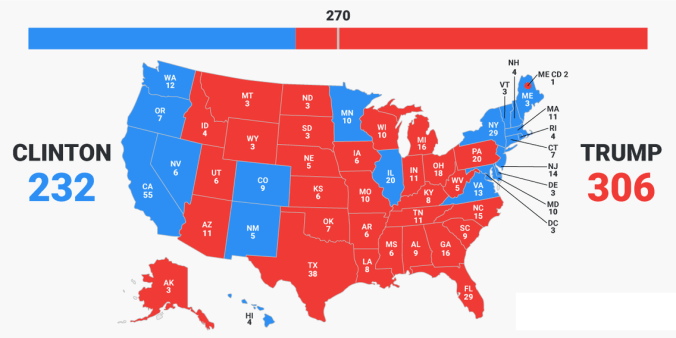
“In 2016, nearly three million more people voted for Hillary Clinton than Donald Trump – but Trump took the presidency. That’s not exactly the sign of a healthy democracy. Democracy hangs on the idea that whoever gets the most votes wins.”

—-Senator Elizabeth Warren, dumbing down democracy to a partisan audience at the Center for American Progress ‘Ideas Conference’ 

No U.S. election proved the foresight of the Founders and their Electoral College innovation more clearly than the 2016 edition. A single state, California, culturally estranged from the majority of the nation in dramatic, perplexing, even bizarre ways, voted overwhelmingly for Hillary Clinton by more than 4 million votes. This single, virtually one-party state, under a pure popular vote system, would have overcome the will of the rest of the 50 states and the District of Columbia, which narrowly favored Republican Donald Trump by more than a million votes. This was exactly the kind of scenario the Electoral College was devised to avoid—indeed, devised in order to have a country at all. The smaller states, then as now culturally distinct from the more populous states and fearing a permanent fate of being dictated to by their larger cousins, insisted on such devices as the U.S. Senate, where all states had equal power, and the Electoral College, which prevented an,overwhelming mob of single-minded voters in one region dominating the choice of a national leader in perpetuity.

There are other benefits of the device as well. The Electoral College tends to handicap single issue candidates and radical ones. It requires that contenders for national leadership appeal to all regions, or at least not to just a powerful few. Narrow issue, increasingly extreme parties as Warren’s Democrats have become are definitely penalized by the Founders’ system, which is why contenders for the 2020 Democratic nomination are already taking aim at it. What the Electoral College should be doing is to force Democrats to become more inclusive, less divisive, and rational. Instead, they are already working to de-legitimatize the results of the next election, should it not go their way. Continue reading

Unethical Quote Of The Month: Microsoft

“By agreeing to these Terms, you’re agreeing that, when using the Services, you will follow these rules:

….

iv. Don’t publicly display or use the Services to share inappropriate content or material (involving, for example, nudity, bestiality, pornography, offensive language, graphic violence, or criminal activity).

b. Enforcement. If you violate these Terms, we may stop providing Services to you or we may close your Microsoft account. We may also block delivery of a communication (like email, file sharing or instant message) to or from the Services in an effort to enforce these Terms or we may remove or refuse to publish Your Content for any reason. When investigating alleged violations of these Terms, Microsoft reserves the right to review Your Content in order to resolve the issue. However, we cannot monitor the entire Services and make no attempt to do so.”

—-From the revised Microsoft Services Agreement.

I do not trust Microsoft to decide what is “offensive language” in my communications, or anyone else’s. Many people, for example, believe that it is offensive that I assert the duty of citizens to allow an elected President to do the job their fellow citizens exercised their rights to select him to do, and that they have an ethical obligation to treat him with the respect the office of the Presidency requires.

We are already seeing indefensible bias on the part of other big tech companies, such as Google, Twitter, Apple and Facebook, as they favor specific ideological and partisan positions and use their platforms to censor and manipulate public discourse. These are private companies and not constrained by the First Amendment or core ethical principles like fairness and respect for autonomy (and, as we all know, definitely not respect for privacy). The problem is that the big tech companies are ideologically monolithic, virtual monopolies, possess the power to constrain free expression and political speech while leaving no equivalent alternative, and are increasingly demonstrating the willingness to use it.

The big tech companies have proven that they are unethical, ruthless, lack integrity, politically-active and willing to abuse their huge and expanding power to advance their own agendas. At the same time, their products and services  have become essential to the daily lives, recreation and occupations of virtually all Americans. This is a dangerous combination.

They must be regulated as the public utilities they are, and the sooner the better.

Morning Ethics Warm-Up, 3/9/18: Update On A Jerk, Deceptive Recycling, A Movement Becomes A Club, And The Future Is Abused

Good Morning!

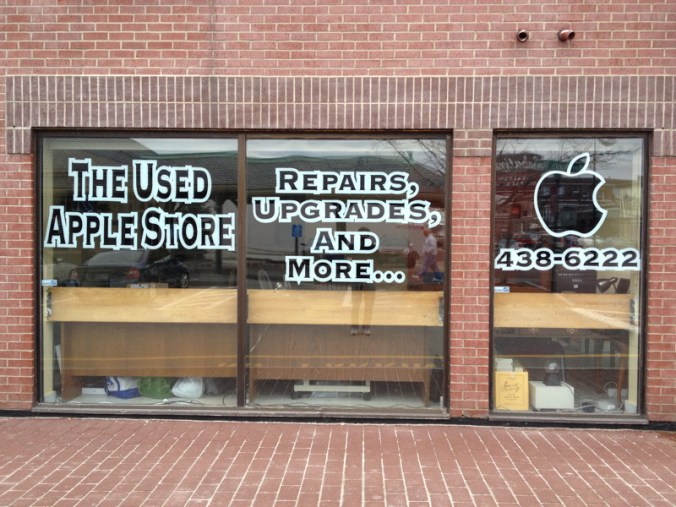
1 Good! Billy Williams, that Derry, N.H. Used Apple Store owner who announced that Republicans weren’t welcome in his store, was evicted from his space. For weeks, a sign in the window has said that the store would re-open after renovations, which Williams’ former landlord says is not true. Williams rented the commercial space for $2,000 per month and owed $15,110 after neglecting to pay rent for seven months.

Williams, you will recall, said that he infallibly could recognize Republicans. His Facebook post announcing the GOP ban described members of the political party as “almost evil, and to be honest, usually evil.” [Pointer: Arthur in Maine]

2. Recycling Deceit: In Atlanta’s Hartsfield-Jackson International Airport, I was intrigued yesterday by the cylindrical re-cycling receptacles that had two deposit holes, a circular one on one side, into which we were told to put cans and bottles, and a long rectangular slot on the other side, for newspapers and other paper refuse.  I lifted off the top: sure enough, everything went into the same place, newspaper and cans alike. I don’t know what the term is for gratuitously demanding that the public do something pointless and trivial just to exert power, but this was it.

3. The problem with #MeToo. Commenting on yesterdays Comment of the Day, in which Carcarwhite wrote, while criticizing the #MeToo movement,

“I was kissed by Eddie Van Halen back stage in the 80’s, on the lips, a few times. He was tipsy and happy and took a selfie of us before seflies were selfies, and I’ve actually had friends on the Left tell me I should my story publicly. And they say I am ENABLING THIS BEHAVIOR by not going forward”

Commenting, Still Spartan said in part, “What you described is NOT “Me Too.” Just because some people take it too far, does not mean that it is not legitimate. Please take it from someone who had to leave a job and have her career derailed for multiple years because of this crap. It happens, and it happens every damn day.” Continue reading

NOW What? The Most Discouraging News Of All

From the Washington Post:

Fifty years after the historic Kerner Commission identified “white racism” as the key cause of “pervasive discrimination in employment, education and housing,” there has been no progress in how African-Americans fare in comparison to whites when it comes to homeownership, unemployment and incarceration, according to a report released Monday by the Economic Policy Institute.

In some cases, African-Americans are worse off today than they were before the civil rights movement culminated in laws barring housing and voter discrimination, as well as racial segregation....

Among the study’s shattering findings…

…7.5 percent of African-Americans were unemployed in 2017, compared with 6.7 percent in 1968 — still roughly twice the white unemployment rate.

…The rate of home ownership, one of the most important ways for working- and middle-class families to build wealth, has remained virtually unchanged for African-Americans in the past 50 years. Black home ownership remains just over 40 percent, trailing 30 points behind the rate for whites, who have seen modest gains during that time.

…The share of incarcerated African-Americans has nearly tripled between 1968 and 2016 — one of the largest and most depressing developments in the past 50 years, especially for black men, researchers said. African-Americans are 6.4 times as likely than whites to be jailed or imprisoned, compared with 5.4 times as likely in 1968.

…The wealth gap between white and black Americans has more than tripled in the past 50 years…The typical black family had zero wealth in 1968. Today the median net worth of white families — $171,000 — is 10 times that of black families.

After all the rhetoric, all the safety nets, The Great Society, the Civil Rights Act, nothing. After busing, 50 years of affirmative action and diversity training in employment and educational institution admissions, nothing. After an explosion in the numbers of African American House members, police commissioners, judges, lawyers, doctors, big city mayors, and governors; after home rule in the District of Columbia, after Barack Obama…no progress. After 50 years that saw attitudes on mixed race marriages, cultural representation in academia,  media and entertainment, broadcasting and sports; after Barbara Jordan, Michael Jordan, Bernie Shaw, “The Cosby Show,” Jesse Jackson, Al Sharpton, Serena Williams, Flip Wilson, Johnnie Cochran, Spike Lee, Oprah, Michael Jackson, “Hamilton,” “Scandal,” “The Butler,” “Hallelujah Baby!”, Rhianna, Beyonce, Jay-Z…how can this be possible?

Naturally, the Post article on the report’s first answer is simple: it’s racism, that’s all:

“We have not seen progress because we still have not addressed the issue of racial inequality in this country,” said John Schmitt, an economist and vice president of the Economic Policy Institute, citing the racial wealth gap and continuing racial discrimination in the labor and housing markets. “One of the key issues is the disadvantages so many African-Americans face, right from the very beginning as children.”

If that’s going to be the reflex response to this disaster, then the next 50 years will bring minimal progress as well. There is more, much more, to this multi-level failure of policy, planning, education, leadership and culture. I have mentioned before that just about 50 years ago I took an excellent course on the problems facing African-Americans in the United States. The Professor was a renowned expert in the field, Thomas Pettigrew. It was also the most depressing course I ever took. We studied how poverty and the lack of leadership and positive role models led to crime and destructive cultural norms; how this led in turn to prison and single parent, female-headed families, which encouraged single women to have children, which fed the cycle. We studied various innovative policy initiatives, and why they seemed doomed to failure. Continue reading

Unethical Quote Of The Month: Derry, NH Used Apple Store Owner Billy Williams

“There comes a time when every man will needs to stand up for what’s right and blaze a better path. Today we do that, today we say no thank you to any Republican. If you affiliate with the Republican Party you are not welcome into our store. We will not offer you service. If you come in anyway, I suppose you could sneak in but we will probably know. In fact, we can point out a Republican just from the way you look in person or in a photo. Once I tried doing this and realized I could. We put to a test and told 30 random people that we were guessing Republican or not and all 30 I was correct. You have an uptight, closed energy, negative aura to you… almost evil, and to be honest, usually evil. You also lack a psychic gateway to technology.”

—Billy Williams, owner of the Used Apple store in Derry, New Hampshire.

Signature significance: Billy is unethical, a bigot, a bad neighbor, a bad citizen, a bad American, and a toxic asshole. He is the kind of hateful hyper-partisan fool who is poisoning our culture, our communities, national politics and our public dialogue.

So is anyone who cheers him on.

Billy takes pains to point out that his bigotry isn’t illegal, so it must be OK. (See: Rationalizations List, #4. Marion Barry’s Misdirection, or “If it isn’t illegal, it’s ethical.”)  He also doesn’t worry about backlash from any potential customers who might choose to direct their business to someone who isn’t working to divide the United States into divided camps, each discriminating against the other based on hate and contempt for their opinions. “If you’re in it for the right reasons, it doesn’t matter that someone isn’t gonna come to you with their money,” Williams said, courageously. .He then compared himself to Oskar Schindler.

You know, that’s exactly who I thought of! No, wait—it was Oscar Wiener….

Continue reading

Comment Of The Day: “Ten Ethics Observations On The Nunes Memo”

I think this is the shortest Comment of the Day yet, a single sentence with an introduction, but it is a brilliant one. I am abashed that I didn’t think of it, but no one else has either, as far as I can determine. Circulate it widely, especially to your Facebook friends who are horrified that anyone would try to impugn a spotless American Institution like the FBI.

Here is Chris Marschner’s Comment of the Day on the post, Ten Ethics Observations On The Nunes Memo

You may have missed one glaring observation…

Comey, pundits, and Democats decry the Nunes memo as a smear on the FBI, attempts to sully the reputations of our premier agencies but have no problem casting doubt on our electoral process, smearing a bothersome but duly elected person to the high office of president, and telling the world of his transgressions.

Comment of the Day: “Ethics Quote Of The Month, Terrifying Thoughts Division: Daniel Greenfield”

Conservative journalist David Greenstein made a provocative speech before a Tea Party group in which he posited a “civil war,” defined by him as when a political party rejects a lawful Presidential election and refuses to accept the legitimacy of any government it does not dominate. I admit that offering up such inflammatory analysis for comment is the pedagogical equivalent of tossing a hand grenade in a room, but there is method to my madness, beginning with my conviction, documented here since  November 2016, that much of the Democratic Party is denying the legitimacy of the last Presidential election, and is actively working to find a way to remove President Trump without having to defeat him in the next one.  I believe that this is among the most damaging and dangerous political developments, and ethics outrages, in U.S. history, and one that has been intentionally covered up by an unethical news media with the same agenda.

Greenstein’s speech placed the matter front and center, and I guessed, correctly, that it would get a lot of attention, though the speech has been largely ignored by progressive commentators, even as numerous Democrats, announced that they would boycott the State of the Union message, a traditional yearly symbol of a unified people.  I also assumed that it would pose an interesting challenge for readers here, specifically the challenge of keeping bias out of their  analysis, since, as we all know, bias makes you stupid.

Chris Marschner did an especially good job of this, and here is his excellent Comment of the Day on the post, Ethics Quote Of The Month, Terrifying Thoughts Division: Daniel Greenfield:

 After listening to his speech I came away with a completely different take on the overall message. To me, he was chastising professional governance. I do not consider it irresponsible demagoguery but an merely the idea that we have gotten away from citizen governance and allowed our governing bodies to be overtaken by a ruling elite that uses its power to obtain more power. In doing so, they have created a civil war that rages within our society which helps them retain power.

Given that the speech was being delivered to a South Carolina Tea Party group his ideas would be readily accepted; and why not? Nationally, Tea Party groups were disparaged by the I.R.S, Anderson Cooper with his vulgar teabagger comments, the Congressional Black Caucus, and left leaning political commentators. Typically, they were characterized as racists, rednecks, rubes, and others that cling to their guns and religion. We know who made the clinger statement. Disparagement and ridicule is the modus operandi of power seekers and those with few abilities or achievements. It works because they know that if someone challenges them the challenger will become the target of ridicule; it becomes psychological extortion.

If asked whether I agree with the statement that the paramount objective of Mueller’s investigation is to remove the President I would have to answer that I don’t know. I do know that current evidence would lead someone to believe that a criminal charge is the objective. I made the point several days ago that seeking an obstruction charge without having the ability to prove an underlying charge of conspiracy is prima facie evidence of not seeking justice but merely to obtain a conviction. This is especially believable given the coordinated efforts to find multiple avenues for removal from office. Continue reading

Ethics Quote Of The Month, Terrifying Thoughts Division: Daniel Greenfield

“The Mueller investigation is about removing President Trump from office and overturning the results of an election. We all know that. But it’s not the first time they’ve done this. The first time a Republican president was elected this century, they said he didn’t really win. The Supreme Court gave him the election. There’s a pattern here. Trump didn’t really win the election. Bush didn’t really win the election. Every time a Republican president won an election this century, the Democrats insist he didn’t really win. Now say a third Republican president wins an election in say, 2024. What are the odds that they’ll say that he didn’t really win? Right now, it looks like 100 percent. What do sure odds of the Dems rejecting the next Republican president really mean? It means they don’t accept the results of any election that they don’t win.

“It means they don’t believe that transfers of power in this country are determined by elections.

“That’s a civil war.”

—–Writer and journalist Daniel Greenfield in a speech he delivered last week.

Oh-oh.

I don’t want to believe Greenfield is right, though I have written essays noting the same phenomenon, and long before “the resistance” tried to take down Trump. This is essentially the reason I decided late in the 2016 campaign that I could not vote for Clinton even though I would not vote for Trump. Since the election, my analysis has been confirmed, though I spend time each day wrestling to the ground the inevitable conclusion that follows, because I don’t want to believe it, so I don’t. Greenfield, however, declares it outright in his next section, saying,

There’s no shooting. At least not unless you count the attempt to kill a bunch of Republicans at a charity baseball game practice. But the Democrats have rejected our system of government.

This isn’t dissent. It’s not disagreement.

You can hate the other party. You can think they’re the worst thing that ever happened to the country. But then you work harder to win the next election. When you consistently reject the results of elections that you don’t win, what you want is a dictatorship.

Your very own dictatorship.

The only legitimate exercise of power in this country, according to the left, is its own. Whenever Republicans exercise power, it’s inherently illegitimate.

The attacks on Trump show that elections don’t matter to the left.

Continue reading

Comment Of The Day: Public Confidence And Trust (2): Observations On Gallup’s Confidence In Institutions Poll

After Charles Green‘s recent  Comment of the Day on the post, Public Confidence And Trust (1): Observations On Gallup’s Trust In Occupations Poll, I was pretty sure that there would be an encore when I posted Part 2, an overview of the Gallup poll on public trust and confidence in American institutions. Charlie didn’t disappoint, so here is his Comment of the Day on the post, Public Confidence And Trust (2): Observations On Gallup’s Confidence In Institutions Poll:

…I agree with you that this stuff is as mission-critical as anything.

As you know, my life’s work is studying trust, and while I focus on interpersonal trust, you can’t ignore the systemic institutional issues either. In fact, they are connected.

In fact, I agree with your fundamental point that the cure for what ails our institutions must lie in personal behaviors, personal relationships, personal ethics.

Without taking anything away from that fundamental and massive agreement, let me suggest two tweaks to the issue as you have presented it.

The first is that this is NOT simply a US phenomenon. I recommend even more sobering reading from the Edelman Trust Barometer, a study that has been ongoing for over a decade. See the 2017 version here: https://www.edelman.com/global-results/

That survey covers about 18 western countries: fully half of them report the level of distrust in institutions – business, communications, NGOs, CEOs, etc. – not materially different from what we see in the US. Continue reading

Public Confidence And Trust (2): Observations On Gallup’s Confidence In Institutions Poll

In Part 1, we looked at the implications of Gallup’s 2017 polling on Americans’ beliefs in the trustworthiness and honesty of various occupations.  This post looks at institutions, and what Gallup’s research shows us when those polled answer the question, “Now I am going to read you a list of institutions in American society. Please tell me how much confidence you, yourself, have in each one — a great deal, quite a lot, some or very little?”

As with the occupations poll results, what is most interesting—or depressing— is how the public’s attitude has changed over time. Gallup has been taking this poll at the end of every year since 1993, and in some years, for some institutions, before that.

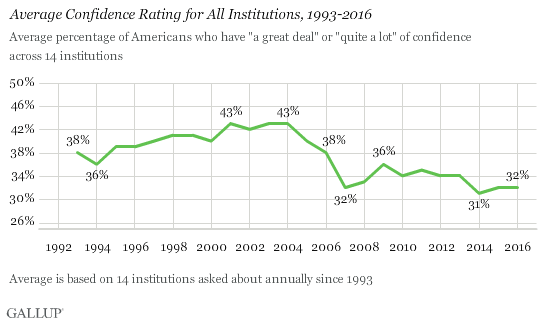
The most important finding is that Americans have less trust and confidence in our institutions than ever before, and have been in this state for three straight years. (See chart above.) The 32% average confidence level in all institutions measured was one point above 2016, which came in at a record low 31%, but that difference is not statistically significant. This is the third straight year that the number has been under 33%. That has never happened before.

I have written about this issue in the past (and discussed it with professional groups, like newly elected state legislators, in ethics seminars), with the same alarm. For a democracy to lack confidence and trust in its institutions portends disaster, and the danger cannot be understated. Of all forms of government, it is democracy that is most built on a foundation of public trust. This erosion in public trust—the average level of trust has fallen about 26% in just ten years—is collectively frightening. Look at the first line and the last in many of these charts: Continue reading