“Nothing personal, you understand. It’s just your dead son we’re angry at.”
Prime Minister Benjamin Netanyahu had vowed a harsh response to the recent terrorist attack on a synagogue in Israel by two Palestinians wielding meat cleavers and a pistol. Four rabbis and a policeman were killed in the attack. What does he consider “harsh”?
“I have ordered the destruction of the homes of the Palestinians who carried out this massacre and to speed up the demolitions of those who carried out previous attacks,” Netanyahu said.
Oh.
Yeah, I’d call that harsh.
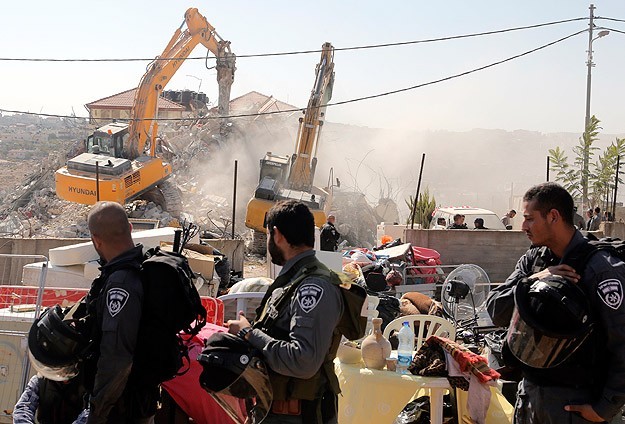
Hours after his announcement, Israeli forces razed the east Jerusalem apartment belonging to the parents of another terrorist youth, Abdelrahman Shaludi, who intentionally rammed his car into a crowd of pedestrians on October 22, killing a young woman and a baby. Shaludi was shot by police at the scene and later died.
There is no indication that Shaludi’s parents were complicit in the attack, except for, I suppose, spawning him.
Israel seems to think that’s justification enough.It had used house demolitions as draconian retaliation for years in the West Bank but ended the policy in 2005 after the army decided that the tactic had no apparent deterrent effect and made violence more likely rather than less. Hmmm…I wonder where the fact that the tactic is just indefensibly wrong figured in that calculation? It obviously isn’t on Israel’s ethical radar now, as the government has reinstituted the indefensible measure.
The Netanyahu government, says commentators, feels that it must show the Israeli public that it is punishing its enemies. But human rights groups are again condemning the practice, arguing that this is unjust collective punishment targeting not the perpetrators but their innocent families…which is exactly what it is. Continue reading

 Ethics Alarms