Ethics Dunce: Monica Lewinsky

Under that bus is Monica Lewinsky, and it wasn't Matt Drudge who threw her there.

Under that bus is Monica Lewinsky, and it wasn’t Matt Drudge who threw her there.

It truly pains me to have to write anything negative about Monica, who was exploited and humiliated by a President of the United States, and had her life permanently derailed because she trusted and even loved a rogue who regarded her as little more than an animated sex toy. Her re-emergence now, however—yes it is sad and desperate and makes me furious at Bill Clinton all over again—in the new guise of a “cyber-bullying” victim is intolerable, a delusion on multiple levels, despicable blame-shifting, and a welcome weasel-out of-accountability-free card for the Clintons. Yeccch.

I’m sorry for what happened to you, Monica, but you’re 40 now: it’s time to start seeing life more clearly—especially your own and the reasons why you are in the mess you are.

“Overnight, I went from being a completely private figure to a publicly humiliated one. I was Patient Zero,” Lewinsky said in a speech Monday to Forbes’s Under 30 Summit in Philadelphia. “The first person to have their reputation completely destroyed worldwide via the Internet.”

It has to take a near-fatal injection of self-serving historical air-brushing for the ex-intern to say this with a straight face, and it tells us volumes about the audience that it didn’t start throwing tomatoes:

  • She wasn’t a “completely private figure.” She was a woman having a sexual affair with the President of the United States while he lied about it—to his wife, his staff, and under oath (I haven’t covered all of the lying, either.) That makes her an individual who is engaged in conduct with tremendous public and official consequences who is only “private” because a powerful official is using his power to make it so. The proper term is “inevitable public figure waiting for the dam to break.”
  • The reason for her humiliation was and is William Jefferson Clinton, and no other. He is the one who described her as “that woman,” while denying what was true. He is the one who made his relationship with her part of a legal record while he was trying to avoid the consequences of another “bimbo eruption,” as his long-time “fixer” liked to call them.

Continue reading

Abuse-Enabling Author Leslie Morgan Steiner Buys A Berth On The Ray Rice Ethics Train Wreck

"So I guess that means that Roger can take a shot at you now and then, Right, Jessica?"

“So I guess that means that Roger can take a shot at you now and then, right, Jessica?”

As if we didn’t have enough Ethics Train Wrecks whizzing around—let’s see, there’s Ferguson, the I.R.S. cover-up, the Redskins, plus oldies like Penn State and Trayvon Martin still gathering riders, and the spectacular Obama Administration Ethics Train Wreck, which is guaranteed at least another six years of track—the Ray Rice Express is gather speed and passengers. It appears feminist, especially abused feminists, are leaping on board as the cars rumble by, and woe to him who is foolish enough to point it out.

Like me, I guess. Today the Washington Post opinion section carried a jaw-dropping essay by Leslie Morgan Steiner, the former Post editor and current author, the lesson of which, as I read it, is that no matter what a woman’s spouse of partner does to her, says to her, threatens her with, or hits her with, she is absolutely absolved of any responsibility or accountability for the harm that comes to her.This, we are told, is because, as Carol Costello (a fellow passenger) said regarding domestic abuse victims like Janay Rice, currently defending her abuser-husband, “It’s complicated.”

To show just how complicated,  Steiner presents a long list of the various hints she got from her lover-man that he might well just kill her some day, including…

Three months into our relationship, the night he choked me during sex and I wrote it off as weird but somehow erotic (for him; not for me).

The morning five days before our wedding when he first physically attacked me, because, he said with his hands around my neck, “you remind me of my mother.”

During our honeymoon, when he punched me so hard my head hit the window in our car…

The first time he threatened to kill our dog.

The first time he pushed me down a flight of stairs.

The first time he threatened to pull the trigger of the loaded gun he held at my head.

Steiner makes certain that she lets us know that she’s a Harvard grad, apparently believing that this eliminates the obvious response, “What an idiot! She also makes a point of noting that yes, once she too derided women who stay with abusive partners, as if this fact inoculates her against well-founded criticism. It doesn’t, and while I’m sure it’s complicated, she’s an idiot, at least in this critical matter.

Her reasons for staying in the relationship do not rebut these conclusions. They are..

  • “No one in my life had ever made me feel so safe, loved, beautiful and validated as he did during the early months of our relationship.” And do we keep, say, automobiles that we loved to drive in the early months that we owned them, after they prove themselves to be unreliable, expensive lemons? Is this a rational reason to do so?
  • “I thought I was the only woman who could help him face his demons.” Well, she might be the only woman willing to help him face his demons while regularly being abused by him.
  • “I confused pity with love, feeling sorry for him because he had been beaten and starved by his stepfather as a child.” This is so nonsensical that it defies argument. Would she feel similarly sorry for her rapist, her child’s molester? In what universe does pity excuse abuse? They taught her that at Harvard?
  • “In between the terrible times, he still made me laugh.” Gag me with a spoon.
  • “I loved him.” God, read “Oliver Twist.” See the musical “Oliver!.” if Harvard didn’t cover English fiction. You love people who beat you up? Or is it pity, like you said three sentences ago?

These aren’t reasons. These are delusions, self-destructive rationalizations, and lame excuses.

Yet somehow, the author thinks they are ennobling, and that anyone who dares to call this conduct what it is—idiotic, reckless, and irresponsible, and thus entailing some accountability for the results of making terrible and irrational choices, as with every other terrible and irrational choices all of us make—is missing some grand truth. No, we really aren’t. She writes,

I wish the world could give Janay Rice, and other victims of relationship violence, the dignity they deserve.

Instead of condemning her for loving a troubled man, let’s educate ourselves about the twisted psychology of abusive love, so that we can be there for her if she decides to leave. Firing Roger Goodell and blaming the NFL won’t do Janay Rice, or any other domestic violence victims, any good.

Rather, we should hold abusers — and no one else — responsible for the damage they inflict.

Wait, what? What’s dignified about letting a man dominate you, threaten you, abuse you and dehumanize you? Does the victim’s terrible reasons for putting up with abuse matter at all? Steiner’s are bad enough: I’m sorry, but I do not respect an intelligent woman who allows herself to be brutalized because “He makes me laugh.” Ah, how we chortled in that afterglow when he knocked in my teeth with that pogo stick! But I can imagine reasons that are less respectable: what if she likes it? What if she endures it because she likes the money more than she minds the pain? What if she wants to hit him at will,, even knowing that she will get the worse of the exchange? All of these reasons earn dignity? Nonsense. This is pure a  “war against women” war against logic: women can do no wrong. Sure they can.

I think the question of why men hurt the women they think they love is at least as bewildering as why their women stay with them. Doesn’t everybody wonder about this, including the abusers themselves? I’m sure the reasons for their conduct is also “complicated,” full of pain, self-esteem issues, childhood traumas, and more. Do the abusers deserve dignity too? Why not? Because they are men? Because they are the aggressors? Not necessarily, as we saw in the Rice Knock-Out Tap. Because holding a loaded gun to your lover’s head is crazier than staying with someone who hold a loaded gun to your head? Is it? I judge that competition a tie.

Steiner’s position isn’t just a self-excusing cop-out, it’s dangerous. It is exactly what abused women do not need to hear. “Just leave him on your own time, dear, when you are ready, and he no longer makes you laugh. Nobody will judge you. Just keep your fingers crossed that you don’t end up on a slab first.”

Alcoholics are in the grip of an illness, but they are told that they, and they alone, are responsible for saving themselves, and that if they don’t, they are responsible for that too. If someone refuses to leave a burning house because “she loves that house,” and “No house had ever made her feel so safe, loved, beautiful and validated ” and burns to death, is she absolved from responsibility for her foolish choice?

Ray Rice has no excuses, no mitigating circumstances, nothing, including his demons, that should shield him from legal punishment and societal condemnation. But Janay Rice, at this point, has no excuses either. We all are accountable for our choices. Women get no dispensation, and there is no dignity in a woman allowing a man to harm her.

_____________________________

Sources: Washington Post

 

Is There An “Almost Naked Lovely Lawyer Principle”?

cathy-mccarthy

Not really.

But it’s complicated.

Cathy McCarthy (above) is a 2013 graduate of Loyola Law School-Los Angeles, and she is sounding the clarion call for the right of bikini model-lawyers to be taken seriously. She wrote…

I graduated law school a year ago after receiving an academic scholarship and passed the California Bar last November on my first try. I am also a model and have had moderate success, building fan base of over 26,000 people where I do mostly bikini promotions. Does this make me better or worse at my job? According to some people, it makes me unable to be taken “seriously” in the business community. In fact, two weeks ago, I was reprimanded by a coworker for my online presence and was told to “handle the situation.”I fought back and was ultimately let off the hook, but this is not the first time that I have faced backlash from colleagues who think that a lawyer should not also get the privilege of “looking hot in a bikini.”

Unlike the case with primary and secondary school teachers, where a published presence on the web that is sexually provocative can interfere with a healthy student-teacher relationship, there is no automatic impediment to a lawyer client relationship posed by the lawyer moonlighting as a bikini model, a fold-out, or even a porn star. The profession acknowledges this in several legal ethics opinions affirming lawyers’ First Amendment rights. Lawyers can express themselves any way they choose, provided that it does not undermine their ability to represent their clients in any way. Continue reading

Unethical Quote of the Month: President Obama

The bottom of the barrel...

The bottom of the barrel…

“Stop being mad all the time. Stop, stop, stop just hatin’ all the time.”

President Obama at a campaign appearance, referring to the Republican House of Representatives.

This may be the most unethical statement I have ever heard any President say, to any one, ever…. Continue reading

PETA’s Unethical Treatment Of Human Beings

"You keep using that word, "ethics." I don't think it means what you think it does."

“You keep using that word, “ethics.” I don’t think it means what you think it does.”

From whence comes PETA’s compulsion to periodically make the organization look as unethical and/or deranged as possible? If I were not charitable by nature, I would say that it was because the leadership of the organization is constitutionally unethical, and nuts. I suspect that the real answer is close to that, but it’s not exactly right. I think that PETA’s concept of ethics begins and ends with “the ends justfy the means,” that they are so besotted with the rights of animals that they dehumanize people, and that arrested juveniles run the organization.

The latest jaw dropper from People for the Ethical Treatment of Animals is to use money to induce poor people in Detroit to comply with PETA’s vision of an ethical lifestyle. From the PETA website:

“With jobs in Detroit disappearing, many residents are struggling. As they’re forced to choose which bills to pay, the Detroit Water and Sewerage Department has chosen for them―shutting off water and leaving many people high and dry. The department put the shutoffs on a temporary hiatus, but people’s water bills are mounting. So with the help of a generous PETA member, we have come up with one small way to assist Detroit residents and save animals, too.Thanks to this donor, PETA will be able to pay off the water bills for 10 families who commit to going vegan for one month. We’ll also help them get started by giving each family a basket of healthy vegan foods and recipes.”

In other word, PETA is exploiting the most vulnerable citizens of the urban wasteland known as Detroit to turn them into human billboards for the group’s utopian vision of an animal-friendly world. Continue reading

Judges At Work

Supreme Court protests

In the threads here stemming from Judge Kopf’s impolite and unprofessional verbiage directed at the Supreme Court, some members of the Nebraska federal jurist’s fan club have sought to justify his incivility by asserting that the judicial system itself is “broken,” and that, more specifically, judges ought to just concern themselves with judicial errors of their lower court colleagues and eschew political controversies, such as, I must presume based on the context of the judge’s compliant, when the other branches of the government break laws and violate constitutional principles.

To say that I’m cynical about this argument understates the case.What it means, I believe, is that members of one partisan orientation believe that the system is broken as long as judges who do not share their progressive biases are in a position to rule on various controversies where judicial intervention is necessary and appropriate, but will no longer be considered “broken” once progressive-minded jurists are in a position to do the intervening, whereupon the critics like Judge Kopf will drop their objections.

The fact that the system is not “broken” and that judges are doing their jobs when called upon to protect the public from abuse of power was illustrated by two events this week: Continue reading

Ethics Dunce: Federal Judge Richard G. Kopf

"Oh dear...and he looks like such a NICE federal judge!"

“Oh dear…and he looks like such a NICE federal judge!”

Richard G. Kopf is a senior district court judge on the U.S. District Court for the District of Nebraska, and a blogger. He is also,I would say obviously, an Ethics Dunce. Why?

He told the U.S. Supreme Court to shut the fuck up.

He really did.

That he did this on his blog, Hercules and the Umpire, doesn’t matter. It was in print, in public, and he’s a Federal judge. The obscenity came in the context of Judge Kopf’s criticism of the recent Hobby Lobby decision, but the context doesn’t matter either. There is no context in which it would be appropriate, judicial and ethical for a member of the judiciary to tell the Supreme Court of the United States to shut the fuck up. Nor does it matter that he used the texting code stfu rather than spelling out the words.

For a Federal judge to be openly disrespectful, uncivil and abusive to the top of the nation’s judicial branch is an assault on the rule of law, and undermines public respect for our institutions. As lawyer and blogger Rich Hasen wrote, Continue reading

Kids On Leashes: Final Hypotheticals

kids on leashes2

Not to beat a dead dog, but while conversing about this surprisingly contentious issue (here, and here) on Facebook with the ever-thoughtful and provocative Lianne Best (Ethics Alarms congratulations go to Lianne for being honored by NARAL as an Outstanding Advocate For Choice), I realized that I should have posed one more hypothetical for the enthusiastic child-leashers to chew on, to wit:

“Have you ever seen anyone in public with both a kid and a dog on leashes simultaneously?”

Would you do that? And if you wouldn’t, why would having a child on a leash without the dog be any better?

To which Lianne countered with an even better hypothetical:

“How about a parent walking in public with the child on a leash but the dog walking along without one?”

____________________

Spark: Lianne Best

Graphic: Baby Cottage Gifts


On Liberals, Dignity, Dogs, Signature Significance and Toddlers On Leashes

But they LIKE it!

But they LIKE it!

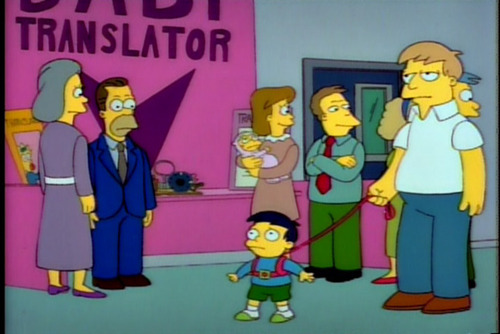
The damndest essays ignite furious debates here. I raised CNN’s mid-day quiz about parents walking children on a leash-–did I mention it featured a video of one mother dragging her prone harnessed child through a store like the kid was a sack of potatoes? I should have—-primarily because 1) it reminded me of “The Simpsons,” 2) because I was struck by the fact that ethics was never brought into a conversation that I would deem as concerning an ethics issue, and 3) because it was notable that CNN wasn’t talking about sunken Malaysian airplanes.

Still, I have been enlightened by the unexpectedly lively discussion, if not encouraged. In particular, this never struck me as an ideological issue, but it certainly seems to be one. Upon reflection, I should have predicted it, though this is not flattering to liberals.

I’ll return to this in a bit.

The defenses of the demeaning practice have been mostly pragmatic, which involves a utilitarian argument: “It works, and the ethical violations either don’t exist, or are too small to care about.” The most annoying defense so far has required  intentionally taking a statement in my post literally that also has an important figurative message, as well as misstating even the literal meaning, all to make it easier to dismiss the intended point. That’s some kind of record for straw men. Or would that be straw dogs? No, I think that’s something else.

The phrase in question was “whether it was fair, kind, respectful or right to treat your child like a cocker spaniel…” To make it easier to attack, my critic has changed that to “…to treat your child in a manner associated with the treatment of dogs.” Sneaky. It is true that dogs are typically kept on a leash, but that is only half the message, as fair readers will acknowledge. The term “treated him-her-them like a dogs/dogs” means, and has meant for a very long time, treating a human being in an inhuman, demeaning, humiliating, unkind, unfair fashion showing a lack of respect and making the human being in question miserable. The description has been used to describe both treatment that is seen in the treatment of actual dogs—such as substandard living conditions, lack of autonomy, domineering oversight, feeding of food not fit for human consumption, and in this case, use of a leash in public, as well as used to describe treatment that would never be literally possible with real dogs, such as too many typing assignments, refusal to give credit or bonuses for effective research, not allowing a family member a sufficient allowance, forcing a child to dress in old, outdated or unattractive clothes, etc. In the current case, both meanings apply, and focusing on just one is intentionally misrepresenting the issue.

As to whether the use of leashes on human children is demeaning, try this thought experiment: Would any white nanny dare to walk in public with two black children on a leash? How about the mother in a mixed marriage, in which the mother is blonde and the children are black? Would not the imagery of whites leashing blacks be inherently distasteful, regardless of the age of the African-Americans involved? Continue reading

Child Care Ethics And Leashes For Toddlers: CNN and Its Viewers Flunk An Ethics Alarm Test

Kids on leashes

It is constantly amazing to me that journalists so seldom identify obvious and critical ethics issues in the topics and events they cover. The rest is mixed emotions: this absence of ethics awareness is a serious culture-wide problem; then again, were this not so, I’d probably be in a different, and less stimulating profession.

Today I sat down to lunch as CNN engaged in a breathless discussion of whether using leashes on toddlers and even older children was a good idea, as it is either a growing trend among parents, or CNN was having a slow news day. The phone lines were open, and many viewers weighed in, with the primary camps expressing the following positions:

1. “If it makes children safer, then there is no reason not to do it. Safety is everything. Kids have been killed running into the street.  A leash will prevent that.”

2. “This shows the decline of child-rearing skills in the United States. If you can’t control your kid better than this, you are the problem.”

If the question of whether it was fair, kind, respectful or right to treat  your child like a cocker spaniel occurred to anybody in this discussion (I know the CNN staff never considered it), I saw and heard no evidence of this. Yet that is the central question, and it is an interesting one to consider. The fact that matters of human dignity, responsibility, respect, fairness, autonomy, kindness, proportion and prudence need to be balanced to answer the question at hand never came into the discussion, and those debating the issue demonstrated neither awareness of the competing ethical values, nor the ability to know how to employ them. Continue reading