The Fruit of the Poisonous Tree is a century-old legal doctrine that extends the exclusionary rule to make evidence inadmissible in court if it was discovered as a result of illegally obtained information or evidence. If the evidence”tree” is “poisoned,” so is its “fruit.” The doctrine was established in the 1920 case of Silverthorne Lumber Co. v. United States; Justice Felix Frankfurter gets credit for the metaphor from his 1939 opinion in Nardone v. United States.
There are three exceptions to the rule. The evidence will not be excluded if it was discovered from a source unrelated to the illegal activity, if its discovery was inevitable, or if the connection between the illegal activity and the discovery of the evidence is weak. The most famous example of the doctrine in action is probably “Dirty Harry,” where a mad serial killer is set free because detective Harry Callahan locates where the maniac had buried a girl alive by torturing him until he revealed the information..
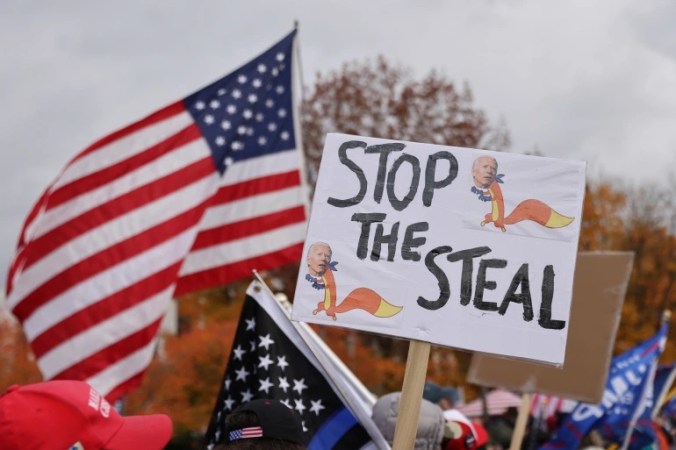
The “fruit of the poisonous tree” analogy has turned up in the Ethics Alarms comments and elsewhere on the web regarding a possible application to voter fraud in the 2020 election. The theory: even if enough votes in a particular state can’t be conclusively shown to have been fraudulent to change that state’s winner in the Presidential election, substantial proof of cheating by the party prevailing in that states’ voting ought to invalidate the result, since the vote total itself was the result of cheating, and the entire election is “poisoned.”
There is a lot wrong with the theory and the analogy, both from a legal and an ethical perspective.
“Ethical Amnesia.” This is the hypothesized malady that some researchers believe could explain instances of repeated unethical behavior by individuals prone to wrongful conduct. The theory is that painful memories of their previous unethical actions are suppressed unconsciously by the habitually unethical, preventing them from learning to be good.
I know, I know. It sounds like a lot of hooey.
Psychologists Maryam Kouchaki from Northwestern University and Francesca Gino from Harvard University designed nine separate studies with about 2,100 participants to test how selective their memories of past unethical acts were. They found that ethical actions (like playing a game fairly) were remembered more clearly than their unethical counterparts (like cheating at the same game).
Barry Bonds, for example, was unable to remember his days playing baseball for the Giants, after steroids had pumped him up like the Michelin Man, but was very clear on his days with the Pittsburgh Pirates, when he was lean, mean, and PED-free.
I’m late to the blog today, because I spent it giving a special program for the Smithsonian Associates called “From Stagecoach to Django Unchained: The Hollywood Western and Its Influence on American Values, Aspirations and Culture.” It consisted of me talking, a terrific Powerpoint presentation by the gifted Grace Marshall, and almost three hours of clips from classic Westerns—the whole session was five hours. My primary message is that anyone who is not literate regarding the Hollywood Western really doesn’t understand the myths and archetypes that powerfully influence U.S. culture to this day. Within that “anyone” are the majority of pundits and journalists, a large percentage of citizens under 50, and the vast majority of women and minorities. This is a problem.
For example, no one can consider the vast influence of the Western genre on American culture and be the least bit surprised that gun control has an uphill battle with the American public. No other culture has as its primary source of heroes, legends and lore figures and events so dependent on firearms as a means to right wrongs, protect the innocent, and punish evil. Frankly, if a pundit doesn’t understand why John Wayne (who died in 1979) just set a Harris poll record by being included in its annual list of top ten most popular movie actors for twenty consecutive years, from 1994 to 2014, I don’t think they can comprehend the nation sufficiently to opine on it.
Joe Biden, however, understands. I have been critical of Joe, as he is frequently an embarrassment, and there was a lot wrong with his comments today as he was honored with the “Voice of Solidarity” award by Vital Voices, a women’s rights charity, at their event celebrating “men who combat violence against women.” Still, Biden proved that whether he knows it or not, he is more atuned to U.S. culture than most of his colleagues. He deserves credit for that, if nothing else.
You see, Biden told a fascinating personal anecdote from his childhood. He related:
“I remember coming back from Mass on Sunday Always the big treat was, we’d stop at the donut shop…We’d get donuts, and my dad would wait in the car. As I was coming out, my sister tugged on me and said, ‘That’s the boy who kicked me off my bicycle.’ So I went home—we only lived about a quarter mile away—and I got on my bicycle and rode back, and he was in the donut shop.”
Biden said the the boy was in a physically vulnerable position,“leaning down on one of those slanted counters,” so he took immediate advantage:
“I walked up behind him and smashed his head next to the counter.His father grabbed me, and I looked at his son and said, ‘If you ever touch my sister again, I’ll come back here again and I’ll kill your son.’ Now, that was a euphemism. I thought I was really, really in trouble… My father never once raised his hand to any one of his children—never once—and I thought I was in trouble. He pulled me aside and said, ‘Joey, you shouldn’t do that, but I’m proud of you, son.’”
The lesson, Biden said, was that one should to “speak up and speak out” to correct wrongdoings. Like much of what come out of Biden’s mouth, this was nonsense in the context of his own story, and was not what the lesson was at all. The lesson was that force, punishment, violence and intimidation is sometimes necessary to stop bullying, discourage misconduct, protect the innocent and vulnerable, set standards, and give more than lip service to core values. Little Joey Biden didn’t “speak up”: he bashed a bully’s head and threatened to kill him. Apparently it worked, too. America, Americans, the culture and our history—as well as the Duke–have long believed that sometimes violence is necessary to stop violence, and send important messages, and can therefore be virtuous and ethical. Biden understood that when he was ten, and somewhere deep in that mess of mush he calls a mind, he understands that now. Continue reading →

 Ethics Alarms