Do We Really Want To Live In A Society Where Tow-Truck Drivers Refuse To Tow The Cars Of Bernie Sanders Supporters?

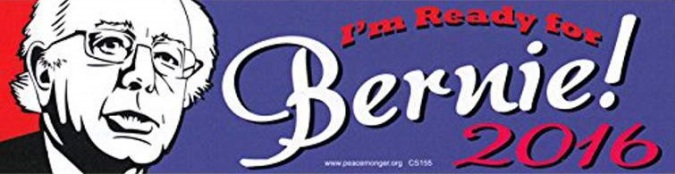
Bernie Sticker

In Ashville, North Carolina,  tow truck driver Ken Shupe arrived on the scene to find motorist Cassy McWade standing by her accident-disabled vehicle  on Interstate 26. “He goes around back and comes back and says ‘I can’t tow you,” Wade told a reporter. “My first instinct was there must be something wrong with the car. And he says, ‘No, you’re a Bernie supporter.’ And I was like wait, really? And he says, ‘Yes ma’am,’ and just walks away.”

Here’s Shupe’s version:

“Something came over me, I think the Lord came to me, and he just said get in the truck and leave. And when I got in my truck, you know, I was so proud, because I felt like I finally drew a line in the sand and stood up for what I believed.”

A few quick points and then I’ll get to the real issue:

1. Shupe is an utter, virulent, IQ-deficient jerk whose conduct and attitude makes a mockery of whatever faith it is cursed to have him belonging to it, and constitute a blight on the society, community,culture and nation so unfortunate as to be stuck with him.

2. News reports make a big deal out of the fact that McWade is confined to a wheelchair. Ah: the theory is that we are only obligated to help our handicapped neighbors in need, is it? It shouldn’t matter if she was an Olympic medalist in the 50 yard dash. You don’t treat other human beings like that in any society that values human rights and common decency.

3. Shupe’s company is Shupee Max Towing in Traveler’s Rest, South Carolina. Nobody in their right mind should patronize this unAmerican creep, including his own family. This was anti-social,  cruel and objectively horrible behavior toward someone in need, and Shupe needs to be shunned, hard. If he can’t co-exist with others any better than this, he needs to live in a cave somewhere, because he’s not fit for human association.

4. To anticipate an objection: you may ask how it is that I can argue that friendship should outweigh political differences and advocacy of unethical conduct, and yet designate Ken for ignominy and rejection. If Ken were a friend of mine, I can see myself standing by him even after this miserable behavior. But, as Samuel L. Jackson tells John Travolta in “Pulp Fiction,” “We’d have to be talkin’ about one charming motherfucking pig.”

In a way, however, we should be grateful to Ken Shupe, who has provided in short order and timely fashion a near perfect example of the society-wrecking virus being actively spread by irresponsible zealots on both ends of the political spectrum who are determined to divide the nation and the culture as never before. Yes, never before. During the American Civil War, generals on opposite sides of some of the most bloody battles ever fought arranged to meet and exchange pleasantries, because they had been, and remained, friends. They understood what the self-righteous tow-truck operator, and, increasingly, our entire society, doesn’t. Continue reading


Finally There’s Name For The Conduct I’ve Been Calling Unethical For Years…Now Let’s Agree To Stop It

eclipse

That name is “partyism.”

From Harvard Professor Cass Sunstein:

“…party prejudice in the U.S. has jumped, infecting not only politics but also decisions about dating, marriage and hiring. By some measures, “partyism” now exceeds racial prejudice — which helps explain the intensity of some midterm election campaigns. In 1960, 5 percent of Republicans and 4 percent of Democrats said that they would feel “displeased” if their son or daughter married outside their political party. By 2010, those numbers had reached 49 percent and 33 percent. Republicans have been found to like Democrats less than they like people on welfare or gays and lesbians. Democrats dislike Republicans more than they dislike big business.”

Based on what I’ve seen, the fact that Republicans/conservatives  are nearly twice as likely to be “partyists”  as their hated enemies to the left on the political spectrum doesn’t surprise me. Most of the manifestations of the bigotry I’ve seen out in the open and written about here—restaurants that give discounts to praying customers and bars that claim that they will only serve “red voters”—have come from that sector, but 33 percent isn’t anything for liberals to be proud of, either. Over all, the trend is horrible for the country. As I wrote regarding “Mary’s,” the restaurant that favored its religious customers…

“I detest this kind of thing, and so should you, because it is ethically indefensible and un-American to the core….splitting the world into them and us, good guys and bad guys, the virtuous and the reviled. All of “Mary’s” customers are human beings, and that is the only thing that should matter in the United States of America.”

I confess that since I have been observing this phenomenon, I am preconditioned to think the Stanford research that purported to measure it as has validity. Most social science research, especially involving politics, is so skewed by researcher bias and agendas that it is inherently dubious, and perhaps this example is too: I wouldn’t rely on the percentages. Also 1960 would have to be the absolute low water mark in U.S. political passions, after the remarkably non-partisan, unifying two terms of Dwight Eisenhower while the public felt united against a common enemy in the Cold War. I’m guessing the numbers in, say, 1860 would show a sharper divide.

I do think that the intensity of emotion, rising to bigotry, distrust and hate, in the nation’s political polarization is growing, is very alarming, and dangerous to our health and future. I’d like to know more about where it resides. Is the bulk of the bigotry coming from the low-information voter, who uncritically absorbs every campaign smear, bumper sticker insult and Facebook meme as fact—you know, morons? Or are the individuals who would rather die than see their daughters marry men who oppose the family’s favorite party the narrow-minded political junkies who watch only Fox News and listen to Rush, or who cheer Al, Chris, Rachel and the 24-7 conservative-bashers on MSNBC? I’d like to know.

Naturally theories will abound regarding the reasons for this new bigotry. In a general sense, it is pure cognitive dissonance, and can be explained by people today caring more about politics and ideology than they have for quite a while. People care about something when they sense that it matters to their lives, health and welfare, as well as those around them: if political views were regarded as no more important than what baseball team one rooted for, there is no way substantive bigotry would attach to them. With foreign threats looming, the economy weak, nobody certain of the right policies in so many crucial areas and the pettiness, corruption and ineptitude of parties in and out of power, trust has plummeted. When we can’t trust those whom we have given the job of looking out for our welfare, we become worried and scared, as well we should. Then it makes sense to care more about politics. If we care more, and feel strongly about what should be done either out of a lack of sophistication and gullibility (the morons) or from unbalanced self-education (the zealots), then those who proclaim opposing views seem more obnoxious and more threatening, prompting active discrimination. The Stanford study found that “discrimination against the out-group is based more on out-group animus than in-group favoritism.” That figures. But for a nation, it is suicidal.

This nation of ideals gleaned from a diverse population must value trust and belief in what all citizens share more than it embraces passion and anger over what we disagree over. If we cherish the basic principles of democracy, then we must accept, encourage and respect dissent, frank speech, the shocking opinion and the minority view.  We must always keep our minds open to new ideas, different solutions to old problems, and the possibility that we, or the public officials, scholars and pundits we favor, may be wrong on any one topic or issue. If we can’t do that, we doom ourselves and our culture to self-righteousness, doctrine, cant  and rigidity, which block out enlightenment like an eclipse blocks sunlight. Continue reading

Noted: A Familiar Debate Over At Slate

battle-marvel

Those who participated in the epic, star-studded battle in February here, led by the departed Bruce Bartup, over what are acceptable levels of intensity and personal attack on Ethics Alarms, will experience some nostalgia reading this debate on Slate about the website’s policies. My favorite line: “…if someone is a dick, and we’ve explained that he’s a dick, why shouldn’t we also call him a dick? He’s earned it!”

If you missed Bruce’s Lament and the terrific donnybrook it generated (sadly, Bruce took his bruised feelings and went home to the British Isles, though I urged him to persevere) can read his Comment of the Day and the responses to it here.

___________________________

Graphic: kiss my wonder woman

Comment of the Day: “How People Rationalize Being Close-minded: A Case Study”

battle-marvel

The Ethics Alarms resident humanist, Bruce, has filed a passionate brief condemning the sometimes rough debate on Ethics Alarms, and, in some ways, the blog itself. This is the latest volley in an ongoing thread that has jumped around from multiple posts: my fault, because I keep raising the issue in various ways. I would normally append some reactions at the conclusion of such direct criticism, but it’s a busy day, so I’ll have to put them in the comments to Bruce’s post later, with this exception.

The Ethics Scoreboard, which was not a blog but a website, embodied Bruce’s suggestion of radically fewer posts, more carefully considered and proofread. I am proud of a lot of the work there, but the format was limiting. The goal of Ethics Alarms is to try to inject ethical considerations into the national analysis and discussion of daily events, including politics, that need them but hardly ever receive them, because, sadly, most commentators are either uninterested or incapable of it.  The reason I chose a blog format is that these issues are time-sensitive, and if I am to have even a wisp of a chance of elevating the discussion and encouraging valid analysis of right and wrong, I have to strike quickly, or I might as well be writing about the ethics of the Spanish American War.

Jeffrey Field, my favorite Occupier who often weighs in here, periodically sends me a note that says “Slow down!”  I appreciate that, and take it to heart. Nonetheless, when the news media was (lazily? maliciously?) misrepresenting the meaning of David Wildstein’s lawyers’ letter regarding Chris Christie’s involvement in the George Washington Bridge affair, and I could find nobody who was pointing out what miserably unethical journalism this was, I had to write about it immediately—and, frankly, Ethics Alarms readers were ahead of most of the public. A little later, the New York Times, for example, had to tune down its characterization of the document.

I know my analysis is not always air tight, but I’m not trying to end discussions, but begin them. I wish I could do ten posts a day.

Here’s Bruce, and his Comment of the Day on the post How People Rationalize Being Close-minded: A Case Study”: Continue reading

How People Rationalize Being Close-minded: A Case Study

close_minded

For “close-minded,” you can substitute ignorant, knee-jerk partisan, misguided, arrogant, stupid, reckless,naive, easily-manipulated, or just stubbornly wrong.

I owe Ethics Alarms expatriate Barry Deutsch for pointing me to this; on weekends I often check out the blogs and websites, and sure enough, on his own blog Alas! Barry was once again discussing the issue that was in part responsible for his contentious departure here—the issue of how comfortable on-line forums should be for participants. Though Barry has his own—typically nuanced, too-equivocal for my tastes—views on the topic, the post I want to feature is one he linked to, a blog called Apophemi. In a post about why the blogger avoids participating on the so-called “rationalist” forum “Less Wrong,” which appears to be a major source for the writers of “Big Bang Theory,” he argues for, as translated by Barry and others—he needs a translator—“safe places,” meaning web forums where certain ideas, topics and positions will not or cannot be discussed. He writes (I warned you, remember);

“I am reasonably confident (insert p value here) that this attitude is self-replicating among people who are accustomed to being at risk in a specific way that generally occurs to marginalized populations. (I cannot speak for people who may have a similar rhetorical roadblock without it being yoked to a line of social marginalization, other than that I suspect they happen.) This would mean that rewarding the “ability” to entertain any argument “no matter how ‘politically incorrect’” (to break out of some jargon, “no matter how likely to hurt people”) results in a system that prizes people who have not been socially marginalized or who have been socially marginalized less than a given other person in the discussion, since they will have (in general) less inbuilt safeguards limiting the topics they can discuss comfortably. In other words, prizing discourse without limitations (I tried to find a convenient analogy for said limitations and failed. Fenders? Safety belts?) will result in an environment in which people are more comfortable speaking the more social privilege they hold. (If you prefer to not have any truck with the word ‘privilege’, substitute ‘the less likelihood of having to anticipate culturally-permissible threats to their personhood they have lived with’, since that’s the specific manifestation of privilege I mean. Sadly, that is a long and unwieldy phrase.) Environments for discourse which do not allow/encourage what I’m calling “discourse without limitations” are frequently (that I have seen) trash-talked in the context of environments which do allow/encourage that type of discourse.”

I guess this would be “trash-talk,” then: Apophemi is rationalizing echo chambers, close-minds and intellectual laziness. Continue reading

Ethics Tales Of Three Governors, As Hope Slowly Dwindles

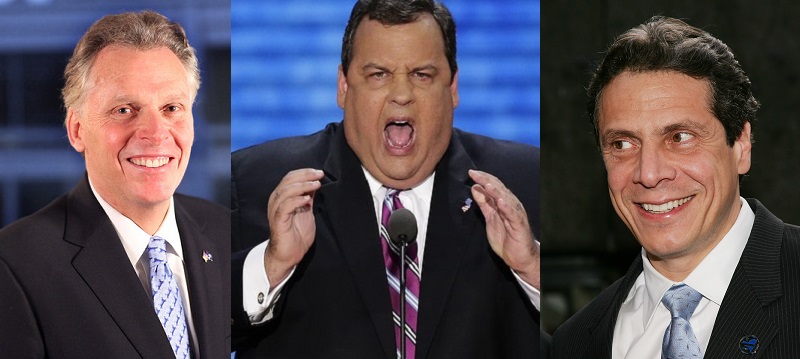
McAuliffe-Christie-Cuomo

The U.S.’s recent experiment with a Senator-President has been disheartening—persuasive words unhinged to action and actual principles. There was a remarkable example of this in the President’s NSA speech, in fact, in a quote that would have been the Ethics Quote of the Month had it not been so cynical coming from him. The President said

“Given the unique power of the state, it is not enough for leaders to say: Trust us, we won’t abuse the data we collect. For history has too many examples when that trust has been breached. Our system of government is built on the premise that our liberty cannot depend on the good intentions of those in power; it depends on the law to constrain those in power.”

Wonderful! If only this had been uttered by a leader with credibility and integrity, rather than one who has shrugged off, firing no one, interference with the federal election process by the IRS, illegal spying by the NSA, and the intentional facilitation of illegal firearms coming into the murderous hands of drug cartels by his Justice Department, after bombing Libya illegally in defiance of law, selectively enforcing immigration laws, using drones to kill American citizens abroad without due process, making recess appointments when the Senate wasn’t in recess, and more recently, unconstitutionally amending the ACA on his own after it was signed into law.

This was all foretold, however. Community organizers and senators make speeches and inspire people, but unfortunately seldom have a clue how to actually govern unless, as Obama himself has wistfully noted, they have absolute power. This is why, in theory, at least, state governors, who at least have experience governing, now seem like a better recruitment field for the next occupant of the Oval Office. It sounds good in the abstract, but the recent news from the state houses  is like ice water in the face—-

Ethics Train Wreck Chronicles: Villains, Victims, Hypocrites and Unlikely Heroes In the Contraception / Limbaugh / Fluke Debacle

If this isn’t the Ethics Train Wreck of the Year, we have something truly horrible in store for us down the line. A no-so-brief brief re-cap:

  • The Obama Administration announces that church-run institutions like hospitals and universities will still be required to offer insurance coverage for abortions, sterilizations and other medical matters that might be in direct opposition to church beliefs. It’s a cynical move, designed to cater to the Democratic base at the expense of religious institutions. It is also irresponsible, since it jeopardizes the huge proportion of medical services performed by church institutions.
  • Conservatives scream that the measure is a breach of religious freedom. The is either ignorant or a lie. The Constitution has no provision requiring the government to make special accommodations for churches or church-operated institutions.
  • Caught by surprise by the intensity of the backlash, the Administration crafts a “compromise,” which is essentially deceitful sleight-of-hand, form over substance. The insurance companies now have to provide those services but the religious institutions don’t have to pay for it. But of course they will, through increased premiums elsewhere.
  • Flagging the deceit, Republican attacks on the measure continue. Democrats successfully frame the debate as a conservative attack on contraception, which it is a misrepresentation, and a “war on women,” which is ridiculous and unfair. The issue is churches being forced to provide or pay for services that violate their faith—which the government has every right to do.
  • The controversy activates GOP presidential candidate Rick Santorum, who is a fringe extremist in sexual matters and toes the Roman Catholic line. He really thinks birth control is immoral. This position, which is unethical, is suddenly given exposure it doesn’t deserve in the 21st Century Continue reading

Unethical Quote of the Week: Slate’s J. Bryan Lowder

“What’s more interesting is his complete refusal to recognize that the uproar around his statements isn’t just about name-calling, but rather his offensive misunderstanding of the importance and uses of birth control. As I wrote on Friday, Fluke’s own testimony was not about her sex life, but rather the painful experience of watching a friend who was forced to have an ovary removed because she couldn’t afford the pill, which, of course, has many medical uses aside from contraception. Many women depend on birth control, not for “social activities,” but for their basic health. And it is in light of his abject ignorance of female biology that Limbaugh’s willingness to demean a woman becomes truly outrageous. This apology only brings that ignorance into sharper relief”

—-Slate blogger J. Bryan Lowder, arguing that the outrage over Rush Limbaugh’s attack on law student Sandra Fluke was not just  because of his cruel and inappropriate denigration.

"Yeah, yeah, the name-calling wasn't cool, but what really ticks us off is that you don't acknowledge that we're right and you're wrong!"

Perhaps I ought to applaud Lowder for his candor, but if sincere, then this is an admission that some of the furious effort to punish and silence Limbaugh is motivated by his opposition to Fluke’s position—that contraception must be paid for in church-run institution health plans. Reminding readers that I a) wrote that the Administration was correct to require such institutions to obey the current laws like everyone else, and b) believe that Limbaugh crossed all lines of decency, fairness and civility in his attacks on Fluke, I find Lowder’s statement a blatant admission that he and his political allies aim to purge dissenting opinions from the media and the public square through intimidation, as well as a confession that the outrage over Rush’s insults was, at least by those who think like the blogger, a cover for the real objective: punishing someone for not bowing to progressive cant. Continue reading