For breedism read racism, for the illogic, bias and cruelty is the same. PetSmart, the nation’s predominant retailer of animal companion products, and one that has built its image, brand and success on being dog-friendly (customers can bring their furry pals on leashes into the stores), engages in the ignorant and deadly practice of anti-pit bull prejudice. Their customers should make it very clear to the company that its unethical and irresponsible stance will not be tolerated.
I’m not going to tolerate it, not because it will make a difference to PetSmart, but because I couldn’t look my dog in the eye again if I didn’t. Continue reading →
Pet dogs are more than property and less than citizens. When they become surrogate children, as they often do, the legal battles over which member of splitting couples will have custody can become as furious and emotional as anything in “Kramer vs. Kramer.” Now the Vermont Supreme Court has approved a a new approach to these cases, deciding one on the basis of “the best interests of the dog.” Here is the relevant portion of the decision, in the case of Hamet v. Baker:Continue reading →
I don’t know what kind of a person Darren Wilson is, and I don’t know if he was justified in shooting Mike Brown. But it there is increasing anecdotal evidence that a lot of police officers have a cruel, vicious and callous streak as evidenced by their attitudes toward animals, and to me, this suggests that are a lot of people in uniform with the authority to use deadly force who should not be police officers at all.
Jonathan Turley highlighted two nauseating cases in recent days.
The first unfolded in Baltimore, when Nala, a young Shar Pei, escaped from her owner’s yard over the weekend and a neighbor tried to check the dog’s tags. Don’t try this with unfamiliar dogs that might be stressed, everyone: Nala snapped at her, causing a minor wound. The neighbor then summoned police to deal with the dog, though she has acknowledged that the bite was her own fault, and Nala was just frightened.
The police and took control of Nala using the long dog-control pole. The neighbor reported that the two police officers abused the dog without cause in the process, twisting its neck and hurting her. One officer kneeled on Nala’s chest, causing her to whimper in pain.
They were just warming up.
Officer Jeffrey Bolger then said, according to multiple witnesses, “I’m going to fucking gut this thing.” As the neighbor and others watched in horror, Bolger pulled out a knife and slit Nala’s throat while Officer Thomas Schmidt held her down. Witnesses say that the dog was already immobilized against the ground and was posing no threat. Animal cruelty charges have been brought against both Bolger and Schmidt.
The Washington Post informs us that greyhound racing, a once popular form of gambling that as recently as 1991 brought in $3.5 billion and was operated at more than 50 tracks in 15 states, is in freefall and headed to oblivion. Betting on the dogs netted only $665 million in 2012, and just 21 tracks remain in seven states, with some of them already on borrowed time. Any decline in state sanctioned gambling is good news (yes, I am shedding no tears over the closing of one casino after another in Atlantic City, even the ones not owed by Donald Trump), but dog racing was always a particularly unsavory and unethical breed of the malady. Good riddance. The sooner that last greyhound has chased his last mechanical rabbit, the better off we are.
I have a bias here, it is true. My uncle, the youngest brother of my mom, was addicted to dog racing in Massachusetts, where the “sport” was banned in 2010, but not in time to save Uncle Charlie. He had a wife and two sons, and worked hard as a truck driver, but threw away an unconscionable percentage of his limited resources betting on racing canines. Maybe he would have crippled his prospects and harmed his family by finding other ways to waste his money if there had been no greyhound racing; probably he would have. Nevertheless, it was this corrupt, ugly, stupid gambling industry that wrecked his life. I hate it.
Dog racing was initially linked to allowing slot machines, another evil beast, to become legal, as little by little—first lotteries, then casinos—the states abandoned their ethical duties to embrace the cheap income that could be made by enticing the poor and the stupid to blow their paychecks on false hopes of a big jackpot. One they were hooked on the instant gratification of video poker and credit card one-armed bandits, however, greyhound racing became too slow a method of losing money. “It’ll take you half an hour to lose $50 at a racetrack. You can do it in five minutes sitting in front of a slot machine, ” said an insider interviewed by the Washington Post. This is called progress. Continue reading →
The rescuer and the rescued (photo from KERO, Bakersfield)
You may have seen this video already, but as I may never again have the opportunity to honor a member of one of nature’s least ethical creatures for exemplary ethical conduct, here is the amazing tale of Tara the Cat.
In Bakersfield, California, four-year-old Jeremy Triantafilo, who is mildly autistic, sat on his bicycle outside his family’s home when the neighbor’s chow-labrador mix, who “doesn’t like children or bicycles” according to his owners, escaped the yard through an open gate , saw the boy, and attacked him. Surveillance footage shows the dog grabbing the boy’s leg and pulling him to the ground, and beginning to shake him. The Triantafilo family cat, Tara, saw the attack and charged to the rescue, leaping on the dog and chasing him off.
The boy’s father posted the video of the jaw-dropping episode to YouTube, and you can see it below.
I have had cats and lived with cats, and one cat in particular, my wife’s Siamese, broke my heart when he died. Nonetheless, cats are nature’s sociopaths, charming but ultimately self-centered, cruel and lacking in empathy. They are not pack animals or group oriented, and “loyalty” is not one of the characteristics that anyone would say distinguishes the species. There is a reason why the film “Cats and Dogs,” which posited that the two rival creatures were really alien races of superior intelligence secretly battling for dominance on Earth, cast the cats as the villains. Cats can’t be trusted, and there is no such thing as an ethical cat.
Or so we have always been told.
Tara (the video is not a hoax) is either an outlier, or this is just one more example of how scientists don’t understand animals as much as they think they do. She clearly places herself in danger to rescue the most vulnerable member of her family. The cat assessed what was happening, set out to rescue the child, and did it efficiently and well.
I have never heard of such a thing. There are other YouTube videos that show cats engaging in ambiguous conduct that is termed a rescue, but such episodes always involve the cat protecting itself or its general vicinity from an intruder. At first, I thought Tara’s video was staged, like “The Incredible Journey.” So far, it doesn’t appear to be.
Thus we have to conclude that, contrary to lore, conventional wisdom and propaganda from the Ministry of Dogs, cats—some cats, one cat, this cat—are capable of conduct that in a human we would regard as altruistic, ethical and courageous acts. Tara not only rescued a little boy from serious harm, she also elevated the status and reputation of cats everywhere.
If you ever want to explain the concept of signature significance in ethics—how one act can be sufficient evidence to make a fair and valid judgment about someone’s character—to a friend or colleague, this story should do the trick.
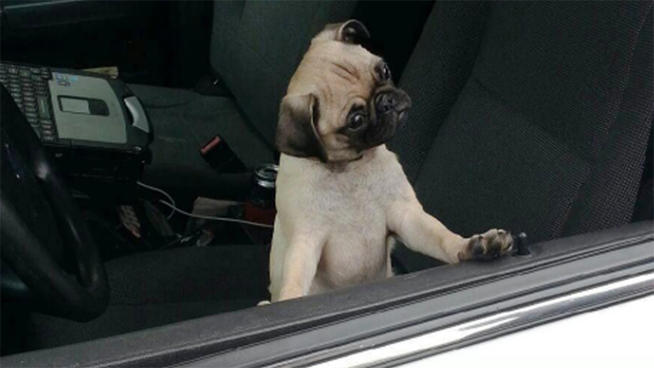
In California, a kind woman named Shawna Hamon heard about a 7-year-old girl with leukemia whose Christmas wish was for Santa to bring her a pug puppy. So Hamon bought a pug puppy, and gave it to a friend who promised to deliver the little dog to the girl in Sacramento in time for the holidays.
The puppy never arrived, however. The friend decided to keep it for herself. Hamon sent an animal delivery service and an attorney to the woman’s Los Angeles home, but the woman refused to give the dog back. Then Hamon filed a theft complaint and police got a search warrant to search the home, but found no pug puppy. After searching some other nearby homes, they eventually found the little dog at a neighbor’s house, where the pug-napper had hidden it.
Hamon now has the dog back, and learned her lesson. She will deliver it herself this time, a bit late, to the sick little girl. The child is currently receiving experimental treatment for leukemia in Philadelphia.
Now, what are the chances that the woman who took the dog, a desperately sick child’s Christmas gift, for herself, and foiled the compassionate act of a friend in the process, was just having a bad day, just made one mistake, really is a fine, upstanding, trustworthy individual and can’t be judged conclusively as an unethical cur (no offense, puppy…) based on this one incident, because a single episode has no statistical and predictive significance?
Janet Sinclair used United Airlines’ “PetSafe” service to fly her beloved greyhound Sedona cross-country from San Diego. The service assures flyers that their pets will make the journey safe and sound, with responsible care and personal handling. Sinclair, however, became alarmed when she saw a United employee kick Sedona’s crate six times to shove it under the shade of the plane’s wing instead of carefully moving it. She then began documenting United’s pet care. Her video shows her dog being left outside in 94 degree heat at a mid-journey stop (in Houston), and not placed in a temperature-controlled vehicle as she had been promised. When Sinclair landed at Logan Airport in Boston, her dog was barking at death’s door.
“Sedona’s entire crate was filled with blood, feces, urine,” Sinclair told reporters. “Sedona was in full heat stroke. All of the blankets were filled with blood. She was urinating and defecating blood. She was dying, literally, right in front of me.” The veterinarian who saved Sedona diagnosed her with heat stroke, urinary tract infection and liver dysfunction, all arising from the over-heating the dog experienced during the United Airlines flight. The airline, for its part, claimed that the dog’s distress was due to pre-existing conditions, though Sinclair’s vet had declared Sedona healthy following a pre-trip exam. Continue reading →
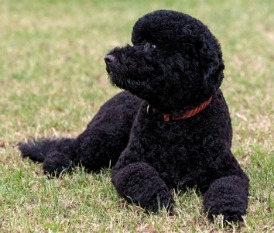
One aspect of being President that cannot be much fun is knowing that anything you do in your very public private life has the potential of permanently altering the culture, like the book about Chicago gangster days left on the developing planet in a famous episode of “Star Trek.” President Kennedy didn’t wear hats because of his bodacious hair (all the better to shag those young girls), and ruined the U.S. fedora trade. Bill Clinton announced that oral sex wasn’t sex after all, and millions of U.S. junior high school students took the hint. Now President Obama and family are being called poor role models because they adopted a new pure-bred puppy from a breeder rather than finding an appropriate rescue dog, as animal welfare activists constantly urge us to do. Continue reading →
I’m sure PETA thinks this is fair; I’m not sure that I do.
No goldfish for you!
Tammy Brown,47, a disabled Moon Lake, Florida woman trying to make ends meet on her $508-a-month government check, argued that she was not able to afford veterinary care for Harley, her 14-year-old dog who had a painful ear infection as well as skin problems, periodic tumors, heartworms and ear mites. Because she did not get treatment for Harley, however—the fact that she tried to treat the dog’s problems with over the counter ointments wasn’t enough to mollify the judge— Brown was convicted of felony animal cruelty. She spent more than a month in jail awaiting sentencing, and then received six months of house arrest, 300 hours of community service, three years of probation, and $1,000 in court costs. Circuit Judge William Webb also commanded, “I don’t want you to own any animals. Not even a goldfish!” (Hartley had been euthanized.)
Apparently Harley’s physical condition was shockingly poor, so much so that jurors found photos hard to look at. An Animal Services officer testified that Harley couldn’t stand up without support. The prosecutor wanted Brown imprisoned.
Has society become so animal-sensitive that it has lost its priorities? Your Ethics Alarms Ethics Quiz is this: Assuming that Harley’s lack of treatment was due to lack of resources and neglect rather than malice…
Was Tammy Brown’s sentence fair, or was it excessive and cruel? Continue reading →
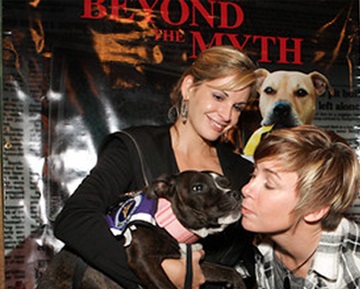
“Beyond the Myth” is a 2012 documentary that provides a vivid, troubling and often moving account of “breed specific legislation” in the U.S., which primarily involves states and municipalities banning “pit bull-like dogs,’ a.k.a. “vicious dogs,” though the dogs such legislation targets are usually not vicious and often are not even pit bulls. If you are one of the misinformed who have been convinced by biased reports and public hysteria that pit bulls are any more dangerous or vicious than any other breed, you owe it to yourself, your children, and the dog owners in your community to watch this film, which is available on Netflix.
Long-time readers of Ethics Alarms know that the site has visited the issue of anti-pit bull cruelty and bigotry frequently, most recently here. For those who have read and absorbed what I have written and the references I provided, there will be much that is familiar in “Beyond the Myth,”; nevertheless, I found the documentary shocking. I had no idea how pit bull bans worked in cities like San Francisco and Miami, with Gestapo-like raids on private homes culminating in harmless and beloved family pets being confiscated and slated for death if a police officer concluded that they have “5 out of 8” physical traits identified with pit bulls. Nor was I aware of how many of these dogs were being euthanized—tens of thousands every year—for being born with a broad head or a deep chest that meant they were legally branded as “vicious.”
The stories of the individual dog owners who have organized, lobbied, sued, and in some cases had to move out of their homes to protect a loving canine companion are also inspiring, if astounding. Wounded veterans have even had their service dogs taken from them. The most illuminating aspects of the documentary, however, are: Continue reading →






 Ethics Alarms