Ethics Quiz (Movie Division): “The Impossible,” Whitewashing, and Betrayal

"Bennett" and Belón

“Bennett” and Belón

I suppose some of you may have thought about this two years ago, when the Spanish film “The Impossible” was first released. I, however, take a while to catch up with my movie-viewing, and though the film was much praised by critics and got Naomi Watts an Academy Award nomination, I had not seen the film until recently. “The Impossible,” about as accurately as a motion picture can, tells the amazing story of how Spanish physician María Belón, her husband Enrique Álvarezs, and her three young sons miraculously  survived the 2004 Indian Ocean earthquake and tsunami when the family was on vacation in Thailand.

It is an engrossing, harrowing movie. I was surprised to find out, however that the family’s name wasn’t “Bennett,” and that they weren’t British, as the movie presented them. Apparently to maximize box office receipts, the film makers decided to take the heroic story of a real family and make the characters “more relatable” by recasting them as English-speaking Brits. There was a minor controversy about the film “whitewashing” the story*, but not much of that made it into the mainstream media. Belón, after all, is white. She was an active participant in the appropriation of story and that of her husband and sons, and they all profited from it, at least financially. Still, the movie’s point of view left a bad taste in the mouths of some international critics. Here is Australian critic Ruby Hamad:

“Based on the true story of a dark haired and darkish-skinned Spanish family, the filmmakers admitted to changing their nationality and casting lily-white actors in order to make the story ‘universal’. In other words, only white people can stand in for the human race as whole. For this reason, Thailand and its people are mere backdrops for the story of a Caucasian family who learn the hard way that even western privilege is no match for the brute force of mother nature.”

Your (two-year late) Ethics Alarms Ethics Quiz, therefore, is:
Is “The Impossible” unethical”?

Continue reading

Comment of the Day: “Print the Legend Ethics: The War of the Worlds Panic”

war_worlds

Bravo and thanks to penn for a thoughtful and thought-provoking personal reminiscence that supports my recent post about the claim that the famous panic over Orson Welles’ famous 1938 “War of the Worlds” radio drama never happened. Here is his fascinating Comment of the Day on Print the Legend Ethics: The “War of the Worlds” Panic:

This story came up every Hallowe’en in my family as I was growing up. We had family living in Toms River and in Lakewood, NJ (about 35 miles from Grover’s Mill) at the time Orson did his thing. The different reactions to the broadcast by the people living in the two places resulted in a minor family schism which continues to this day in the attitudes of their descendants.

It was a city mouse/country mouse situation. The Lakewood adults were elementary school teachers — the sophisticates. They listened to that program as a matter of course and as they later reported, they declared this one silly from the very beginning. But then, all science fiction was silly to them (really! space ships and aleeums? pshaw!) — my father (it was his side of the family) always contended they had no imagination. My mother recalled, however, many years later (and after taking several psychology courses at the New School), that commercials or not, she was convinced they had been very disturbed, if not downright scared. Scared enough to sit through the whole “silly” program in the first place, and for the rest of their lives to focus an uncharacteristic rage on the writers … for using the name of a real location in the program. [I think this naming of Grover’s Mill may account for some of the anxiety, if not the panic — people were sooo trusting of the media in those days .. . .] Continue reading

Print The Legend Ethics: The “War of the Worlds” Panic

OrsonWellesDailyNews

One of the worst results of an untrustworthy news media is that it becomes difficult, as time passes, to determine with any certainty what the truth is.

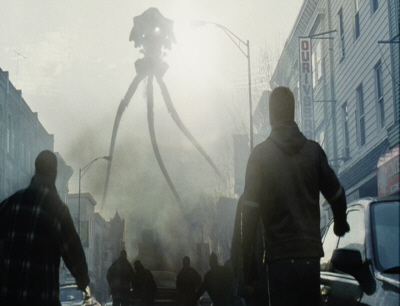
A classic example is on display today, in Slate, which celebrates the 75th anniversary of young, svelte, Orson Welles’ famous Halloween Eve broadcast of his radio adaptation of H.G. Wells’ “War of the Worlds,” with no Tom Cruise or Dakota Fanning but a nice conceit that involved telling the story through fake news flashes and eye-witness interviews. (One reporter is fried on the air by the Martian invasion vehicles.) An new NPR program and a PBS documentary both tell the familiar story of how the realistic-sounding radio play caused widespread panic among radio listeners who missed the opening credits, leading them to think that Earth was really under attack. Newspapers of the day headlined mass panic, and gave accounts of citizens running for cover, huddling in the basement, and cringing in terror.  The episode made Orson Welles a national celebrity, and launched him on his meteoric, long and strange career.

According to Slate authors Jefferson Pooley and Michael Socolow, it never happened. Declaring the story of the “War of the Worlds” panic a myth, the authors state without equivocation that the newspaper accounts, headlines, commentary and interviews, were fabricated:

“Radio had siphoned off advertising revenue from print during the Depression, badly damaging the newspaper industry. So the papers seized the opportunity presented by Welles’ program to discredit radio as a source of news. The newspaper industry sensationalized the panic to prove to advertisers, and regulators, that radio management was irresponsible and not to be trusted. In an editorial titled “Terror by Radio,” the New York Times reproached “radio officials” for approving the interweaving of “blood-curdling fiction” with news flashes “offered in exactly the manner that real news would have been given.” Warned Editor and Publisher, the newspaper industry’s trade journal, “The nation as a whole continues to face the danger of incomplete, misunderstood news over a medium which has yet to prove … that it is competent to perform the news job.” Continue reading

The Oscar Nominee Truth Squad Goes After “Argo”

argo-poster

The ethics of using artistic license in films based on fact isn’t only being debated in the case of “Lincoln” as we approach the Oscar ceremonies: “Argo” is also under fire.

For some reason conservative radio hostess Laura Ingraham is fond of James Lipton, the unctuous host of PBS’s “Actor’s Studio” interview program. He sounds off frequently on her show, usually about films, and in his most recent gig was pontificating about the Academy Awards. Lipton seems to believe that bias is a condition one is helpless to adjust for: he kept announcing his preferences for various nominees based solely on their association with him or the Actor’s Studio, and explaining his choices by saying, “I’m biased, you see.”

Recognizing bias is just half the job, James. The other half is getting over it. Continue reading

Artistic License, History, and Lincoln’s Green Socks

Of course, some historical fabrications are harmless.

Of course, some historical fabrications are harmless.

Several well-placed critics are taking “Lincoln” screenwriter Tony Kushner to task for what they believe are unethical misrepresentations of fact in the much-praised, and supposedly scrupulously accurate film. He, on the other hand, is annoyed. Kushner counters that unlike in history books where a historian gives a well-researched “a blow-by-blow account,” it is reasonable and ethical for a screenwriter to “manipulate a small detail in the service of a greater historical truth. History doesn’t always organize itself according to the rules of drama. It’s ridiculous. It’s like saying that Lincoln didn’t have green socks, he had blue socks.”

I’m going to spare Kushner lawyerly word-parsing and not hold him to “a greater historical truth,” though I suspect that in his hands (he is a skilled political propagandist as well as writer), we would not be pleased with what that license would bring. A politically sympatico film director named Oliver Stone, for example, thought it served a greater historical truth to present completely fictional evidence that Lyndon Johnson was complicit in John F. Kennedy’s assassination, even though Stone’s vehicle, “JFK,” was marketed as a veritable documentary on the “truth” of the Kennedy assassination. Let’s just say that Kushner feels that in a work of entertainment and drama, strictly accurate representation of all historical facts is impossible and unreasonable to expect or require.

I agree. But there is a big, big difference between the ethics of showing Lincoln wearing the wrong color socks, and representing a highly dubious story as fact to denigrate the reputation of a probable hero, as James Cameron did in “Titanic” when he showed First Officer William Murdoch taking a bribe to let a passenger on a lifeboat ( fantasy), shooting a passenger (pure speculation), and committing suicide (denied by a fellow officer under oath at the inquest). Continue reading

“The Good Wife” Ethics Addendum: Why Misrepresenting the Legal Profession’s Standards Does Real Harm

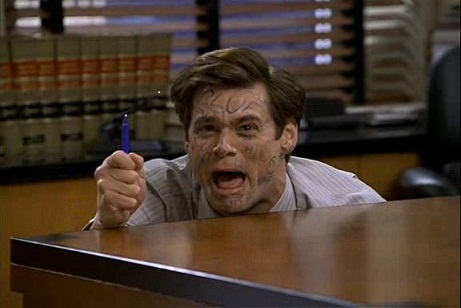
Sure, it was a comedy, but how many people believe that Jim Carrey's compulsively lying lawyer was not that far from the truth?

A comment from reader Penn on my post about “The Good Wife’s” recent misrepresentation of legal ethics standards got me thinking, and what it got me thinking was that I was too easy on the show.

Penn asked why I waste my time watching programs that raise my blood pressure, and there are two answers. The first is what I wrote back: it’s not a bad show; in the past it has been a very good one, even from the legal ethics perspective. I have used several scenarios from episodes in seminars.

The second answer, which I didn’t mention in my response to Penn, is the more important one, however. Good show or not, millions of Americans get their information about the legal profession from the portrayal of lawyers and law on TV and in movies. From these fictional sources, they think they know that most lawyers are liars, that they allow their clients to lie, that they put witnesses on the stand who they know will lie under oath. The public thinks that lawyers abuse the law, don’t earn their fees, don’t give a damn about their clients (unless they are sleeping with them), switch sides routinely and confuse juries to release serial killers on more victims. Continue reading

Ethics Dunce: Lexington (Mass.) High School Principal Natalie Cohen

“Columbinus” is a tough play by Stephen Karam and PJ Paparelli that combines interviews and news footage about the Columbine shootings with dramatic and cinematic techniques to explore the human and cultural issues raised by the tragedy. It is not “Grease,” by any means, and though many high schools have produced it successfully, I would not quarrel with the decision by any school official who decided that the show was inappropriate for high school drama and that it would better to do, say, “The Mikado.”

But Lexington High School principal Natalie Cohen managed to make this decision in the worst way imaginable, for the worst reasons imaginable, showing rank ignorance of the purpose of theater while being irresponsibly dismissive of the efforts and creative energies of her students. Continue reading

CNN and John King, Endorsing “Newspeak” and Disgracing American Journalism

And so it begins.

CNN’s John King: “Before we go to break, I want to make a quick point. We were having a discussion about the Chicago mayoral race. My friend Andy Shaw used the term ‘in the crosshairs’ in talking about the candidates. We’re trying, we’re trying to get away from that language. Andy is a good friend, he’s covered politics for a long time, but we’re trying to get away from that kind of language.”

What “kind of langauge”? Oh, you know: vivid language. Metaphors. Similes. Can’t have that on CNN, because, as everyone knows, a completely unrelated use of a cross-hairs graphic on a Sarah Palin campaign map had nothing to do with the shooting of  Rep. Gaby Giffords and 19 others, but the media decided to make everyone think it was the fault of the map anyway. So now a news network, which is supposed to convey information, is apologizing for a guest’s use of the word “cross-hairs” in a context that had nothing to do with violence. Continue reading

When TV’s Ethics Matter, and When They Don’t

As one who has argued that certain TV commercials, notably the infamous “green shirt” Tide commercial, the Twix commercial  and Direct TV’s disturbing (but often funny) series showing football fans hurting rival team supporters, I know I’m asking for trouble by declaring, as I officially do here, that for compliance firm Global Ethics to criticize TV shows like “The Office” and “30 Rock” for supposed workplace ethics violations is absurd. But it is absurd. And criticizing the commercials in question is not.

Hear me out. Continue reading