Let Us All Bow In Gratitude To Colorado For Generously Sacrificing Its Children And The Safety And Welfare of Its Citizens To Prove What Responsible People Knew Already: Pot Should Stay Illegal

Hey, Que pasa! You idiot...

Hey, Que pasa! You idiot…

I’m probably going to stray a bit from strictly professional rhetoric here, but this really makes me angry.

According to a report released this month by the Rocky Mountain High Intensity Drug Trafficking Area, there has been a 29% increase in marijuana-related emergency room visits and a 38 % increase in pot-related hospitalizations during retail marijuana’s first year in Colorado.

[ NOTE: This is a correction. The original version of the post gave the wrong impression that hospitalizations were up: this was not my intent. Thanks to Humble Talent for being persistent. Ethics Alarms apologizes for the error. We’ll try to do better.]

Now 11% of Colorado’s 12 to 17 year-olds use pot,  56% higher than the national average.There has also been a 40% increase in drug-related suspensions and expulsions in school, primarily from marijuana.

Mercy, what a surprise! Who could have predicted that? Well me, for one, as well as others neither dedicated to getting their periodic recreational buzz nor addled by moldy Sixties cant.

Of course making pot legal and widely available for adults would cause an epidemic of use by kids, who, the evidence increasingly shows, may suffer long term adverse effectsOf course it is causing accidents. Of course adding a third harmful legal drug to the devastating and deadly duo of alcohol and tobacco is going to make society dumber, less safe and less productive. Continue reading

Ethics Quiz: Good Samaritan Drug Overdose Laws

heroinoverdoseI know how this one will break down, but it’s an interesting issue nonetheless. And it doesn’t involve Hillary, Donald Trump of Bill Cosby!

Many states have addressed drug-related deaths by allowing junkies using illegal drugs to call 911 for a fellow shooter or snorter in life-threatening distress and be immune from prosecution.   New Mexico passed a “Good Samaritan law” in 2007 that granted limited immunity from prosecution on simple possession charges for people who used 911 to report a drug overdose going on in front of them. The Drug Policy Alliance reports that 28 states and the District of Columbia have passed laws differing in exact provisions but providing limited freedom from prosecution in exchange for saving lives.

There is an explosion of heroin use nationwide, and therefore heroin deaths, right now. (The government abandoning its vital statements via law that drug use is wrong has a lot to do with causing this, but that is for another day.) As always, the first proposals to address a drug crisis involve loosening enforcement. Slate writes,

“In the end, of course, it doesn’t much matter how or why states pass these laws, as long as they pass them. A University of Washington study evaluating the initial results of Washington state’s Good Samaritan policy found in a survey that drug users who were aware of the law were 88 percent more likely to call 911 in the event of an overdose than before. “Despite lingering concerns about possible negative consequences of the new law, such as prosecutions being impeded, no evidence of negative consequences has been found to date,” the study concluded. Good Samaritan laws are humane and sensible. There are no compelling reasons to oppose them.”

Your Ethics Alarms Ethics Quiz of the Day:

Are there really “no compelling” ethical reasons to oppose such laws?

Continue reading

Jerks, Liars, Hypocrites, Fools and Hoosiers: 10 Ethics Observations On Indiana’s Religious Freedom Restoration Act Controversy

Indiana5

1. The law was passed to make discrimination against gays, trans individuals and especially same-sex couples seeking marriage if not easier, to at least seem easier. Anyone claiming otherwise is lying, or being intentionally obtuse. Would Indiana be passing this law without the Hobby Lobby decision or the various court rulings requiring photographers, bakers, and other businesses to provide the same products and services to gay couples that they do to heterosexuals? Yes, you say? Tell me another.

As GLAAD alertly pointed out, Governor Pence was surrounded by anti-gay activists when he signed the bill:

GLAAD Pence

This is res ipsa loquitur, and doesn’t speak well for the Governor’s candor or intelligence.

2. Context matters. The original laws of this sort (the Federal law signed by President Clinton is also called the Religious Freedom Restoration Act) were part of the left’s long range pro-drug strategy, like medical marijuana. It was essentially a hippie law designed to create a slippery slope to recreational drug legalization by allowing fringe religious groups, specifically Native American tribes, to use peyote in tribal ceremonies. Now you understand why Clinton signed the bill.

Oops. Excuse me if I enjoy the spectacle of the clever members of the Church of the Perpetually Stoned—including the ACLU, which once supported such laws as long as they pointed the way to their young lawyers being able to have their Saturday night joints legally but now opposes them—being hoisted on their own petard.

“When the federal government adopted a religious protection act in 1993, same-sex marriage was not on the horizon,” whines the New York Times. Well, competent, well-considered, properly drafted, responsibly passed laws don’t suddenly become unbearable, then fine, then unbearable again with every shift of the cultural winds. The intent of the law was never to protect mainstream religions, but cloaked itself in language that did. It backfired.

3. That being stipulated, the good states need to read their own laws before they start grandstanding. Connecticut Governor Dan Malloy just announced on Twitter that he plans to sign an executive order banning state travel to Indiana in response to its Religious Freedom Restoration Act. Yet Connecticut, hippie enclave and bedroom community of rich, white, liberal New Yorkers that it is, happily jumped on the religious freedom train with a law of its own, one that, as the Federalist points out, makes discrimination on the basis of religion easier than the Hoosier version, which only prohibits the government from substantially burdening religion. Connecticut’s law does not include the word “substantially,” meaning that all government-enacted burdens on religion are theoretically illegal.

I wonder how Malloy is going to ban government travel to Connecticut? Is the theory that the same law can be good when liberal states pass it and evil when those bad conservative states pass it? It is more likely that the governor hasn’t looked at his own state’s law.

4. The hysteria being stirred up over the supposed horribles Indiana’s law will lead to is irresponsible. Jonathan Adler explains on The Volokh Conspiracy: Continue reading

March 1 Is “Remember What Drugs Cost Society Day”

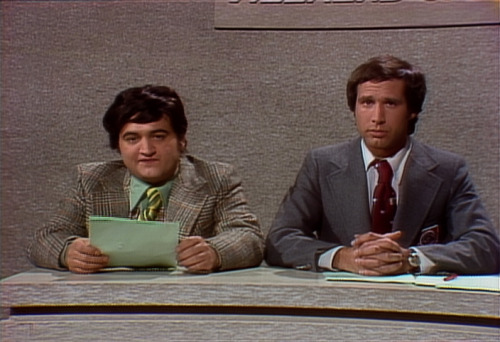
Belushi

The District of Columbia is poised to completely legalize pot, which will be the most ringing of government endorsements of  societally destructive personal conduct, in a malfunctioning culture that should not be placed at further risk. This overwhelmingly black, poor, educationally-challenged and struggling population needs competent, trustworthy leadership and an injection of values.  It is a community, after all, that idolized the late Marion Barry, a mayor who smoked crack on the job, and never apologized for it. It’s not surprising that the adults in the District would tell the young African-Americans that it’s cool to spend their your money to get stupid, to avoid clear thought rather than practice it.

Every March 1, I watch this old clip (below) from Saturday Night Live  (it’s not on YouTube, so I can only link to it) , featuring the great, and thanks to recreational drugs, late John Belushi. It unfailingly makes me laugh out loud. It also makes me furious that a talent like this gave himself so little time to entertain us, because he killed himself with an insatiable appetite for illegal drugs.

For me, March 1 is “Remember What Drugs Cost Society Day.” Those arguing for our government placing a societal  seal of approval on these costs have yet to persuade me that it is ethical, wise or even sane to not just accept them, but to multiply them by a number unknown.

Here’s John Belushi (1949-1982), enlightening us about March around the world.

Ethics Quote of the Week: Senator Rand Paul

Senator Paul, forever young.

Senator Paul, forever young.

“I think that’s the real hypocrisy, is that people on our side, which include a lot of people who made mistakes growing up, admit their mistakes but now still want to put people in jail for that. Had he been caught at Andover, he’d have never been governor, he’d probably never have a chance to run for the presidency.”

Senator Rand Paul (R-Ky), in reaction to Jeb Bush’s admission that he smoked marijuana heavily as a student. Bush currently opposes the legalization of medical marijuana.

Oh, great: Rand Paul is 16 years old.

The chip off the old libertarian block Ron Paul (who would legalize heroin, ecstasy, LSD, you name it) now proves that he has no idea what hypocrisy is. It is troubling: Senator Paul is an MD, and can be an articulate and powerful speaker;  he can take bold strategic political steps that his Republican colleagues are too timid to try, like correctly charging Hillary Clinton with complicity in her husband’s sexual predation,  but he repeatedly conveys the impression that he’s just not all that bright. This quote is a sterling example. Continue reading

Introducing Rationalization 1A: Ethics Surrender, or “We can’t stop it”

White Flag: Last LapForty six rationalizations have been added to the Ethics Alarms Rationalizations List, and today I not only stumbled upon a carelessly omitted one, but realized that it belongs near the top.

Ethics Surrender, or “We can’t stop it,” is the rationalization that argues that if society is incapable of effectively preventing unethical conduct, for whatever reason, we might as well stop regarding that conduct as wrong. This is yet another variation on the most common and insidious rationalization of them all and #1 on the list: “Everybody Does It.”

The Golden Rationalization has many variations, among them…

“It’s done all the time.”

“It’s always been done this way.”

“It’s tradition.”

“Everybody is used to it.”

“Everybody accepts it.”

“Nobody’s complained before.”

“It’s too late to change now.”

…and others. Ethics Surrender, however, warrants particular attention, as it encourages moral cowardice and ethics complacency. “We can’t stop it” is a lazy capitulation that assumes cultures can’t change, and we know they can and do change, both for better and worse, all the time. One society has been convinced, though legitimate, persistent, coherent and ethically valid arguments, that a common practice or conduct is bad for society, society can stop or seriously inhibit that unethical practice of behavior, either by law, regulation, or best of all, the evolution of cultural consensus. The examples of an Ethics Surrender resulting in undesirable societal consequences are too numerous to list, and many of them are still controversial. I would assign having children out of wedlock, adultery, lying by elected leaders and the use of illegal recreational drugs to the “We can’t stop it, so let’s say it’s not so bad” category. The most obvious and currently significant example is illegal immigration, wrong, but increasingly being rationalized by both advocates and lawmakers who have run out of ideas and principle. At this moment, we are hearing the defenders of dubious police shootings making that argument to avoid examining possible changes in law enforcement policy so there will be fewer deaths without putting police in peril.

Ethics is hard. Rationalization 1A, Ethics Surrender, or “We can’t stop it,” wrongly concludes that it is impossible.


Prediction: Stories Like This Will Be Compared To “Reefer Madness”

ReeferMadness_04

Because elite potheads love their weed, nobody has the guts to stand in their way, and consequences be damned.

The CNN story describes a new study that suggests that smoking a lot of pot, especially if you are young, makes you dumber.

It’s not conclusive, of course. Research seldom is. It also doesn’t matter, since a combination of relentless pro-stoner advocacy, resulting contempt for the law and the fact that a disproportionate number of minorities and poor are getting caught with the drug and going to jail—making the prohibition itself racist in today’s “race trumps everything” political culture—has assured that marijuana will join tobacco, alcohol and legalized gambling as socially destructive—but lucrative! Profits! Taxes! Yum Yum!—forces in our society. Lives will be ruined, shattered and lost, real costs in money and productivity will be huge, and little positive will be gained in exchange.

It just seems so obvious that we should know how harmful these kinds of things are before we legalize them, and not start looking into it after the horse is gone, the genie is out and Pandora’s Box is open and lying on the floor.

It just seems dumb to…Hey! Wait a minute…

________________

Pointer: Fark

Facts: CNN

Comment Of The Day: “US Priorities: Make War On Cheese, Not On Drugs”

smoking_weedThe articulate squid commenter, Extradimensional Cephalopod, weighed into the contentious discussion over the wisdom of pot use and government approval there-of with this thought-provoking piece.

Here is his Comment of the Day on the post: US Priorities: Make War On Cheese, Not On Drugs.

I’ll have a few comments at the end.

Full disclosure: I have not used marijuana, but I have had its effects described to me in detail by people who have. My understanding of it is that it has at least two separate and notable effects, which can vary based on the particular strain. One of them is a relaxing effect, although some strains actually increase anxiety at some point after use. However, the relaxing effect makes it suitable for medical purposes such as treating seizures. The other effect I am aware of is an increase in the brain’s divergent thinking patterns; that is, it increases random association, enhancing creativity and making experiences more vivid. A user can increase this effect deliberately by increasing the quantity inhaled or ingested to the point where coherent thought is difficult, but this requires very high levels of intake. I am told that it is not chemically addictive, or toxic except inasmuch as inhaling smoke in general is toxic, but more on the level of incense rather than cigarettes.

In my opinion, people have a right to use the substance provided they do not take actions that put others at risk by doing so, such as driving. I see no reason to ban the substance, but one can certainly ban taking actions that become dangerous under its effects. As a transhumanist, I see nothing inherently wrong with using a form of technology to alter one’s mental state artificially. Marijuana does not seem like a harmful or dangerous way to do so, as long as one is responsible. I agree that people who use marijuana, or alcohol, for that matter, can become very boring and less able to have interesting conversations, although sometimes the opposite happens; it depends on who the person was to begin with and how they react.

On the other hand, the ethics system that I subscribe to and through which I come to the above conclusions is based on promoting consciousness. One of the root problems with this world is that humans get very easily addicted to mindsets, experiences, or control. Addictions are blind spots, limitations that a consciousness has picked up that allow it to be manipulated by the world instead of being its own master. An addiction occurs when a mindset, experience, or form of control automatically becomes a person’s first priority in certain situations even where the person would intellectually judge it to be subordinate to a more important goal. It is possible to get mentally addicted to pretty much anything: alcohol, marijuana, candy, sex, adrenaline, attention, solitude, et cetera. To a certain extent we all have addictions in that when our lives are changed we feel uncomfortable and stressed, but toning addictions down is part of empowering ourselves.

That being said, my ethics system leads me to disapprove of the use of marijuana (or other drugs, for that matter) as a means to induce apathy to escape the stress that would otherwise lead a person to self-improvement. My worldview draws a distinction between joy and well-being. Joy is a positive feeling towards one’s current circumstances. Well-being, however, I define as regularly developing new abilities or improving one’s point of view, or any sort of change that results in a person having a more harmonious relationship with the world and being able to promote harmony for other individuals. Here is where the “it’s the journey, not the destination” cliche comes in. Joy may be the destination that people try to reach because it is associated with a state of increased harmony, but consciousness, the process by which people try to reach asymptotically-increasing states of harmony, is what makes us people in the first place, with all the associated awareness and abilities, and it is consciousness that I prioritize.

Long story short: it’s okay to use drugs to augment one’s ability to improve oneself (especially if one has a disability that requires the use of drugs to bring mental functions within human normal), as a tool (yes, sometimes a crutch) to access mindsets you want to use but can’t invoke at will, or as a neutral form of recreation. Using drugs as a substitute for self-improvement so that one can stagnate without feeling bad about it is pathetic and not empowering at all.

I hope this post has been coherent, but I have an internal vocabulary that has developed in partial isolation, so if there is any confusion that you want resolved, please let me know.

It’s me again. Just a few notes:

  • One thing I always appreciate about EC is that he never makes a typo. I am awash in envy.
  • I have been shocked at how many commenters on the main post never have used pot. Either I am not as strange as I always thought I was, or this blog does not attract anything close to a representative cross-section of America.
  • I should have mentioned in the original post that the Federal government still regards pot as illegal. However, with its first confirmed former pot-head as President ( Clinton didn’t inhale, remember), and the “base” of the Democratic party as well as most reporters clearly in favor of Stoned America, I think the eventual legalization is a certainty.
  • Alcohol is not chemically addictive either, except for the minority of the population that doesn’t metabolize booze properly, those we call alcoholics. However, there are many alcohol addicts who are not alcoholics, and they are psychologically addicted, and seriously so. Psychological addiction to a drug can be and often is both indistinguishable from the physical kind, and just as destructive to them and those who depend on them.
  • I am dubious about the substantive beneficial effects of pot, John Lennon and Timothy Leary notwithstanding. The use of marijuana for genuine palliative purposes is obviously valid; it is also obviously being abused.
  • I endorse the Squid’s penultimate sentence, but I think that this kind of drug use should never be discussed without the adjective “irresponsible” prominently displayed. For this is why discouraging such use is a legitimate, indeed crucial, government function, and a function the government cannot perform while approving the conduct, and, as we all know is coming, profiting by it. The government has to promote responsible conduct from its citizens, because irresponsible conduct does material harm to society.

US Priorities: Make War On Cheese, Not On Drugs

wisconsin-cheese-headsUSA Today reports that the increase in state-approved marijuana use is being accompanied by an increase in pot-related auto fatalities.

Gee…who could have seen that coming? Well, I did, among others, but never mind: far worse lies ahead. The consensus of American society is now that being able to get stupid for recreation is worth more death and addiction, and our cowardly political leaders have neither the wit nor the fortitude to swat away the lame rationalizations that have driven that position–“Hey, alcohol is worse, so why not add another destructive, useless drug to our societal pathologies?”—that have led to the dawning of a perpetually stoned America.

But not to worry: when the threat to our health posed by other non-essential pleasures looms, the government nannies are on it like piranha. The FDA, for example, has moved to make sure American can’t buy and eat cheese aged on wooden boards, because it, well, there really isn’t a good reason. Because they can, I guess. It couldn’t be because board-aged cheeses cause automobile accidents, workplace deaths and kids to fail at school, because we know our culture no longer cares about any of that.

Cheese-heads are out, pot-heads are in.

Cool.

It’s comforting that we have our priorities straight.

__________________________

Sources: USA Today, Overlawyered

50 Years After Kitty Genovese, Inhumans On A Bus

The title describes the public transit riders who watched this disturbing scene unfold on a Philadelphia bus, and did nothing:

2014 is the 50th anniversary of the infamous Kitty Genovese case, and dueling books on the incident either recount the accepted version that 38 people in an apartment building heard the 28 year-old woman’s screams as she was being stabbed to death but “didn’t want to be involved” and let her die, or adopt the revisionist theory that the apathy of bystanders was unfairly and inaccurately hyped by the news media. The incident on the Philadelphia bus tells me that the revisionists have a burden of proof that will be hard to meet. There was plenty of evidence already, like here, or here, or here, or here, or more recently here, that Kitty Genovese might not fare any better today. Continue reading