“Camp Kill Jews” Ethics

And they say “Washington Redskins” is offensive.
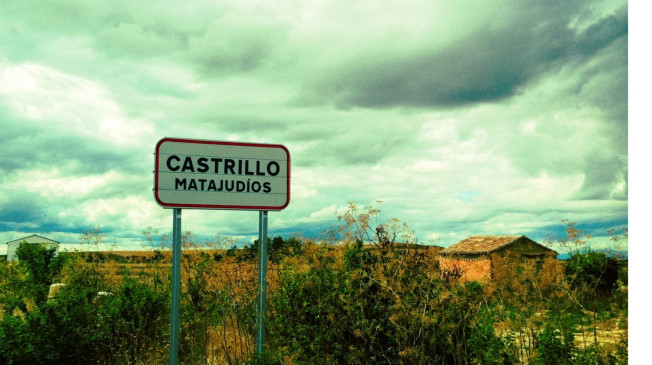
"What a charming name! What does it mean in your language? Oh...wait, WHAT???"

“What a charming name! What does it mean in your language? Oh…wait, WHAT???”

From Spain comes the news that the town of Castrillo Matajudios, which literally means “Camp Kill Jews,” has voted to change its name after 400 years. This appears to be part of Spain’s recent, rather belated, I would say, efforts to acknowledge and express regret to Jews for the persecution they endured during the Spanish Inquisition.

Strange as it seem, the current name probably came into being not to denigrate Jews, but to protect Jews in the town who had officially converted to Catholicism under threat of torture and death. As such, it is a piece of history, and the words convey information about the town, the country, and the people who lived there, not a slur….except to someone who knows nothing about the town.

I’m not aware of a perfect analogy for this situation. It has some similarities to the plight of the towns of Blue Ball, Pennsylvania, named for a famous and long-gone hotel in the area, and the Amish community of Intercourse, Pennsylvania, named when a common uses of that term conveyed “fellowship.” In a  parallel universe where political correctness was dictated by social conservatives rather censorious progressives, these towns might be getting coercive signed letters from Republican Senators “suggesting” that they change their names to something less offensive, even though, as with the Redskins name, history and context would be lost. Continue reading
November 9-10, Kristallnacht, And The Duty To Remember

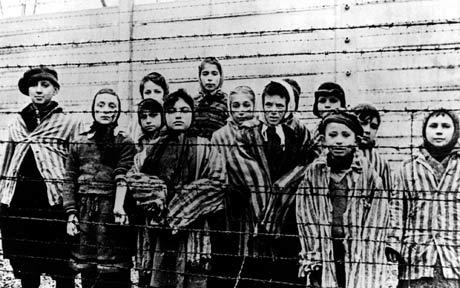
Auschwitz

This is the 75th Anniversary of Kristallnacht, November 9-10, 1938. Had you forgotten? Did you even know? If you weren’t looking in the right places, it would be very easy to miss the fact that these are days to remember—that we have a duty to remember.

In 2009, citing the cultural importance of another date in November, one that is going to be much commemorated this year (being the 50th anniversary) but that was barely noted four years ago, I said…

“Apart from national holidays, there are not an overwhelming number of calendar boxes that citizens of the United States should pause and think about every year. July 4. September 11. December 7, when America was attacked by Japan at Pearl Harbor. June 6, D-Day. We can argue about others, but there should be no argument about November 22. It was a sudden, unexpected tragedy that scarred a generation, and it changed the course of  national and world history in many ways.

“Year after year, Americans know less and less about their own country. This makes us incompetent in our civic duties, infantile in our understanding of America’s role in the world, stupid and apathetic on election day, and patsies for our supposed elected officials, who can tell us lies about our country’s mission and heritage as we stand nodding like cows. Most of all, it makes us disrespectful of the brave and brilliant men and women who built, sustained and defined the United States. College graduates go on “The Jay Leno Show” and shamelessly identify the faces on Mount Rushmore as the Marx Brothers or the Beatles, and giggle about it as Jay rolls his eyes. This is becoming the standard level of American appreciation of the nation’s past.”

In holding close critical events affecting the rest of the world, we are even worse, as the overwhelming ignorance of this date shows. If July 4, 1776; September 11, 2001; December 7, 1941, and November 22, 1963, are moments in history that all of us should remember, honor and think about because we are Americans, November 9 and 10th present the same obligations because we are human beings, and citizens of the world. Continue reading

July 2, 1863: When 262 Minnesotans Saved The United States Of America

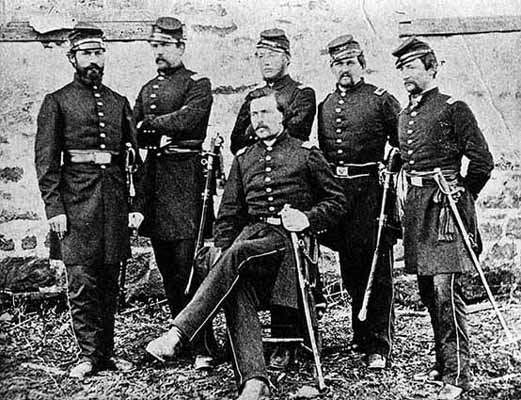
Officers of the First Minnesota Volunteer Regiment

Officers of the First Minnesota Volunteer Regiment

For the last two years, I have posted here about the courage and sacrifice of the men of the First Minnesota Volunteer Regiment at the Battle of Gettysburg. There was more than enough of those qualities, on both sides, to go around that day, and unless you are in the vicinity of that lovely and unbearably sad little Pennsylvania town, it isn’t just the brave Minnesotans who are neglected, but all of the participants. Yesterday was July 1, the anniversary of the beginning of the battle in 1863, and there was scant mention of it in the media. After all, there is the Zimmerman trial, and outrage over Jennifer Lopez accepting a million dollars to sing “Happy Birthday” for a brutal dictator, and whether movie viewers will flock to see Johnny Depp play Tonto. One of the few excellent acknowledgements of the date and its significance was by CBS, which also featured the famous feature on the battle published years ago by the Saturday Evening Post. 

In an ambitious mood, I once resolved to find a different group of battlefield heroes from that day to feature every July 2, the messiest, most important pivotal of the battle that itself has been overshadowed by the tragedy of suicidal Pickett’s Charge on July 3. But I have neither the historical research skills nor time to do justice to such a task, though the injustice of so many forgotten heroes is great. It is best to allow the First Minnesota Volunteer Regiment, who obeyed a desperate order to fill a breach in the Union line, knowing that it meant almost certain death,  “to gain a few minutes’ time and save the position and probably the battlefield,” to stand for all of them.

As for me, I’m going to watch, once again, Ted Turner’s excellent film Gettysburg, and play its soaring score in my home and my car. We have a duty to remember, and honor, every moment of those three days in July, 150 years ago. Continue reading

The Forgotten Meaning of Labor Day

Do you know who this is? You should! It’s Labor Day, dammit!

Labor Day commemorates one of the great ethical victories of American society, and not one in a hundred Americans know it. Labor Day marks the end of summer, and a time for retail store sales, and the last chance to get away to Disney World, but few of us think about the real meaning of the word “labor” in the name, and how it is meant to honor brave, dedicated men and women who fought, sometimes literally, the forces of greed, political influence, wealth and privilege in this country to ensure a measure of safety, consideration, fairness and justice for the hardest working among us.

Today labor unions are controversial, and with good reason. Many of them have been run as criminal enterprises, with deep connections to organized crime; many operate in a blatantly coercive and undemocratic fashion. Union demands and strong-arm tactics, while providing security and good wages to members, have crippled some American industries, and limited jobs as well. Today the unions  get publicity when one of them tries to protect a member who should be punished, as when the baseball players’ union fights suspensions for player insubordination or even drug use, or when school districts are afraid to fire incompetent teachers because of union power, or when the members of public unions protest cutbacks in benefits that their private sector counterparts would be grateful for. It is true that today’s unions often embody longshoreman philosopher Eric Hoffer’s observation that  “Every great cause begins as a movement, degenerates into a business and ends up as a racket.” *

That not what Labor Day honors, however. It is celebrating the original labor movement that began at the end of the 19th century, and that eventually rescued the United States from an industrial and manufacturing system that was cruel, exploitive, deadly and feudal. Why the elementary schools teach nothing about this inspiring and important movement, I do not know. I suspect that the story of the American labor movement was deemed politically dangerous to teach during the various Red Scares, and fell out of the curriculum, never to return. Whatever the reason, it is disgraceful, for the achievements of the labor movement are every bit as important and inspiring as those of the civil rights movement and the achievements of our armed forces in the protection of liberty abroad. Continue reading

Justice for the Nicholas Brothers [Corrected (1/27/25)]

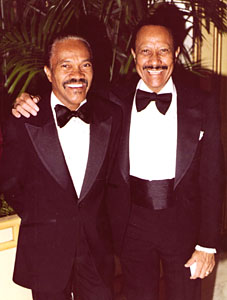
At the Sun Valley Lodge, there is a television station devoted to playing the 1941 film “Sun Valley Serenade” on a loop. It is a genuinely awful movie, starring John Payne of “Miracle on 34th Street” fame, Norwegian ice skater Sonia Henie, and Milton Berle, although it does show the famous ski resort in the days when guests used to be towed around the slopes on their skis by horses. Last time I was in Sun Valley to give a presentation, I watched about half the film in disconnected bites, since I never can sleep on such trips. This time I finally saw the whole thing. At about 3 AM, as Glenn Miller was leading his band in the longest version of “Chattanooga Choo-Choo” in history, Fayard and Harold Nicholas suddenly flipped onto the screen, and Sun Valley Serenade briefly went from fatuous to immortal.

If your reflex response to that last sentence was “WHO??“, you are part of the reason for this post, and also in the vast and deprived majority of Americans. As I went among my future audience of lawyers and their spouses yesterday morning, happily informing them that the terrible movie playing around the clock in their rooms included the dance team called “the unforgettable Nicholas Brothers” in more than one tribute, I learned that none of them had any idea what I was talking about, and many of these individuals were old enough to have been able to see Fayard and Harold in a theater. The Nicholas Brothers were, you see, the greatest tap-dancers who ever lived, and the most amazing dance team that ever will be. Continue reading

The Ethical Fate For Joe Paterno’s Statue

In the wake of the Freeh Report’s revelations regarding the extent of the late Joe Paterno’s involvement in allowing Jerry Sandusky’s child molesting appetites to be sated with Penn State’s  assistance, many are calling for the campus statue honoring the now-disgraced coach to be removed.

I am generally opposed to removing memorials and honors to historical figures according to the popular verdicts of the day, for several reasons. The main one is that every individual who ever achieved something worthy of such honor also was guilty of misconduct that someone could convincingly argue outweighs it on moral or ethical grounds. New facts are uncovered, cultural values shift, and over time, no revered figure is safe from deconstruction. The reverse is also inevitable: if a life can be judged unworthy of honor, subsequent generations may well disagree. The verdict of a community, a culture and an era should be given due weight and respect;  a statue, memorial or monument not only recognizes an individual but also represents the judgment of our predecessors. Leave their judgments alone, and if we disagree with them, try to make ours better. Continue reading

Reminder: July 2 Is “Thank Minnesota Day,” and Remember Gettysburg, Too.

Last year on this date, I posted about the injustice of historical memory, and how the heroic exploits of the Maine soldiers on Little Round Top commanded by Col. Joshua Chamberlain on the second day of the Battle of Gettysburg have all but obliterated recognition of the even more remarkable sacrifices made by the First Minnesota Volunteer Regiment that same day, when it took on the suicide mission of blocking a hole in the Union line against a Confederate force that outnumbered it five to one. Those Minnesotans quite possibly saved the United States of America at the price of their lives.

I see that some readers are finding that post today: let me make it easier for everybody. Here is the link. This a day for all of us to honor the heroism of the First Minnesota, and indeed all of the Americans, North and South, who fought for their nation, their states, their ideals and the soul of America in the Pennsylvania town of Gettysburg, on July 2, 1863. Continue reading

July 2: A Good Day to Thank Minnesota For Saving The Country

If you know anyone from Minnesota, today would be a good day to say “thank you.”

July 2 was the second day of the decisive Civil War battle at Gettysburg, Pennsylvania, and the most complicated and wide-ranging day in the conflict. So much was going on at Seminary Ridge and Cemetery Ridge, on Little Round Top, the Peach Orchard, Devil’s Den and a half dozen other key features on the battle field that whether an instance of heroism was recorded or forgotten is as much a matter of chance as anything else. Even determining what was the turning point in the day’s conflict, which ultimately was won by the forces of the North, is an exercise in searching for order in chaos.

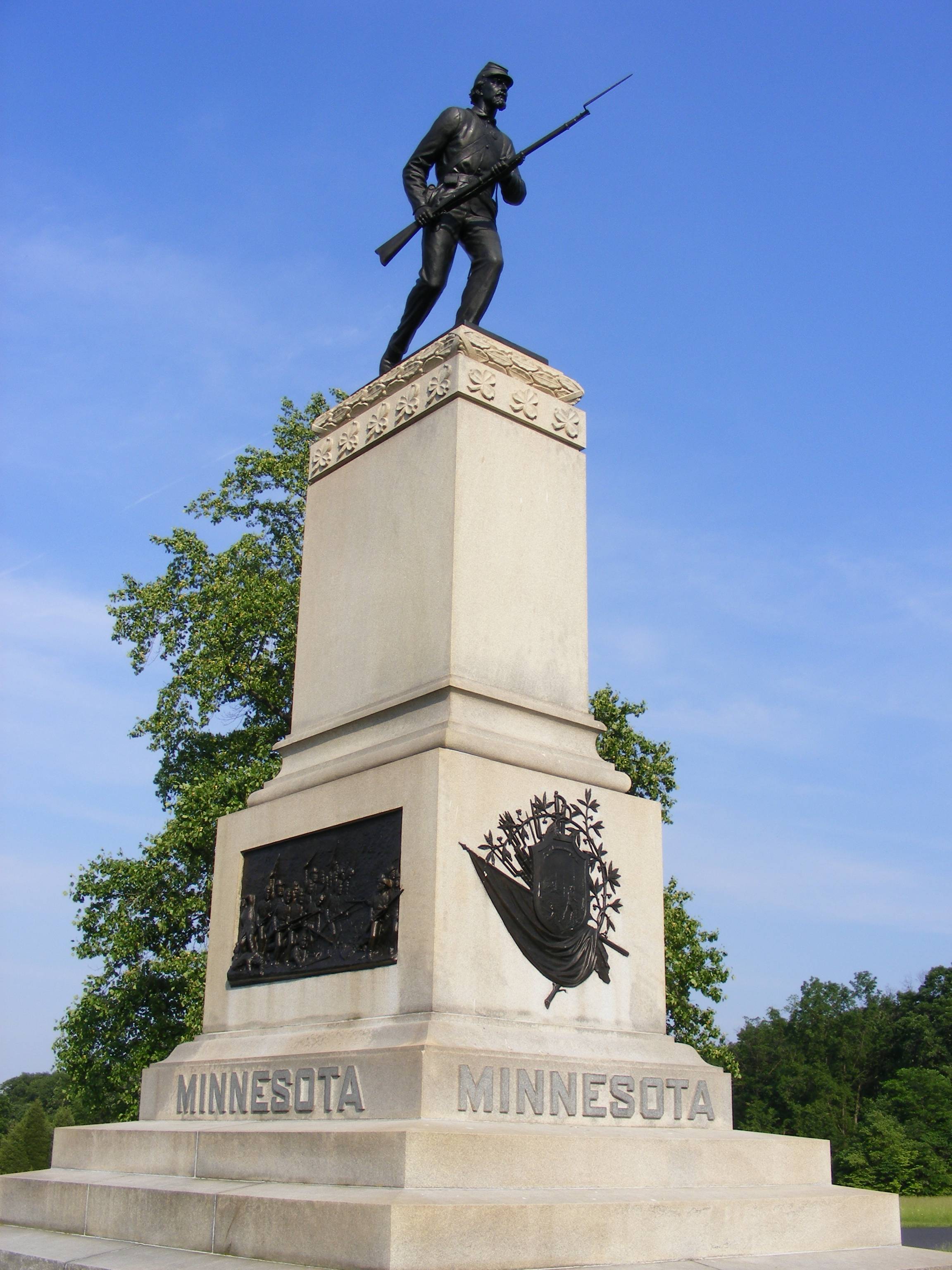
There is no question, however, that the First Minnesota Volunteer Regiment’s astonishing heroics stand out even among the many other examples of gallantry on that day. The battlefield monument to the First Minnesota is the one of the largest erected to any Union regiment, and yet it has not guaranteed our cultural memory of the epic sacrifice those soldiers made. Other second day exploits, due to sometimes arbitrary choices made by historians and film makers, have taken up the limited space available in the public’s attention to the details of the Civil War.

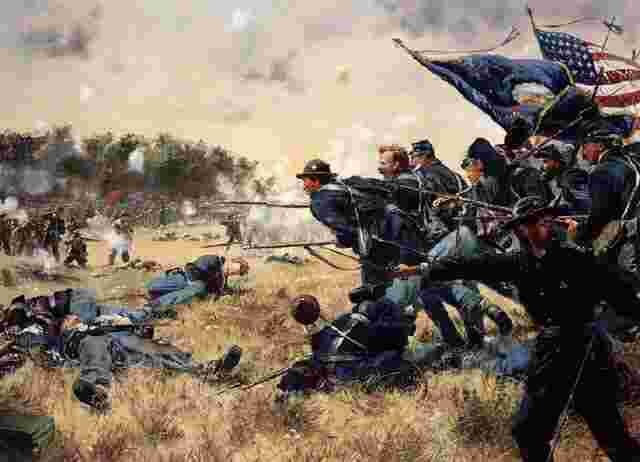
This is an injustice. As the battle raged for Cemetery Ridge, crucial high ground occupied by Union forces, General Winfield Hancock saw a serious breach in the Union line, and realized that Wilcox’s Alabama Brigade had to be opposed and stopped in their advance until he could round up reinforcements. He ordered the First Minnesota to charge the brigade and hold the position, even though its 262 men would be outnumbered by a force of more than 1200.  Continue reading

Remember Gettysburg

Today is July 1, which is being treated across the United States as the gateway to a long weekend and the Fourth of July, and little more. July 1 is also, however, the anniversary of the first day of the Battle of Gettysburg, the most important and most deadly battle of the many important and deadly conflicts in the American Civil War. The two American armies that clashed in the Pennsylvania town sustained more than 50,000 casualties on the Gettysburg battlefield, which may be the saddest and noblest place in America.

If you have not made at least one pilgrimage to the battlefield, you owe it to yourself, and to the memory of the combatants, to go. Continue reading

Frank Buckles, Speaker Boehner, and the Duty To Remember

Frank Buckles is our last chance to remember...

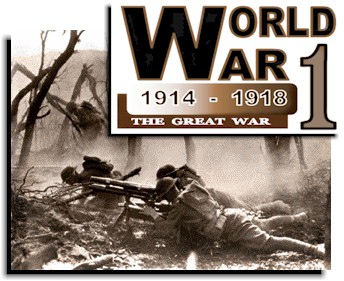
They fought overseas in battles with strange names like the Meuse-Argonne Offensive. They sang charmingly upbeat songs like “Over There!” and “Inky-Dinky Parley-Voo.” A lot of them were gassed, about 200,000 were wounded, 120,000 died, and many of them who  came home were never the same, dubbed “the lost generation” by Ernest Hemingway. They were America’s “doughboys,” the young homegrown heroes of World War I, who arrived late to a pointless war they didn’t start, and became the first American soldiers to die in large numbers in foreign lands.

The last of them died last week. His name was Frank Buckles, and he had lied about his age to become a soldier at the tender age of 16. In his 110 years, Buckles took part in a lot of history, sailing for the Continent on the Carpathia, the very same ship that rescued the Titanic’s survivors; traveling the world by sea as ship’s purser, which afforded him an accidental encounter with Adolf Hitler, and having the bad luck to be in the Philippines when the Japanese invaded, ending up as a prisoner for most of World War II.

Sen. Jay Rockefeller (D-W.Va.), and Rep. Shelley Moore Capito, (R-W.Va.) have introduced resolutions to allow fellow West Virginian Buckles to lie in honor in the Rotunda of the U.S. Capitol, where the public could pay their respects to him by filing past his casket. Though usually reserved for former presidents and distinguished members of Congress, unelected American citizens of distinction have laid in state in the Rotunda, such as civil rights icon Rosa Parks and Gen. Douglas MacArthur.

Apparently Speaker of the House John Boehner doesn’t think Buckles makes the grade, for he has rejected the idea and decreed that the last World War I soldier in a special ceremony at Arlington National Cemetery, but not at the Capitol. Continue reading