Even so, as I said in brief summary of Rep. Mace’s uncivil and disrespecful treatment of a constituent who dared to imply criticism of her representational, “This doesn’t help.”
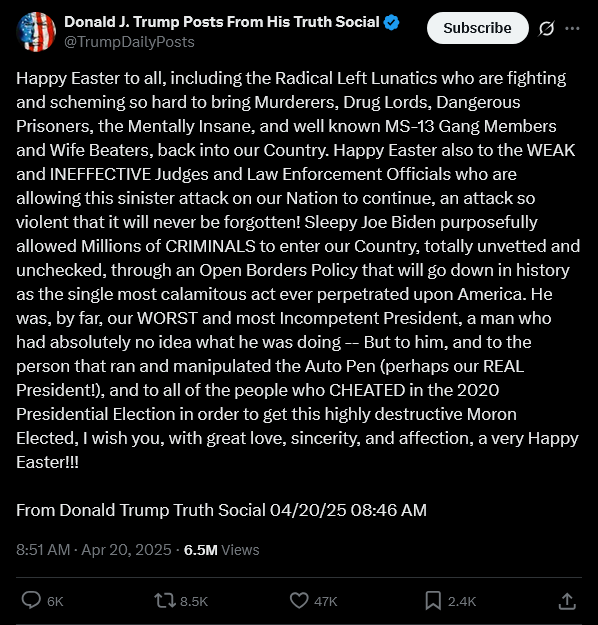
Once upon a time, Presidents chose their words carefully for their public pronouncements. I defy anyone to explain how the Truth Social rant above can accomplish anything positive. I place it in the same category as the Trump Hate outbursts by the likes of Maxine Waters, Adam Schiff or Jasmine Crockett, all of which are designed to inflame rather than to unite, except that a President should be held to higher standards than members of Congress.
The only question in my mind is whether exploiting the holiest of Christian holidays to barf out insults and declarations of personal pique is less revolting, more revolting, or about as revolting than President Biden’s use of the day last year to issue a pandering, celebratory proclamation about “Transgender Day of Visibility.” I score Trump’s message as worse, as in “more unethical,” because its language is, though typical of this President, still inappropriate for any resident of the White House. (Trump issued a similar message last Easter, but he wasn’t President them. That’s a material distinction, or should be.)
It is also, like Biden’s message, stupid and incompetent. Trump has a challenging agenda and a tough road ahead; his personal popularity is crucial to achieving that agenda, and there is no way these kinds of self-indulgent outbursts can do anything but alienate potential supporters.
The photo above, showing three illuminated cross along Lower Manhattan Skyline in New York city symbolizing the three crosses on Calvary, contrasts sharply with Item #3 of the previous post noting that the White House viewed Easter egg decorations with “religious symbols” inappropriate for the day’s festivities.
I ask, without irony or innuendo: “Is this progress?”
Turner Movie Classics decided to kick off Easter with an abject lesson in art and life for us all. The movie is 1965’s “The Greatest Story Ever Told.” One of the very greatest of American film directors was George Stevens, who specialized in smart comedies (the Hepburn/Tracy classic “Woman of the Year”), light-hearted adventure films (“Gunga Din”) and musicals (“Swing Time,” the best in the Astaire-Rogers canon). Then, as wonderfully told in the documentary “Five Came Back,” he joined fellow directing greats John Ford, John Huston, William Wyler and Frank Capra in documenting World War II for the public, the troops, and posterity at the high cost, for all of them, of their emotional and mental health. (Wyler and Ford also suffered serious service-related injuries).
Stevens, though, drew the assignment of filming the horrors at the liberated extermination camps. When he returned to Hollywood, he didn’t feel light-hearted any more. From then on he directed dramas with serious themes, and they were his best films, like “Shane,” “Giant,” and “The Diary of Anne Frank.” Finally, he took on his most daunting challenge, filming the life of Christ with an all-star cast befitting of the project’s importance. “The Greatest Story Ever Told” is terrible; I find the film unwatchable, and I’m not alone. Imagine the embarrassment of titling your movie “The Greatest Story Ever Told” and watching to turn out to be one of the worst movies ever made.
The bomb even has a special kick at the end when John Wayne appears as a Roman centurion staring up at Jesus on the cross, and says in the Duke’s trademark drawl, “Surely this man was the son of God!”
The Duke could shrug off, after all the resulting mockery; he had been more embarrassed playing Genghis Kahn throughout an entire film, Howard Hughes’ camp classic “The Conqueror.”
George Stevens, however, wasn’t used to bombing. The movie was a critical and box office bust, and the fiasco sent Stevens into retirement for five years. When he finally tried again, the director’s heart not only wasn’t light, it wasn’t in his work any more. “The Only Game in Town,” with Elizabeth Taylor and Warren Beatty, was an even bigger disaster than “The Greatest Story Ever Told,” though it’s easier to sit though. After all, it’s an hour shorter, and John Wayne doesn’t show up as a centurion.
The life lessons? Hubris and humility…don’t get cocky. Next: Nobody is too good or talented to fail, even at what they are best at. Finally: Aim for the stars, but be prepared to crash and burn.
1. Speaking of Stevens’ “The Diary of Anne Frank,” there was a weird episode on Ann Althouse’s blog. In one post she quoted David Mamet in his just-published book, as saying in part,
“Albert Hackett and Frances Goodrich… took an adolescent girl’s diary and raped it into “The Diary of Anne Frank,” a sitcom….”
Anne has many and large holes in her cultural literacy, especially regarding film. Her commentary left it open to question whether she really believed that Hackett and Goodrich had written a comedy based on Frank’s diary (They wrote a Tony Award-winning drama as well as the acclaimed film based on it), and passed on several comments by readers who took Mamet literally as well. An example: “Joan Rivers did an interview once about what things should never be the fodder for humor….Perhaps, younger people today are distanced enough from it for a sitcom about a Jewish family hiding in an attic for over two years who are then found and killed by the Nazis to not be in poor taste.” Another “Turning the Diary of Ann Frank into a comedy is a pretty loathsome thing to do. Things like Hogan’s Heroes worked because the Nazis were the main objects of the jokes. The victims of the Nazis aren’t.” There are others. Why would Ann let those comments through to make the commenters look like fools, especially since she helped lead them astray? Or is she, as I very much suspect, unfamiliar with the movie (which is moving and excellent)? Continue reading →
To summarize the thrust of my criticism as I reiterated it in my replies to his comment and others, Mark argues persuasively that the authors of the Gospels were, at least in this case, trying to tell the story as they heard it, and were not trying to embellish or distort it in the telling to make it more credible in its time. Good. That does not mean, however, that the story they heard is in fact true. The post was also aimed in part at debunking conspiracy theories about the Resurrection being a hoax. Taking Mark’s argument as that, and that alone, it is also persuasive. However, proving something was not intentionally false does not prove it is true.
I will do this however: at the end of my discussion, I said that I regarded Mark’s argument as a tautology, where a controversial document is cited to prove the accuracy of the document itself, and that I regarded that device as intellectually dishonest. Mark’s response persuades me that my assessment was unduly harsh and unfair, and I both retract and apologize to him for it.
Moreover, the fact that he chose to respond in person so quickly reaffirms my original favorable assessment of his professionalism and character.
First, thank you for your kind words regarding my secular writing. I hope that my work in that area continues to merit your approbation. We are, as I believe Confucius is reputed to have said, “cursed to live in interesting times.”
Unfortunately, my reaction is not nearly so positive regarding your critique of my post on eight reasons to believe Jesus was literally resurrected from the dead three days after His crucifixion, just as He said He would be.
“Intellectually dishonest” and tautological? With all due respect, your readers deserve more candor than that from you. You accuse me of these two errors because: “All of his reasons are based on New Testament text. If one believes that the New Testament text is true and accurate, then you don’t need any more reasons. His is a self-ratifying argument.”
If my post was simply arguing for the credibility and historical accuracy of the New Testament, your statement might well more accurately represent what I wrote. I did indeed assume the accuracy of the New Testament accounts of Jesus’ resurrection, but the eight reasons I offered concerned characteristics of the scriptural accounts and events that point a reasonable reader to their credibility. Continue reading →
Our family always celebrated Easter twice, at least when Greek Easter fell on a different date, which is usually the case.On traditional Easter, until my sister and I were well into high school, my parents hid two dozen colored eggs that we had decorated the day before all over the house for us to hunt for Easter morning. If there had been a pandemic then, my mother would have still hidden the eggs, because she knew even she, with her incredible talent for making BS credible, would not have been able to convince us that the Easter Bunny was “social distancing.”
How my parents loved family celebrations of holidays! I miss them so much, and days like this just makes not having them in our lives harder.
1. Can’t do this. I had been recommending the usually reliable website Ars Technica to my friends for updates on the virus so that they wouldn’t be battered hither and yon like skiffs made of paper on the ocean of hype and disinformation. I also relied on it myself. The site promised daily updates at 3 pm every day, along with a useful set of information, also updated as needed. Then, on April 6, the updates just stopped; no explanation, and nothing since. Unethical. If you promise a service for those in need of it, you can’t just stop it without warning or explanation. It doesn’t matter what the reason is. You have created reliance and dependency. If you can’t be sure that you will carry through on your commitment, then don’t make it.
I headed a small professional theater for 20 years at great personal sacrifice on that principle.
2. Welcome to my world...Since so many were forthcoming in their reactions to my quarrel with one ex-commenter, here’s another one. Unsolicited, I received a book about two weeks ago from an Ethics Alarms follower. It was by L.Ron Hubbard, the science fiction writer and founder of Scientology, and the topic was ethics. I was and am grateful, for all ideas about ethics are interesting to me, and most come in handy eventually. A few days ago, I received a long, handwritten letter from the same source, who told me that he was no longer following the blog. He then excoriated my for insulting him by posting, so soon after receiving the book, this post, which in item #3 I made some uncomplimentary comments about Ron’s “church” (it’s a cult and probably a criminal enterprise), its current leader, and his whacked-out message to the flock about the pandemic, which he called “planetary bullbait.”
My critic thought it was mean and rude of me to respond to his kind gift by deriding his faith and his friend, the Church’s Chairman of the Board, David Miscavige.
1. A cultural note: there is no discernible Easter programming anywhere on TV, cable or network. Oh, TCM is playing “Easter Parade” and “King of Kings” in prime time, but that’s it. ‘Twas not always thus.
2. Speaking of TCM…Bravo for the classic movie network’s teaming with Fandango to offer big screen presentations of John Wayne’s “True Grit” in May. They could have justifiably chosen many other Westerns equally worthy or more so, like “Shane” or “High Noon.” I like to think that choosing the Duke’s Oscar winning performance is an intentional rebuke to the recent attack on Wayne’s legacy by the social media mob, a true “Fill your hand, you son of a bitch!” to the cultural airbrushers and statue-topplers.
I’ll be there, cheering Rooster on.
3. Other than journalists, have any other professionals debased themselves and their professional integrity more flagrantly that lawyers and law professors in their determination to Get Trump? This article in Slate by a law professor argues that asking or telling one’s lawyer to do something that the lawyer refuses to do—like firing Robert Mueller—can be criminal obstruction of justice. By this theory, every time a client says that he wants the lawyer to assist in an illegal act, it’s a crime. But that’s not how attorney-client relationships work. The attorney is obligated to say, when appropriate, “No, you can’t do that, and I won’t do that for you, and here’s why.” In the end, it is indistinguishable from the client asking the lawyer’s advice, because clients only have the power to order a lawyer to do a very limited number of things, like accepting a settlement.
The professor’s argument also assumes that Trump firing Mueller would be obstruction of justice. Not only is this unprovable—that would have to be his intent—the President had a perfectly good reason to fire the special counsel, just as he had good reason to fire James Comey. Mueller’s investigation had been tainted many ways, and since Trump knew he was innocent, he saw the exercise as a calculated scheme to make it impossible for him to do his job. Firing Mueller and ending the investigation would have been really, really stupid politically, but it wouldn’t be obstruction.
This, however, is how desperate “the resistance” is to bootstrap some kind of impeachment theory. Continue reading →
[My family celebrated Greek Easter (next Sunday, this year), or not, depending on how Greek my mother was feeling. The whole thing left me thoroughly confused. And why no Greek April Fool’s?]
1 Hey, it’s only the Pope carelessly allowing centuries of Catholic teachings to be declared, if informally, null and void. What’s everyone so upset about? Recipe for a fiasco:
The Pope inexplicably has a meeting with a 93-year-old atheist reporter, Eugenio Scalfari, who has reported on the alleged contents of their private meetings before.
Scalfari has admitted “on more than one occasion” that he doesn’t take notes or record his conversations with the Pope.
The Pope either opines, or doesn’t, or sort of does depending on your interpretation, and if you are an atheist confirmation bias comes into play, opine that Hell doesn’t exist, saying, according to his pal, “Hell does not exist…The disappearance of sinful souls exists.”
Scalfari, presumably without permission or consent, but he’s a journalist, so he’s going to report the news, and the Pope saying that all that stuff in the Bible about Satan is a lot of hooey is, you have to admit, news (although who knows if Matt Pearce would report it as news; I guess it would depend on whether he wanted the public to know there was no Hell, right?), naturally lets the world know that the Pope doesn’t believe what his predecessors and follower have been using to scare the Hell out of sinners all this time.
“What is reported by the author in today’s article is the fruit of his reconstruction, in which the precise words uttered by the Pope are not cited. No quotations in the aforementioned article, then, should be considered as a faithful transcription of the words of the Holy Father.”
That’s called “spin.” Why do we trust these people?
2. Why is NPR taxpayer-funded again? This “correction” actually appeared in the NPR story about the Pope’s Hell problems:
Correction March 30, 2018: An earlier version of this post incorrectly described Easter as “the day celebrating the idea that Jesus did not die and go to hell or purgatory or anywhere at all, but rather arose into heaven.”
Competence? Editors? Basic education? Respect for people’s faith? Knowing something about the predominant religion ins the nation you are reporting on? Hello?Continue reading →



 Ethics Alarms