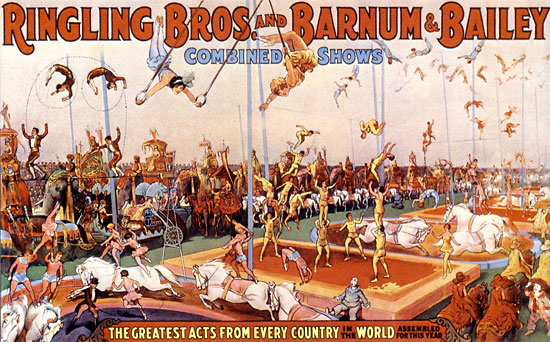
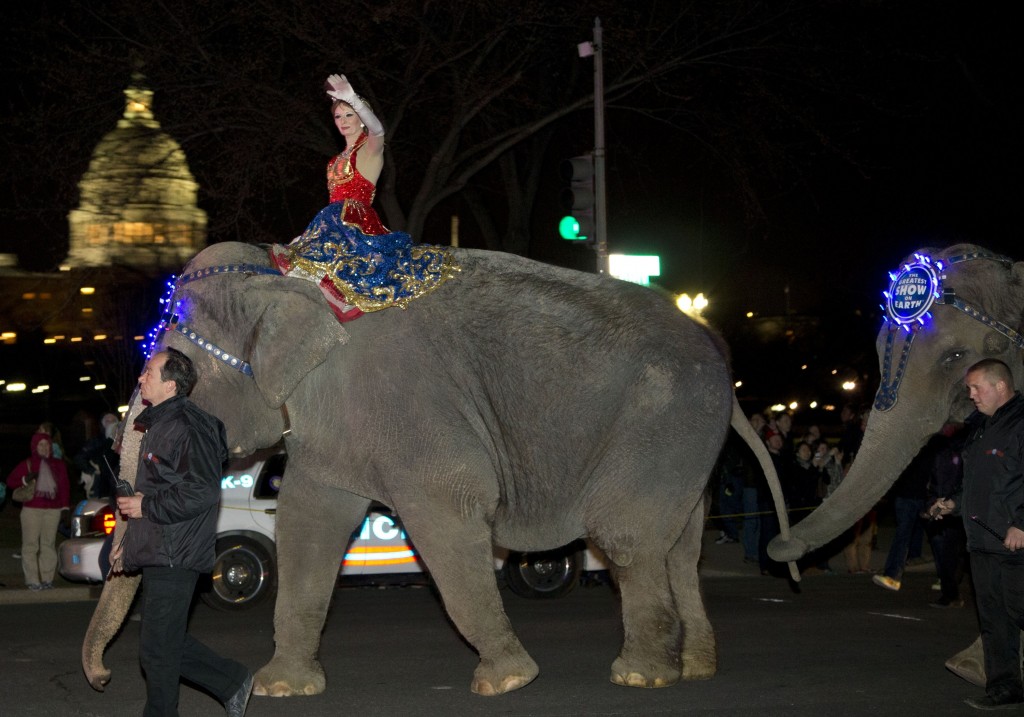
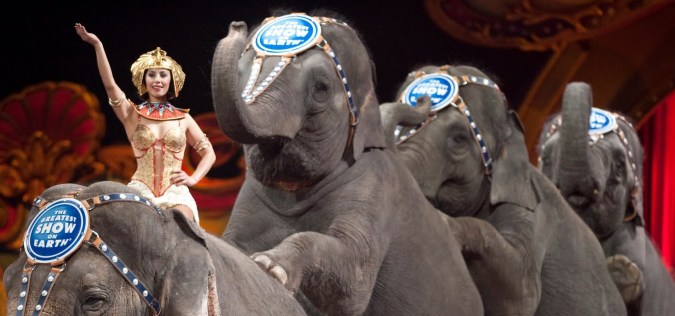
The Ringling Brothers Barnum and Bailey Circus will bring down its metaphorical Big Top for the final time in May. Its business model simply does not work any more, as an executive of the arena entertainment company that owns it said recently—especially since the circus capitulated to animal rights activists and fired its performing elephants. (Ticket sales dropped by almost a third.) This was an iconic cultural institution vanishing, so I had to say farewell, and did so last weekend, when the circus came to Washington, D.C. for the final time.
Observations:
1. It is still an entertaining show, even though the Ringling brothers would never have recognized it as a circus. Several of the acts were worth the ticket price (in our cases, about 75 bucks) all by themselves.
2. The Verizon Center was about a third filled for the final show of the legendary Ringling Brothers Barnum and Bailey Circus. The Center itself was sparsely staffed; it took 20 minutes in line to buy popcorn. Americans, as a group, don’t care about history, culture and significant changes in it landscape any more. The circus and its components gave us imagery, lore, metaphors—“walking a tight rope,” “three ring circus,” (this one is now a two-and-a half ring circus at best), “ringmaster,” “dog and pony show,” “the big tent,” “side-shows,” “clown act,” —and “The Man on the Flying Trapeze.” The nation is a little poorer and less colorful without it.
3. The public also increasingly sees little value in the mass audience experience. Live entertainment, especially family friendly varieties, were traditionally seen as an important and natural way to strengthen community ties, by bonding disparate members of society through a shared experience involving witnessing something transforming and memorable.
4. Assisting in the death of this experience is the trend of making sure all arena and stadium events are filled with loud, never-ending, pounding electronic music that would make Phil Specter grab ear plugs. Once, the circus’s dramatic music consisted of drum rolls, bands and soft calliopes. If you watch the Cecil B. DeMille movie “The Greatest Show On Earth,” you will see spectators talking to each other during the acts, or shouting out to performers. Either is virtually impossible now. Conversation consists of screaming a few words repeatedly until your companion nods. This continues the cultural trend of making meaningful interaction with fellow human beings passe. How can this possibly be a healthy development for society?
I did see a lot of people texting….maybe to those sitting next to them.
5. Almost no venders were walking among the seated. A single snow cone from one of these cost $12.00.
6. This is how unintended cultural pollution takes place. The conglomerate that owns the circus also owns various ice shows, like Disney on Ice. To cut costs, it decided to employ performers from the ice shows in the circus too, meaning that instead of a sawdust path around the rings, the track around the performing areas are ice. Everyone is on skates half the time. It isn’t a bad effect: it’s faster than the old-style parades. But now the circus is an ice show. Continue reading
 Ethics Alarms