Ethics Exercise: What’s Ethically Wrong With Sybrina Fulton’s Endorsement Of Hillary Clinton?

Author above...

Author above…

Sybrina Fulton is Trayvon Martin’s mother. Here is the entire article, published on CNN’s website:

Today, throughout many communities of color, our young people go about their lives feeling as if they are a target in their country. It’s become a sad fact of life that senseless gun violence can strike with little or no warning, either from neighborhoods that have become flooded with firearms, or police who are too quick to resort to deadly force.

Gun violence is an epidemic that kills 33,000 men, women, boys and girls every year. On top of those needless deaths, law enforcement agencies in America kill more people in a month than many other countries’ police forces kill in years. When those precious lives are taken, it forever tears apart the lives of thousands more — the friends and families who loved them, and who always will.

Losing a child is any parent’s worst fear. As a mother who has had to live that horrible nightmare in a very public spotlight, I hope that by speaking out, it will help focus some of that light onto a path that can help our nation find its way out of this darkness.

Last week, President Barack Obama took some important steps that included strengthening the background check system for purchasing guns without diminishing our Second Amendment rights. I was glad to see these actions put in place, and was moved by the tears of not just our President but of a father who clearly understands my anguish.

But next year we will have a new president. And everything Obama has done — even common-sense reforms that a majority of gun owners agree with — will be overturned if that president is a Republican. In fact, the Republican candidates have vowed to roll back all of these sensible measures. And many of them have shown open contempt for the simple notion that Black Lives Matter.

With so many of our children’s lives on the line or taken, we simply can’t afford to elect a Republican who refuses even to acknowledge the problem of senseless gun violence. The rising generation of our young people need a president who will stand up to inaction from Republicans and indifference from the National Rifle Association.

I believe that person is Hillary Clinton.

I know Clinton is tough enough to wage this fight. I’ve seen her do it for years. As first lady, she advocated for the Brady Bill and convened meetings on school violence. As a senator, she voted to extend the assault weapons ban and against an immunity law that protects irresponsible gun makers and dealers from liability.

In spending some time with her in person, I also found a mother and a grandmother who truly heard me, and understood the depth of my loss.

She knew all the statistics. But like so many, I’ve long since grown numb to the numbers. So instead, we talked about Trayvon and other families who have lost a loved one to gun violence. We talked about all of the wishes and hopes we had for their lives. And knowing we can never get them back, we discussed how to prevent more moms from losing their sons to gun violence.

Clinton will uphold President Obama’s recent executive actions, and then she’ll go even further. Her plan focuses on reforms that would help keep more guns out of the hands of criminals. It would finally close the gun show loophole, and the outrageous provision that allowed someone with an arrest record to buy the gun used to shoot and kill nine parishioners at the Emanuel AME Church in Charleston, South Carolina.

I agree with the President: We should only support leaders that fight for common-sense gun reforms. Clinton passes that test.

Just as importantly, Clinton also wants to address the larger, systemic problems. She has a plan to begin to heal the distrust and divide that too often exists between law enforcement and the communities they serve.

She has called for key reforms — from better training for officers to eliminating racial profiling and investing in body cameras for every police department. She sees what I see: a criminal justice system that is not always just. A system that has contributed to creating a reality where just selling cigarettes, playing loud music, looking at a cop the wrong way or walking home from the store are now activities that can get you killed.

If you look at the numbers, America is missing 1.5 million men of color — lost to a system of violence and mass incarceration that seems to have long since forgotten them, but we haven’t.

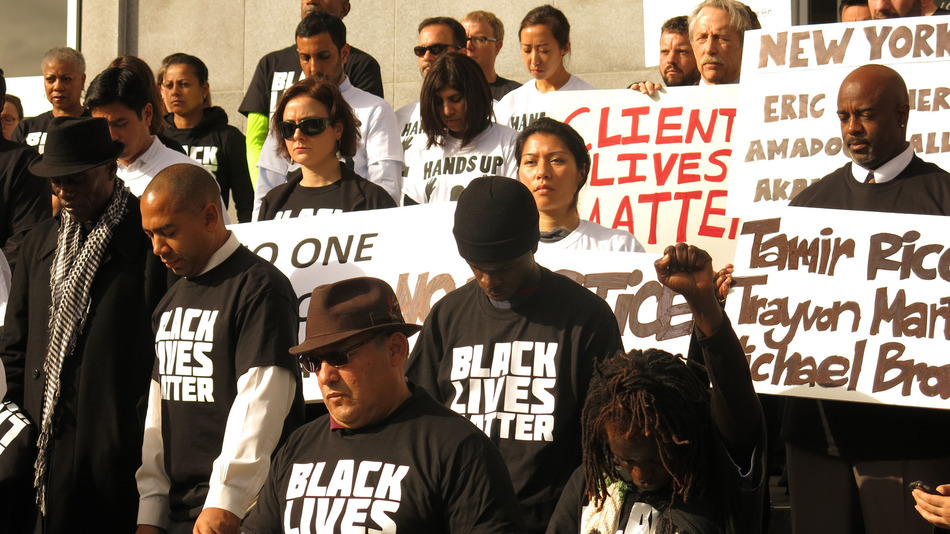
Not only am I missing my son, but too many other moms like me are missing their sons — Eric Garner, Jordan Davis, Laquan McDonald, Freddie Gray, Michael Brown, Oscar Grant, Sean Bell, Tamir Rice. As their mothers, we must do more than just cry. And all of us must do more than speak out, protest and march.

We must vote!

Ethics fouls: Continue reading
The Tamir Rice Fiasco And “Ethics Zugzwang”

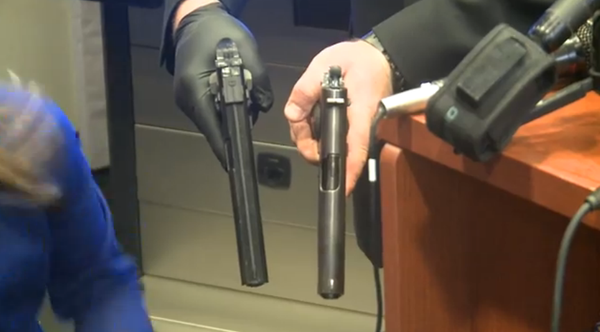
Gun comparison

There are circumstances in which all ethical options have been eliminated by poor choices and bad luck. Henceforth Ethics Alarms will refer to this dilemma as ethics zugzwang, zugzwang being a chess term for the situation where a player must make a move, and any move will worsen his position.

By the time the killing of Tamir Rice got to the grand jury, it was ethics zugzwang. The grand jury’s decision not to charge the two officers involved is troubling, and a decision to charge would have also been troubling. To get anything out of this utter and fatal fiasco, a lot has to change, and we have to recognize what in order to make those changes occur. It won’t be easy. I think it may be impossible.

There is no way that the justice system can do its job objectively and well when every police shooting involving a black victim is instantly labelled racist and murder by vocal activists, pundits and and social media, with the implied threat of civil unrest. If an indictment is handed down as in theFreddie Gray matter in Baltimore, it appears as if mob passions are manipulating the system, and, in the Gray case, it was. Such a result, in turn, makes it more difficult for the next accused cop to get justice. It estranges the police force from the government entity it serves, and makes police wary and less likely to assume the risks associated with their vital and inherently dangerous  job.

These considerations create their own impetus making a failure to indict more likely. A city cannot afford to be seen as not supporting the police, even when they make a deadly mistake in judgment. District attorneys are on the same team as police, and automatically share their perspective; it is important that the police recognize that. The police receive the benefit of every doubt, and the deserve that. Yet a failure to indict, especially now that police shootings have become high profile matters that every blogger and pundit prejudges according to their own biases and agendas, will inevitably be used to indict the system instead. Continue reading

Unethical Quote Of The Month: The Democratic National Committee

blm

“[T]he DNC joins with Americans across the country in affirming ‘Black lives matter’ and the ‘say her name’ efforts to make visible the pain of our fellow and sister Americans as they condemn extrajudicial killings of unarmed African-American men, women and children.”

—-The Democratic National Committee, in a resolution passed last week endorsing #Black Lives Matter”

You think that having Donald Trump running (temporarily and momentarily) as a front-runner in the race for the 2016  Republican Presidential nomination is embarrassing for Republicans? That’s nothin’! The official endorsement of the racist, violence-promoting, anti-police and anti-rule of law movement Black Lives Matter ought to disqualify the Democratic Party as a trustworthy political organization until it stops pandering and apologizes for this statement.

Black Lives Matter is a racist, anti-white, hate-fueled organization that considers any law enforcement involving black criminals presumptively racist. The movement continues to rely on false and discredited media and activist narratives (“Hands up! Don’t shoot!”), citing “victims” like Michael Brown as the justification for its existence, presuming guilt in cases where the facts are uncertain or in legitimate dispute (Eric Garner was not “choked to death,” nor was he intentionally killed; Sonny Gray’s death is still unexplained; there is no evidence that Tamir Rice’s death was related to race). The primary result of the group’s efforts so far have been to increase racial tensions, to spark deadly attacks on police officers, and to cause a catastrophic rise in urban murders as police avoid proactive methods and stops involving black suspects to avoid becoming the next Darren Wilson. Continue reading

Suggested Journalism Ethics Rule For The Washington Post: If You Want To Publish Race Hate, Anti-American Op-Ed Pieces,At Least Insist That They Don’t Misrepresent The Facts.

Is that too much to ask?

Sunday last,  the Washington Posts’s Outlook section included an anti-American diatribe against police and whites by a California public defender named Raha Jorjani. I know there are black racists that see the world, law enforcement and government as he does, and there is nothing wrong or irresponsible in the Post allowing such screeds to see the light of day in its pages—all the better to expose them. I would feel better if the equivilent racist bile from the white side was not treated differently, but I tire of pointing out this double standard, at least right now.

But no editor should allow such a piece to include factual distortions on the scale of the opening paragraph, which begins,

Suppose a client walked into my office and told me that police officers in his country had choked a man to death over a petty crime. Suppose he said police fatally shot another man in the back as he ran away. That they arrested a woman during a traffic stop and placed her in jail, where she died three days later. That a 12-year-old boy in his country was shot and killed by the police as he played in the park.

Suppose he told me that all of those victims were from the same ethnic community — a community whose members fear being harmed, tortured or killed by police or prison guards. And that this is true in cities and towns across his nation. At that point, as an immigration lawyer, I’d tell him he had a strong claim for asylum protection under U.S. law.

What if, next, he told me he was from America? Black people in the United States face such racial violence that they could qualify as refugees.

The short and well-earned response to his last sentence is “Bullshit.” Before one can even get to his offensive and absurd (and paranoia-seeding: the lawyer must regard it as good for business) thesis, the utter dishonesty of his premises disqualify the op-ed for serious consideration, as well as raise question about the way this guy would practice law. If that is how he represents facts in court, he won’t be a lawyer long: Continue reading

“Black Lives Matter” Is Unethical, And So Are Politicians Who Pander To It

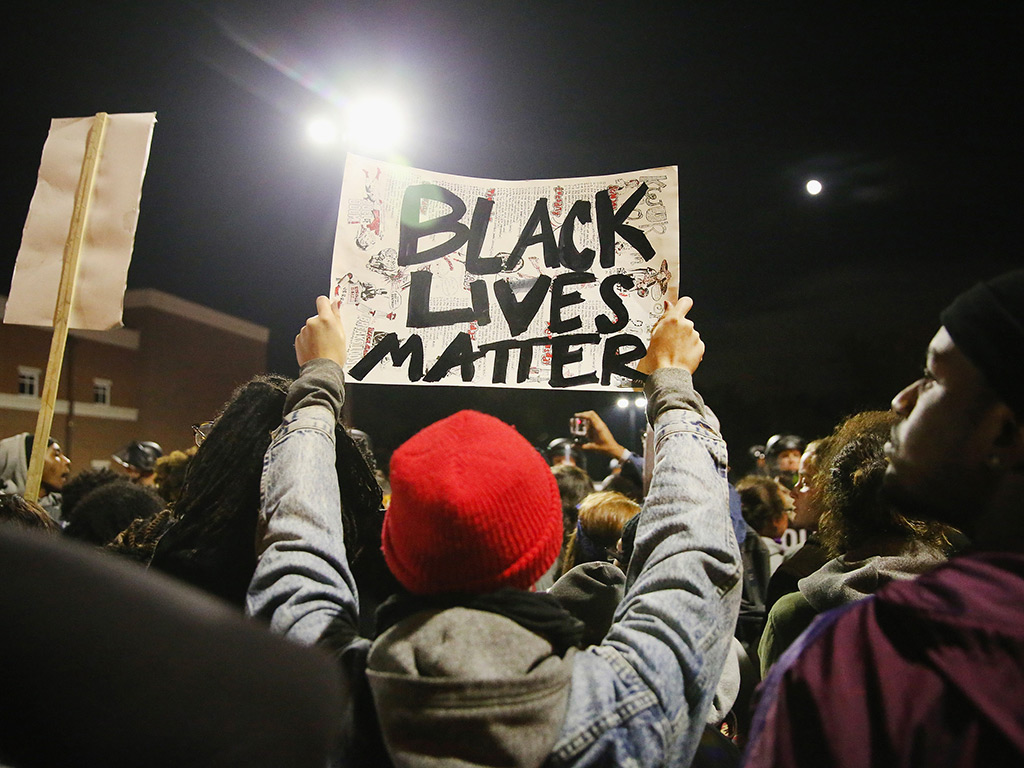
black-lives-matterThat’s the tipping point for Ethics Alarms. “Black Lives Matter” is unethical, and those who use it are unethical. And politicians who grovel to those who criticize them for not embracing it are contemptible.

The Martin O’Malley embarrassment over the weekend clinched it for me. Demonstrators interrupted the former Maryland governor, mounting a pathetic campaign against Hillary Clinton for the Democratic presidential nomination, as he was speaking at the Netroots Nation conference. When they shouted, “Black lives matter!” a rallying cry of protests that has superseded “Hands Up! Don’t Shoot!” because that one was eventually exposed as a lie,  O’Malley—the naive, racist fool!!!!— responded: “Black lives matter. White lives matter. All lives matter.”

The activists  responded by jeering him and refusing to let him speak. .Later in the day, O’Malley, “showing the firm commitment to leadership in the face of adversity that we expect in a presidential candidate,” as one wag put it on Jonathan Turley’s blog—apologized, saying…

“I meant no disrespect. That was a mistake on my part and I meant no disrespect. I did not mean to be insensitive in any way or communicate that I did not understand the tremendous passion, commitment and feeling and depth of feeling that all of us should be attaching to this issue.”

I bent over backwards to defend Smith College President Kathleen McCartney when she apologized for using the phrase “all lives matter” in December of 2014. I wrote:

If an activist says to me, “too many children go to bed hungry!” and my retort is, “Too many people go to bed hungry!”, the unspoken argument is “So stop acting like children are a special problem!” If I say, “We need peace in Syria,” and a friend’s response is “We need to end war, period!”, I view that as an effort to minimize my concerns by launching it from the realm of a specific issue into vague, generic territory.  “Black Lives Matter!” in the context of recent police episodes where African Americans died under circumstances that many believe show police callousness and excessive force against blacks is a distinct assertion that suggests that the law enforcement and justice systems do not currently function as if black lives matter as much as white lives. It is true that “All Lives Matter” includes the larger subset “black lives matter”; it is also true that it blurs the issue at hand, and dilutes the protesters’ point. It is not inappropriate for  President McCartney to apologize in this context…unless, of course, she intended a rebuttal, in which case she is indeed spineless.

I still believe that made sense in December, but “Black Lives Matter” means something very different now, after six police officers were charged with murder to quell a Baltimore mob after Freddie Gray’s death, and after President Obama decided that the merciless shooting of a  young white woman in San Francisco by an illegal immigrant wasn’t worthy of the same attention he has given other deaths when it was a black life that had been lost. Continue reading

The Tamir Rice Fiasco: A Step Toward Embracing Mob Justice In Police Shootings

Oh, yeah, THIS is going to work...

Oh, yeah, THIS is going to work…

Because they believe that law enforcement officials did not move fast enough to indict (or not) the officers involved in the tragic, mistaken shooting of Tamir Rice, community activists are going  to seek the indictment and arrest of the Cleveland police officers involved by using a little-known and eccentric Ohio law that permits citizens to go directly to a judge with affidavits to seek murder charges. We can only hope that the judge chosen for this end-around has the courage and integrity to reject the petition as the attack on due process that it is.  I would not want to bet the farm on that happening.

Twelve-year-old Tamir Rice’s death is one of the most horrible among the spate of police shootings that have caused local and national outrage in the past year. On November 22, 2014 two police officers, 26-year-old Timothy Loehmann and 46-year-old Frank Garmback, responded to a city park after receiving a police dispatch call about “a male sitting on a swing and pointing a gun at people.” A 911 caller had reported that an African American male was pointing “a pistol” at random people in the Cudell Recreation Center and that “he is probably” a juvenile .The caller also said the gun was “probably fake,” but was unable to tell whether the weapon was real or not because the orange barrel markings used to identify toy weapons had been removed. This information was never relayed to the officers. Continue reading

“Hands Up! Don’t Shoot!” Ethics: The Public Defenders And The Rap Video

defenders30n-1-web

Kumar Rao and Ryan Napoli, two  lawyers who worked for the New York City-funded public defenders group called the Bronx Defenders, ran headlong into an ethics mess when they appeared in a video posted on YouTube the December day after the grand jury voted not to bring criminal charges in Eric Garner’s suspicious “choke-hold” death. In the video titled “Hands Up” (of course), Rao and Napoli comfort a grieving mother at the Bronx Defenders offices as they work on a case involving police brutality. The video also includes the image of a white man in a police uniform with pistols pointed in his face and the back of his head by black men, as rappers chant that it’s “time to start killing these coppers.”

Nice.

The video came under heavy criticism from Mayor de Blasio and others. City-paid public defenders should not be lending their positions and the prestige of their office to calls for retribution and violence. Lawyer Rao defended his appearance, arguing that the video supported the mission of the Bronx Defenders to zealously defend minority clients, and that a rap video was an ideal vehicle to make their services known. Gallant try, but no cigar. That message about killing cops is not part of the organization’s mission presumably, nor is it a responsible message for those in the justice system to appear to endorse. Continue reading

Ethics Hero: Montgomery County, Md. Police Chief Tom Manger

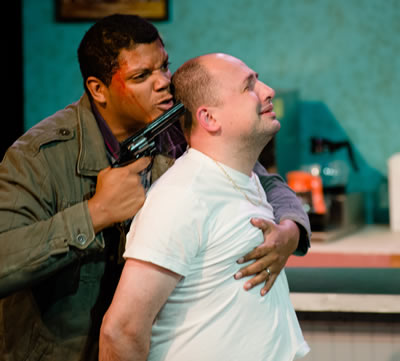
"Cops": Chaz Pando as the doomed perp; Nello DeBlasio as the hostage.

“Cops”: Chaz Pando as the doomed perp; Nello DeBlasio as the hostage.

My theater company is performing the 1976 Terry Curtis Fox drama “Cops” as we wind down this season after 20 years. I chose the show, and its companion piece in an evening called “Crime and Punishment in America,” William Saroyan’s classic one-act “Hello Out There,” in direct response to Ferguson, the growing controversy over police violence, the increased racial divide in the U.S. and the gun control debate. Both dramas, as cast, involve African American victims of violence in a law enforcement setting. “Cops,” in particular, features openly biased Chicago police (at least based on their choice of words) and the police execution of a disarmed and surrendering cop-shooter. As the lights fade, the police are discussing what their cover story should be.

I invited the Chief of Police in Montgomery County, Maryland, Tom Manger, to come to the production and field questions from the audience regarding its relevance to current controversies in Ferguson, New York City and across the nation. [Full disclosure: I have known Chief Manger and his wife for many years, and consider them friends] You might recognize him: he was a major figure in the apprehension of the D.C. Snipers, and has been seen and interviewed on the national news and on issue talk shows several times, most recently on CNN’s “State of the Nation” with Candy Crowley. Not only did Tom agree to come, but he let me schedule him twice, said the sessions could be videotaped, and that no question would be off limits.

The first of the talkbacks took place last week (I am moderating another this Sunday), and Tom was as good as his word—candid, blunt, open, and frank.  He was quizzed, hard, by our diverse, astute and always combative audience members about police training, police force diversity, bad cops, police who lie and cover-up misconduct, and racism in the ranks, as well as the details of specific shootings including the local one I have referred to here more than once, in which an unarmed white man, John Geer, was shot and killed by police as he stood in his doorway negotiating with them over a domestic dispute.

Since the episode in Ferguson, Chief Manger said, he has been meeting with community groups two or three evenings a week, doing everything he can to bolster community trust. Among his comments in response to questions: Continue reading

Ethics Observations On Mayor de Blasio’s Refusal To Apologize To His Police Officers

Integrity and leadership are not the same thing, Mayor...

Integrity and leadership are not the same thing, Mayor…

New York City Mayor Bill de Blasio’s relations with his own police force could not be worse, and this is not in the best interest of the citizens both the mayor and the police are duty-bound to serve. Can the rift be repaired?

This week de Blasio ruled out one avenue of peace: he said he would not apologize for his remarks following the Eric Garner grand jury decision not to bring charges against the officer who appeared to precipitate the unarmed black man’s death by using a choke-hold. The mayor said…

“You can’t apologize for your fundamental beliefs. The things that I have said were based on my beliefs, the truth as I know it. Can we do a better job communicating, and listening, and deepening an understanding of what our officers need? Yes.”

Fascinating.

I can’t think of a better example of a dilemma where the most ethical conduct is still irresponsible leadership, and thus, from the perspective of a leader’s obligations, unethical.

From an isolated perspective, de Blasio is asserting his integrity. “I could apologize and help smooth over my toxic relationship with the police, but that would require me to be insincere, and I’m not going to do that,” he is saying. He is saying that his constituents can trust him to be straight and honest, and if that means that he must pay a political price, he will pay it. This is admirable, on a human level. Praiseworthy…in a vacuum.

De Blasio, however, doesn’t have the luxury of being ethical in a vacuum. He is the mayor of a city with a lot of problems, controversies, obstacles to effective governance and people in need. The context of all of his words and actions must be his duties to address those issues, and his integrity, in this case, must be subordinate to getting the job he was elected to do done. Continue reading

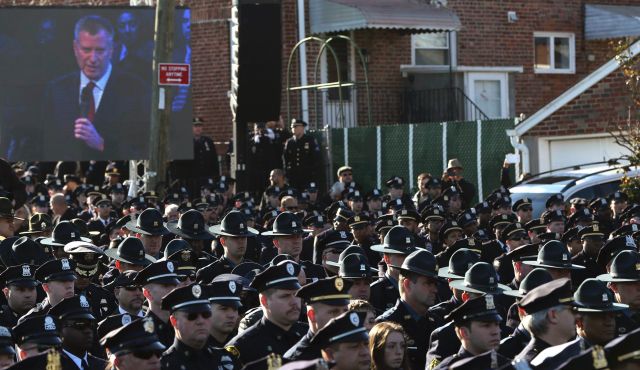
The NYPD Turns Its Back On De Blasio: What’s Going On Here?

NYPD backs

The rift between New York Mayor de Blasio and his city’s police department  is more than an internal spat. It has the potential to divide and harm the city and citizens, not to mention crashing the Mayor’s already self-jeopardized political career early in his term. Both sides if this dispute committed hostile acts that the other considers grievously disrespectful. Neither combatant appears ready to apologize.

De Blasio crossed what many of his department’s officers consider an uncrossable line when he suggested, in the immediate wake of the grand jury’s decision not to indict in the Eric Garner case, that his own bi-racial son was at risk of harm should he be apprehended by the NYPD. As I have written before, this was not, as the spinners would have it, just a case of a mayor being candid about genuine problem in community relations. This was a tacit endorsement of the “hands up” protests and their contention that Garner, Mike Brown and others were the victims of police racism, that police are killing, likely to kill, want to kill, black kids. It doesn’t matter that de Blasio may not have intended that implication: under the circumstances and in the context of events, this is what police officers interpreted his remarks to mean. He was siding against them. He was suggesting that the grand jury was wrong not to indict. He was suggesting not that some NYPD officers were racially biased, but that black children like his son “may not be [Translation: “are not“] safe from the very people they want to have faith in as their protectors.”

The police have responded with multiple demonstrations of anger and contempt for their boss. Most recently, there were boos and jeers when De Blasio spoke at a police graduation ceremony this week. Over a hundred officers symbolically turned their backs when the mayor spoke at the funeral of Officer Rafael Ramos, who was assassinated by a man who suggested that he was seeking vengeance for the deaths of Garner and Brown. That had followed the theme of an airplane-towed banner over the city that read,“Our backs have turned to you,”which in turn was inspired by the spontaneous gesture by officers present when de Blasio visited the hospital where the bodies of Officer Ramos and his partner lay.

The New York Times, which has been guilty of bolstering the “hands up” lie by carelessly linking the deaths of Brown and Garner as well as Trayvon Martin, none of which can be fairly blamed on racism based on available evidence, has come down squarely against the police, writing in an editorial: Continue reading