After The Brooklyn Cop Murders, The Sound Of Spinning: WindyPundit Takes On My “Smear”

None for me, thanks.

None for me, thanks.

Mark Draughn, a.k.a Windypundit and the Ethics Alarms 2013 “Blogger of the Year,”  has swallowed the Kool-Aid, apparently, and decided to defend the race-baiters, from the tippety top of our government to the stygian depths of MSNBC, who have finally managed to get police killed in retaliation for the “racist murders” of Michael Brown, Eric Garner, and others. In his most recent post he challenged my analysis, and ended up making me feel pretty good about it. I love Mark’s blog and admire Mark’s mind, and if can’t do any better than this, I am obviously on firm ground.

I want you all to visit Windypundit, for Mark is terrific (usually), so I’m not going to go through the whole post, which you can read here. I will make a few salient observations though. Let’s play “Mark Says”:

Mark Says:

“I knew there would be people who would take Brinsley’s reputed motive and use it to smear protesters and activists who had spoken out against police abuse.”

1. Mark wrote this before my straw man post, and sure enough, he followed the script. It’s about “police abuse.” Right. Not race. Not the racism of whites, the hunting down of black men; not about how blacks can’t get justice even when they have been gunned down with their hands in the air. Indeed, it’s not “about” any of the irresponsible, exaggerated, inflammatory accusations that we have been hearing since Trayvon Martin was shot…and not by a cop, either.

2. “Reputed motive.” Mark thinks I am unfair to conclude that a killer who wrote online that he was going to kill some “pigs” in retaliation for police killing Mike Brown and Eric Garner killed the two police officers in retaliation for police killing Mike Brown and Eric Garner.  Got it.

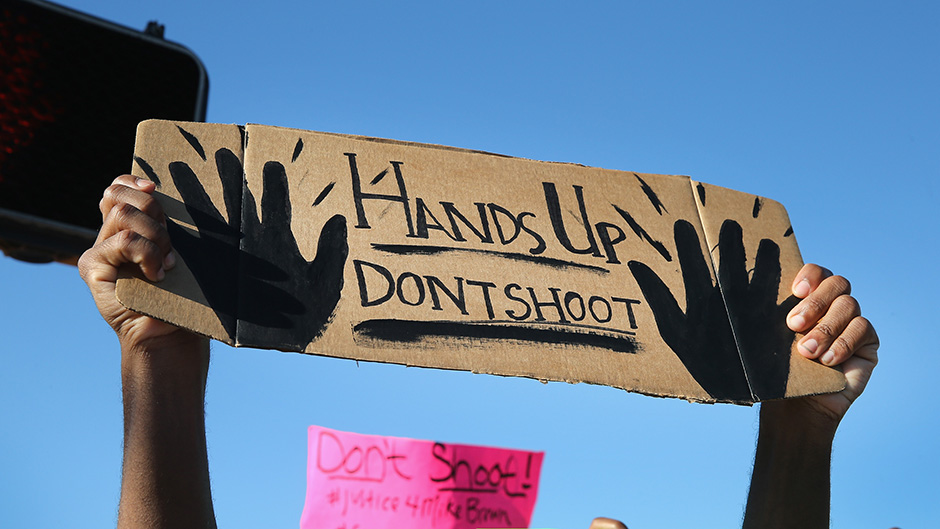
3. I’m smearing protesters! These are, recall, protesters who, by their use of the “hands up, don’t shoot” theme, were smearing a specific police officer with the false claim that he was a racist and a murderer, though the evidence says otherwise, and smearing the integrity of the citizens on the grand jury who refused to indict him.  By extending this smear to police generally, they were also asserting that this—that is, the fictional racist murder of that “harmless, unarmed black teen” who had just tried to take the officer’s gun and was charging all 300 pounds of his body at Officer Wilson—was the potential orientation of all white police.  I was smearing them by pointing out that this was divisive, inflammatory, dishonest and irresponsible. Continue reading
The Straw Man Cometh: Confronted With The Inevitable Results Of Their Race-Baiting, The “Hands-Up!” Crowd Claims It Was All A Misunderstanding

strawmanargument

Don’t let them get away with this.

The Straw Man logical fallacy occurs when a person ignores the actual issue being debated and substitutes a distorted, exaggerated or misrepresented version of the opposing position that is easier to rebut. For years, there has been an organized effort in the Obama Administration, the progressive movement, the civil rights movement and among black activists to represent American society as racist, along with the American law enforcement system and justice systems, and to maintain  the false narrative that racism was responsible for several high-profile deaths of black men, and that specific police officers, such as Darren Wilson, were guilty of racist executions and exonerated by a racist system.

The strategy has been richly fertilized by relentless accusations that white voters and the Republican party hold racial animus against Barack Obama because of his race. The deliberately divisive effort has resulted in a level of fear, anger and distrust of white Americans in the African American community not seen in over half a century, with white police officers serving as the immediate targets. Predictably, two New York City cops were assassinated by a deranged black man after posting social media messages referencing the deaths of Mike Brown and Eric Garner, and critics have correctly stated that the reckless race-baiters have “blood on their hands.” Sensing that a looming tipping point may be going against their divide and conquer agenda, they are ducking and weaving like Muhammad Ali in his prime. Continue reading

President Obama’s Unexpected Legacy: The Deadly Deterioration Of Racial Reconciliation And Trust

Murdered cops

I really hate thinking this, much less writing it.

At this moment, race relations in the United States are in a more precarious and dangerous state than at any time since the 1960s. The arrogance, incompetence, biases, and in some cases intentional political machinations of the nation’s first African American President and his party are substantially and perhaps primarily responsible for this tragedy. This is a catastrophe for the nation and its society, though one that the mainstream media will deny, obscure, or refuse to admit. It is still true.

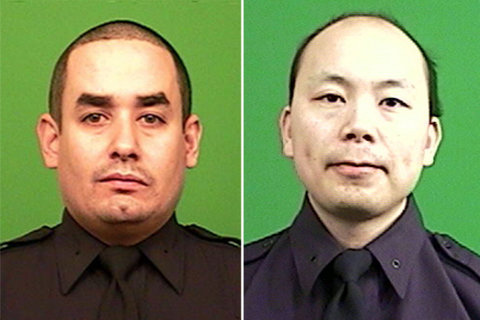
As we begin December 21, 2014, two NYPD police officers named Rafael Ramos and Wenjian Liu, one white and one Asian, are dead, having been assassinated by a deranged African American criminal who drove from Baltimore to New York in order to put “pigs in a blanket.” He announced his plan with message referencing the deaths of Michael Brown and Eric Garner, as well as “them” and “us”—“us” being black men, “them” being police officers.

You will hear and read Obama/Holder/Sharpton/ De Blasio defenders furiously denying the connection between these politicians’ repeated suggestions that white police officers were profiling black men and often killing them, and the racial hatred currently focused on police. They will say that the killer, Ismaaiyl Brinsley, was insane, and perhaps that he was more likely a lone wolf Islamic terrorist. The journalists  should be reminded that they were immune to such alternative theories when they blamed the Tucson attack that maimed Congresswoman Gaby Giffords on the rhetoric of Rush Limbaugh and Sarah Palin, even though the shooter in that case had no smoking hashtags that indicated any motivation other than insanity.

Ironically, their arguments apply fairly now, when they did not then. Re-read Paul Krugman’s infamous column from 2011, substituting the “climate of hate” he attributed to attacks on big government by conservatives (because, like the Michigan professor who authored this, Krugman doesn’t regard what he and other liberals express as hate, just well-earned contempt) with the real and deadly racial distrust and suspicion nurtured by the rhetoric of black leaders, progressive pundits, and others, suggesting that young, black men are being hunted down and killed for the crime of being black. Krugman won’t make that argument now, but if he had any integrity or objectivity, he would.

President Obama, elected on the promise that he would bring the races together, lit the long fuse for this unfolding disaster for our democracy in July of 2009, less than a year into his first term. A prominent African American professor, Henry Lewis Gates, Jr., acted like a jerk to a white Cambridge, Mass. police officer responding to a call, and was arrested for disturbing the peace. Obama, in the first of his many unethical pronouncements that interfered with local matters completely unrelated to his job, made public comments suggesting that Gates was treated unjustly because of his race. The facts indicated that Obama had impugned the character of not only a model police officer, but one recognized for extraordinary sensitivity in the area of black community relations. There was no public apology from Obama, however, and the fuse was lit. Continue reading

Ethics Observations On The Brooklyn Police Shootings

Hands up

Via Vox: Two Brooklyn police officers were shot and killed execution-style today by a lone shooter, an African American male named Ismaaiyl Brinsley, who had posted two messages on Instagram suggesting that he was putting “wings on pigs today” because “they take one of ours, we take two of them.”  The message was accompanied by hashtags referencing Eric Garner and Mike Brown. The shooter later killed himself, and had allegedly shot an ex-girlfriend as well.

Five Observations:

1. The dangerous escalation of rhetoric and the persistent  misrepresentation of facts by civil rights advocates, activists, journalists and pundits made this kind of episode nearly inevitable. You cannot flood the airwaves with constant references to “police shooting unarmed black men” as if there was an organized racist liquidation of blacks by police in the streets and not risk sparking violence from the hysterical, the deranged, the angry, the lawless and the desperate.

2. The irresponsible “hands up” protests did not cause these deaths, but they probably helped create the conditions that led to them. The shootings of the  two NYPD police don’t make the false “hands up” lie—which continues to assert that Michael Brown was executed when the evidence indicates he was not, and that there was racial bias involved, when there is no evidence of this at all—any more unethical, reckless or irresponsible than it already was. It was wrong from the beginning. It was wrong to assert these things before what happened in Ferguson had been investigated, and it was wrong to keep asserting them after it was clear that they were unsubstantiated or false. It is still wrong. It is still dangerous. Continue reading

Smith College President Kathleen McCartney’s Apologizes For Saying “All Lives Matter”: Is There A Problem?

Damned if you do, damned if you don't.

Damned if she does, damned if she doesn’t.

There is a problem, all right, but not the one you might think—at least not this time.

Smith College President Kathleen McCartney attempted to  show support for her students  protesting racism and police brutality by sending a campus-wide email titled, “All Lives Matter.” But the official slogan of such protests is “black lives matter.” McCartney immediately came under fire from black students and others, accusing her of minimizing the specific nature of her concerns. “No, Kathy. Please do not send out an email saying ‘All lives matter.’ This isn’t about everyone, this is about black lives,” Sophia Buchanan, a Smith student, in a typical critique.

The college President apologized several hours later, saying that she hadn’t thought about the fact that “all lives matter” was being used by some as a rebuttal to “black lives matter”:

“I regret that I was unaware the phrase/hashtag ‘all lives matter’ has been used by some to draw attention away from the focus on institutional violence against Black people…. “It minimizes the anti-blackness of this the current situation; yes, all lives matter, but not all lives are being targeted for police brutality. The black students at this school deserve to have their specific struggles and pain recognized, not dissolved into the larger student body.”

That statement put her in the cross-hairs of the “conservative media” and others, who treated it as a full-fledged “gotcha!” What??? Saying that all lives matter is offensive now? What next Orwellian proposition will political correctness bullies demand from spineless college administrators? Continue reading

Comment of the Day on “Comment of the Day on ‘The Perils Of Over-Regulating The Police: A Case Study'”

Robocop

Stephen Mark Pilling contributes the second consecutive Comment of the Day providing perspective on the issue of police militarization, in response to the first. Here is his Comment of the Day to the post (by dragin_dragon, which you should read first if you haven’t yet), Comment of the Day on “The Perils Of Over-Regulating The Police: A Case Study”

When critics speak of the “militarization” of the police, not all are looking at it from the same viewpoint. Some are, of course, sociopathic or are conspiracy theorists. Some have swallowed the loudly flaunted concept that policemen are evil racists, corrupt ward healers in uniform or just about anything heinous, as they represent law as an absolute, not a relative.

There is a rational based distrust, however. Many of us grew up in a time where the police still walked a beat or patrolled his neighborhood in a squad car, armed with nothing more than a revolver. We’re also the product of an old tradition of law enforcement that stems from the British mold. Unlike the continental European system of paramilitary gendarmes, we adapted a system of localized lawmen, run by an elected county sheriff. The metropolitan police department is still a relatively new phenomenon, started in late 19th Century London.

To many citizens, police who are unaccountable to a directly elected chief and who sport automatic weapons strike a sour note. But recently, people have been seeing them acquiring armored vehicles, military assault training and a tendency to wearing black uniforms. They’ve also noted an increased likelihood of these tactics and weapons being utilized and the increased incidence of “no knock entries”. Likewise, citizens have been imaging police making arrogant idiots out of themselves and caused other cops to become ever more touchy about cell phones, whether they’re right or wrong.

These and other factors have been serving to create a gap between the citizens and the police. That’s never a good thing, of course, because that trust is vital in a free society. Citizen distrust only deepens when they perceive policemen in whom this sense of civil mastery is full blown. As a former military cop, as a private citizen and as a friend or relative of a lot of civilian cops, I’ve seen all this from different angles. I’ve also seen the divide deepen in recent days.

One small note. The funding of police units on all levels directly from federal sources coincides with the worry by many that state and local police units may be more or less within the pocket of federal departments. The actual militarization of once innocuous federal police units and the memory of Obama’s projected National Civilian Defense Force has resulted in fear that this is an intentional part of a program to create an instrument of oppression. For myself, I highly doubt that any street cops would lend themselves to some “martial law” based takeover of the homeland of America. What I’m not sure of, though, is how many in higher authority have not conceived of the notion and would execute it if they could.

Again; it’s vital that the bonds of trust be strengthened between the police departments and those law abiding citizens whom they “serve and protect”. They must never- ever- be heard to make disparaging remarks about “civilians”, as that only deepens the gulf. In the Army Military Police Corps, the official motto is “Of the troops and for the troops”. It’s a good motto. It should also carry over to every local police or sheriff’s department in America. “Of the citizens and for the citizens”. Policemen who embrace that attitude will seldom go wrong. Both they and the communities they serve will benefit.

Continue reading

Comment of the Day on “The Perils Of Over-Regulating The Police: A Case Study”

militarization

ABC News Political Analyst and former Bush advisor Matthew Dowd said on ABC’s This Week  that the recent cases of police violence involving unarmed African Americans were as much due to the militarization of police forces as race.

“We basically dress up officers as if they’re machines,” Dowd said. “And then we expect them to act like human beings. So what happens is, they confuse power with force. Most of the officers in this country do a great job. But when we militarize our police force and dress them up like machines, they act like machines.”

Technically, he was right: there is no evidence that those tragedies were caused by race or militarization. He had exactly no evidence or documentation that the “militarization of police” caused these deaths, or that alleged militarization has caused any deaths. This appears to be emerging conventional wisdom, just one of those things someone says and everyone nods in agreement with no real thought. Why is the so-called “militarization” of police forces such a threat or cause to distrust police? If police are not trustworthy, that’s a reason not to give them fire-power, but having more fire-power doesn’t make them less trustworthy. It simply makes it more important than ever that police be well trained and responsible.

I was preparing a post about this emerging theme as an example of bias, in this case, pre-existing anti-police bias, being translated into false and discourse-warping assumptions by activists and the police when stalwart commenter dragin_dragon delivered this, the Comment of the Day, on the post The Perils of Over-Regulating the Police: A Case Study:

Police departments have been quasi-military for many years, and it has not seemed to hurt their ability to enforce the law. As early as 1974, Austin, Texas P.D. referred to it’s officers on patrol as “the troops”. S.W.A.T. units have traditionally used what they thought of as “Military” weapons, tactics and mode of dress; never mind that a properly trained infantry squad could and would wipe them out in minutes. Note, also, that most states and/or cities ban the mounting of weapons on the surplus (obsolete) armored and tracked vehicles or helicopters. They do NOT ban a man carrying a weapon being mounted on those vehicles. I also point out that many police officers are ex-military so are bringing to the job an environment with which they are already familiar. Rank structures are similar, and the police in the United States, at least, carry weapons, perhaps as a holdover from the Old West, perhaps not.

Given the rise in crime rates (see Chicago, Detroit), many of these escalations of Police equipment and training are needed. This became evident a number of years ago when a Los Angeles bank robbery went south and the robbers began shooting at the converging police with automatic (not the semi-automatic versions described as automatic, but rock-and-roll full automatic) assault weapons. The out-gunned police (9 MM pistols and shotguns) did the best they could and, like Israel, vowed “Never again”. Strangely enough, many in the National Media agreed, at the time. So, what we are referring to as the “Militarization” of the Police is being undertaken for 2 reasons: 1) to provide a higher likelihood that the officers will get to, at the end of the day, go home to family, and 2) so that the public, which they are sworn to protect and defend, will also, at the end of the day, get to go home and family.

Does this increase the likelihood that a perpetrator may not make it to trial? Quite likely. Do I care? Not so much. As I am sure will be pointed out repeatedly, death tends to be relatively final, with no appeal. And, after all, the most dangerous criminal has the right to due process. Unfortunately, crime, violent crime, is not something one does accidentally. It requires a conscious decision, often along with a misplaced almost arrogant sense of invincibility. Getting shot, and probably killed is the most natural consequence in the world of that attitude. Ask Michael Brown. Like it or not he jeopardized the well-being of an armed police officer, apparently arrogantly disregarding the consequences of his behavior and, quite probably putting the officer’s life at risk. I am assuming that Wilson, like many police officers these days, was wearing a very militaristic bullet-proof vest under his shirt, but, since Ferguson is a fairly poor community (and rapidly becoming poorer) possibly not, so he might have been better off if Brown had shot him, first. At least he would still have a job.

All this is by way of saying that militarization of departments is not necessarily a bad thing. The use to which the training and equipment is put may be a bad thing, but I have not seen, in any report, any attempt to oppress or exert Nazi-like control over the citizenry. So, am I in favor of the “Militarization”? You bet. I am in favor of anything that makes it more likely that they will be able to survive the work day. And make no mistake, that is always a question for a police officer, just like it is for the combat soldier. Am I also in favor of more and better training? Also, you bet. Need I repeat? And the management, or “command” element of the police need to be taught How and When to use the equipment and training.

Continue reading

KABOOM!* Our Hyper-Sensitive Future Lawyers

headexplode

Well, friends, for the second time this month my brains are on the ceiling, walls and floor again, and I’ve had to gate the dog so that…well, you know.

Columbia Law School announced that it is permitting students who are so devastated by recent non-indictments in the Michael Brown and Eric Garner matters to postpone taking their final exams. Isn’t that nice?

By “nice, “I mean stupid, irresponsible and embarrassing. You can read the Dean’s nauseatingly delicate statement here: I don’t want it polluting the blog, so I’m not going to quote it. Besides, if I look at it again, who knows what else might be on my walls. Continue reading

Transparency, Causation, Eggshells, Trust : Seven More Ethics Issues In The Eric Garner Case

jigsaw-puzzle-record

1. There is near unanimity in the response to the non-indictment by the Staten Island jury in the Eric Garner case. In light of the graphic video, it is hard to see how there wasn’t probable cause to indict. The coroner verdict of “homicide” would see to provide sufficient evidence all by itself. However, in the absence of the complete record of what the grand jury heard and saw, nobody can be certain that this was a miscarriage of justice. However, given the context of the case and its deleterious impact on faith in the justice system, that is no solace and scant mitigation. As in Ferguson, it is prudent and essential that the public see what the decision was based upon. It is true that those who are determined to see injustice, bias and racism will do so regardless of what the evidence shows–again, as in Ferguson—but the only evidence that has been made public, the various videos and the officer’s testimony–only makes the non-prosecution more suspicious.

2. Can the non-prosecution be justified? If so, the only reason I can see would be lack of proof of causation. Causation is tricky, and  juries get confused about how to analyze it. Since it is fair to assume Daniel Pantaleo did not intend to kill Eric Garner, the issues are a) whether his actions during the arrest were negligent, and b) whether they were the proximate cause of Garner’s death. That his conduct was negligent is not enough to sustain and indictment—that negligence had to be the reason Garner died. Remember, he was not choked to death. The medical examiner ruled that Garner died from a collection of factors: compression on his chest and throat, the position he was forced into, his obesity, weak heart, and asthma, all causing asphyxia.

  • If Pantaleo’s actions alone would not have caused Garner’s death, then it could be legitimately argued that he was not guilty of a crime. The other officers were given immunity for their testimony, which seems like either a bad decision by the district attorney, or intentional sabotage of the case against Pantaleo’s. If it was the collective action of the police that caused Garner’s death, it would be unjust to make Pantaleo the sole officer punished. If some of the testimony from the unchargeable cops made the case that it was another officer, or several, who really caused Garner’s death, that would explain the no indictment result.

In the widely seen video of the arrest, Pantaleo can be seen with his arm around Garner’s neck as Garner is taken to the ground and for some time thereafter, but in watching the video it’s difficult to determine whether Garner was in fact choked. And if he was, it did not appear it was long enough even to render him unconscious, much less kill him…I saw nothing excessive in the manner in which the officers subdued Garner. He was neither beaten with batons nor even punched. To me, it appeared to be a fairly typical scuffle with a large man who had clearly demonstrated his unwillingness to be arrested peacefully.

He misses the point. The question is whether the take-down was excessive for Garner, not some theoretical average arrestee. It is true that with a normal, healthy subject, what the officers did would not typically cause death….but Garner was obviously not normal, nor healthy. He was morbidly obese, and 350 pound middle-aged people tend to have the kinds of heath issues Garner in fact had. Nobody would argue that an elderly woman or a ten-year old girl or someone in a wheelchair should be manhandled like that. Such treatment was negligent for Eric Garner, and the deadly result could and should have been anticipated.

It is true that the officers couldn’t know that Garner had a weak heart and suffered from asthma, but it doesn’t matter: the rule in negligence is that “you take your victim as you find him.” If your negligence is the proximate cause of someone’s death, the fact that it wouldn’t have caused anyone else’s death is no defense. This is the so-called “Egg-shell Skull” rule.

Garner was an egg-shell perp. Continue reading

Observations on the Eric Garner Non-Indictment

http://www.youtube.com/watch?v=En5linhM7Qo

The New York Times, among others, reports that the Staten Island grand jury has brought no indictment in the Eric Garner case, in which a large African American man resisted arrest and was brought down by multiple cops, as one, Daniel Pantaleo, used a choke hold to restrain him. After saying that he couldn’t breathe, Garner, who was asthmatic, stopped breathing and died

Observations:

1. I haven’t seen all the evidence, and stipulate that there may be some good reason for the non-indictement that I am not aware of. That aside, however, it certainly seems like this case embodies many of the features that were not present in the death of Michael Brown but that the media and activist narrative attributed to it nonetheless. Garner’s case, in contrast, appears to demonstrate an unwillingness of the law enforcement and justice system to hold police officers accountable for the results of excessive force, even when the result is death.

2. Again, absent some significant evidence that has not been made public, I believe that the video of the fatal arrest, the fact that the choke hold tactic is prohibited by police department policy [ Note: I originally wrote that it was illegal; that was in error, and I apologize for the mistake], and the coroner’s verdict that Garner’s death was a homicide should have been sufficient to mandate the grand jury finding probable cause for at least a charge of negligent homicide.

3. This seems like a result worthy of protest. It is one more reason why activists continuing to use Brown’s death as a rallying point is foolish and wrong. For their purposes, it is a weak case. Garner’s is not. Continue reading