Ethics Inquiry: Did Sen. Cruz Do Anything Wrong?

Cruz trip

As Bill Clinton might say (and probably has, maybe more than once), it depends on what your definition of “wrong” is.

Millions of Texans were left without electricity this week in the middle of the state’s power crisis following a massive winter storm. The Senator’s wife Heidi sent text messages to friends and neighbors complaining that their home was “FREEZING,” and that she wanted the family to escape on the 17th to someplace warmer, at least until Sunday. The mission, if her husband chose to accept it: get to the luxury Ritz-Carlton in sunny Cancún, Mexico. The destination is apparently a family favorite. The GOP Senator did accept, and the Freezing Cruzes fled Houston, hopping an afternoon flight. The consensus of the news media, the commentariat and social media was that…

In fact, you would think Cruz had been caught having a secret romantic rendezvous with a goat. Incriminating photos of Cruz and his wife boarding the flight launched a full-fledged scandal. How dare he flee a crisis when his state was in misery? Ted responded by playing the Parent Card, explaining he had flown to Mexico “to be a good dad” and to chaperone his daughters and their friends, and he promised he was coming back yesterday, which he did.

When he returned, Cruz admitted that his family trip had been a mistake. That is undeniable.

But was it unethical? Was it wrong?

Continue reading

Integrity Test At Harris -Teeter’s

I was doing a quick shopping run this afternoon at the local Harris Teeter’s, and ran into one of those little ethics challenges that eventually define us all.

As I was placing all my items on the conveyor belt, the nice old guy loading my cart—he’s helped me before—pulled the cart ahead so he could start putting in the bags. I had to catch up to to it to rescue the soft-drinks in the lower section of the cart. Eventually all was well and I was checked out— I saved 50 bucks!—and I rolled my bounty into the parking lot where I began loading it all into the trunk. Just as I thought I had finished, I noticed a large pack of paper towels (speaking of Bounty), maybe 15 dollars worth, sitting in the bottom of the cart in the front where I had originally put it. I got a horrible thought: had I left teh store without paying for it? I didn’t recall putting it on the belt. I decided that it must have escaped the old bagger’s attention when he pulled my mostly empty cart past the register.

So I was a paper towel thief. Now what? There was a huge line at all the registers. I could take the package to the customer service counter, but my receipt had the name of the cashier on it, and I worried that I would get her in trouble. I’ve been in these mess-ups before, and usually everyone would rather just avoid the hassle of getting it straight. I even considered driving back to the store tomorrow and just paying the money after explaining what happened. I checked the receipt, and didn’t see the item, but then I didn’t see several things I knew I had purchased. After avoiding several bouts of “Oh, hell, it just paper, why not go home and forget about it?,” I decided to be late coming home and to just get at the end of the line with the paper towels.

Continue reading

Comment Of The Day: “Who Killed ‘Judith’s’ Baby?”

Enigmatic commenter Extradimensional Cephalopod (that’s not him in the picture, just a relative) returned to Ethics Alarms after an unexplained absence (though who knows how time passes in his dimension) to provide one of several excellent observations on the post and poll about “Judith,” the expectant mother whose faith in a “freebirthing” cult cost her unborn child his life. The comments of Tim LeVier, Humble Talent, JutGory, and Mrs. Q, among others, were all Comment of the Day worthy, but for now, I’m going to award EC the prize.

Here is the current state of the poll…

…and here  is Extradimensional Cephalopod’s Comment of the Day on “Who Killed Judith’s Baby?”

First off, I’m grateful for all the nuanced and well-considered opinions here. I can always count on getting reasonably well-balanced information about human society from people’s experiences here, and the encouragement that reasonable people are not alone–just not yet organized.

The poll didn’t let me vote multiple times, but I’m tempted to select “all of the above,” in the sense that “responsible” can mean “contributing to the problem and needing to change.” For “primarily responsible,” I’m obligated to go with “Judith,” since she is presumed to have ultimate decision-making authority in this case.

That survey question by the National Partnership for Women & Families spins so hypnotically, I’d like to take it off its axle.

“Giving birth is a natural process that should not be interfered with unless absolutely medically necessary.” Who wouldn’t agree to that?

1. Yes, giving birth is objectively and literally a natural process, in that humans didn’t deliberately design it. (Although I wouldn’t put it past them to have done so under a tight budget of time and money. I’ve supported software rollouts that were just as awkward and painful.)

However, stating something to be “a natural process” in so many words implies on an emotional level that it is by default perfectly healthy and should remain purely natural, which is an appeal to nature fallacy. “Cancer is a natural process.” “Epidemics are a natural process.” “Hurricanes are a natural process.” There are plenty of natural things that I am very grateful civilization has altered or wants to alter using technology. Continue reading

This Explains A Lot, I Guess…

Here’s another planned post from those lost notes on a Sunday Times I just found from two weeks ago:

In  the New York Times Magazine,  the Times announced the results of an online poll of 2, 903 subscribers by its research-and-analytics  department. 72% Times loyalists would prefer to have done something horrible that only they knew about than to have everyone think they did a horrible thing that they really didn’t do.

Wait…what?

See, if you did a secret horrible thing, there really was someone hurt by your conduct. If people just think you did a horrible thing, you in fact hurt nobody, and did nothing wrong. This was a sneaky way of asking, “Are you a selfish and unethical human being, or not?”  Well, sneaky assuming that Times subscribers are incapable of thought, or that they let their 12-year-old kids answer Times research questions. About 3/4 answered, “Oh, I’m completely unethical!”

For the sake of clarity, let’s assume that both sides of the question involve the same horrible act, agreed? After all, if the real act is setting an orphanage on fire, and the wrongly believed act is farting loudly during a funeral service, or vice versa, the question is ridiculously easy.

So…72% of Times subscribers would rather have murdered a child than have everyone wrongly think they murdered a child? Molested a child? Broiled and eaten a child? Committed adultery? Spousal abuse? Spousal torture? Buried a spouse alive? Keeping a spouse locked in a dungeon? Locking a spouse in a dungeon with rabid wolverines?

What does this poll result tell the Times? What were they trying to learns? What does it tell us?

I guess it might explain the continued presence of the likes of Charles Blow, Thomas Friedman and Paul Krugman on the Times op-ed pages.

Or maybe their presence explains why Times subscribers reason as they do.

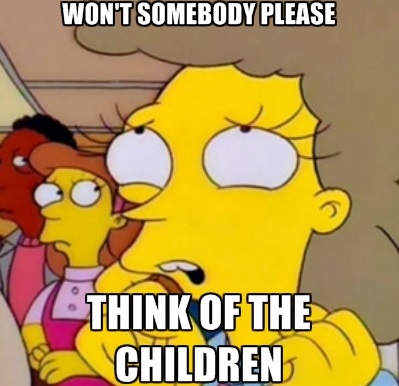
By Popular Demand: Welcome Ethics Alarms Rationalizations #55, “We’re Better Than This!” and #56, “Think of the Children!”

Think of the Children

About a week ago, I asked readers whether “We’re better than this!,” at the time being wielded like a club by Democrats to counter various Republican proposals to control, limit or cease the immigration of Muslims into the U.S., was a true rationalization that deserved inclusion on The List. The response suggested that most of you felt it was, and upon reading the responses, I agree. A rationalization is an invalid and dishonest argument used to advocate or defend questionable conduct. “We’re better than this!” fits that description, and thus I officially dub it Ethics Alarms Rationalization Rationalization#55, “The Idealist’s Delusion,” or “We’re/ You’re Better Than This.”

Like the other rationalizations, “The Idealist’s Delusion” may sometimes be fair and true, but it is still an unethical argument if there is nothing more substantive to back it up. Think of it as the reverse of  #14. Self-validating Virtue, in which unethical conduct supposedly becomes ethical because the person doing it is deemed—usually by himself— incapable of wrongdoing. Rationalization #55 uses presumed virtue to claim that a potential actor is too good to do something…without ever making the case that the considered conduct is really wrong or unwise.  #55 is a pretty neat trick, when you think about it: it simultaneously appeals to an individual or organization’s self-esteem while unilaterally declaring an objective, motive or methods demeaning. This relieves the advocate for avoiding the conduct in question of the requirement to make the case with more than vague declarations of principle. If #55 is effective, it can only be because those persuaded never engaged in critical thinking, asking and answering such crucial questions as what are the benefits of this proposed action, who will it benefit, what ethical principles does it follow or violate, and are the intended results worth the cost? The Idealist’s Delusion is a cynical tool to bypass ethical decision-making by assuming the result, and using ego and guilt to stifle objective analysis. As I wrote in the earlier post.

When “We are better than this” is followed by “because..’ and more substantive points, I have no objection to it, although “we should be better than this” is fairer. It can begin an analysis, but is not an analysis itself. However, when it is used as a substitute for analysis, it is pure rationalization.

I am also finally adding “Think of the Children!” to the list, as Rationalization #56, The Universal Trump. Continue reading

Ethics Quiz: “Rear Window” Ethics At The Ball Game

RearWindow1

The New York Daily News recounts the tale of two sisters attending an Atlanta Braves game who exposed a man’s cheating wife by taking photos of her as she apparently sexted another man with her arm around her husband. Delana and Brynn Hinson posted photos of her texts on Twitter.

The sisters said they slipped a note to the woman’s suspected husband as he was leaving, which read,

“Your wife is cheating on you. Look at the messages under Nancy! It’s really a man named Mark Allen.”

You can read the details—accurate or not—here.

I don’t care if the story is exactly as it was reported. Let’s assume it is.

The Ethics Alarms Ethics Quiz for the day is this:

Did the sisters behave ethically when they informed the husband about his wife’s secret texting?

Continue reading

Presenting Rationalization #45: The Abuser’s License, or “It’s Complicated”

complexity

I owe Carol Costello for this one, which she unveiled today while explaining why it was unfair to criticize Janay Palmer for marrying Ray Rice, the pro football star who punched her lights out in a hotel elevator when they were engaged.  “It’s complicated,” Carol said, as her entire argument, as if this settled the issue.  My rationalization alarm immediately began clanging. Then I thought about all the other times I have heard that explanation used to avoid accountability or blame for wrongful action. Thus Ethics Alarms will add to its useful and always growing Rationalizations List…

45. The Abuser’s License:  “It’s Complicated”

 Costello later noted that the decision to stay with a potentially deadly partner was related to the emotion of love, as if love deserves an ethics pass that other emotions do not qualify for.  In this context, “It’s complicated” is a matched set with #23. Woody’s Excuse: “The heart wants what the heart wants.”

Love does not get a pass, or warrant one. Love is one of the most powerful of the non-ethical consideration magnets that stop ethics alarm clappers from moving when they should, and the sentimental, warm and fuzzy tradition of excusing harmful, irresponsible, clearly wrongful conduct because it might have been motivated by love is a rejection of ethics in favor of romance. Love is not the most benign of impediments to sound ethical reasoning, but rather one of the most insidious. Some of the worst crimes in human history have been rationalized by lovers. If the the coded meaning of “It’s complicated” is “it’s love, and we can never plumb the mysteries of the heart!”, the sentiment should be received with exactly the same contempt as “It’s greed,” It’s hate,” or “It’s revenge.”  Continue reading

Unethical Ad Of The Month: Kurl-On Mattresses

A phenomenon I have never understood and will never understand is the destructive herd mentality in group decision-making. Yes, I know there is peer pressure and ass-kissing and strong motivation to go along with the crowd, but when an organization is considering something mind-blowingly stupid, including actions that should set off every ethics alarm within 20 miles, why is it that nobody, not a single person, steps up and says, “What??? Are you all insane? You can’t do this, and here’s why: it’s stupid! It’s obviously stupid. Think about it for ten seconds, and you’ll know it’s stupid, and will be a disaster for everyone.”

But nobody says it. So we get the Titanic without enough life boats, and Pickett’s Charge, and Lawn Darts and a sequel to “The Exorcist” featuring James Earl Jones dressed as a giant locust. On a slightly less epic scale, you get this mattress ad, by the Kurl-On company in India :

Mattress ad

Continue reading

“The Walking Dead” Ethics: The Toughest Leadership Dilemma Of All

“Michonne, you’re gone..these are words that Rick choke upon, my Michonne…

“Michonne, you’re gone..these are words that Rick should choke upon, my Michonne…

In the absence of “Homeland,” currently waiting for Claire Danes to get back in shape after becoming a mom, AMC’s “The Walking Dead” is the best ethics show on TV. Apocalypse ethics is instructive and fascinating, because it addresses ethical problems as they were originally considered, before laws, before enforcement methods, and before organized morality. The objective is survival and continuation of the tribe and the species, without abandoning all semblance of humanity.

Yesterday’s episode built to an ethical dilemma of major consequence; naturally, some reviewers thought this was boring. Rick, the former sheriff leading the (mostly) good guys through the zombie-filled wilderness that was once the United States, is trying to protect the group’s refuge, an abandoned prison, from the imminent attack of a larger, better-armed commune run by a deranged psycho who calls himself “the Governor.” A former member of Rick’s group who now consorts (cough!) with the Governor (and who has been rightly condemned as an idiot for doing so, since she either knows or should know that he has the basic instincts of Vlad the Impaler), attempts a mediation to avoid bloodshed, and Rick and the Governor meet to parley. Continue reading

Perry, Insomnia, Leadership, and the Death Penalty

When should a leader lose sleep over a decision?

A lot of ink has been spilled over NBC’s Brian Williams’ question to Rick Perry regarding the death penalty, the Republican candidates debate audience’s strange reaction to it, and Perry’s response. Conservatives see Williams’ question—“Your state has executed 234 death row inmates, more than any other governor in modern times. Have you struggled to sleep at night with the idea that any one of those might have been innocent?”—as a loaded query by a biased questioner who is pressing the progressive anti-death penalty agenda. Liberals see Perry’s answer as proof-positive that he is an unthinking, unfeeling, blood-thirsty monster. Continue reading