The NFL’s Replacement Ref Dilemma

There are some things even football fans won’t stand for. I think.

It was Week #3 of the NFL season, and there is a growing consensus that the replacement referees, the consequence of the NFL’s labor dispute with its regular refs, are making, if not a mockery of the game, a mess of it. The ethics issue: at what point is the quality of the NFL’s product so compromised by sub-professional officiating that the league is cheating the public by presenting it at all?

Airlines don’t use replacement pilots when pilots go on strike; they wouldn’t dare. Chicago didn’t hire street mimes to stand in for the striking teachers. In the NFL’s case, it is making the calculation that football fans will put up with lousy officiating if the alternative is no games at all on Sunday. Meanwhile, the NFL still charges the same outrageous prices for its tickets and still collects full value in merchandising and TV revenue. Translation: It is getting full price for a less than complete product. Is that ethical? Continue reading

Trayvon Martin Ethics Train Wreck Update: The Wreckage So Far, and The Wreckers

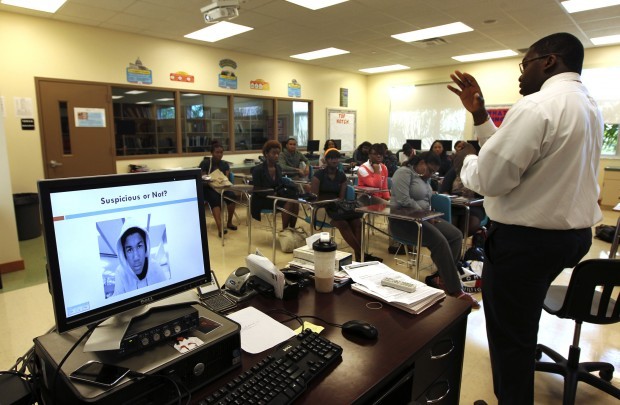
The "George Zimmerman Is a Racist" segment in Clinton Mitchell's high school ethics class.

Gallup released a poll yesterday, showing:

  • African-Americans are nearly five times more likely to be convinced that gunman George Zimmerman is “definitely guilty” of a crime than non-blacks.
  • 75% of African-Americans believe that racial bias led to Martin’s shooting, whereas less than half of non-blacks do, though a majority of the public believe that race was a factor in the tragedy.
  • 73% of blacks, about twice the percentage of the rest of the population,  believe that Zimmerman would have been arrested if the person he shot was white.

What we now have, clearly, is  significant, dangerous, and festering racial distrust, not created solely by the Trayvon Martin incident but exacerbated by it. This can only harm race relations, law enforcement, and the nation generally, and yet it is beyond argument that this divide has been encouraged and nurtured. Obviously the potential already existed, and one would think that responsible figures in public life, the civil rights establishment, elected office and the media would take the responsible course and attempt to minimize the shooting’s potential for increasing racial divisiveness in America.

They did not. Once again, they ripped the scab right off racial healing, and did so recklessly, cruelly, ineptly, and in some cases, maliciously. They are still doing it, or passively allowing it to be done by others. This is wrong, and shockingly so. Rational and fair analysts and observers all along the ideological spectrum should be saying so, but they are not. Fairness and honesty should not partisan issues. Playing the politics of hate and divisiveness is a threat to the fabric of the United States of America and in this case, risks unraveling decades of progress in race relations and understanding. There can be no excuse for it, and yet the primary culprits reside among the most influential and prominent institutions in the country. Journalists. Congress. Civil rights organizations. Pundits. Educators. And the President of the United States. Continue reading

Obama, Trayvon Martin, Biases and Kansas City Burning

In Kansas City, Missouri, a 13-year-old East High School student was walking home after the end of his daily classes when he was grabbed by two older teens just as he reached his front porch. They pinned his arms behind his back,  poured gasoline on him, and set him on fire. The victim of the attack was rushed to an emergency room, where he was treated and released. Doctors fear possible damage to his lungs and eyes, but outside of losing his eyebrows and some hair, he only suffered first degree burns.

The boy is white; his attackers were black. They allegedly said, as they were lighting him aflame, “You get what you deserve, white boy.”

This frightening incident occurred on March 2. I only recently learned of it, because the news media didn’t treat it as a national story. Though the boy’s attackers have not been found, no activists are demanding that the police chief resign. There have been no marches or protests, and students aren’t walking out of Kansas City schools. Nobody, as far as I can determine, has claimed that this is just the tip of a lurking race iceberg, and that it shows the racial hate of blacks toward whites that is hidden by the media and the culture. Most of all, the President of the United States did not say , just to give a wild, hypothetical example… Continue reading

“It’s A Wonderful Life” Ethics, Part 3

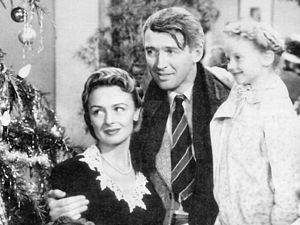
Here is the final installment of the Ethics Alarms overview of the ethical issues raised in Frank Capra’s classic. Some of the comments on Parts 1 and 2 have suggested that my analysis is unduly critical. Nothing could be further from the truth. I love the movie, and have already said that I find it ethically inspiring. Noting that characters act unethically in a movie about ethics is no more criticism than pointing out that people in horror movies never just leave when things start getting weird (as I would). I know that their actions drive the plot and are necessary. This is, however, how an ethicist watches a movie with as many ethical choices as “It’s A Wonderful Life.” I can’t help it.

Now back to George, Mary, and Bedford Falls:

11. Uncle Billy screws up as we knew he would

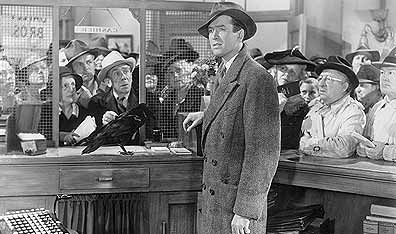
11.  Christmas Eve arrives in Bedford Falls, and Uncle Billy manages to forget that he left the week’s deposits in the newspaper he gave to Mr. Potter. Thus more than $8,000 is missing on the same day that the bank examiner is in town. Why is Uncle Billy still working for the Savings and Loan? He’s working there because George, like his father, is putting family loyalty over fiduciary responsibility.  Potter, of course, is a thief; by keeping the lost money to trap George, he’s committing a felony, and an unnecessary one. As a board member on the Savings and Loan, Billy’s carelessness and George’s negligence in entrusting him with the bank’s funds would support charges of misfeasance. Mr. Potter, had he played fair, might have triumphed over George legitimately, and no Christmas miracle or guardian angel could have saved him. But this is the inherent weakness and fatal flaw of the habitually unethical: since they don’t shrink from using unethical devices, they often ignore ethical ways to achieve the same objectives that would be more effective.

12. George folds under pressure Continue reading

“It’s A Wonderful Life” Ethics, Part 2 (of 3)

When we last saw George Bailey, he was defending his father’s dubious loan practices. In this, Part 2 of the three installments of  “It’s A Wonderful Life” Ethics, we take the saga up the fateful Christmas Eve when George Bailey meets his guardian angel.

6. George’s Fork in the Road

George Bailey’s decision to give up his plans to go to college to save the Savings and Loan is clearly not motivated by his personal dedication to the institution; he doesn’t like the place. He says so over and over again. He admires his father’s motivations for starting it. Had Potter not sparked his resentment with his nasty comments about George’s late father, George would have been out the door. But his passionate speech in rebuttal of Potter’s words put him on the spot: after those sentiments, turning down the Board’s appointment of him to be the new operating manager of the S&L would have made George a hypocrite in his own eyes, and rendered his passion  laughable. If George had integrity, then he had to accept the appointment.

It is one of the most interesting ethical moments in the film, because it represents a realistically complex ethical decision. George does what he does for selfish reasons as well as altruistic ones, and irrational reasons as well as considered ones. He wants to respect himself; he fears what might happen to his family and the community if Potter becomes the only financial power in town, and knows he will feel guilty if the consequences are bad. He feels like not staying will be taking Potter’s side over his father’s—completely irrational, since his father had given his blessing to George’s college plans, and wasn’t alive to be harmed by whatever he chose to do anyway. A large proportion of George’s decision seems to be motivated by non-ethical considerations, for he doesn’t like Potter—even hates him, perhaps—and wants to stick it to the old tycoon by foiling his victory. There are few ethical decisions in real life that are made purely on the basis of ethics, and Capra makes George’s decision wonderfully impure. Continue reading

Loop-Hole Ethics and The New York Times

The NYT’s website paywall plan floats in a sea of holes.

Ariel Kaminer, author of “The Ethicist” column in The New York Times Magazine, made an interesting assertion in her answer to a reader who asked about whether he could exploit several loop-holes in the Times’ new paywall plan for its website.

Noting that he was a struggling freelance journalist who visits the Times website often, he asked if it was unethical for him to use his parents’ free access to the content, since they are subscribers.  Then he Mused about other scenarios. “If I buy online access, can I share the password with my live-in girlfriend, even if I move to New York for the summer? What about our other housemates?” Continue reading

Blogger’s Ethical Dilemma: The New York Times’ New Plan

I'm gonna hate to lose you guys!

The New York Times announced yesterday that it will begin charging for content on its website. After 20 articles have been read by any user within a month, that user will be required to purchase a $15 a month access fee, or forgo the “Grey Lady,” online at least. (Subscribers to the paper will have still have unlimited free access to the digital version.)

For bloggers like me, who rely on hundreds of on-line sources for my ethics commentary, the new Times plan poses an ethical dilemma. Continue reading

Michael Palmer’s Ethics No-Brainer

Physician/novelist Michael Palmer is something of the new Michael Crichton, though unlike the eclectic late author of “Jurassic Park,” Palmer generally restricts himself to medical thrillers. He is promoting his latest novel, “A Heartbeat Away,” with a series of “ethics brainteasers,” as he called them in a recent Twitter post. Here is the latest, which he posted on his Facebook page and asked fans to discuss:

“What if a close friend confides to you that he/she has committed a heinous crime and you promise that you’ll never tell. However, you soon discover that an innocent person has been accused of the crime and is possibly facing significant jail time. You plead with your friend to give him/herself up, but he/she refuses and reminds you of the promise. What should you do? What if the if jail time was only a few months? What if the sentence was death?” Continue reading

Golden Globe Ethics: Ricky Gervais’s Hosting Dilemma

Hollywood is buzzing and griping about the manner in which Ricky Gervais chose to host the Golden Globe Awards last night. The L.A. Times pronounced him “too nasty,” and it was clear as the night went on that his pointed and often personal jibes at the film and television egomaniacs filling the ballroom at the Beverly Hilton were often infuriating or embarrassing his targets. There was even speculation during the show (via Twitter) that he had been fired mid-ceremony. Continue reading

Ethical Insights From The Great Butter Tub Debate

Colleague Rushworth Kidder has an enlightening ethics post on his Institute for Global Ethics site. After watching two diners scoop up handfuls of a restaurant’s butter tubs on their way out, Kidder queried friends about whether the conduct was unethical. His question sparked a longer debate than one might expect, and more valuable too. Kidder writes… Continue reading