Morning Ethics Warm-Up: 7/10/17

Morning, All!

(That’s a Flat Earth sunrise! I couldn’t resist...)

1. I’m encountering Ethics Alarms ethics alarms. For example, is it unethical for me to choose not to fix the typos in a comment from an obnoxious commenter? I generally fix mistakes when they turn up in comments from regulars here, or missing words and letters in first posts by newcomers. But the other day an annoying commenter of recent vintage registered a comment that seemed as careless as it was badly reasoned, and had several typos.Yeah, I fixed them. But I didn’t want to.

Then, after a long period without any blog banishments, I banished a commenter yesterday whose first post was really poor, and whose last was insulting in response to my pointing out just how poor it was. As I told him in the exit response, he had triggered The Stupidity Rule. I really don’t allow stupid people to comment here once I determine that they are hopeless. Is that wrong? Elitist? Mean?

I don’t want to keep explaining things to people whose comments indicate that they have preconceived notions, unshakeable biases, inadequate education and training in critical thinking, and are under the impression that an uninformed opinion is worthy of publication because it’s theirs. Yesterday’s exile also made the fatal error of criticizing the blog because it was “judgemental.” Yes, it’s a blog in which we analyze whether conduct is right or wrong, or something else. That demands judgment, and being judgmental. The fact that the matter at issue was a lawsuit—you know, before a judge?—and the commenter still made that observation anyway sealed his fate, even before he wrote that I was bald and presumably “repulsive to women.”

Wait…I’m bald???

2.  The University of Missouri, aka Mizzou, is in crisis as a direct result of its administrators craven capitulation to race-based extortion triggered by general angst and the Ferguson Ethics Train Wreck in 2015. Before the protests (which were based on nothing specific at the University that was ever demonstrated by the protesters, other than the President refusing to bow to demands that he condemn random reported racial incidents that didn’t involve students), Mizzou was thriving, growing, and building new dormitories. Now, in response to the nationally publicized meltdown of common sense and adult supervision (climaxed by a  protester-allied communications professor, Melissa Click, being caught on video calling for “some muscle” to prevent a student reporter from recording an ugly campus confrontation), enrollment is down 30%. The university is  closing seven dormitories and cutting more than 400 positions, including  faculty members.

Good.  But from the comments of students and remaining faculty members, it doesn’t sound as if the right lessons have penetrated the campus culture’s race-addled skull. Continue reading

Morning Ethics Warm-Up: 7/2/17 [UPDATED]

1. I wonder when and if the LGTBQ community will ever grow up. I had an annoying exchange yesterday when a Facebook friend began whining that President Trump hadn’t done or said anything to honor Gay Pride Day, proving again that he was the spawn of Satan. A friend of that friend then added, to the usual flood of “likes”—all you hve to do is insult the President to get likes— that for him to honor Gay Pride Day would be like Hitler observing ceremonies for Holocaust victims. Of course, nobody had the integrity or the decency to point out what an idiotic comment that was, so I did. When will people stop making me defend Donald Trump? He is the first and only President to enter office fully accepting same sex marriage (unlike Obama and Clinton) and the unending slur that he is hostile to gays is the product of two factors: fearmongering (He was going to put gays in camps!) and bigotry (If he’s a Republican, he must hate gays.) One response to my rejoinder was someone posting this NBC story as a “rebuttal.” The sum total of the anti-gay actions of the Trump administration, according to this alleged indictment? Here’s the description:

“For many LGBTQ Americans, the early days of Trump’s Republican administration have been fear-inducing. A series of Cabinet appointments have been roundly criticized by LGBTQ advocacy groups. An early draft of a reported executive order legalizing broad discrimination against LGBTQ people threw the community into a panic. The dismantling of Obama-era protections through executive orders came with the simple stroke of a pen.”

This is modern day fake-news journalism at its most obvious. All  the paragraph says is… Continue reading

Morning Ethics Warm-Up: 6/30/17

1. Traffic here is cratering in the run-up to the 4th, guaranteeing that for one of the few months in Ethics Alarms history, June 2017 will have seen significantly less traffic than its previous year’s equivalent. 2017 and 2016 are now in a dead heat.

I have some theories: by this point last year the campaign was heating up, and I was being sufficiently critical of both parties and candidates to make everyone happy. Ethics Alarms also started getting a lot of those paid Hillary shills commenting; I banned more commenters in 2016 by far than any other year. Also because of the campaign, there were an unusual number of posts shared by hundreds and even thousands of readers, as well as a record number of the anomalous posts that double or even triple the daily average. Those, I have found, are completely unpredictable. What I consider important or especially astute essays almost never attract readership; the runaway posts are usually about something relatively trivial.

On the other hand, the blog has many more followers in 2017, more consistently high-quality comments, and, as my life partner continues to remind me with dagger glances, revenue is holding steady…

2. There was another Ethics Hero tale to tell yesterday, though the only one I had time for was the group in Texas that bought a car for a young fast-food worker.

Major League Baseball umpire John Tumpane, assigned to a Pittsburgh Pirate home series, was walking from his hotel to the ball park across the Roberto Clemente Bridge when he saw woman climb over the railing to the outside of the bridge. He decided to approach her, and in response to his queries, she told Tumpane she just wanted to get a better view of the Allegheny River below.

The look on her face and the tone of her voice told Tumpane otherwise, so he grabbed her and refused to obey her demands that she let her go…and jump. Another  bystander saw what was going on and joined him, grabbing the woman’s free arm. A third grabbed her legs through the railing as Tumpane implored the gathering crowd to call 911. The three men held on  until emergency responders arrived. Continue reading

Morning Ethics Warm-Up: 6/23/17

1. When I am forced to be away from Ethics Alarms for a long time, as was the case yesterday, it often renews my musings about whether I respond too much to reader comments. Everyone generally does just fine when I’m silent, and sometimes I find that fascinating and unexpected new topics have not only sprung from whatever ethics fertilizer I left behind,  but have grown and flourished like bamboo.

Unfortunately, I have also noticed that there have been a lot ( as in “too many”) of extended arguments between commenters that not only extend beyond reasonable limits, but also explode into personal attacks. I admit that Ethics Alarms is, for a moderated blog, unusually tolerant of this phenomenon. One reason for that is that sometimes such epic confrontations are both entertaining and enlightening, as when liberal commenter and Ethics Alarms immortal tgt and uber-conservative commenter Steven J. Pilling engaged in the Ethics Alarms equivalent of the Lincoln Douglas debates, only occasionally snapping and calling each other names.

However, while the occasional emotional outbursts are excusable, they should be rare. Reprimanding a commenter for  commenting style and habits is certainly fair, but doing it repeatedly is boring; and I want to remind everyone that while it is often frustrating, allowing someone to have the last word is not capitulation, especially when that last word is not particularly persuasive.

We also owe ourselves and everyone else self-awareness. When a commenter finds himself or herself repeatedly embroiled in long, heated exchanges, that commenter should consider the possibility that he or she is the problem.

The general principle is that we should strive to have all comments contain substance that advances the discussion. “You’re an asshole” is occasionally justified (when a comment has objectively revealed a commenter to be an asshole, and even then is not mandatory), but rarely.

2. When President Trump issued his trolling tweet about James Comey and the possibility that there were “tapes” of their conversations, I wrote that it was the President’s dumbest tweet to date. (I think he has made worse ones since, but at this point any tweet by the President is evidence of crippling stubbornness, impulsiveness and bad judgment). I did not think that what was obviously a bluff without substance would still be considered a headline-worthy issue many weeks later. Continue reading

The Michelle Carter Verdict

Michelle Carter’s 18-year-old boyfriend, Conrad Roy III, had told her that he has been considering suicide. First, she told him to seek counseling, then  she changed course, texting him to go through with it. “The time is right and you’re ready, you just need to do it!” she wrote.  “You can’t keep living this way. You just need to do it like you did last time and not think about it and just do it babe.”

Later, she texted to Roy that his family accept his death, and that he would enjoy the afterlife. “Everyone will be sad for a while but they will get over it and move on. They won’t be in depression. I won’t let that happen. They know how sad you are, and they know that you are doing this to be happy and I think they will understand and accept it. They will always carry you in their hearts,” she texted.

“You are my beautiful guardian angel forever and ever. I’ll always smile up at you knowing that you aren’t far away.”

A week before the suicide, encouraging her boyfriend to be more diligent as he searched for the supplies he needed and then going through with his plan in these exchanges:

“Do you have the generator?”

“Not yet LOL,”

“WELL WHEN ARE YOU GETTING IT?”

“Now.”

“You can’t think about it. You just have to do it. You said you were gonna do it. Like I don’t get why you aren’t”

“I don’t get it either. I don’t know”

“So I guess you aren’t gonna do it then All that for nothing. I’m just confused. Like you were so ready and determined.”

“I am gonna eventually. I really don’t know what I’m waiting for but I have everything lined up”

“No, you’re not, Conrad. Last night was it. You keep pushing it off and you say you’ll do it, but you never do. It’s always gonna be that way if you don’t take action”

 “You better not be bullshitting me and saying you gonna do this and then purposely get caught.”

“No, none of that.”

On July 12, 2014, Conrad drove to a Kmart parking lot and connected his truck to a pump that released carbon monoxide. When he lost his nerve and got out of the truck, his girl friend texted him  to “get back in.”  She never alerted any authorities to stop the suicide attempt. The young man was found dead in his truck.

Yesterday, Judge Lawrence Moniz, of Bristol County Juvenile Court in southeastern Massachusetts, ruled that Ms. Carter, just seventeen at the time of her crime, committed involuntary manslaughter by urging Roy to kill himself. Continue reading

Morning Ethics Warm-Up: 6/16/17

1. It looks like Bill Cosby is going to be acquitted, and probably rightly so, though probably for the wrong reason: bias. The jury is deadlocked, and I’d bet my head that one or more hold-outs just can’t accept the fact that that nice Cliff Huxtable would do those horrible things unless the victim consented somehow. Cheat on his wife. maybe. But not that.

Celebrity defendants whose public images are benign begin criminal trials with automatic unreasonable doubt built-in; this is part of the reason O.J. and Robert Blake (“Baretta”) avoided murder convictions. Celebrities with less sterling reputations are not so fortunate: had Bill Cosby been the one who shot a woman he barely knew at his home under strange circumstances, he would have probably been acquitted. Unfortunately for Phil Spector, the pop record producer had a well-established reputation for being nuts. The reasons Cosby can be acquitted for just reasons is that the victim is on record calling and chatting with him dozens of times after she was drugged and sexually assaulted, and because only one of the 50 or so Cosby victims was allowed to testify to show a pattern of behavior. The standard of  proven  guilt beyond a reasonable doubt is intentionally difficult to meet. There is no doubt whatsoever in my mind that Cosby is guilty, and his eventual acquittal won’t change my certainty. Nonetheless, those attacking the verdict and the jurors will be wrong, just as they were with O.J. and Casey Anthony.

2. One more thing regarding Cosby: yesterday I heard a CNN anchor who was about to interview another Cosby victim describe the woman as someone who has accused Bill Cosby of “inappropriate conduct.” The host caught herself, sort of, by adding, after a pause, “to say the least.” The woman claimed she had been raped. Even the anchor couldn’t bring herself to attach to dear, funny, sweet Cos such a heinous crime, so she engaged in craven equivocation. “Inappropriate conduct”?  Belching at the dinner table is inappropriate conduct. Drugging trusting young women and raping them is entirely different.

This is CNN.

 I regard a broadcast news journalist stating that Bill Cosby has been accused of “inappropriate conduct” misleading, incompetent, and fake news. Continue reading

Ethics Quote Of The Month: Judge John Boccabella

“[These defendants are] good people who made a terrible mistake…Why no one made a phone call to police is beyond me.”

—-Dauphin County (Pennsylvania) Court of Common Pleas Judge John Boccabella,  as he sentenced three former Pennsylvania State University officials, including  former university president  Graham B. Spanier, to jail terms last week for doing nothing after they were informed that told in 2001 that a former assistant football coach, Jerry Sandusky, had been seen molesting a boy in a locker room shower. Sandusky was found guilty of subsequently molesting many other children.

Of course he’s good person—just look at the guy!

This is, of course, the last act of the Joe Paterno/Penn State/Jerry Sandusky tragedy, which burgeoned into an Ethics Train Wreck and occupied as much attention on Ethics Alarms as any other event in the blog’s history. You can review all of that here, if you have the interest or the time.

Right now I want to ponder the judge’s statement with a few questions and observations….

1. By what standard can the judge call this “a mistake’? This is like George Costanza in “Seinfeld” asking his boss if having sex on his desl with the office cleaning woman was wrong, as if the option posed a legitimate puzzle at the time he did it. Was it a mistake because Sandusky turned out to be a serial child predator rather than just trying it out that one time? Was it a mistake because for once the justice system held a university president and other administrators criminally responsible when they looked the other way to protect their precious institution while endangering innocent children? Did Spanier et al. make a “mistake” in calculating the odds? Was the  alleged “mistake” not understanding that “I saw Jerry a huge 50-year old man naked in a shower with a little boy” meant that something was amiss? Do you really believe that was how these men were thinking? Did the judge?

2. Why does the judge say these were good people? Because they had responsible, prestigious jobs? Because people trusted them? Because they are white, or wealthy, or have no criminal records? There are millions of prison inmats who have done less damage than Spanier, Peterno and the rest. Are the good too? Better than the Penn State enablers?

3. It your ethics alarm fails when it is most essential that it ring like crazy, what good is it?

_______________________

Sources: Washington Post, New York Times

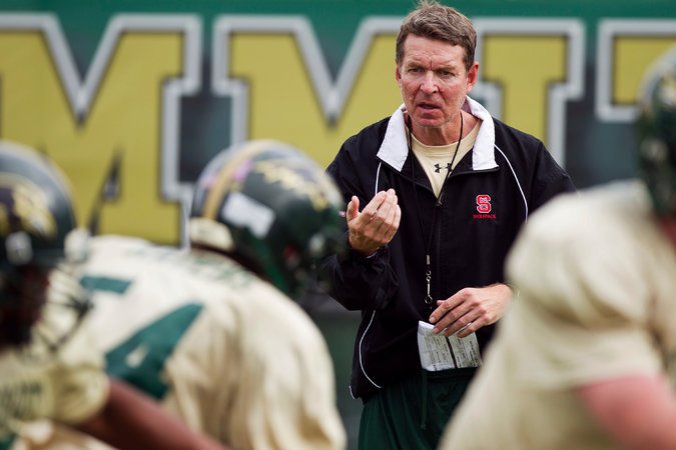
When Ethics Alarms Don’t Ring: A Coach With CTE Continues To Allow Young Players To Risk Brain Damage

…but he felt really guilty about it, so that’s OK.

The New York Times had a very strange sports story yesterday. Its subject was the late Don Horton, a prominent assistant coach at Boston College and North Carolina State for nearly 20 years who was diagnosed with Parkinson’s disease but was also experiencing symptoms linked to chronic traumatic encephalopathy, or C.T.E., a degenerative brain disease caused by repeated hits to the head strongly linked to football. The sensitive reporter, Bill Pennington asks,

“Was his deteriorating health, Horton wondered, a consequence of his many years as a football lineman?” Even worse, he worried, was he responsible for exposing hundreds of players to the kind of head trauma now impairing his life? After all, as he had recruited and encouraged scores of athletes to play major college football….There was only one way to be sure if he had C.T.E. His brain would have to be examined post-mortem, the only way to confirm the disease since there is no reliable test for the living. At first Horton balked, but as his cognitive difficulties intensified, he relented and even insisted that the findings of his brain examination be made public.”

The Times article makes this sound like a noble and brave resolution of his crisis of conscience. It was not, however. Having his brain dissected after his death was no sacrifice at all; Horton would be dead, of course.  In the meantime, Horton, despite his symptoms and his wife’s investigation into them, continued sending young men out to get their brains beat in.

We learn,

In 2009, seven years before Horton died, [Horton’s wife] called Chris Nowinski, a co-founder and the chief executive of the Concussion Legacy Foundation, and told him that she thought her husband had C.T.E. She also raised her suspicions with Horton’s doctors, but they said that, even if true, it would not change the course of his treatment.

Horton continued his duties at North Carolina State.

“He never missed a day of work and still produced great offensive linemen,” said Jason Swepson, an assistant coach at North Carolina State at the time. “You could see him struggling sometimes, but he never opened up about it because, I think, he didn’t want to feel like he was letting the group down.”

At home, however, Horton’s illness was leading to a variety of changes, physically and philosophically. His daughters, Libby, 14, and Hadley, 9, had begun playing soccer, but Horton pointedly refused to allow them to head the ball in games or in practices, aware that some studies had linked heading to brain injury.

“Don told them, ‘If I ever see you head the ball, I’ll run onto the field and yank you off myself,’” Maura said.

Although Horton kept his misgivings about football’s potential consequences within his household, he talked about it regularly.

“Don would ask, ‘Are we just carrying this cycle on?’” Maura Horton said. “That was a question I couldn’t answer. But it’s definitely the right question to ask.”

It’s not just the right question to ask, it was a question with an obvious answer, and both Hortons knew it. YES he was just carrying the cycle on. YES, he was continuing to coach college players when he had first-hand, personal knowledge of the horrible fate in store for some or many of them as a result, and said nothing.Was he responsible for exposing hundreds of players to the kind of head trauma now impairing his life?” If he refused to let his daughters head the ball while playing soccer, we know he was responsible, and so did Coach Horton. Was he in denial? Was he willing to let his player risk crippling cognitive impairment because he wouldn’t and couldn’t give up the only job he knew? Why does the Times suggest that there was any question about his culpability or breach of duty?

Continue reading

A Brief Message From Your Host

Before we get into the Memorial Day weekend and I start obsessing about the sharp dip in traffic that always triggers (What’s the matter, too busy for ETHICS???), I want to convey my appreciation, admiration and gratitude to Ethics Alarms commenters, who have shined even more brilliantly than usual in the last couple weeks.

I just trashed a comment under moderation that said,

As soon as I saw what Gianforte did here in kaliforniah I went to his website and donated $50.00. I wish someone would slam Rachel Mad-dike. I was very happy to see him win in spite of the commie collective of main stream news commies.

This is the kind of comment I don’t allow here, and yet it is typical of most of the discourse I read on all but a few websites and blogs. Contrast that with the varied, substantive, perceptive and serious comments that appear here every day, as exemplified, though not exclusively, by the recent flood of Comments of the Day by Extradimensional Cephalopod, Mrs Q, Glenn Logan, Spartan, crella, Humble Talent, texagg04, fattymoon, Zoltar Speaks!, and Steve-O-in-NJ. This was all in 10 days, and some of these contribution prompted over a hundred comments themselves.

I envisioned Ethics Alarms as an ongoing participatory pan-ethics conference or colloquy, never as a monologue. For that ambitious concept to work requires a lot of passion, thought and commitment from more than just the moderator, and recent days have proved that, thanks to all of you, Ethics Alarms has these and more in abundance. Few other online forums are so fortunate.

Thank you.

Bravo.

Ethics Alarm Check: What Do You Do If You Get A Text Like This One From A Close Friend?

Hypothetical:

A friend asks via text:

“What you do if you knew a friend was trying to commit suicide?”

You text back,

“Talk them out of it”

Then he texts you…

“The thing is i wanna help kill them. it be awesome. seriously im going to help her. Its like getting away with murder! Im so fucked up. I’m seriously not joking. Its going down in about a week or two.”

This was the actual scenario preceding the suicide of a 16 year old girl (above. left) in Utah.

Hunters found the girl’s body hanging from a tree.  A can of industrial strength air duster and a cellphone were nearby, and the latter  contained a video of the girl’s death.

It showed the girl with a noose around her neck, standing on  on a rock. She inhaled the contents of the air duster can, lost consciousness, and fell off the rock, causing the noose to tighten and slowly strangle her. The video captures the ten minutes  it took the girl to die.

Tyerell Przybycien, 18, arrived at the scene to claim credit for the video, telling officers that he knew the girl and was with her when she died. He told detectives that he had a fascination with death and wanted to see what it was like to watch somebody perish.

Yes, it was Przybycien who wrote the text message to a friend.

There are other disturbing aspects to the story, but my professional interest is in the conduct of Przybycien’s friend. Let us eschew, for now, the question of why anyone would have a friend like this sicko in the first place.

We know the friend has at least rudimentary ethics alarms, since his first response, “Talk her out of it,” was the right one. After that, however, his ethics alarms died. Przybycien told him that he was planning on helping a girl kill herself because it would be a turn-on, and the friend did nothing to stop him…or at least did nothing that did stop him.

We can speculate endlessly about what would work and what would not, but this tragic scenario lands squarely in the realm of the Ethics Alarms principle, “If you are in a position to stop unethical conduct, stop it.” Here a life was involved, activating the coda, “Whatever it takes.”

What might some measures be that could fulfill this ethical imperative?

Continue reading