Alexander Cheezem contributed an informative and well-argued comment challenging my ethical conclusions in the case of “Jasmine Tridevil,” who supposedly had a surgically constructed third breast attached between her two natural ones in an effort to become a reality TV star. Her story turned out to be a scam, but the ethical analysis is still worthy of consideration. Ethics Alarms doesn’t have many medical ethics dilemmas to ponder, and it is a fascinating area. As I considered Jasmine’s titillation, I suspected it might be a hoax, but from the standpoint of honing ethics alarms, it doesn’t matter. I’m kind of relieved, frankly. Continue reading
ethics codes
Three Breasted Ethics

UPDATE: Snopes, the urban legend and hoax website, now thinks that this is a scam. As I noted in the post, that would not be a surprise and in fact would be a relief. In such cases, I suggest that the post be read as a hypothetical, since the ethics issues raised by the three-breasted woman remain interesting, even if the story itself turns out to be fiction.
A 21-year-old woman being identified with the alias Jasmine Tridevil ( don’t over-think it) says she paid $20,000 to a plastic surgeon to give her a realistic third breast. She wants to become a TV reality show star. Jasmine has hired a camera crew to follow her around Tampa, Florida, documenting the challenges she faces as a three-breasted woman.
I know what you are thinking.
I HOPE this is a hoax.
“Jasmine” was rejected by more than 50 doctors who believed they would be violating professional ethical codes. Scot Glasberg, president-elect of the American Society of Plastic Surgeons, condemned the surgery as ‘worse than unethical’ and ‘harmful to society’. ‘This violates every ethical principle not just in surgery but in medicine as well. We look to enhance the norm. This is not the norm. Nothing speaks louder than the fact that the surgeon required the patient to sign a non-disclosure form.” Continue reading
KABOOM! And THIS Is Why Teachers Need An Ethics Code
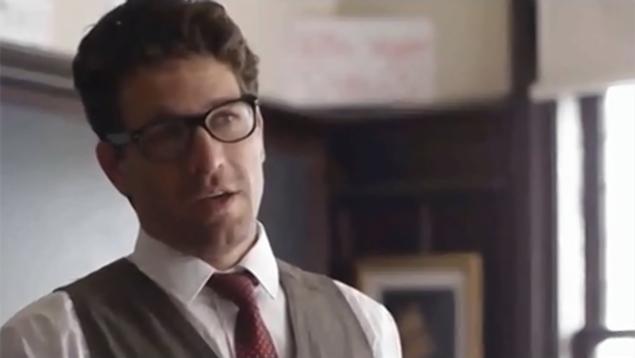
Actor-Teacher Richard Graffanino, who knows how to play a teacher, but not how to act like one.
Yes, there apparently is an Actor-Teacher Showing His Middle School Class Film Clips Of Himself In Bed With A Naked Actress As He Regales The Students With His Romantic Designs On Another Teacher While Wagering On NFL Games Using Food As Bets Principle.
The principle: such teachers get fired, and are damn lucky if that’s the worst thing that happens to them.
I sure hope the A-TSHNSCFCOHIBWANAAHRTSWHRDOATWWONGUFABP doesn’t come into play often, but nothing surprises me any more.
River Dell Middle School teacher Richard Graffanino, teaches impressionable young teenaged minds, and he also acts professionally, with roles on “Law & Order,” “30 Rock,” and some independent films. He was suspended in September of 2013 after complaints from female students, and a sexual harassment claim by a fellow teacher. It looks like he is going to be fired, following an arbitrator’s report last month that found that Graffanino showed a sexually-oriented, inappropriate video, featuring him, in class; discussed his personal relationship with another teacher; and was “inappropriately using food when interacting with students.” Continue reading
Comment of the Day: Ethics Dunce: Rep. Steve Stockman (R-Texas)
 Reader Rip Claassen, a true Renaissance Man and good friend (Full Disclosure: Rip has costumed several of my shows, and is a director for The American Century Theater, where I serve as Artistic Director), also something of a historian on comedy and performance art, contributes this to the discussion of what the media is now calling “Clowngate,” contributes this, the Clown Code of Ethics.
Here is his useful Comment of the Day for all you clowns, on the post, Ethics Dunce: Rep. Steve Stockman (R-Texas):
“As a clown and a Republican, I am offended. The art of clowning should make people laugh and think. To entertain is the object, but a clown must follow a strict code of ethics, and that this performer missed.
“This is one of several Clown Codes of Ethics, one that I particularly approve of… Continue reading
Ethics Hero: Cartoonist Ted Rall
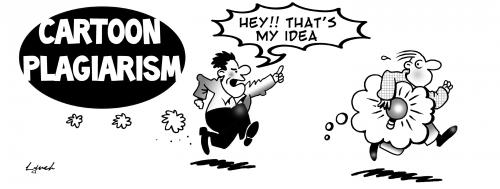
It is always courageous and exemplary when someone calls out his own profession for deficient ethical standards, and this is what political cartoonist Ted Rall has done on his blog. The topic: plagiarism in editorial cartoons, which is bad enough. Rall, however, makes strong case that the unethical practice flourishes because syndicates, editors, publications, honors committees and the professional associations tolerate it, and journalists don’t seem to care. He also blows the whistle on the practice known as self-plagiarism, where a cartoonist recycles his previous work as new. Rall writes, Continue reading
CNN and the Ambassador’s Journal: Unethical or Ick?
Answer: Ick
 Ambassador Chris Stevens, murdered in Libya in what is now finally being described as a planned terrorist attack (and not spontaneous film criticism, as the Obama Administration successfully persuaded the media to claim for more than a week), left a brief hand-written journal behind that somehow was retrieved by CNN instead of the U.S. government. When Anderson Cooper revealed that the journal had been reviewed by reporters and used to cover the story of the Benghazi attack, both the slain diplomat’s family and the State Department criticized the network, which said,
“We think the public had a right to know what CNN had learned from multiple sources about the fears and warnings of a terror threat before the Benghazi attack which are now raising questions about why the State Department didn’t do more to protect Ambassador Stevens and other US personnel.Perhaps the real question here is why is the State Department now attacking the messenger.”
Well, there are interesting theories about that, since what the late Ambassador had written suggests that there was fear of a terrorist attack in the vicinity of the 9/11 anniversary, yet both Secretary Clinton and President Obama went to great lengths to characterize the Benghazi violence as prompted by spontaneous and legitimate rage over an American’s exercise of his right of free speech. There is a rebuttable presumption that the State Department was prepared to bury the implications of what Stevens wrote, since everything else it has done in relation to his murder has been misleading or pusillanimous. In the latter category is using Stevens’ family as its excuse for bashing CNN for delivering on its duty to provide what the public “has a right to know.” Continue reading
Discovered: An Ethics Hero and a Theater Code of Ethics—From 1945!
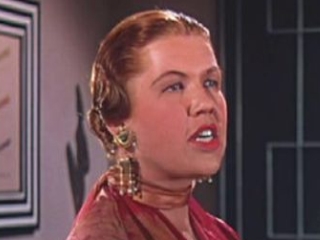
The ethicist in “Singing in the Rain”
For many years, I have been attempting to persuade the local professional theater community in Washington, D.C. to develop and adopt an official Code of Ethics. I have not been successful, and it’s not surprising. Theater, indeed professional show business of all kinds, has been almost ethics-free for centuries. These are tough pursuits, and tough pursuits easily gravitate toward the Law of the Jungle—“Kill or be killed”—unless the culture makes a concerted effort to evolve in a different direction. Theater certainly has not. There a few unwritten rules in theater that could form the backbone of a useful code, such as “The show must go on!”, and there have certainly been members of the profession who are thoroughly ethical, they tend to be very successful individuals who have taken on high ideals once the need to back-stab has lessened, people who are so talented and fortunate that the need to lie and cheat never arises, or, a special category, marginally talented but hard-working and versatile professionals whose trustworthiness is their primary asset. (This last group usually fares poorly in the end.)
Not only have I been unable to interest anyone in developing a code for the theater, I have never heard of one being developed anywhere else. Until now, that is. I recently learned that Kathleen Freeman, a great character actress* who died in 2001, wrote and adopted an ethics code for a small theater company, the Circle Players, that she established in Los Angeles when she was 24 years old. Continue reading
Unethical Website of the Month: The Ethical Psychic Project
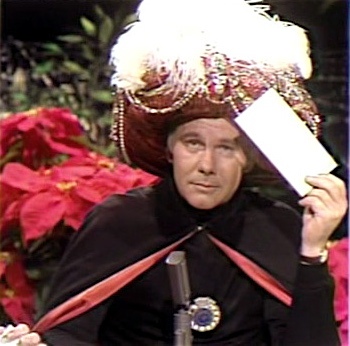
Here’s all you need to know about “The Ethical Psychic Project” and the website that supposedly advances it. One of the ethical topics covered in the ethical forum section is “Animal Communication”:
“Our animal friends need help, too! Ask one of our Psychic Animal Communicators to connect with your pet, either on the Earthly plane or crossed over!”
Sounds ethical to me! I was surprised not to see other topics of similar ethical weight and credibility, like “Want to win in at the slot machines?” and “Ever wonder what Joe Biden will say next?”
There appears to be nothing whatsoever ethical about the The Ethical Psychic Project, except that a bunch of people who decided they couldn’t make enough money selling phony deeds to imaginary uranium mines thought that the word “ethical” might suck in some marks. Oh, there’s an ethics code on the site, all right. This psychics code is considerably worse than the last one I wrote about, and that won no prizes. This one is funnier, though, because with a little tweaking, it could just as well serve an ethics code for Superman or Green Lantern, or the Good Witch of the North. It contains such self-validating blather as: Continue reading
Naked Teacher Principle Sighting in Ohio

“A part-time Catholic elementary school teacher was fired for posting nude photos of herself on the Internet.
The Cleveland Catholic Diocese said today the teacher was employed at St. Michael’s Elementary School.
Officials declined to release the teacher’s name, age or length of time she was employed with the diocese. They also declined to explain where the photos were posted or how they learned about them.
“In accordance with the Diocesan Education Department’s policies in such matters, St. Michael’s school officials took immediate action to terminate the part-time instructor,” a news release said. “The well-being of the students is paramount in these cases and assistance has been offered to students and their parents.”
More teachers need to read Ethics Alarms ( especially the Naked Teacher Principle)…at least until the profession develops a useful code of ethics.
By the way, how are you coming with that, teachers?
“Who Ya Gonna Call?” Paranormal Ethics, and the Irony of Same
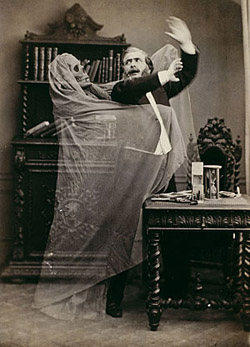
Here we see a common ethics violation: the paranormal researcher has allowed himself to become emotionally involved with his subject...
Any profession, no matter how strange, that thinks seriously about ethics is to be encouraged, and thus it is that Ethics Alarms gives a hearty shout-out to paranormal investigator L.S. Watts, 8 years a ghost-hunter and the co-founder of Grigori Research Institute of Paraspsychology. She has published a set of ethical standards for paranormal investigators that appear to be serious, thorough and well-thought out, addressing issues of professionalism, candor, honesty, conflicts of interest and fairness. Since her profession is by definition likely to be involved with a lot of people who are, shall we say, easy to deceive, and that must also attract more than its share of con artists, humbugs and frauds, there is an obvious need for a clear and sensible ethics code, for which her work would be an excellent starting point. Back in May of 2010, I noted that there was a planned “Town Meeting” on ethics in the field of paranormal investigation, and it’s nice to see progress has been made.
Ms. Watts seems sincere, so I can’t fairly apply the principle I am itching to state, which is that there are activities and fields like astrology, paranormal research, psychics, spiritualism, faith healing, creation science, loan-sharking and hacking for which the only truly valid Code of Conduct would be an extremely brief one that says, “Don’t Do This.” As long as these professions are with us, however, they might as well try to be as ethical as possible.
 Ethics Alarms