
Post-Thanksgiving Ethics Quiz: Is This Ethical? (Giant Lips Edition)

Jessica also apparently has only one eye…

Look at the bright side: at least she didn’t have octuplets.

Kristina Rei, 22, of St. Petersburg, Russia, wants to look like Jessica Rabbit, so naturally she opted to get herself a pair of hugelips.She has undergone over 100 silicon-injection procedures, and considers it just the initial step in her quest to look like Roger Rabbit’s
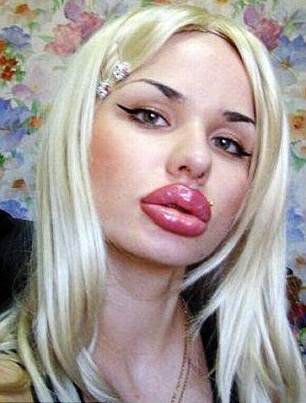
Kristin’s hickies are deadly.

Toon wife from “Who Framed Roger Rabbit?”. “When I can afford it I want to enlarge my breasts from a C-cup to a DD, change the shape of my nose and I want to make my ears pointed like an elf,” she told reporters. “It’s good to be different.”

Well, she’s different, all right.

Your Post-Thanksgiving Ethics Quiz: Was it ethical for a plastic surgeon to give her the lips she wanted?

Plastic surgeons are subject to the Hippocratic Oath like other doctors, but in  cases of elective surgery the standards of what constitutes doing substantive harm to a patient are extremely elastic. None of the Codes of Ethics for plastic surgeons would clearly prohibit giving a patient lips that look like they belong on a Macy’s helium balloon, or similar exaggerated features. These lips make Kristina happy. Is she mentally ill? A doctor who suspected so would be wrong to submit to her wishes if they were based on clinically defective judgment, but the fact that a doctor thinks a patient will look like a freak if he does what she wants isn’t ethically dispositive. Continue reading

The NPR Ethics Train Wreck

Ethics train wreck scholars take note: when an organization’s image and existence is based on multiple lies, an ETW is inevitable.

Oh NO! It's another Ethics Train Wreck!

National Public Radio is now in the middle of a massive, six-months long ethics train wreck that began with the hypocritical firing of Juan Williams on a trumped-up ethics violation. The disaster exposes the culture of dishonesty and entitlement at the heart of NPR, and by extension, the Corporation for Public Broadcasting. To the extent that their supporters blame anyone else, it is evidence of denial. This is a train wreck, however, and the ethics violators drawn into the wreckage are many: Continue reading

Don’t Knock “The Code of the West”!

A commenter just nominated the Republicans in the Montana State Legislature for “Incompetent Elected Official” status because they have proposed “The Code of the West” as  Montana’s State Code.

Nomination rejected. I don’t want to argue about whether a state needs a State Code, although it seems a lot more useful and constructive than state birds, state songs and state pies. I also don’t feel like debating the political correctness attacks on the potential use of the Code of the West by Native American activists, who apparently think the Code glorifies cowboys and insults Indians (Oh, all right: the complaint is nonsense. Valid ideals are not sullied by the misdeeds of those who espoused them.) But I like the cowboy codes, all of them. One is already on the site. I might not choose the same ten tenets of the unwritten Code of the West that is being debated in Montana, but the Code of the West is a perfectly good statement of ethical principles, and any state that embraces it should be praised, not embroiled in a lot of political posturing. Continue reading

The Ashley Payne Affair Revisited

What's wrong with this picture?

One of the earliest Ethics Alarms posts concerned Barrow County, Georgia, teacher Ashley Payne, who was forced out of her job at Apalachee High School for posting photos on Facebook that showed Payne drinking beer and wine while on a vacation to Europe. Barrow had a policy stating that employees can be investigated, disciplined and terminated for postings on Web sites that contain provocative photographs, sexually explicit messages, use of alcohol, drugs or anything students are not supposed to do. In the initial post, I took the position that the school over-reacted, but that Payne was still accountable because she knew what the policy was and violated it:  Continue reading

A Code of Ethics For Each Blog

Health and science writer Maryn McKenna has a provocative post on Wired exploring the question, “Do old  ethics apply to new media?” Although the short, obvious and accurate answer is “yes,” she concentrates on the legitimate problem of defining what ethics standards we should require of bloggers and blogs, particularly regarding disclosure of sponsors and other potential biases. Continue reading

Do Economists Need A Code of Conduct?

We can learn a lot about the discipline of economics, the thinking of its practitioners and the limitations of ethics codes by reading the various reactions of economist to the question, “Do economists need a Code of Conduct?” The responses range from “yes” to “sure, but it won’t do any good” to “no.”

You can read all about it here.

Observations on “The Psychic’s Code of Ethics”

I was surprised to find a long dissertation about ethics posted on a website for self-designated psychics. [UPDATE: The link that I originally supplied here no longer works.] The post itself was also full of surprises, such as the revelation that there is a “Tarot Certification Board of America’s Client Bill of Rights,” which declares, among other things, that…

“Tarot readers are not qualified to give medical advice unless they are physicians. Tarot readers are not qualified to give financial advice unless they are qualified financial advisors. Tarot readers are not qualified to give legal advice unless they are attorneys.”

This is all good ethical advice. Notably missing, however, is the statement that “Tarot readers are not qualified to tell individuals what the future holds in store for them since it is impossible to discern this from reading novelty playing cards.” Continue reading

Juan Williams, Revelations and the Phony NPR Ethics Code

We have learned a lot from the Juan Williams firing. For example,

  • We learned that at NPR, opinions that run counter to the officially sanctioned culturally-diverse cant are not merely regarded as mistaken, but crazy.  NPR’s CEO stated that Williams should have kept his opinions about Muslims “between himself and his psychiatrist.” This is how the Soviet Union used to treat anyone whose opinion varied from state Marxism, too, and the dissidents were sent to mental institutions. Does it bother anyone else that the head of a state-funded radio network treats dissent so disrespectfully? Yes, Vivian Schiller later apologized for her “thoughtless”—as in, “I don’t want people to know I think this way”—remark. It was telling nonetheless. Continue reading

A Traveling Photographer’s Code of Ethics

The Photo Foodies have posted a sensible, compassionate, clear ethics code for photographers, particularly applicable to those working in foreign countries. It concentrates on the act of taking the photograph, not what one does with the image afterward.

Excellent work, Photo Foodies, and thanks for not calling the site “Foto Foodies.” I know it must have been a temptation.

You can read the entire post here. These are the tenets of the code: Continue reading