Eventually it is irresponsible and cowardly to criticize all of the rhetoric regarding abortion and not make a serious proposal. I feel like I’ve reached that point.
Let’s start with what we have to work with.
25 Stipulations
I have not labored to put these in order of priority or importance, and many constitute “but on the other hand” reflexes upon considering the previous point.I’ll bold the items that seem particularly important as I post them. I am certain that I will miss some or many points that need to be considered as well.
Gee, that was fast! All the Supreme Court did was agree to look at a part of 1973’s Roe v.Wade that has been rendered anachronistic by subsequent developments in science and medicine, and the pro-abortion lobby freaked out. Dobbs v. Jackson Women’s Health Organization involves the 2018 Mississippi law that bans abortions after 15 weeks of pregnancy. The case raises the obviously relevant ethical, moral and legal question of when human life can be and should be subject to law’s protection. Roe, nearly a half century-old now, based its limits regarding when an abortion was a woman’s constitutional right on when an unborn child was “viable,” a word that requires a conclusion about when human life begins as well. It is not only reasonable but necessary for the court to clarify this. Question 1 in the petition for the writ of certiorari is “Whether all pre-viability prohibitions on elective abortions are unconstitutional.” Good question.
So why the freakout? Simple: neither side in the abortion debate has ever been willing to debate the issue fairly, as both ignore the obviously relevant rights and issues of one of the two human beings involved in the abortion equation. As Ethics Alarms has pointed out before and will continue to do until the stars turn cold, this is an ethics conflict, and a difficult one. Two strong ethical principles are opposing each other, both with major societal implications. In ethics conflicts, the ethical process of balancing is required, but neither side is willing to risk balancing regarding abortion. Thus both have conducted their side of the debate by dishonestly denying the existence of the ethical realities opposing the result they want. The anti-abortion advocates refuse to give fair weight to the effect an unwanted pregnancy can have on a woman’s life and future, and women’s legitimate interests in their own autonomy (which still may not be absolute.) Pro-abortion advocates deliberately ignore the fact, and it is a fact, that abortion involves the taking of human life.
This mutual dishonesty is reflected in the euphemisms the sides of the controversy use to obscure the real problem. “Pro Choice” makes it sound like the only issue is a woman’s autonomy ( Life? What life?). “Pro Life” wrongly cuts the interests of the women involved out of the balancing act. This is the reason the abortion debate has made no progress in a hundred years. The two sides are talking about two different things, and have neither the integrity nor the honesty to deal with the balancing problem.
Roe was a badly reasoned and irresponsibly issued ruling, authored by a serial SCOTUS mediocrity, Justice Harry Blackmun. Somehow, the opinion bootstrapped abortion into being a right under the “unenumerated” Constitutional right of privacy by analogizing it to birth control. But the case in which the Court rightly found that the State had no business telling couples that they could not engage in birth control didn’t involve killing anyone. I’d call that a material distinction.
Roe was one of the most breath-taking leaps of law and logic in the history of the Court, and a throbbing example of judicial activism run amuck. Nonetheless, it has been the law of the land long enough to be regarded as stare decisus; for good and practical reasons, over-ruling the entire case would be bad judicial policy. Addressing aspects of the opinion that were based on scientific assumptions no longer valid, however, is common sense, as well as sound legal policy.
As Bill Clinton might say (and probably has, maybe more than once), it depends on what your definition of “wrong” is.
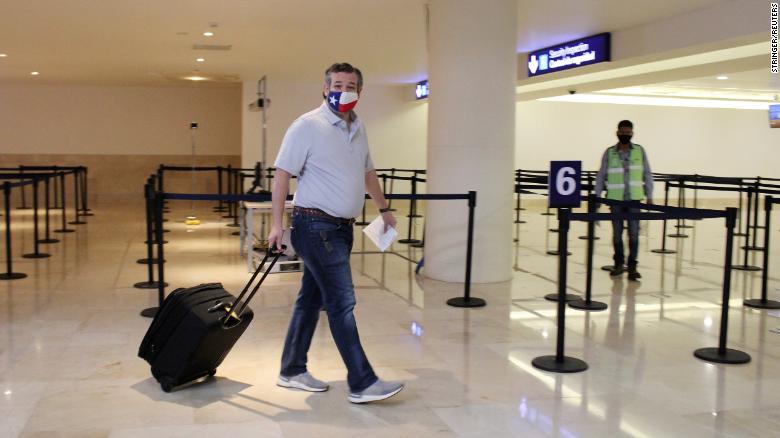
Millions of Texans were left without electricity this week in the middle of the state’s power crisis following a massive winter storm. The Senator’s wife Heidi sent text messages to friends and neighbors complaining that their home was “FREEZING,” and that she wanted the family to escape on the 17th to someplace warmer, at least until Sunday. The mission, if her husband chose to accept it: get to the luxury Ritz-Carlton in sunny Cancún, Mexico. The destination is apparently a family favorite. The GOP Senator did accept, and the Freezing Cruzes fled Houston, hopping an afternoon flight. The consensus of the news media, the commentariat and social media was that…
In fact, you would think Cruz had been caught having a secret romantic rendezvous with a goat. Incriminating photos of Cruz and his wife boarding the flight launched a full-fledged scandal. How dare he flee a crisis when his state was in misery? Ted responded by playing the Parent Card, explaining he had flown to Mexico “to be a good dad” and to chaperone his daughters and their friends, and he promised he was coming back yesterday, which he did.
When he returned, Cruz admitted that his family trip had been a mistake. That is undeniable.
The above image is for “Fallout Shelter-The Board Game”
Last night’s pre-dawn post inspired this one (it’s just after 5 am here) , another thoughtful reflection on the ethics process from enigmatic commenter Extradimensional Cephalopod.
Whenever we encounter an ethical conflict, we need to take a look at the bigger picture, figure out what the most ethically effective way to deal with the relevant liabilities is, and then scale that principle back down to the current situation.
If we ever encounter a situation where people really do need to seek shelter, each family should ask itself, who do I most want to offer shelter if they need it? Those people get first choice. If they pass, then the family reaches out to the next group they care about. And so on. People can’t just wait for situations to happen to them; they need to ask themselves the hard questions about who they prioritize and why.
Having done that, everyone should prepare themselves to help in other ways, to offset the help they can’t offer through the space of their home. These ethical situations don’t take place in a vacuum. There are plenty of options for people to help in various ways and coordinate to make sure people get what they need even if it’s from someone they didn’t know. Benefactors can go shopping, donate money or food, organize, offer listening ears, et cetera. It’s amazing what people can do for each other when they put their minds to it. Continue reading →
It was reported by a non-reliable source that this is the anti-virus mask Rep. Lee put on her dog…
[Okay, bear with me now. This COTD by Steve Witherspoon was actually entered on this post, where the issue at hand was alluded to obliquely in the post, then expanded upon in a comment. But I went into far more detail regarding the issue in today’s Warm-Up, and there was even a poll on the issue, so I’m assigning the comment to that post, not the one that inspired it.]
I officially mark my immediate ethics conflict as solved. The poll results are moot regarding this specific episode but still valid regarding the general problem. So far, about half the voters said I had a duty to post the non-diverse idiot photos even if it did get me called a racist (Easy for them to say!). Fortunately, the option I favored (with three votes out of 24) was made accessible within minutes of the posting. I know have a fully diverse array of dufuses wearing their masks wrong, and hope to have more.
In addition to Rep. Lee, we have Houston Mayor Sylvester Turner:
And, best of all, taking us out of Houston and also into racially diverse territory, the very white Senate Minority Leader himself, New York Senator Chuck Schumer! (Pointer: Willem Reese):
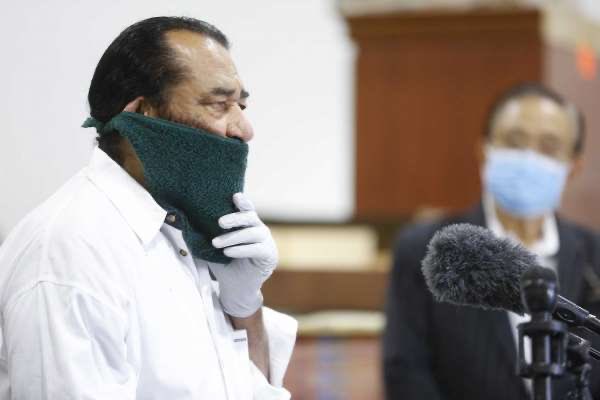
No photos on Asian-Americans yet, but commenter Zoebrain found one of an Asian nose-breather, Korean cult leader Lee Man Hee:Continue reading →
1. More on my mask photo ethics conflict...I wrote about this in a comment on the post last night about Rep. Lee, but I’m still obsessing about it because I still don’t know what the ethical course is. When I saw that photo of Rep. Lee wearing her mask with her nose exposed (this makes her a nose-breathing idiot rather than a mouth-breathing idiot; it was also upside down), I was going to post it with two other photos showing elected officials doing the same thing. At literally the last second, an ethics alarm sounded. The other two officials, a city mayor and a member of Congress known to be, shall we say, an unlikely “Jeopardy!” contestant, were both black. In the case of Lee, who is the chair of a task force on the national response to the epidemic,the validity of pointing out the visual evidence that she’s an epic boob (we knew that, but still) is unassailable, perhaps even by the race-baiting standards of the Congresswoman herself, who repeatedly attributed any criticism of Barack Obama to racism.
Objectively, however, when accompanied by two other photos of African-American political figures making fools of themselves, would not the array appear to be a racist “dog whistle”? I don’t need to be tarred as a racist—I already have lost considerable income because I dare to oppose the anti-Trump mobs—and this would invite that result. Moreover, as I also commented last night, conservative sites were stinking with racist comments about the Lee photo. (“If you let blacks vote, you get blacks in power over you. This applies to every other non-American race and culture too,” wrote one commenter on Instapundit.) Thus the Second Niggardly Principle seemed to be triggered:
“When an individual or group can accomplish its legitimate objectives without engaging in speech or conduct that will offend individuals whose basis for the supposed offense is emotional, mistaken or ignorant, but is not malicious and is based on well-established impulses of human nature, it is unethical to intentionally engage in such speech or conduct.”
In the narrow context of my post, I’m confident that this is the right call. In a larger context, however, the Third Niggardly Principle seems to apply:
“When, however, suppressing speech and conduct based on an individual’s or a group’s sincere claim that such speech or conduct is offensive, however understandable and reasonable this claim may be, creates or threatens to create a powerful precedent that will undermine freedom of speech, expression or political opinion elsewhere, calls to suppress the speech or conduct must be opposed and rejected.”
Indeed Ethics Alarms has made a recent Third Niggardly Principle stand, refusing to accept the widespread ban on any designation of the virus that references its origins and the Chinese government’s role in turning it into a pandemic. I have done this even though the Chinese connection has led some thugs to attack Asian-Americans. I believe the principle that facts and words must not be suppressed because some may misconstrue them or react irrationally is a crucial one, and a principle that the totalitarian Left is working hard to deconstruct.
So in light of all the factors, what was, or is, the ethical way to handle this conflict?
2. Speaking of polls, here’s where the last one sits. Polling is still open, and you can vote as many times as you want, for different candidates. The poll asks you to choose which Democratic Presidential candidates would endorse withholding online classes from all public school students because poor students didn’t have WiFi access:
3. And speaking of masks, here’s what NBC Washington tweeted along with a photo of Virginia Governor Ralph Northam demonstrating the right way to wear a mask: Continue reading →
One of the policy and medical ethics issues that is looming larger as the pandemic continues is the requirement that hospitals not be burdened by “non-essential surgery and medical procedures.”
I agree: it would have been better if Ethics Alarms has more precisely defined “essential surgery and medical procedures” in the previous post on the issue, when I examined the question of whether abortion can be ethically put in that category as Texas and Ohio have decreed. Abortion, as that post noted, is a particularly poor choice for such analysis, given that our society cannot agree on what it is, other than the Supreme Court’s ruling that whatever it is, a woman has a Constitutionally right to do it.
Incidentally: can we agree that there is also a constitutional right to have any surgery or medical procedure? It hasn’t been specifically stated by the Court, but I assume that the abortion precedent applies to everything else as well, from having a kidney transplant to getting a wart removed to acquiring breast implants. These would all fall under the right of privacy and inalienable rights of life, liberty and the pursuit of happiness. Forbidding any surgery, non-essential or otherwise, is a big deal, and my guess is that a judicial challenge to the whole concept would stand a substantial chance of success. What is essential surgery to me might not be such to you, but frankly, my dear, I don’t give a damn, and unlike an abortion, my procedure isn’t killing anyone. Continue reading →
Naturally, the common sense measures are being condemned as bigoted and unethical.
Idaho is now Ground Zero in the controversy over the ethical and equitable treatment of transgender individuals. In addition to the newly passed and signed Fairness in Women’s Sports Act, which bans biologically male transgender athletes from competing in women’s sports events, Idaho Governor Brad Little (a Republican, of course) signed a bill making it more difficult to change the sex designation on a birth certificate.
Ethics Alarms has discussed the transgender/women’s sports controversy in many posts. It’s admittedly a difficult ethics conflict that has played out in many strange ways across the country, including a female high school wrestler transitioning to male being forced to compete against females, and many instances of formerly male athletes competing as women crushing their double-X opposition while giving us photographs like this:
Female athletes who have protested the unfairness of this development, like Martina Navratalova, have been attacked as bigots, while some feminists have predicted that allowing trans athletes to continue to take advantage of their passing through puberty as males will destroy women’s sports, negating the salutary effects of Title IX, the law that made gender discrimination in sports illegal. Idaho state Rep. Barbara Ehardt , who played basketball at Idaho State University and later coached Division I women’s teams, led the way in pushing the legislation through to law. “If I had had to compete against biological boys and men, I don’t think I would have had the opportunity to play,” she told reporters. “Honestly, I know firsthand that we simply can’t compete against the inherent physiological and scientifically proven advantages that boys and men possess. We simply can’t do it, regardless of any hormone usage.”
Texas and Ohio have included abortions among the nonessential surgeries and medical procedures that they are requiring to be delayed, setting off a new front in the fight over abortion rights in the middle of the coronavirus pandemic in the United States.
Both states said they were trying to preserve extremely precious protective equipment for health care workers and to make space for a potential flood of coronavirus patients.
But abortion rights activists said that abortions should be counted as essential and that people could not wait for the procedure until the pandemic was over.
On Monday, Ken Paxton, the attorney general of Texas, clarified that the postponement of surgeries and medical procedures announced by Gov. Greg Abbott over the weekend included “any type of abortion that is not medically necessary to preserve the life or health of the mother.” Failure to do so, he said, could result in penalties of up to $1,000 or 180 days of jail time.
Oh-oh.
Is abortion truly a non-essential medical procedure? Is it ethical to treat it as one? This is a perfect storm of an ethics conflict colliding with an ethical dilemma, with so many of the factors that confound ethical analysis present. For example, is the shortage of beds and the stresses on medical services really the only factors being considered by those in making the policy decisions in Texas and Ohio? Is the pandemic really a cover, in whole or in part, for other motives, like a desire to limit abortions generally for as long as possible? Is the ethical response by a pregnant woman to comply with the policy, even to the point of giving birth. There are many ethics decisions involved here.
Let’s just focus on one of them, the decision to call abortions non-essential procedures, and run it through one of the ethics decision-making systems. I’m going to use Professor Laura Nash’s 12 Questions, from her Harvard Business Review article, “Ethics without the Sermon” (1981)]
As I thought it would, today’s ethics quiz about the 6th grade dance with the “must accept” policy has sparked some excellent reflections and flashbacks. Taking off from Bryan’s comment—
When my son was in sixth grade cotillion class, the instructor prefaced dances with “in this class, and only in this class, if someone asks ‘may I have this dance?’ the answer is ‘yes, thank you.’ “ They also switched off having boys ask girls and girls ask boys. The whole point of the class was to learn polite interaction at an age when they’re so confused and might otherwise act weird. I thought it was a lovely compromise. This was in about 2005, so it was not so long ago, yet not inflicted with today’s outrageous thinking.
My experience was the same as Bryan’s – about a half-century prior. The class was once a week, part of the gym program as well as a “social” activity, I believe, and emphasizing a similar “buddy” system – you partnered with everyone at one time or another.
Ours was a smallish class so we got around to everyone else at least twice. We learned ethnic circle dances in lower classes, then box step, fox trot, waltz, and some others, ending the 8th grade (preparing for our first “formal”) with a singularly unsensual rumba. One of my classmates had hyperhydrosis, aka, a surfeit of sweat, and holding her hand was a chore for her partner and an agony for her. It got so we would safety-pin a pair of socks – not necessarily clean ones – under the shirt’s left shoulder to take care of half the problem and then, with her eager cooperation, each would try to touch each other’s palms with as little pressure as possible. Continue reading →








 Ethics Alarms
The above image is for “Fallout Shelter-The Board Game”
Last night’s pre-dawn post inspired this one (it’s just after 5 am here) , another thoughtful reflection on the ethics process from enigmatic commenter Extradimensional Cephalopod.
Here’s his (it’s?) Comment of the Day on the post, “Exactly How Much Are We ‘All In This Together’? The Golden Rule Vs. ‘Look Out For #1’”: