Ethics Hero: Bill Clinton

Clinton and Bloom

A couple of initial observations on an ironic first Ethics Hero for 2014:

  • President Clinton has been an Ethics Hero before, despite the fact that it was his successful efforts at corrupting the nation’s ethics that led me to launch my first ethics website.
  • As always, when Bill does the right thing, it raises the classic ethics conundrum: did he do the right thing because it was right; did he do it because he knew someone had to do right and he wanted to be first; did he do it because he felt he had a duty to do right; did he do it because he wanted to be perceived as doing right; or did he do it to fool people into believing that he was the kind of person who just does the right thing?
  • Good luck, New York City! You are going to need it.

The speakers lined up for  Mayor Bill  de Blasio’s inauguration’s made one wonder if being rude, arrogant and confrontational is a mandatory qualification for being a New York progressive. Continue reading

Ethical Burglar Of The Year (Assuming Santa Doesn’t Qualify)

Now this is an ethics category you don’t see very often!

"Let's hope that I do not, while gathering my swag, encounter evidence of a crime that, unlike burglary and theft, my personal value system regards as repugnant, for then, as a responsible citizen burglar, I would be ethically obligated to report it to law enforcement officials, thus placing myself at greater risk of arrest..."

“Let’s hope that I do not, while taking valuables and property from the private residence I am about to break into, encounter evidence of a crime that, unlike burglary and theft, my personal value system regards as repugnant, for then, as a responsible citizen burglar, I would be ethically obligated to report it to law enforcement officials, thus placing myself at greater risk of arrest…”

In Spain, a burglar  broke into the home of a trainer for a kids soccer team, and discovered a collection of child pornography, including self-made recordings of the homeowner sexually abusing children as young as ten. The burglar placed an anonymous call to local police and said he left the evidence in a car, along with a note on which he wrote the apparent pedophile’s address. “I have had the misfortune to come into possession of these tapes and feel obliged to hand them over and let you do your job, so that you can lock this … up for life,”  the burglar told police in his message.

The trainer has been arrested and charged;  one of his victims, who is now 16, told authorities she had been abused since the time she was 10.

A few ethics observations on an intriguing case: Continue reading

The Ethics of Singing For Muammar…No, Wait, I Mean José

Mariah-CareyIt is seldom that an ethics controversy repeats itself so exactly that I am tempted to re-run a previous post word for word with just a couple of names changed, but the flack Mariah Carey is getting from human rights activists and others for accepting a million bucks to perform for Angola’s dictator is just such an instance.

I wrote about this situation in 2011, when Nelly Furtado (and Carey) were under fire for performing for the late Muamar Gaddafi, when he was dictating to Libya.  I officially incorporate said post into this one, in full.  Just read it here, with “Mariah” substituted wherever I wrote “Nelly,” “Carey” for “Furtado,” and the name of Angola’s president, José Eduardo dos Santos, wherever the dead Libyan leader’s name appears.It all still applies. To sum up for the large percentage of people who, surveys say, can’t be bothered to click on links, it’s completely bogus criticism. Continue reading

Ethics Quote Of The Month: Tom Crist, Canadian Lottery Winner

“I just retired at the end of September so I was fortunate enough in my career to set myself up and my kids anyway, and there was no doubt in my mind where that money was going to go, it was going to go to charity.”

Tom Crist, of Calgary, Canada, announcing that he was giving the 40 million dollars  he won in Canada’s Lotto Max jackpot on May 3 to support cancer research.

Tom Crist, who understands what "enough" is.

Tom Crist, who understands what “enough” is.

Just in time for Christmas comes the aptly- named anti-Scrooge named Tom Crist. Christ retired as president and chief executive of the electronics company EECOL in September, and has said that he had done well enough in his career that he did not need the money.

He did not need the money. How often does anyone in this country say that, feel that, or think that? In a nation that is founded on the principles of liberty and self-determination, the freedom to make as much money as we can also imparts the freedom to say, “Ok, that’s it: enough.” Yet we do not.

Why?

Continue reading

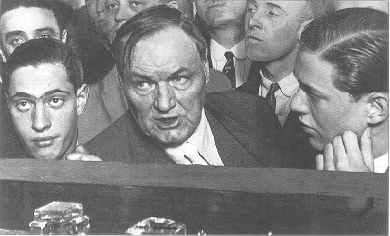
Perspective: The Trial of Nathan Leopold and Richard Loeb (1924), Clarence Darrow’s Closing Argument, And Judge Caverly’s Sentence

Darrow and his clients

Darrow and his clients

I just commented, on the controversial post here about Judge Boyd and the media frenzy regarding the “affluenza” defense offered by Ethan Couch’s lawyers, that the fact that so many of the comments, many of them angry, focused on the fact that a spoiled, rich kid got a break, or, as they used to say in the old days, mercy, that I began thinking about the famous Leopold and Loeb murder trial.   In 2011, I  posted a shortened version of Clarence Darrow’s famous closing argument in that trial, one of my favorite of all courtroom speeches, and it seems appropriate to do so again. It is far from a perfect parallel, but any excuse to revisit Darrow at his best is a good one.

 Nathan Leopold and Richard Loeb were, like Ethan Couch, young, rich and spoiled; they also were Jewish and gay. Their crime was  far worse than Crouch’s: they planned and executed the murder of a child just for the fun or it, and to show that they could outsmart authorities. (Ironically, they were arrested almost immediately). The two teenagers were charged with the premeditated murder of fourteen year-old Bobby Franks. Both defendants were brilliant students (Leopold, the youngest graduate in the history of the University of Chicago; Loeb, the youngest graduate of the University of Michigan),  and the sons of wealthy and successful Chicago businessmen. Neither showed any remorse for their terrible crime. There is no question that had they been poor, they would have been sentenced to die, and would have been hanged. Their parents, however, could afford to hire Clarence Darrow, a foe of capital punishment who had never had a single one of his often guilty clients executed. They got their money’s worth.

His summation on August 22, 1924, remains perhaps the most persuasive and eloquent argument against capital punishment ever made in a court or anywhere else.  It is also an argument for mercy, and especially mercy for the young. The plea worked: Judge John L. Caverly spared Leopold and Loeb, and he sentenced them to life imprisonment without parole—under the circumstances and in those days of rough justice, a gift. In his sentencing statement, which is posted here after Darrow’s summation, Caverly did not indicate that he was swayed by Darrow’s eloquence or reasoning. Caverly based his sentence on the ages of the defendants. Darrow was counting on this particular vulnerability of Caverly, who had helped establish juvenile justice courts in Chicago. Later, Nathan Leopold suggested that he and Dickie Loeb might have gotten the same result if they had simply submitted their birth certificates into evidence.

I doubt that he would have bet his life on it. The pressure on Caverly to hang these two despicable sociopaths was overwhelming, and having Clarence Darrow put his decision in such heroic terms had to steel his nerve, if it needed steeling. Still, as with Judge Boyd in the Couch case, there is no way to be sure that he would not have spared Leopold and Loeb anyway. Also as in Ethan Couch’s case, critics said this was disparate justice, bought and paid for.

This is a condensed version of Darrow’s closing,  edited for The Essential Words and Writings of Clarence Darrow, (2007),  that I co-edited with historian Ed Larson.  Here is one of the great orators of the 20th Century, one of the great progressive thinkers in our history, and the greatest trial lawyer who ever lived, arguing for the life of two murderers and for the soul of our civilization. I do not share Darrow’s absolute rejection of the death penalty, but I always do for a few hours, at least, after reading this. Continue reading

The Harsh Realities Of The Naked Teacher Principle

The Naked Teacher's Curse: What she wants the students to see (L); What they think they see (R)

The Naked Teacher’s Curse: What she wants the students to see (L); What they THINK they see (R)

So-called revenge websites are run by the scum of the earth. These cyber-offal of the internet, among their other cruel activities, post unauthorized photos of women and men in embarrassing, often naked or otherwise provocative poses, submitted by jilted lovers, assorted enemies, and vicious rivals. Then the site extorts money from the victims shown in the photos, or the photos remain up for all to see.

The existence of such sites ought to convince any rational person that allowing anyone to take digital photographs involving his or her naked body or sexual proclivities is a about as prudent as hiding active land mines in the back yard. If said rational person is a teacher, then allowing this crosses the line from unwise to certifiably insane, with gradients pointing toward a straitjacket and a padded cells according to the ages of the students. This is because, you see, the Naked Teacher Principle does not take into consideration why the teacher’s nude and luscious bod is suddenly a feast for prying young eyes and stimulus for newly minted libidos. It doesn’t matter, to the school, the students or their parents. What matters is that the photos exist, they got out, and he or she will never be looked at or thought about the same way again. Continue reading

“When Will They Ever Learn?” Department: “Baby Emma” Déjà Vu

Preston and Baby Wyatt

Preston and Baby Wyatt

Once again, an unmarried father is trying to get the courts to award him custody of his child after the mother handed the child off to adoptive parents. This issue was recently examined by the U.S. Supreme Court in the case of Adoptive Couple v. Baby Girl, and on Ethics Alarms two years ago in its examination of the “Baby Emma” drama. Now it is in the news again, as Preston King, the 19-year-old father of “Baby Wyatt” fights for his child in the California courts

The details of these cases vary, as do the state laws governing them. In the Baby Emma case, for example, among the complexities were the fact that the state of the couple’s residence, Virginia, recognizes an unmarried father’s right to custody, while the state where the adoption took place, Utah, does not. All the cases have  in common a conflict between rights, law and ethics. Continue reading

To Get Your Christmas Ethics Off To The Right Start…

its-a-wonderful-life-collage-73136

…the Complete Ethics Alarms “It’s A Wonderful Life” Ethics Guide is here.

Just in case you forgot!

Encore: “Forgetting What We Know”

Rosemary's director is more horrible than her baby...because he's real.

Rosemary’s director is more horrible than her baby…because he’s real.

I noted with horror that Roman Polanski has a new film out that is, as usual, garnering rave reviews. Polanski is a perpetual burr under my metaphorical saddle, and when he is out of the spotlight I am a happier person. One of the early reviews, under the heading “About the director,” describes him this way:

“Roman Polanski is a Polish film director, producer, writer and actor. Having made films in Poland, Britain, France and the USA, he is considered one of the few truly international filmmakers.”

This leaves out what I would argue are the most important parts of his biography, namely that he is a child rapist and a fugitive from the law of the United States. He is also an ethics corrupter on a grand scale. When his name once again made its unwelcome intrusion on my senses, I recalled that one of the very first posts on Ethics Alarms, on Halloween of 2009, was inspired by Polanski. I read it again last night, and reflected on how the blog recently passed its 1,000,000th page view since its launch that same month. I like it, and not many people read it at the time. With a few small edits, I decided to post it again.

Here it is:

Ethics evolves. It isn’t that what is right and wrong actually changes, but that human beings gradually learn, sometimes so slowly it can hardly be detected. For example, slavery was always wrong, but for centuries very few people who weren’t slaves understood that fact. There was never anything immoral about being born gay and living accordingly, but it has taken all of the collected experience of civilization to make this dawn on most of society. While we are learning, and even after we have learned, there are always those who not only lag behind but who work actively to undo the ethical progress we have made. We assume these individuals will come from the ranks of ideological conservatives, misapplying valid concepts like respect for tradition, suspicion of change for change’s sake, and a reliance on consistent standards, making them slow to accept new wisdom . Sometimes, however, the people who try to make us forget what we know come from the left side of the political spectrum, misusing values such as tolerance, freedom, empathy and fairness in the process. This is especially true when it comes to the topic of sex. Liberals fought so long and well to break down the long-established taboos about sex that many of them lost the ability to comprehend that unethical conduct can  involve sex in any way.

The most striking recent example is the bizarre defense of Roman Polanski, best known as the director of the horror classic, “Rosemary’s Baby.” Continue reading

Comment of the Day: “Ethics Quiz: The Kidneys of Orlac”

But first, a last act of altruism...

But first, a last act of altruism?

The presumptive winner of the annual Ethics Alarms award for “Commenter of the Year” in 2013, texagg04has delivered a Comment of the Day expanding the topic of the post regarding a condemned prisoner in Ohio who wrangled a postponement of his execution so he could donate his organs to relatives. Here is  texagg04’s  take on “Ethics Quiz: The Kidneys of Orlac.” I’ll have some comments at the end.

“First, a murderer or other capital criminal being held responsible for his or her conduct seems to be in conflict with the same individual being allowed to display charity when you say they  forfeited their freedom, all of it, with their commission of a  capital crime. I’m not so sure it should be viewed from that angle.

Punishment serves a variety of purposes. Some petty crimes receive punishment designed to compensate, as best as can be, the victim – the victim being dead, capital punishment does not serve this purpose. Some crimes are of an anti-social nature, and the apt punishment seeks to rehabilitate or reconcile the perpetrator to the community. Capital crimes are so heinous that we have determined that the perpetrator must be completely cut off from society, through their death. In this case, the punishment does nothing for the victim OR for the criminal; the punishment is designed solely for the benefit of society.

If the criminal wishes to donate his/her organs to (what we must assume is to salve their own conscience – even though we can, probably, cynically assume is just a delaying tactic), we should not care one bit. They are gaining no material benefit from the community, nor are they engaging in any direct interaction with the community – so the act of cutting them off from the community as part of the punishment is still complete. Continue reading