July 3: A Day To Honor Custer’s FIRST Stand, At Gettysburg… And Reflect On How Our Greatest Strengths Can Be Our Fatal Flaws

custercharge

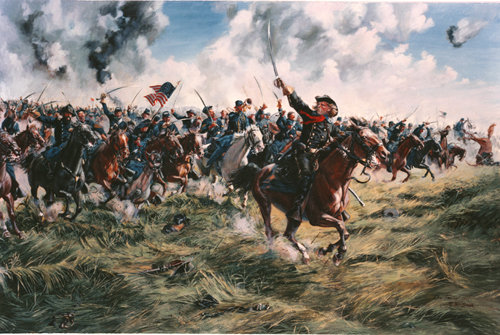
I wrote this post two years ago, concerning my favorite neglected episode of the Civil War, when young George Armstrong Custer shocked Confederate J.E.B. Stuart with his unexpected and furious resistance to Stuart’s attempt at disrupting the Union flank while Gen. Meade’s army defended itself against Pickett’s Charge. As with the First Minnesota’s suicidal stand on the second day of the Battle of Gettysburg, Custer’s crucial moment of truth has been largely neglected in the assembly of the battle’s heroes; I don’t think it has ever been depicted in a Civil War film, for example, though there is at least one book about it.

The incident is especially fascinating to me because of the its multiple ironies. Custer succeeded when his nation needed him most because of the exact same qualities that led him to doom at the Little Big Horn years later. Moreover, this man who for decades was wrongly celebrated in popular culture as an American hero for a shameful botched command that was the culmination of a series of genocidal atrocities actually was an American hero in an earlier, pivotal moment in our history, and almost nobody knows about it.

Thus it is that among the brave soldiers of the Blue and Gray who should be remembered on this 150th anniversary of the greatest battle ever fought on this continent is a figure whose reputation has sunk to the depths, a figure of derision and ridicule, a symbol of America’s mistreatment of its native population. Had George Armstrong Custer perished on July 3, 1863, he might well have become an iconic figure in Gettysburg history. The ethics verdict on a lifetime, however, is never settled until the final heartbeat. His story also commands us to realize this disturbing truth: whether we engage in admirable conduct or wrongful deeds is often less a consequence of our character than of the context in which that character is tested.

Here is the post, slightly lengthened:

July 3, 1863 was the date of Pickett’s Charge, when Confederate General Robert E. Lee ordered a desperate Napoleonic advance against the Union line at Gettysburg in what has come to be a cautionary tale in human bravery and military hubris. The same day marked the zenith of the career of George Armstrong Custer, the head-strong, dashing cavalry officer who would later achieve both martyrdom and infamy as the unwitting architect of the massacre known as Custer’s Last Stand. Continue reading

Superhero Ethics: The Duty To Rescue

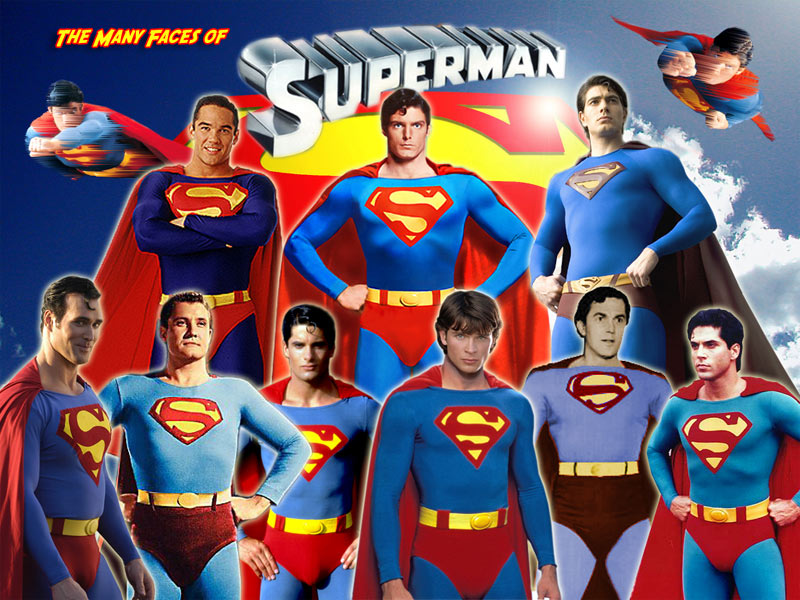
Which is the cold, calculating, utilitarian face?

Which is the cold, calculating, utilitarian face?

In the new Superman film, Supie fails to rescue an important character in distress after the character requests that he allow him to perish.

Lawyer and superhero obsessive James Daily, co-author of “The Law and Superheroes” and the Law and the Multiverse blog, has taken to his keyboard to examine whether the transplanted Kryptonian had a legal duty to rescue the victim anyway.

His conclusion, and the law’s, is no. Daily writes,

“People are sometimes surprised to learn that, by default, there is no obligation under American law to help or rescue other people…Even “Good Samaritan” laws do not create an obligation to act as a Good Samaritan, but instead only encourage such acts of kindness by shielding some would-be rescuers from legal liability if they accidentally end up hurting rather than helping the victim. This “American rule” (not to be confused with the American rule for attorneys’ fees) applies even when a life could be saved with the most minimal of effort. As a result it has been called “morally repugnant” and “revolting to any moral sense,” but it is nonetheless the law in most states….” Continue reading

The Deadliest Rationalization Of All?

woodys excuse

All rationalizations can be deadly and have been. History and human nature teach us, however, that “Woody’s Excuse,” #22 on the Ethics Alarms Rationalization list, can hold its own with any of them when it comes to tallying up pain, ruined lives, and death. This is “The heart wants what the heart wants,” the comedian, actor and acclaimed director’s personal pass for his seducing and marrying a girl who was, in essence, his adopted daughter.

Today the Washington Post carries the grim final act of a story so terrible that it crosses into the realm of black humor. A veteran Labor Department lawyer, married, with an impeccable record, was found dead in his cell after being arrested and charged with violently attacking a co-worker with whom he had become infatuated. The story is full of weird U-turns of phrase; for example, the judge called the lawyer, charged last week with first-degree burglary while armed and third-degree sexual assault relating to the June 5 attack, a “wonderful person in most respects”—-that is, “most respects” beside the implications of his breaking into a woman’s home, punching her in the face (or spraying her with mace,) then trying to incapacitate  her with a stun gun, handcuffing her hands behind her back and knocking her to the floor. The victim was so badly injured that a plate had to be surgically implanted in her face.

Other than that, Judge, you’re right: he was a hell of a guy. Continue reading

“Rubbish” and Ethics

That's me!

That’s me!

Cognitive scientist and philosopher Daniel Dennett has a brilliant and original mind. One of the seven tools he advocates (in his most recent book) for those of us who want to think more clearly and make better use of our time caused me to reflect on one of the most persistent criticism I receive about Ethics Alarms. one of America’s foremost thinkers. Here are the seven, with a sample of Dennett’s comments about them:

1. USE YOUR MISTAKES

“Try to acquire the weird practice of savoring your mistakes, delighting in uncovering the strange quirks that led you astray. Then, once you have sucked out all the goodness to be gained from having made them, you can cheerfully set them behind you and go on to the next big opportunity. But that is not enough: you should actively seek out opportunities just so you can then recover from them.”

2. RESPECT YOUR OPPONENT

“Just how charitable are you supposed to be when criticizing the views of an opponent? If there are obvious contradictions in the opponent’s case, then you should point them out, forcefully. If there are somewhat hidden contradictions, you should carefully expose them to view – and then dump on them. But the search for hidden contradictions often crosses the line into nitpicking, sea-lawyering and outright parody. The thrill of the chase and the conviction that your opponent has to be harboring a confusion somewhere encourages uncharitable interpretation, which gives you an easy target to attack….” Continue reading

Flat, Flat, Flat…and Infuriating

This was bound to happen.

A graph of President Obama's leadership learning curve since January, 2009. This is actually a new graph, including data since the last one of these I posted, though I recognize that the difference is hard to see...

A graph of President Obama’s leadership learning curve since January, 2009. This is actually a new graph, including data since the last one of these I posted, though I recognize that the difference is hard to see…

Waaay back in 2009, when the new President improvidently and recklessly commented on a local dispute between a Harvard professor and a Cambridge policeman, I pointed out that Obama needed to learnthe ethical limits on his power and influence. Teddy Roosevelt’s “bully pulpit” is not license for the highest office-holder in the land to try to mold public opinion on every conceivable matter, local or national, and to influence decisions solely within the authority of others. For the President to state his personal verdict on anything he wakes up concerned about risks putting a weighty thumb on the scales of justice. It is an abuse of power—a President behaving like an emperor.

This is not a difficult concept; indeed, with occasional lapses, every other President has grasped it instinctively. Not Barack Obama. Brilliant Barack Obama. “Constitutional scholar” Barack Obama. For while the Gates episode may have been a rookie mistake, he has engaged in exactly the same unethical, arrogant conduct repeatedly, here, and here, and here and here, and here, and especially here—and I’m sure I may have missed a few.

Each time I pointed out this inexcusable habit, I was barraged by glossy-eyed readers who made excuses for Obama  and rationalized his grandstanding remarks, accusing me of being biased and hypercritical. But with each new instance, it should have been progressively clearer that I correctly diagnosed this malady in 2009. Now, after Obama has done it yet again, commenting inappropriately about the military sexual harassment scandal, this proclivity has finally had tangible legal consequences. You can’t say I didn’t warn him. Continue reading

Indoctrination Ethics: Boy, Do I Ever Hate Thinking Like This, And Curse The Irresponsible Leaders Who Made Me.

constitution-burning1

In Huntingtown, Maryland, a school bus driver heard an 11-year-old boy talking about how he wished he had a gun to protect everyone from bad guys. You know—like a normal American kid, or at least like how a normal American kid used to be able to think of himself, until silly, freedom-fearing, anti-violence fanatics and ideologues were allowed to get their hands on the controls of the culture. But this is 2013, and we have an irresponsible President who speaks about justifying any measure “if it will save the life of just one child.” So the bus driver reported this innocent conversation to the principal, who suspended the sixth grader for ten days, telling him that “with what happened at Sandy Hook if you say the word ‘gun’ in my school you are going to get suspended.”

Fact: This is blatant indoctrination, state-sponsored bullying and attempted mind-control. Continue reading

Ethics and “Casey At The Bat”

casey-at-the-bat-1888-granger

Today is the 125th anniversary of the publication of “Casey at the Bat,” arguably the most popular and famous of American poems, the creation of humorist Ernest L. Thayer in 1888.

The poem carries many  lessons relevant to ethics and life within its tale of the hometown hero who fails spectacularly just when heroics are most needed and anticipated, such as…

  • Don’t promise what you cannot be sure of delivering.
  • Good faith failure isn’t unethical, a sin or a crime, but it still carries with it the need for someone to accept responsibility for it.
  • The focus of disaster is always on the last individual who might have prevented it, but that is neither fair nor logical. The Mudville Nine lost the game, not Casey.
  • Expecting miracles, last-minute rescues, heroic intervention and infallible rescuers is foolish and irresponsible.
  • Respect your adversaries, for your own sake as well as theirs.
  • “Pride goeth before a fall.”

Today, however, I am struck by how neatly the poem reminds us that in baseball there is no spin, no rock to hide under and no Fifth Amendment to claim. When a player fails, or makes a mistake, or misbehaves, it is usually all out on the field, watched in person by thousands, seen on TV by millions, and recorded forever. There is usually no way to deny or hide responsibility, and indeed part of the professionalism of baseball is accepting that, facing the media and the public, and saying, “That was on me. I failed. I’ll do better next time.”

Most of the time, that’s all the crowd asks after failure. Honesty and accountability.

As long as Casey doesn’t keep striking out, that is.

Here’s the poem, recited by the now-forgotten Bob Hope sidekick Jerry Colonna, he of the rolling eyes:

________________________________________

Spark: Craig Calcaterra

Graphic: Fine Art America

Curtis Morrison, The Face Of Ethics Bankruptcy

How did you get this way, Curtis?

How did you get this way, Curtis?

Curtis Morrison’s post at Salon, “Why I secretly recorded Mitch McConnell,’ is disturbing in the manner of those periodic exposés where a journalist gets candid answers from a soul-dead 14-year-old inner city drug dealer,  a short-order cook who hates his customers and spits in their food, mad Islamic terrorist, or venal hedge fund manager. Morrison exposes himself as a politically active, ethically ignorant zealot, and ludicrously proud of it. I’m sure that conservative bloggers will seize on his damning post as evidence of the character rot at work on the Left, but he could just as easily be a young Andrew* Breitbart, or James O’Keefe.

The chilling revelation that dawns as one reads Morrison’s  piece is that mis-wired people like him increasingly warp our political process and turn it into incoherent, useless and destructive warfare. I don’t want to think about how many will read his words and admire him, rather than feel their gorges rise, but unfortunately, it’s my job to think about it. Our task is to make sure there are fewer Curtis Morrisons in the future. Maybe his Salon article, which should horrify anyone who isn’t already beyond ethics repair, will help. Continue reading

Here’s A “No-Tolerance” Policy We Should Get Behind

At least Springfield understands...

At least Springfield understands…

All sane and compassionate adults, tax-payer, responsible citizens and elected officials should adopt this “no-tolerance policy”:

“School officials and teachers who engage in child abuse, hysterical over-reactions and otherwise indefensible punitive measures against children who talk about guns, show pictures of guns, wear T-shirts with guns, use their fingers as guns, form objects that vaguely look like guns, or display obvious toys of any size and material that nobody who has ever watched TV or a movie or traveled among the living could conceivably think was dangerous or a real gun, will not be tolerated, not even once. They will be fired, shunned, and forbidden to engage in any occupation that will give them power or authority over children, anywhere, forever. And school board members, administrators, elected officials or parents supporting such fools will also not be tolerated. Their indefensible opinions will go on their permanent record, creating a prima facie case for any future employer that they are, in fact, too silly to be trusted.”

Is that too harsh? I don’t think so. After all, I just removed the provision that says that any school housing such teachers or officials should be closed down and converted into a shooting range. I can’t stand any more of these stories. Anyone who can read them and blithely send their kids to be “educated’ by such utter dolts and hysterics should be investigated for child cruelty themselves. Who knows what other irresponsible things such parents might be doing?

From the Washington Post: Continue reading

James Lipton: Proud To Be A Pimp

James Lipton, circa. 1951

James Lipton, circa. 1951

James Lipton, he of the most pompous interview show in the universe, Inside the Actor’s Studio, has decided to celebrate that franchise’s 250th episode by cheerily revealing that he worked as a pimp in Paris in the 1950’s. This was apparently legal there and then, and Lipton, he tells us, was out of a job, so why not earn your money by recruiting desperate women into accepting cash to have sex with strangers, and take a cut of their proceeds for your trouble?

Lipton tells Parade:

“I had to be okayed by the underworld; otherwise they would’ve found me floating in the Seine.The great bordellos were still flourishing in those days before the sheriff of Paris, a woman, closed them down. It was a different time.”

Oh…you mean there was a time when dealing with organized crime was good? There was a time when it was admirable to trap innocent young waifs into the sex trade because of their poverty? To facilitate adultery and infidelity? To tell women who they had to have sex with, and accept a percentage of their fees for doing so? There was a time when doing all of this didn’t mean you were an exploitive, venal, amoral, low life?

I don’t think so. I don’t think there has ever been such a time, no matter what France may think. Continue reading