The Importance of American Culture

Pericles delivering his famous funeral oration

By necessity, Ethics Alarms often ventures into the realm of culture, because ethics defines a culture as surely as culture determines ethical standards. This, unfortunately, make politics unavoidable as well, because politics are the means by which laws, primary tools of culture as well as the products of it, get made.

In The New Criterion, Roger Kimball has written a thoughtful essay about the current stakes in America as our culture evolves. He discusses politics and Pericles, and makes his own orientation (classic conservative) clear, and proudly clear at that. It is also an essay with great relevance to ethics. I recommend it highly. Here are some excerpts. The link to the whole article is at the end. Continue reading

Ethics Quote of the Week: Wellesley High School Teacher David McCullough

“Exercise free will and creative, independent thought not for the satisfactions they will bring you, but for the good they will do others, the rest of the 6.8 billion–and those who will follow them.  And then you too will discover the great and curious truth of the human experience is that selflessness is the best thing you can do for yourself.  The sweetest joys of life, then, come only with the recognition that you’re not special. Because everyone is.”

———-Wellesley High School Teacher David McCullough, in his commencement speech to graduating seniors. McCullough annoyed some parents by basing his speech on the fact that students today are encouraged to believe that they are more “special” than they are, leading to selfishness, narcissism and delusion.

Yes, the parents apparently wanted something more conventionally inspirational, like a speech telling their children how special they are.

The speech, in text and in video, has gone viral on the web; obviously it struck a chord that needed to be struck. I wasn’t going to post about it, I must confess; I think it McCullough’s speech is being over-praised. It is disorganized. It includes false information (50% of all marriages do not end in divorce, but that fake, unsubstantiated statistic  is harder to kill than the Hydra), and I don’t think teachers should be disseminating bad facts. It contradicts itself: “Don’t bother with work you don’t believe in” is dangerous and confounding advice for narcissists who one is trying to convince to think of the needs of others. And throbs with the smug contrariness of someone who set out to be controversial. Continue reading

How To Make A Wanetta Gibson

Reader Fred Davison sent me this video of two teenage girls being interviewed by a Florida TV reporter regarding their theft of a 9 year-old Girl Scout’s proceeds from the sale of cookies. If it went viral in 2009, I missed it; if it didn’t, it should have. And although the crime is old news, it is an enduring warning, and a current cause for alarm:

Those who wonder how a young girl like Wanetta Gibson could have casually fingered an innocent boy with who she had been necking in a school corridor and sent him to jail for rape can get some of their answers from the two frightening creatures shown in the video. They have no comprehension of right and wrong. Their parents obviously couldn’t imbue them with any values, and their teachers, if they mentioned ethics at all, did it so fleetingly, ineptly or incoherently that it made no impression at all. They obviously have never been influenced by any church, religion or moral code. They lack empathy, respect for others, regard for fairness or justice, and most of all, shame. Continue reading

How Consequentialism Leads To Bad Ethics: An Illustration

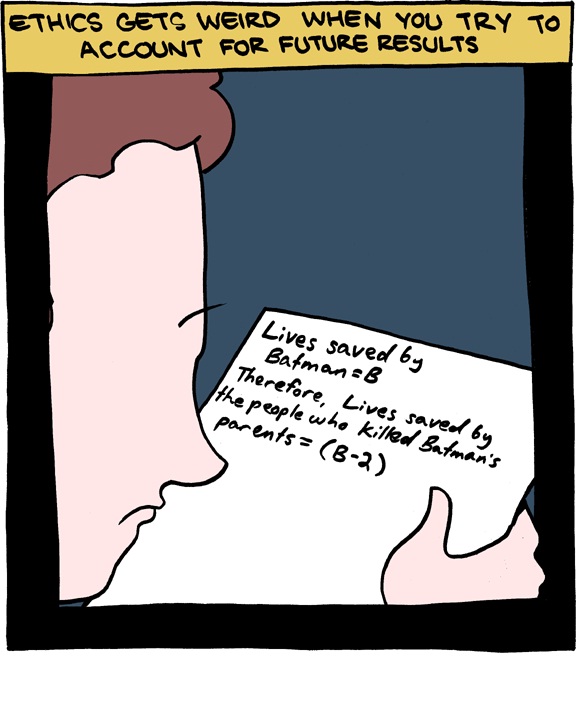
Tgt passes along this cartoon by Zach Weiner. He knew why I would like it: I am often railing about the misuse of consequentialism, justifying an act as ethical after it has produced desirable results. This fallacy bolsters “the ends justify the means” reasoning and makes every act, even clearly wrongful ones, theoretically redeemable in retrospect, after the results are in (although, of course, all the results are never in. That’s Chaos for you!)  The defense of torture by Bush administration defenders on the grounds that it may have uncovered valuable intelligence is the most recent example. Had the unconstitutional imprisonment of Japanese-American citizens in World War II  prevented some Japanese undercover plot by imbedded traitors, undoubtedly that fact would be used to justify an unjustifiable and disgraceful breach of American law and values. Looking backward creates this ethical distortion.

It is equally infuriating, to me at least, when good and ethical decisions are judged, usually by the media or by political pundits, as “wrong” or ” mistakes” because of bad results that could not have been foreseen when the decision was made or the act undertaken.

Weiner’s cartoon nicely marks the logical flaws in backward ethics, for those for whom the word “backward” is an insufficient clue.

___________________________________________

Spark and Pointer: tgt

Source: Saturday Morning Breakfast Cereal

Ethics Alarms attempts to give proper attribution and credit to all sources of facts, analysis and other assistance that go into its blog posts. If you are aware of one I missed, or believe your own work was used in any way without proper attribution, please contact me, Jack Marshall, at  jamproethics@verizon.net.


Justice Is Served: Torry Hansen Gets The Bill

Look out for that sword!

Two years ago, Ethics Alarms featured the story of Torry Hansen, the Tennessee adoptive mother who couldn’t handle her adopted Russian child, so she pinned a note on him and sent him back to Russia, alone, on an airplane. I wrote:

“Sending an innocent child back to the orphanage, like he was a defective toaster returned to Walmart, is the ultimate betrayal, as unforgivable as treason, and far, far worse than adultery. A child who, in Justin’s case (his Russian name had been Artyom), was neglected by his alcoholic mother and taken by the state, sent to an orphanage and given to an American mother, has been rejected again and abandoned. I cannot imagine what this would do to a child. I cannot imagine allowing anyone’s child to endure this, least of all my own.

“Her son was making her life impossible. She couldn’t handle the stress; she looked into the future and saw only problems. Check: I understand. I empathize with Mrs. Hanson completely, for we knew when we adopted our son that this was a possible scenario. Again, it doesn’t matter. Sending an adopted child back to Russia is not an option, because it is absolutely wrong, like murder, like torture, like sacrificing one human being to save another. Never. Absolutely never. Nothing can ever justify treating a child—your own child— like that.”

Now CBS has reported that Hanson will have some consequences of her actions in addition to being roundly detested by every adoptive parent in the world (like me) and being a permanent member of the Bad Mothers Hall of Infamy. Continue reading

Ethics Round-Up in Race, Religion and Sex: GOP Bigotry, Georgetown’s Integrity, and Warren’s Absurdity

Help! I’m buried in great ethics stories!

This is one of those periods in which there are so many juicy ethics stories that I am falling far behind. Here are three that are worthy of longer treatment that I can’t allow to get lost in the crowd: Continue reading

Occupy Eduardo Saverin

Too bad for Severin that they don’t make students read this any more.

You use the culture, markets, resources and freedom of the United States to turn your innovation into a fortune, and when your nation needs you, more than ever, to contribute your fair share to address its serious economic crisis, you decide to flee to foreign shores.

 That’s Facebook co-founder Eduardo Saverin.

Despicable.

Occupy Wall Street and its offspring engage in slander and bigotry by characterizing all wealthy, successful individuals as selfish leeches, but their stereotype fits Saverin like a wetsuit. As his company is poised for a public offering and his shares in it are about to lay golden eggs, he has decided to give up his citizenship, and his tax obligations, to live in luxury in Singapore. This will save him at least 67 million dollars in taxes, and probably more. His lawyer-spokesman says that the timing of Saverin’s exodus is coincidental; he just had an overpowering desire to live in Singapore.

Right.

Well, good riddance. The U.S. needs his money, and had a right to it, but it doesn’t need him. He is an ungrateful, greedy and selfish wretch, and richly deserves to be remembered as this generation’s Philip Nolan, “The Man Without A Country.”

__________________________

Facts: Bloomberg

Graphic: Barnes and Noble

Ethics Alarms attempts to give proper attribution and credit to all sources of facts, analysis and other assistance that go into its blog posts. If you are aware of one I missed, or believe your own work was used in any way without proper attribution, please contact me, Jack Marshall, at  jamproethics@verizon.net.

Ethics Dunce: France

France

France doesn’t seem to comprehend it yet, but it is embarking on an uncharted and dangerous journey by installing a leader whose lifestyle argues for the irrelevance of marriage.

Valérie Trierweiler, the partner of France’s newly-elected president François Hollande, is being referred to world-wide as France’s new, and unmarried, “First Lady.” She seems like a serious, admirable professional, and there are certainly benefits to any nation by having a woman of substance, intelligence and talent at or near the top of that country’s public figures. I know very little about Hollande, but I am assuming that he is qualified for the difficult job he is undertaking, and that he, like Trierweiler, are mature adults who have every right to structure their personal relationships however they please. That assumption, however, requires the omission of the duties of leadership from the calculation. Leaders cannot make personal decisions based only on their own needs, but must make those decisions while acknowledging an immutable and long-proven fact: leaders have a disproportional, almost frightening power to influence, shape and change a culture, and the more successful and popular  leaders are, the greater that power is. Continue reading

Ethics Quiz: The Conundrum of the Crushed Crab

“OH THE HUMANITY! I mean…well, you know what I mean…”

A good friend related this scene on Facebook, and asks if she is losing her mind:

She was shopping at the open air fish market on Maine Avenue in Washington, D.C. when a vendor, whose cart was full of live blue crabs, had an escape attempt. One of the crustaceans made a dash for freedom, only to be squashed by the wheel of the cart.  “I screamed and then burst into tears,” she wrote. “It was awful. I tried to save the little guy.”  Then she realized that people were laughing at the drama, thinking it was a comedy….laughing at the crab getting crushed and at my friend for being upset by it.

She wrote: “Now I know he was destined for a pot of boiling water. But somehow – seeing that little creature getting run over was just too much for me. I know someone was going to eat that crab – but do we have to be cruel?”

Your Post-Mothers Day Ethics Quiz for crab mothers everywhere:

Were the laughers cruel, or merely recognizing a funny scene when they saw one? Continue reading

Ethics Dunce: Sportswriter Jason Reid

I really don’t care how bad you feel, Jason.

In designating national sportswriter Jason Reid an Ethics Dunce because of his sensitive, thoughtful, brave but ultimately unethical column this morning, I don’t intend to suggest that his ethical failing is unusual, or noteworthy for any reason other than the fact that it is universal.

Sometimes we are all like Jason Reid, I think. We all engage in conduct that we suspect is wrong, but we enjoy it. Gradually, truth breaks through our denial and we cannot avoid the conclusion that the conduct is wrong; still, despite the fact that we do not believe human beings should willfully do wrong, we persist in the conduct.

Because we enjoy it.

Reid’s column is titled “Seay’s Death Forces Uncomfortable Questions For Football Fans,” referring to the recent suicide death of former NFL star Junior Seau, the second suicide of a former pro football star in recent weeks. The uncomfortable question is the same one I raised on Ethics Alarms in November of 2009, which tells you how many NFL fans read ethics blogs. I wrote then,

“Simply put, it is wrong to pay money to persuade people to permanently damage themselves for our entertainment. No fight fan can watch Muhammad Ali today, recalling his nimble wit and amusing patter, and not feel complicity in his current near-mute condition, the result of being induced to box after his skills were eroded by time. When we know, and players know, that playing football in the NFL is going to lead to premature dementia for a significant number of players who will accept the risk if the money is right, can we ethically continue to provide that money?”

Sportswriters don’t read ethics blogs either, so in May of 2012, Reid has decided that this and related questions need asking. So he writes.. Continue reading