White House “Ethics”: Obamacare Justifies The Means

Supreme Court protests: pointless when anyone else organizes them, unethical when the White House organizes them.

I was stunned by the news reports of the White House organizing pro-Obamacare demonstrations outside the Supreme Court, and then found myself stunned that I was stunned.

It should have been obvious to all, which includes me, that President Obama and Democratic supporters of Obamacare were so determined to pass this mess that it stopped mattering to them long ago what democratic and constitutional principles were nicked, warped, distorted and violated in the process. This should be obvious regardless of whether one likes the final product (as if anyone knows what that really is, even today—principle nicked: transparent government).

The final bill was passed with a series of legislative maneuvers that had never been mustered all in the support of one controversial bill (principle warped: process and representative democracy); it was built on an expansion of Congressional power the is either unconstitutional or a frightening slippery slope (principle distorted: individual freedom); the individual mandate was (and is) simultaneously sold to the public as not being a tax while argued to the courts as one (principle violated: honesty and integrity), the Congressional Budget Office’s verdict was obtained using accounting tricks and deceitful projections (principle nicked: fairness); and misrepresentation was the norm on both sides of the debate (principles violated: respect for the public; candor, transparency and honesty). Now that the President is already campaigning for re-election and the health care law remains his signature accomplishment—if you consider it that and not a fiasco—the White House has made it clear that, while it may not be fair to say it will stop at nothing to save it, what it won’t stop at to protect the measure is a damning indictment of its integrity.

From the New York Times, one of the few non-conservative media sources to cover the story: Continue reading

Needed: An Ethics Alarm For Twitter

Pat Heaton, Twitter road kill.

Twitter, I have concluded, is itself an ethics trap. What the social networking site allows one to do is to take the usual, daily, routine moments of bad judgment, bad manners, carelessness meanness, incivility, indiscretion and stupidity that we all are guilty of on a regular basis, and magnify their perceived harm and significance exponentially. For the famous, this is especially perilous—witness “Everybody Loves Raymond” star Patricia Heaton, one of Hollywood’s few  open conservatives. She decided to join the Fluke-Limbaugh Ethics Train Wreck with a snotty tweet (“If every Tweaton sent Georgetown Gal one condom, her parents wouldn’t have to cancel basic cable, & she would never reproduce — sound good?”), and it has turned into a career crisis. Pre-Twitter, such a sentiment could have been shared orally with a few friends in snark-fest, or sent as an e-mail to a few trusted associates. But the tweet was viewed as piling on, which it was.

Even the non-famous are at risk: many women were outed on various blogs as idiots for tweeting after the Grammys how much they would like to be beaten up by Singer Chris Brown. Nobody knows when a badly thought out or offensive tweet will be re-tweeted into immortality. Then there is Twitter negligence. Pop idol Justin Bieber just engaged in that form of unethical Twitter conduct. Instead of sending a partial phone number to one friend, he sent it to all of his thousands of followers, who then drove a poor innocent crazy by flooding him with over 1000 phone calls. Continue reading

Self-Promotion Department

Fortunately, you won't have to look at me...

I’ll be “appearing” on NPR’s “Tell Me More” tomorrow with Michel Martin, discussing the NFL’s bounty scandal and maybe another issue or two. Check local times in your area, or just plan on rearranging your sock drawer.

The NFL, Battling Its Own Sick Culture

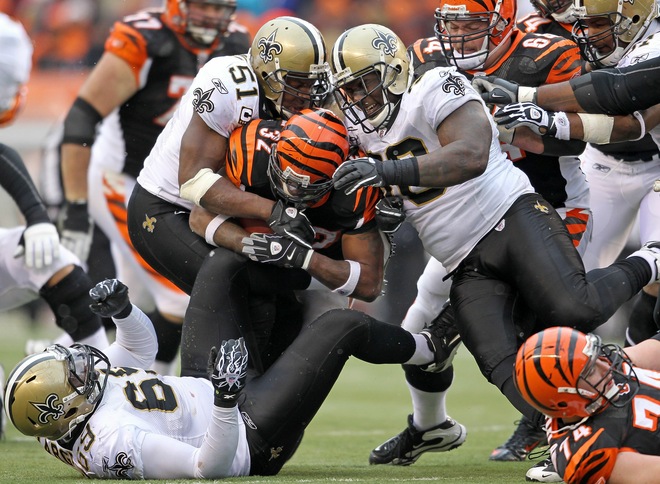
"OK, it's a deal then: we put this guy in the hospital, and split the bounty 50-50..."

The last Super Bowl was phenomenally successful, as its audience size shattered previous records. Yet for many years, I have not been able to enjoy the sport, because of the unethical conflict at its core. Pro football’s appeal and swagger is based on violence, and we now know that the violence damages its players to an unacceptable extent. The players are paid both to accept the crippling and often-life shortening abuse, as well as administer it. For this former fan, that makes football too close to boxing from an ethical perspective. If the NFL is paying  players to do permanent harm to each other, then so are the fans that pay the NFL.  Sorry: there are too many other forms of entertainment that don’t require me to endorse and subsidize brutality. Thus I was not surprised to read this, in the New York Times:

“During the past three seasons, while the National Football League has been changing rules and levying fines in an effort to improve player safety, members of the New Orleans Saints’ defense maintained a lucrative bounty system that paid players for injuring opponents, according to an extensive investigation by the N.F.L. The bounty system was financed mostly by players — as many as 27 of them — and was administered by the former defensive coordinator Gregg Williams, who also contributed money to the pool. The N.F.L. said that neither Coach Sean Payton nor General Manager Mickey Loomis did anything to stop the bounties when they were made aware of them or when they learned of the league’s investigation.  According to the league, Loomis did not even stop the bounties when ordered to by the team’s owner. “

This practice is not only unethical and against NFL rules, it is criminal.  Continue reading

Ethics Hero: Journalist Harris Meyer

Harris Meyer is an Ethics Hero because he won’t let a bad lesson go unchallenged.

Meyer is an award-winning  freelance journalist and a former editor at the Yakima (Wash.) Herald Republic. That was the paper that first broke the story of Gaby Rodriguez last year, which I wrote about here. With the encouragement of her high school principal, Rodriguez, a senior, embarked on some amateur social science research that involved deceiving everyone in her life except her mother, one (of seven) siblings, her boyfriend, and the principal. She pretended that she was pregnant, suing padding. She faked the pregnancy for months, finally announcing the sham in a student assembly. This extended hoax was supposedly designed to expose how pregnant teenagers are treated by their peers and others. It was, by any rational standard, a despicable thing to do—a betrayal and exploitation of her friends,  her boyfriend’s family, her siblings and teachers. Deception on such a scale must be justified, if at all, by both need and necessity. Were there other, less destructive ways to investigate the treatment of pregnant teens? Sure there were; interviews come to mind. Collecting published journals and other accounts. But Gaby’s unethical stunt was in spiritual synchronicity with a reality show-obsessed culture, where fake is entertaining and collateral damage is of no concern.  I wrote: Continue reading

Social Science, Group Research and Bigotry: The Most Slippery Slope

Typical...

Decades ago, Arthur Jensen became a target of critics and a pariah in his field by publishing a controversial study that indicated that differences in racial performance on intelligence tests probably had a genetic component. He was, and is, called a racist, though Jensen has continued to produce respected research. Since the publication of the 1969 Harvard Educational Review article that made him infamous, Jensen has won the prestigious Kistler Prize in 2003 for original contributions to the understanding of the connection between the human genome and human society.

The problem with Jensen’s research results, whatever the legitimacy of the data and his methods, was this: What do you do with it? Like other studies that show women, as a group, with less aptitude for the sciences, or those that show superior traits in other races and ethnic groups, this information just serves as a catalyst for bigotry. Whatever the trends within a large group may be, they tells us nothing about any individual in that group. Yet the existence of a study creates a natural tendency to apply the claimed group characteristics to every group member. Most people think like that, always have and always will. This is similar to the problem with stereotypes. Many, perhaps most, stereotypes have some truth in them. I was raised in a Greek family, and Greeks are reputed to be clannish, cheap, bigoted, and gifted in the kitchen. Well, that would describe a large proportion of my relatives, too, but not all of them. My Aunt Bea is fanatically liberal. My Mom couldn’t cook a lick.  All right, they all were cheap, but the point is that it would be foolish and unfair to assume what any of them would be like without knowing them.

Knowledge is an absolute good, but perversely, some knowledge also guarantees abuse, and thus results in more bad than good. Jensen’s study, as far as I can see, has no good use in a democracy where every individual has the right to be assessed according to his or her conduct and character. Nor do any studies that “prove” character or ability differences in broadly defined groups.

This is all a prelude to my conclusion that the now widely publicized National Academy of Science study that has this conclusion-“Higher social class predicts increased unethical behavior”—is just throwing gasoline on a fire, and has no useful or benign purpose at all. Continue reading

Robot Ethics: Let’s Not Get Silly About It

Today seems to be “Ethics Questions That We Shouldn’t Have To Ask Day,” and Andrew Sullivan, over at the Daily Beast, phrases his entry this way:

“Is Sex With A Robot Adultery?”

Sherry Jackson as a robot on the original "Star Trek." Lovely, convincing, but still basically a toaster.

Gee, I don’t know, Andrew: is sex with a toaster adultery? What has Sullivan asking such nonsense is a new book called Robot Ethics, which has some legitimate issues to explore, and then some other phony controversies included to get publicity and interviews. The field of robot ethics still includes little that hasn’t been thoroughly explored by Robert Heinlein, Isaac Asimov and on “Star Trek: The Next Generation,” but as a few of these dilemmas are likely to enter reality from science fiction in the foreseeable future, it is reasonable to dust off the issues again as long as we don’t get silly about it. Getting overly excited for the Boston Globe, however, Josh Rothman writes: Continue reading

Matrix Chicken Ethics

Yum-yum!

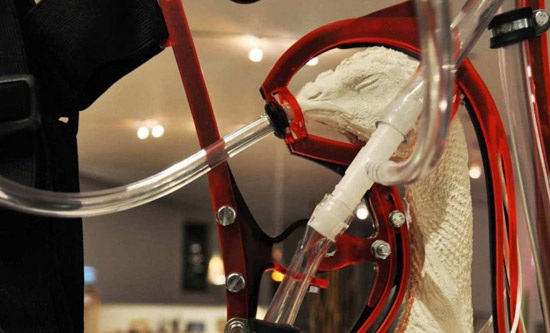
Architecture Student and artist André Ford has sparked an ethics debate after proposing that chickens be raised for meat in vertical racks after  their frontal cortexes have been severed, rendering them brain-dead and essentially growing meat. The question is, would this practice be more ethical than current factory farming, less ethical, or does it make no difference?

Ford’s system would have the chickens suspended and immobile, with their feet removed. Tubes would supply water and nutrients directly into them while other tubes would carry away their waste. The chickens, of course, wouldn’t feel a thing, which one could argue is a superior state to the well-documented stress and misery they would experience in traditional chicken farms. Meanwhile, the costs of raising chickens would be (theoretically) reduced, in part because far less space would be required, and the process would also be cleaner—again, theoretically. Continue reading

Facebook’s Weird Ethical Standards

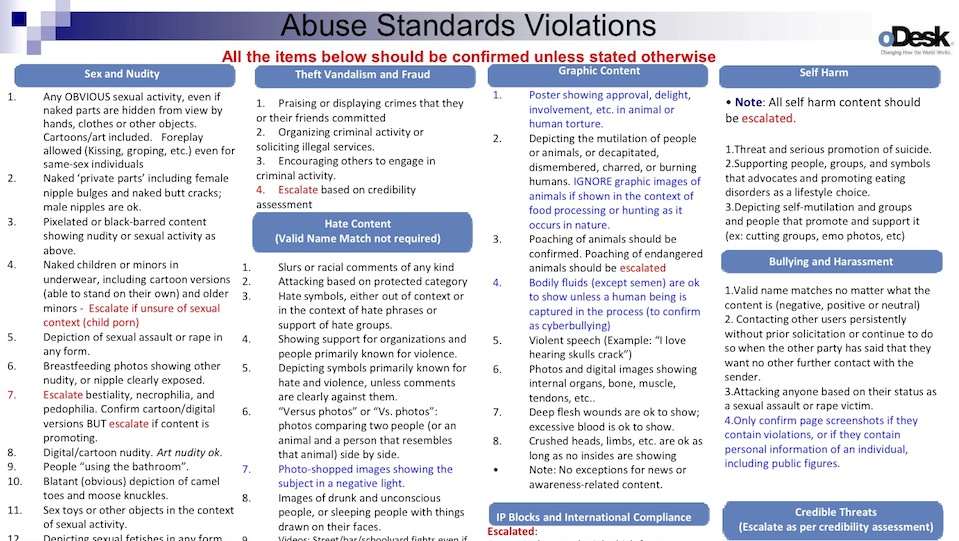
I know, they're too small to read. Never mind; they also don't make any sense

The idea of Gawker, a website that shares the ethical standards of the seamier denizens of “Rick’s” in “Casablanca,” doing a legitimate ethics expose gives me a brain cramp, but the gossip site has given a platform to a Facebook whistleblower, sort of.

I say “sort of,” because knowing Gawker, I wouldn’t be surprised to learn that he was paid to rat out his former employers-once-removed (he was hired by  Facebook’s outsourcing firm that handled his training—oDesk), making him ethically less of a whistleblower than a candidate for Gawker’s editorial board. The argument, I suppose, would be that a dollar an hour, which is what Gawker’s source says was his princely reward for doing Facebook’s dirty work, shouldn’t buy much loyalty and confidentiality, if any. Ethically, that’s false: you are obligated to abide by the terms of bad deals if you voluntarily agree to them. Practically speaking, it is true. A worker a company exploits is likely to harbor more animus than good will, and it isn’t the happy workers who blow whistles. Fine: neither Gawker’s source nor Gawker are ethically admirable. On to Facebook.

The whistleblower is Amine Derkaoui, a 21-year-old Moroccan who was recruited by an outsourcing firm to screen illicit Facebook content. This is what he was paid a dollar an hour for, which, when one considers the news reports flying around recently about how rich Mark Zuckerberg is, and after the company filed its record $100 billion IPO, seems unequivocally exploitive. His real exposé, however, involves what he was paid to do, which was to be Facebook’s censor. Derkaoui supplied Gawker with a bootleg copy of part of Facebook’s abuse standards, which lays out what the company believes is appropriate and what it believes should be banned from the web. Thus it is Facebook’s morality, revealing the ethical standards that the company embraces. Continue reading

Ethics Hero: Pastor Thomas Keinath

Rev. Keinath on holiday, under the overpass

Thomas Keinath is the pastor at Calvary Temple in Wayne, New Jersey, a so-called mega-church with a 2,000-plus seat sanctuary in an affluent community. It was time for him to take some vacation time, so he did. And what did he do?

Keinath spent his week off living with the homeless in the very un-affluent community of nearby Paterson, New Jersey. During the day, he wandered through the streets along with desperate, sick and destitute. At night, he stayed with them as they built fires to keep warm in freezing cold,  and slept with them, under a bridge, surrounded by discarded hypodermic needles.  He wrote down the life stories of the people he met, so he could learn from their life stories.

“I needed to understand what they were experiencing, and I needed to feel their pain.  How could I bring help or healing to the streets if I did not know what their needs are?” the pastor told reporters. Continue reading