Dear Ethics Alarms: We Are Stealing Your Content. Love and Happy Hollidays, The Making Relationships Site

I think this is strange.

Yes, it's true: Nelson may be running a relationship website.

Ethics Alarms got a trackback, which means that a website notified me that it had used a post here. I get these all the time, and sometimes it leads me to a new source of ideas, or new professional relationship. A site has quoted or re-posted some or all of an essay, and that is fine with me.

This trackback led me to a website called “The Making Relationships Site,” and there was my recent post about Zenas Zelotes, the Connecticut lawyer who argues that it’s good for a lawyer to have a romantic relationship with his client. What wasn’t there was a link to the blog, a reference to Ethics Alarms, or any credit to me as the author. My post was presented as the original content of  The Making Relationships Site. The re=post permitted no comments, so I couldn’t write a “What the hell are you doing?” comment, and the site includes no information about who operates it or how to contact webmaster.

But whoever it is was kind enough to let me know, via the trackback, that it had stolen my post. This is the fickish behavior of being candid about being unethical, which also carries an implication of shamelessness, and a dash of Nelson Muntz, the bully on The Simpsons whose reaction to everybody’s misfortune is to point and laugh.

I’m not especially worked up about the theft itself. I don’t like it, but I assume my work will be lifted without attribution from time to time; it goes with the job, though stealing articles about ethics has an especially oxymoronic tinge.

But for a site to make sure that I know about it is strange. Now I’m send it a trackback, so the operators know that  The Making Relationships Site is the first official online fick.

Alek and the Amazing Controllable Christmas Lights

I haven’t plugged my friend Alek O. Komarnitsky in quite a while, and since I’m having a hard time keeping up with all the abuse ( and repetitious rationalizations) from the NORML  crowd over on the “Distracted Driving…” thread, this is a good time to re-introduce him.

Back in 2004, Alek received national attention for his whimsical holiday website that allowed people all over the world to turn his elaborate Christmas lights on from their home computers. Everyone had fun, which was clearly Alek’s design. Still, when it became known that his site was a hoax and that the lights going on and off were only an illusion, I weighed in (on The Ethics Scoreboard) with the opinion that perpetrating such a large-scale deception was wrong, no matter how well-intentioned. Alek objected to my criticism, and we had a spirited e-mail debate.

Then, at a significant cost in time and money, Alek devised a way to really let people all over the world turn on his lights. He has done this ever since, and uses the site to raise money to cure Celiac disease. This year, he writes: Continue reading

Comments of the Day: “UNICEF’s Unethical War Against International Adoption”

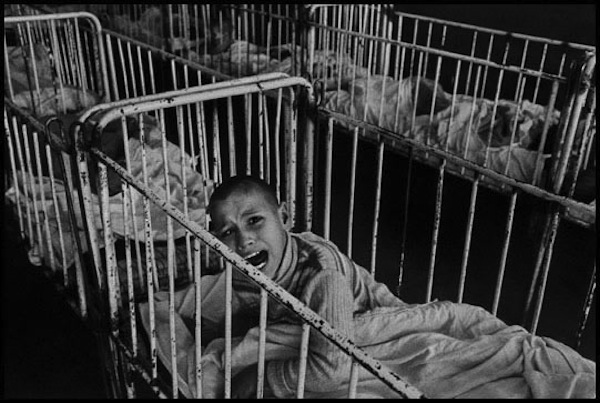
A Rumanian child in an orpahanage for "incurables," circa. 1990, enjoys his "heritage."

A post that is a year old recently attracted two important comments, thanks to a link to the essay from another website. The topic is international adoption, an issue that I have a special interest in as the parent of an adopted son who was born in Russia. I have seen first hand the conditions described in these posts, and when I wrote the original article, I was unaware of the substantial movement opposing international adoption, a misguided effort with tragic consequences to the children these people supposedly want to protect. I am aware of it now. It is an especially tragic example of what happens  when tunnel vision and ideology causes individuals to lose perspective and objectivity.

I am taking the unusual step of pairing two comments as the Comment of the Day.  They arrived together, and compliment each other well. You might want to read the original post, “UNICEF’s Unethical War Against International Adoption.”

Here are the Comments of the Day, by Mel and Holly F. Continue reading

Ethics Hero Emeritus: Christopher Hitchens (1949-2011)

Too many excellent writers are writing about Christopher Hitchens in the wake of his premature death from cancer for me to add much of value. I disagreed with Hitchens frequently, but then, so did everyone. What I appreciated was his integrity, which was unshakable. What I admired, and will always try to emulate, was his refusal to be seduced by convention, ideology, political agendas and partisan bias. Hitchens looked at the world with clear and piercing eyes, and dissected what he observed with a mind that was curious, rigorous, and forever open. Thus he was never a comfortable ally for liberal or conservative, Republican or Democrat, because he would never hesitate to arrive at conclusions that shocked his friends and cheered his friend’s enemies. He was fearless and principled.

Most of all, however, Christopher Hitchens wrote like an angel, a simile the committed atheist would have hated. It is a measure of the depths to which popular taste and intellect have fallen that the Mark Train Prize was awarded in recent years to the pedestrian likes of Will Farrell and Tina Fey when Hitchens routinely churned out prose wittier than their best efforts on the most inspired days of their creative lives. He was truly the spiritual and literary descendant of Mark Twain, as well as Swift, Ambrose Bierce, H.L. Mencken, George Bernard Shaw, W.S. Gilbert, Dorothy Parker, Gore Vidal and the rest of the select crew of social critics blessed with the ability to infuriate, illuminate and amuse simultaneously. When he focused all of his passion, intellect and rhetorical skills on a topic he cared about, Hitchens was as close to an irresistible force as a writer can be. Yet his mission was always noble. His constant goals were truth, justice, fairness, and wisdom. Of him it could be fairly stated, as of few others, that while Christopher Hitchens was around, bullshit was never safe.

I’ll close with four links about Hitchens: the New York Times obituary, the Washington Post obituary, a collection of comments and other links about Hitchens, a collection of his essays, an appreciation from a friend, and a collection of some of his best quotes.

If you can only read one, choose the last. The list is heavily tilted toward Hitchens’ attacks on religion, and he wrote about so many other things, but it is representative of his skill and style. One quote on the list  in particular I remember well, and it makes me laugh every time I read it:

“If you gave [Jerry] Falwell an enema he could be buried in a matchbox.

Ah, we’ll miss you, Hitch!

Gallup’s Trust Survey: Congress in Freefall

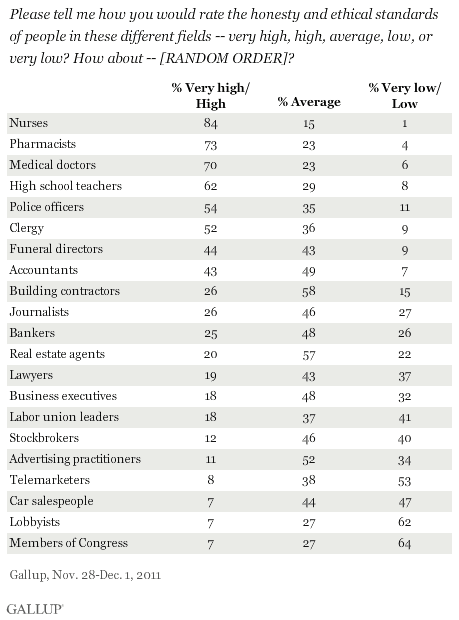
Gallup’s just released annual survey of public attitudes toward various professions held few surprises this year. As has been the case for over a decade,nurses and pharmacists topped the list as the  professions regarded as the most honest and ethical. I find the presence of high school teachers fourth (ahead of police officers)  a triumph of public relations, nostalgia and wishful thinking, but the other top rated professions were predictable. In general, the professions we are forced to depend upon the most are the ones we trust the most—because we have little choice. The ones we trust the least tend to be those with whom we can be in conflict with or see as having differing interests from our own. Doctors are always going to rank higher than lawyers, for example, because there are no doctors trying to make us sick.

Of the 21 professions in the survey, only seven—including funeral directors!—had positive numbers, meaning that more people regarded them as ethical than unethical. The seriously distrusted professions, with a percentage of very low ratings significantly higher than the proportion of very high ratings, begins with lawyers, business executives, union leaders, stock brokers, and advertising execs in order of trustworthiness; bankers, interestingly, avoided this group and had about as many supporters as detractors. But the bottom four is where the really dishonest professionals dwell, according to the poll. With single digit positive ratings compared to negative ratings of  more than 50% are telemarketers, car salesmen, lobbyists, and at the very bottom, Congress, with 64% of the public regarding the institution as dishonest and unethical. That, Gallup says, is not only the lowest rating for Congress since the survey has been taken; it is the worst rating for any profession.

That Congress has sunk so far is not a surprise. It is just depressing.

Here are the results:

So Who Do We Trust To Fight Crony Capitalism?

Shut out of the last Iowa debate because of low poll numbers, earnest, honest, ethical, reasonable, intelligent and boring candidate Jon Huntsman gave his assessment of the event to ABC’s Christiane Amanpour, saying that the main issue facing the country was a trust deficit:

“The most important issue of all was not even touched upon and that is the deficit of trust we have in the United States, in fact it may have played right into the trust deficit. That is, nobody trusts Congress anymore. We need term limits in Congress, we need to close the revolving door that allows members of Congress to move right on into the lobbying profession. No one has trust anymore towards the executive branch, no one trusts Wall Street with the banks that are too big to fail. So I would argue that the issues that are most salient in our political dialogue today were not even touched upon last night…”

Huntsman is right. It was especially astounding that this issue wasn’t addressed in the debate (and that those crack moderators Diane Sawyer and George Stephanopoulos  didn’t mention it) after more than a month of Occupy Everywhere protests that sorta-kinda dealt with the trust issue (oh,  what a little focus could have wrought!)  and the recent “60 Minutes”  expose on insider trading by members of Congress. Also preceding the debate was this trust-buster: in July of 2008, Bush Treasury Secretary Hank Paulson held a meeting with select Wall Street fund managers and gave them advance notice of government action that they could use to make significant profits: Continue reading

Letting Homes Burn in Obion County: Re-send the Memo

"I'll pay the $75 now."

Just in time for Christmas, we have the heart-warming story—or just plain “warming”—of the South Fulton (Tennessee) Fire Department once again standing by as someone’s home burns down.  Ethics Alarms wrote about this  outfit doing the same thing in 2010, following Obion County policy: pay the yearly $75 fire department fee, or be prepared to put out your own damn fires.

In 2010, it was the home of a cheapskate named Gene Cranick, who, like the people who can afford health insurance but don’t buy it anyway, figured that his  community would still do the right thing if the worst happened, so he gambled to save the money.  The South Fulton Fire Department did the right thing, all right, at least according to Obion County officials. They let his house go up in flames.

This time, it was mobile home owner Vicky Bell whose dumb gamble backfired.  Continue reading

Ethics Hero: Ken, Popehat Blogger

"You'll find what you're looking for over at Popehat!"

In the spirit of “Miracle on 34th Street,” in which a Macy’s Santa famously sends a shopper to its rival department store Gimbels (R.I.P.), I’d like to direct readers to run, not walk, over to Popehat, the witty and cantankerous blog that often covers similar territory as Ethics Alarms. There Ken, a practicing lawyer, has penned as strong an essay on ethical issues as you are likely to encounter. Writing about an unethical marketer’s outrageous tactics that included posing as a lawyer to intimidate bloggers, Ken powerfully expounds on the use of bogus lawsuit threats to stifle free speech and opinion on the web, and how to fight it.

This has been a continuing theme of his for a long time, to the point of qualifying as a crusade. It is a worthy crusade, and Ken, along with Popehat, is performing a public service with posts such as this one, colorfully entitled, in the Popehat fashion, “Junk Science And Marketeers and Legal Threats, Oh My!”

Good work, Ken.

Ethics Dunce: Alec Baldwin…and Anybody That Sympathizes Or Defends Him In Any Way, Shape or Form

"I'm a certified jerk, AND I play one on TV!"

Like Ashton Kutcher and Charlie Sheen, Alec Baldwin is a mega-jerk actor who plays mega-jerks superbly.  Designating him as an Ethics Dunce is like shooting fish in a barrel. Still, there is a material difference between portraying a fictional jerk that people laugh at and behaving like one in real life without apology. Baldwin’s stunt on an American Airlines flight yesterday and his subsequent comments about it mark him as a very special breed of self-entitled jerk, and should, in a culture that understands that admiring jerks is the equivalent of endorsing their warped values, lead to his decline in popularity.

We shall see.

Baldwin was quite properly tossed off an American Airlines flight when he repeatedly defied a flight attendant’s request, then command, that he turn off his iPad, on which he was playing a game. The actor, like the arrested development case he apparently is, retired with his game to the plane’s bathroom, slamming the door, and also verbally abused the attendants. Continue reading

“It’s A Wonderful Life” Ethics, Part 3

Here is the final installment of the Ethics Alarms overview of the ethical issues raised in Frank Capra’s classic. Some of the comments on Parts 1 and 2 have suggested that my analysis is unduly critical. Nothing could be further from the truth. I love the movie, and have already said that I find it ethically inspiring. Noting that characters act unethically in a movie about ethics is no more criticism than pointing out that people in horror movies never just leave when things start getting weird (as I would). I know that their actions drive the plot and are necessary. This is, however, how an ethicist watches a movie with as many ethical choices as “It’s A Wonderful Life.” I can’t help it.

Now back to George, Mary, and Bedford Falls:

11. Uncle Billy screws up as we knew he would

11.  Christmas Eve arrives in Bedford Falls, and Uncle Billy manages to forget that he left the week’s deposits in the newspaper he gave to Mr. Potter. Thus more than $8,000 is missing on the same day that the bank examiner is in town. Why is Uncle Billy still working for the Savings and Loan? He’s working there because George, like his father, is putting family loyalty over fiduciary responsibility.  Potter, of course, is a thief; by keeping the lost money to trap George, he’s committing a felony, and an unnecessary one. As a board member on the Savings and Loan, Billy’s carelessness and George’s negligence in entrusting him with the bank’s funds would support charges of misfeasance. Mr. Potter, had he played fair, might have triumphed over George legitimately, and no Christmas miracle or guardian angel could have saved him. But this is the inherent weakness and fatal flaw of the habitually unethical: since they don’t shrink from using unethical devices, they often ignore ethical ways to achieve the same objectives that would be more effective.

12. George folds under pressure Continue reading