Facebook Wars: Parental Abdication, School Abuse of Power

Student Facebook pages were much in the news yesterday. One student was suspended from an Illinois school for posting a list of girls at his high school ranked by appearance and sexual proclivities, while another school, Uniondale High, contacted authorities in Nassau County who prevailed upon Facebook to take down a similar page posting provocative comments about high school girls in various area high schools. Uniondale says it has a “no tolerance” policy toward cyber-bullying.

When did schools suddenly acquire disciplinary control over what students do when they aren’t at school? Continue reading

CNN and John King, Endorsing “Newspeak” and Disgracing American Journalism

And so it begins.

CNN’s John King: “Before we go to break, I want to make a quick point. We were having a discussion about the Chicago mayoral race. My friend Andy Shaw used the term ‘in the crosshairs’ in talking about the candidates. We’re trying, we’re trying to get away from that language. Andy is a good friend, he’s covered politics for a long time, but we’re trying to get away from that kind of language.”

What “kind of langauge”? Oh, you know: vivid language. Metaphors. Similes. Can’t have that on CNN, because, as everyone knows, a completely unrelated use of a cross-hairs graphic on a Sarah Palin campaign map had nothing to do with the shooting of  Rep. Gaby Giffords and 19 others, but the media decided to make everyone think it was the fault of the map anyway. So now a news network, which is supposed to convey information, is apologizing for a guest’s use of the word “cross-hairs” in a context that had nothing to do with violence. Continue reading

“Finishing the Hat”: Sondheim, W.S. Gilbert, and Expert Malpractice

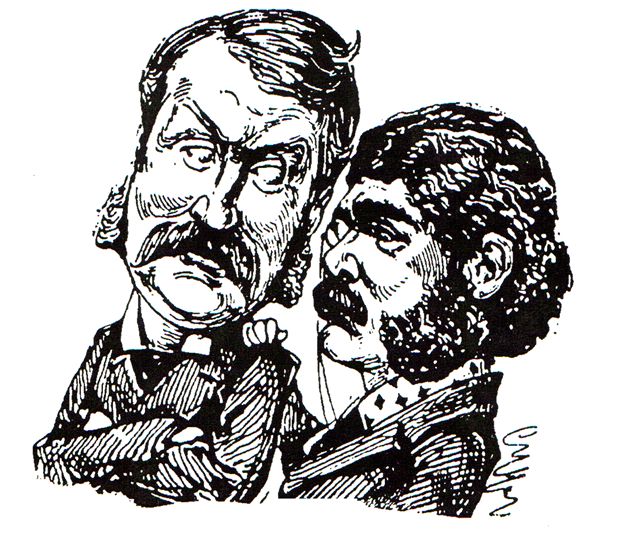
Stephen Sondheim’s “Finishing the Hat” is a fascinating reflection on a remarkable career and the craft of making musicals by the greatest living master of the form. In the course of recounting his formative years, triumphs, failures, and duels with producers, authors and composers, Sondheim also critiques the lyrics of his predecessors, contemporaries and role models—as long as they are dead. In a nod to gentility or cowardice, the only living lyricist he subjects to his expert critiques is himself.

Sondheim is a tough judge, as one might expect from a composer/lyricist who meticulously measures each vowel sound and stressed syllable for maximum effect. He is also, by virtue of both his reputation and technical expertise, an influential one. The lyricists he grades highly in the book, such as Frank Loesser, Cole Porter and Dorothy Fields, are likely to have their reputations burnished by his praise, and those he slams, like Lorenz Hart and Noel Coward, will suffer by comparison. Because of this, Sondheim had an obligation, as a respected expert in his field, to make each case carefully and fairly. To his credit, Sondheim seems to recognize this, and all of his critical discussions of an individual lyricist’s style and quirks include specific examples and careful analysis. We may disagree with Sondheim as a matter of personal taste, but it is difficult to argue with his specific points, because they are backed up by examples, technical theory, and the weight of his authority.

It is therefore surprising and disappointing to see Stephen Sondheim slide into expert malpractice when he undertakes, clearly half-heartedly, a critique of the lyrics of W.S. Gilbert, of Gilbert and Sullivan fame. Continue reading

“Cat Ballou” Ethics

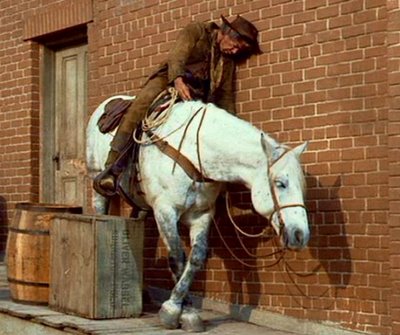
It is generally believed that Lee Marvin’s drunken horsemanship (as well as the comic appearance of his horse, which also appeared to be drunk) greatly assisted his winning the 1966 Academy Award for Best Actor. In case you are considering riding your own horse or mule while in a state similar to Marvin’s “Kid Shelleen,” this article may be of interest. While it is undoubtedly unethical to ride a horse while intoxicated (irresponsible, reckless, and dangerous to both the horse and anyone near it), it may not be illegal, because a horse is not a vehicle.

The Lost Flashdrive and Presumed Consent

“Lose a flashdrive here? Call the Arboretum if you’re one of the visitors in this photo, or phone these guys if they are friends of yours. A flashdrive packed with photos and software has been in our lost-N-found for at least a month — Store manager Lynnea suggested we post a photo from the drive and see if someone cla…ims it. Describe the drive and its contents accurately & provide your postal — we’ll happily return it.”

The Boyce Thompson Arboretum in Superior Arizona recently posted this notice on its Facebook page, along with one of the photographs a staff member took off the lost flashdrive. Obviously the material on the drive is private; just as obviously, the flashdrive is lost. Is the Arboretum within reasonable ethical boundaries to examine and publicize private information without the permission of the flashdrive’s owner to help the owner recover his lost property? Continue reading

Speaker Boehner’s Sensitive/Cowardly Removal of Harmless/Violent Wording in Response to a Trumped-up/Genuine Problem

One of the characteristics of a true Ethics Train Wreck (or ETW for short) is that it eventually reaches the point where unethical and ethical responses to it are indistinguishable. The Tucson shooting ETW officially reached that point today, when Speaker of the House John Boehner apparently yielded to the complaint that referring to the health care reform law as “job killing” was inappropriate in light of Jared Loughner’s near-murder of Rep. Giffords along with killing or wounding 19 other victims.

In a post on his official blog, Boehner referred to the law as “job destroying” and “job crushing,” an apparent concession to critics like Democratic Rep. Chellie Pingree, who argued that the House bill called the “Repeal the Job Killing Health Care Law Act” should be renamed something without “killing” in it, “for Gabby’s sake.” By doing so, the Speaker of the House gave credibility to an argument that… Continue reading

Police Raid Ethics

At 5:30 a.m. on Thursday of last week,  police officers, weapons drawn, burst into the home into the house and pointed guns at the McKay family of Spring Valley, New York. David McKay said officers were screaming for someone named Michael, and when he tried to explain that nobody by that name lived there, the police pulled him, in his underwear, outside into the freezing cold. Then officers ordered McKay’s 13-year-old daughter out of her bed at gunpoint, a trauma that caused her to vomit, faint, and later to have an asthma attack. Continue reading

Unethical Web Post of the Month: William Rivers Pitt

I had been unaware of the existence of a writer named William Rivers Pitt before yesterday, and I now I will look back on those days of naive and blissful ignorance with nostalgia and deep mourning for innocence lost. The face of unreasoning hate and bigotry is always ugly, but one seldom encounters such purple-complexioned, vein-popping, spittle-spewing fury on the web, especially from a published author with a vocabulary exceeding “Deliverance” levels. I had been aware of the website Truth-Out, a hard Left commentary site that I now know exercises no editorial discretion whatsoever.

Mr. Pitt’s rant is entitled “The Wrath of Fools: An Open Letter to the Far Right,” which, if it were written by anyone with a history of the relative moderation of, say, Richard Cohen, Nancy Pelosi or Bill Maher, I would assume was satire. Continue reading

Marketing the Glock and Corporate Social Responsibility

Dr. Chris MacDonald has a thoughtful post on this topic on the always excellent Business Ethics Blog. “The social benefits of selling handguns may be fundamentally contentious; in other words, reasonable people can agree to disagree,” he writes. “But I doubt that the same can really be said for marketing moves designed, for example, to foster the sale of high-capacity magazines (ones that hold 33 bullets instead of the usual 17).”

You can read the whole article here.

The Maine Incivility Project

Thank goodness for the Maine Incivility Project.

With all the talk about incivility sparked by the media’s determination to blame a madman’s shooting rampage on Sarah Palin, Rush Limbaugh and the Tea Party, it rapidly became evident that civility is a somewhat elusive concept. For example, while shouting “You lie!” at the President while he is speaking is definitely uncivil, arguing that the President was really foreign born isn’t—it’s stupid, but not uncivil. Calling Rush Limbaugh “a Big, Fat, Idiot” in the title of your book, as Sen. Al Franken did, is uncivil, as is calling Nancy Pelosi “the Wicked Witch of the West,” as Rush Limbaugh did. Using cross-hairs to designate Democratic House seats that Republicans are “gunning for'”, “targeting” or “taking aim at”, on the other hand, is not uncivil…just unsettling if one is metaphor-challenged or hoplophobic (having a pathological fear of guns.)

Never fear, however. Before the echoes  of President Obama’s call for Americans to come together had barely faded, the public got a handy lesson from the Governor of Maine about what incivility sounds like, as his term launches the new Maine Incivility Project. Continue reading