If You Liked “Enhanced Interrogation,” You’ll Love The “Disposition Matrix”

Is THIS the Administration’s secret weapon against terrorists?

The Washington Post launched a three-part series today about the U.S. drone strike program, in which terrorists abroad are targeted and assassinated from the sky. I’m not prepared to attempt an ethical analysis of this deadly tool against international terrorism, although I will acknowledge that my initial, gut level assessment is that the unique nature of terrorism requires adjustments in the ethics of national security and warfare, and drone killings seem to be a fair and reasonable adjustment.

Yet it is still killing. It is also controversial, with many human rights activists, international law specialists and ethicists vehemently condemning the tactic, especially when used against turn-coat Americans abroad without due process of law. Consequently, the Post’s revelation that the Administration’s “kill list” is called something else rings the ethics alarms.

The Post:

“Over the past two years, the Obama administration has been secretly developing a new blueprint for pursuing terrorists, a next-generation targeting list called the “disposition matrix.” The matrix contains the names of terrorism suspects arrayed against an accounting of the resources being marshaled to track them down, including sealed indictments and clandestine operations. U.S. officials said the database is designed to go beyond existing kill lists, mapping plans for the “disposition” of suspects beyond the reach of American drones.” Continue reading
Snafu Ethics

A persnickety Washington Post reader recently reprimanded that paper for using the term “snafu,” which, he said, is but an acronym for “Situation Normal, All Fucked Up” and therefore inappropriate in a “family paper.” Leaving aside whether there actually is such a thing as a family paper any more, the letter once again raised the ethics and civility issue of whether a stand-in for an uncivil word is less uncivil than the word itself. The reader actually agrees with the position I have taken in the past, though he reaches some conclusions from it I would not. Continue reading

Word Use Ethics

"Super Glue doll? "Mucilage buddy?" "Fly-paper friend"

Ah, politics! Words that are dishonest are winked at by the media without objection, and harmless terms generate apologies that support ignorance and vagueness.

I. Colorado Republican Congressman Doug Lamborn apologized yesterday for using the term “tar baby” during a Friday appearance on a Denver radio program.  Lamborn said this: “Even if some people say, ‘Well the Republicans should have done this or they should have done that,’ they will hold the President responsible. Now, I don’t even want to have to be associated with him. It’s like touching a tar baby and you get it, you’re stuck, and you’re a part of the problem now and you can’t get away. I don’t want that to happen to us, but if it does or not, he’ll still get, properly so, the blame because his policies for four years will have failed the American people.” Continue reading

The Attack of the Grievance Bullies Continues…on “Napoleon Dynamite”???

So...I guess "Tropic Thunder" is out of the question, right?

A bulletin from the Austin (Texas) Parks Foundation:

“The Austin Parks Foundation is canceling tonight’s (Wed, 5/25) showing of Napoleon Dynamite at Republic Square. A new movie will be shown next month. A number of people contacted us objecting to a word used by actors in the movie. We didn’t recall that this word was used and we did not mean to offend anyone. Our apologies for this as well as for the last minute cancellation.”

The PG movie, you see, about a maladroit teen, upset advocates and defenders of the mentally challenged, or whatever code words are deemed politically correct these days–I haven’t checked my “Offense-O-Meter” in the last couple days—because one of the characters uses the word “retarded” exactly once…not to describe someone who is actually laboring with a disability, mind you, but to insult his friend, as teenagers are wont to due, and as they were especially wont to do in the Eighties, when “retarded” was used the way my generation used “spaz.” In other words, there was no justification whatsoever for either the complaint or the movie’s cancellation. Continue reading

Oxymoron Alert: “Ethical Cheating”

What will they think of next?

From Arthur M. Harkins, Associate Professor based in the Department of Organizational Leadership, Policy, and Development, University of Minnesota, and George Kubik, comes a scholarly paper that will have students cheering. Here is the abstract…you can buy the paper here.  Personally, I can tell where this is going, and I can think of more productive ways to spend my money.

Here is the abstract…a good workout for those of you who like to spot euphemisms, buzz words, and looming rationalizations:

Title:    “Ethical” cheating in formal education Continue reading

Now THIS is a Euphemism…

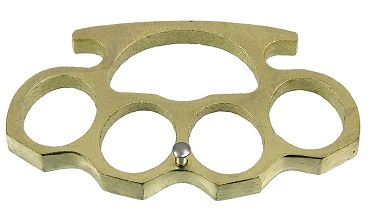
"Hey, where'd you get that lovely paperweight?"

While we’re on the topic of euphemisms, I want to show you one of the most intriguing.

The purpose of euphemisms, as in the case of the two in the recent Ethics Alarms Quiz, is often to avoid legal consequences. The Bush Administration didn’t want to brazenly violate the treaties it has signed banning torture, so it came up with a description of torture that made it seem like something else. President Obama doesn’t want to be accused (though he is anyway) of joining a war without Senate consent, so his Administration is calling the Libyan adventure a “kinetic military action.”

But they are both amateurs compared to the on-line marketers of brass knuckles, those  deadly metal devices one puts over one’s fingers to give an adversary the beating of his soon to be shortened life. Brass knuckles are illegal in many countries, and in most states here; their sale is also prohibited in various ways, and as weapons, they are subject to other regulations. The companies that sell them on-line, however, get around all this by calling them…

Paperweights! Continue reading

Ethics Quiz Time! Which Euphemism Is More Unethical?

Ethics Alarms hates euphemisms, which are usually not intended as delicate ways of describing something controversial, but rather an unethical effort to hide its true nature. Affirmative action…pro-life… pro-choice….all cowardly, all designed to deceive and avoid accountability for one’s actions and views.

Today’s quiz involves a brand new euphemism, cooked up by the Obama administration to describe warfare in Libya that the administration doesn’t want to admit is warfare: kinetic military action!

The Quiz:

Which euphemism is more unethical?

A

“Enhanced interrogation” for torture (The Bush Administration)

or

B

Kinetic military action” for warfare (The Obama Administration)

Here is how to reach your decision: rank A and B in each of three categories…misrepresentation, cowardice, and degree of disrespect and contempt for the intelligence of the American public. First place is worth one point; second gets none. If you rate the category a tie, each gets one-half a point.

Good luck. By the way: there is no wrong answer, since both euphemisms are disgraceful. But let’s see if there is any consensus. I’ll reveal my answer later.

Aesop’s Unethical and Misleading Fable: “The North Wind and the Sun”

Today, by happenstance, I heard an Aesop’s Fable that I had never encountered before recited on the radio. Like all Aesop’s Fables, this one had a moral, and it is also a statement of ethical values. Unlike most of the fables, however, it doesn’t make its case; it is, in fact, an intellectually dishonest, indeed an unethical, fable.

It is called “The North Wind and the Sun,” and in most sources reads like this:

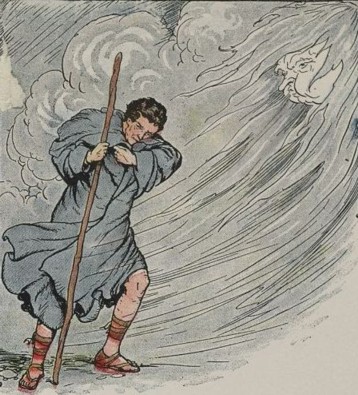
“The North Wind and the Sun disputed as to which was the most powerful, and agreed that he should be declared the victor who could first strip a wayfaring man of his clothes. The North Wind first tried his power and blew with all his might, but the keener his blasts, the closer the Traveler wrapped his cloak around him, until at last, resigning all hope of victory, the Wind called upon the Sun to see what he could do. The Sun suddenly shone out with all his warmth. The Traveler no sooner felt his genial rays than he took off one garment after another, and at last, fairly overcome with heat, undressed and bathed in a stream that lay in his path.”

The moral of the fable is variously stated as “Persuasion is better than Force” , or “Gentleness and kind persuasion win where force and bluster fail.”

The fable proves neither. In reality, it is a vivid example of dishonest argument, using euphemisms and false characterizations to “prove” a proposition that an advocate is biased toward from the outset. Continue reading

The Second Annual Ethics Alarms Awards: The Worst of Ethics 2010 (Part 2)

The final categories in the Worst of Ethics 2010. Coming up: The Best of Ethics, 2010.

(If you missed Part 1 of the Worst, go here.)

Worst Ethics Presentation: “Ethics in Politics: An evening with Former Governor Rod Blagojevich” (Presented to its students by Northwestern University) Continue reading

Spin or Fairness? Fox News and “the public option”

Media watchdog Howard Kurtz’s latest column for “The Daily Beast” illustrates how tricky achieving both objective and accurate journalism can be difficult, and sometimes impossible.

Examining Fox’s coverage of the health care reform debate, he discloses that after Republican pollster Frank Luntz tipped off Fox Tea Party booster and talking head Sean Hannity that the public was favorable to something called “the public option.” but suspicious of the same provision when it was referred to as “the government option.” Shortly thereafter, when the Senate Democrats introduced a health care bill with a public insurance option, Fox News vice president and Washington managing editor Bill Sammon sent the news  staff a memo: Continue reading