Cuomo Interviewing Cuomo? Of Course It’s A Conflict!

The interesting question isn’t whether CNN’s Chris Cuomo blithely interviewing the Governor of New York Andrew Cuomo—who happens to be his brother–is a conflict of interest and an example of unethical journalism. Of course it is. The interesting question is what it tells us about the state of U.S. journalism that such an interview could even occur.

Here are two prominent provisions of the Society of Professional Journalists Code of Ethics, requiring that ethical journalists…

  • “Avoid conflicts of interest, real or perceived.”
  • “Remain free of associations and activities that may compromise integrity or damage credibility.”

Is there any question that a CNN anchor man interviewing his brother regarding anything whatsoever violates both of these? Real or perceived? Compromise integrity or damage credibility? Seriously?

Cuomo the Anchorman was interviewing Cuomo the Governor regarding the recent train accident. Conflict? Sure: the journalist is supposed to have only one duty, and that is to his audience. But Cuomo the Anchorman obviously has another, potentially confounding duty of loyalty to his interview subject, and this he must not have. It calls into question his willingness to probe and, if the facts warrant it, to ask uncomfortable questions of his subject. If Chris Cuomo’s duty to his audience unexpectedly requires him to breach his loyalty to his own brother, which will he choose? We don’t know. Perhaps Cuomo himself doesn’t know. He was obligated not to place himself in a situation where the question even needed to be asked.

The various defenses being offered are, I have to say, misguided and disturbing. The usually sensible Joe Concha of Mediaite writes that the controversy is “much ado about nothing.” His reasons are … Continue reading

The Daily Beast’s Lloyd Grove, Cultural Pollutor…But Only One Among Legions

Interestingly, THIS grove understands ethics better than Lloyd.

Interestingly, THIS grove understands ethics better than Lloyd.

There are three primary reasons the United States of America is getting steadily disoriented, more gullible, less discerning, cruder and unethical. The first is that our leaders now only care about maintaining power, where once  leaders tended to their duty of being what John Adams called America’s aristocracy. Such leaders, not too long ago, modeled the best values and behavior for the public because they carried the most crucial responsibilities, and thus had to be trustworthy. They understood this obligation was theirs because they had the most visibility, and recognized that this demanded positive, admirable, virtuous public behavior. Now our leaders use sophisticated modern marketing techniques to package themselves and ideas like a phony weight-loss remedy, gradually dropping the facades once they are too entrenched to remove. The dispiriting journey make us cynical, less civically involved, and confused. Continue reading

Language Ethics: Letting The Inarticulate Control Expression

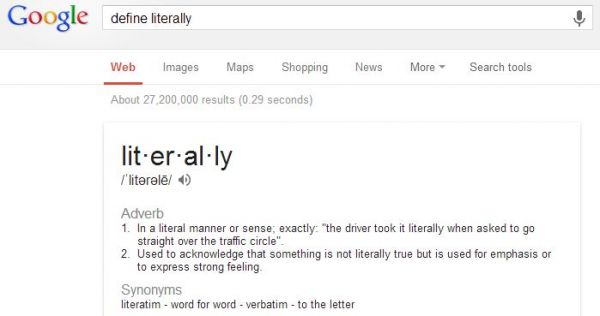
literally

I know, I know.

Tell me about how the English language is dynamic. Next, “irregardless” will be in the dictionary—heck, maybe it is already; I’m afraid to look. Baloney. The fact that “everybody does it,” defined as “people in high places, like Joe Biden, who should know better but don’t,” does not justify treating inarticulate, lazy, careless, embarrassingly stupid language as acceptable. If “literally” means figuratively, then nothing means literally. When someone says that “her marriage was literally destroyed,” thanks to Google and the rest, the only way we know whether her marriage was destroyed or not is if we can find out whether or not the speaker is literate, and maybe not even then.

Call me a stickler, call me a crank, but making the public dumber and communication harder by declaring that those who are poor speakers and lazy thinkers are right and those who champion expressive and accurate language are wrong is not ethical. It is literally irresponsible.

_______________________________

Pointer: Fark

Comment of the Day: “Ethics Dunce: Photographer Jill Greenberg”

Tornado ruin

A home in Tanner, Alabama, after the events of April 3, 1974…

Here are the always thoughtful and often profound Fattymoon’s reflections, in the Comment of the Day, inspired by the post, Ethics Dunce: Photographer Jill Greenberg:

“This reminds me of the time I made a critical decision, on the spot, while covering the aftermath of a killing F5 tornado at Tanner, Alabama the night of April 3, 1974.


“Walter McGlocklin was walking away from me, carrying one of his two surviving daughters. He was cradling this little girl, her upper body and tear streaked face peeking just above her father’s right shoulder. The look of utter horror on her face! The lighting was perfect, an eerie cross hatch of flashlights and spotlights – I KNEW I had the picture of the year. I raised my Minolta 35 mm and focused in. And that’s when it happened. Something inside me said, Do NOT violate this little girl’s privacy. Do NOT allow this little girl’s unbearable pain to act as fodder to sell newspapers across the country. I slowly lowered my camera. It’s a decision, one of only a very few, of which I will forever be proud of.”

_______________


The Ethics of Cheering Alex Rodriguez

Poor Alex Rodriguez and his wife...

Poor, downtrodden, Alex Rodriguez and his wife…

Baseball’s most embarrassing super-star, the steroid cheat Alex Rodriguez, in playing for the New York Yankees while appealing his long suspension by Major League baseball. As he is unquestionably a repeat liar and a serial violator of the game’s rules against PED’s (performance enhancing drugs), as he signed a contract, in part generated by the results of his cheating, that will both enrich him by millions and handicap his team competitively while conferring few, if any benefits, as he would qualify, by most objective standards, as the antithesis of a sports hero, the fact that Arod, as he is called, still was cheered by a vocal minority in Yankee Stadium when he made his season debut this week is intriguing. What does this mean? Can it be ethical to cheer Rodriquez now?

These are deceptively complex and difficult questions. The threshold  issue is whether cheering or jeering any sports figure, or any public figure at all, is an act with ethical content rather than just a communication of an opinion. Is it conduct, or just “words”? I think, in the context of the Rodriquez situation, a sound argument can be made that it is conduct. Registering group approval or disapproval of prominent conduct by someone of status and influence is a crucial societal function in setting standards, registering disapproval, and prompting shame, regret, apology and reform—none of which, so far at least, seem to register with Arod.

That is pretty clearly what the boos convey, but what about the cheers? If the boos are ethical—they are if the disapproval is proportionate, rational, fair, and just—then are the cheers automatically unethical? Not necessarily. Here are some of the things those cheers could be expressing: Continue reading

Ethics Dunce: Photographer Jill Greenberg


"No emoticons were upset in the writing of this post."

“No emoticons were upset in the writing of this post.”

In Slate, renowned photographer Jill Greenberg returns to the topic that gained her unwanted notoriety in May: her exhibition of photographs of children crying their little eyes out. Greenberg revealed at the time that she captured the powerful photographs by giving the very young children lollipops or something else they liked or wanted and then having family members ask the kids to return the item. Strangely,  as Drew Curtis’Fark, one of my favorite web  sources for stories is wont to say, some people had a problem with this.

Greenberg revisits the issue because she has a book of the weepy photographs coming out. Seldom does one read a more casual, “What is the matter with people?”, utterly clueless display of invalid rationalizations for unethical conduct as Greenberg belches out. Unfortunately, another tendency illustrated by the article is far more common: a news sources examination of an ethics issue without any apparent sensitivity or understanding of the ethics issues involved.

Here are Greenberg’s rationalizations, or at least the ones she gave to Slate. I’m sure she has many more.

  • The Trivial Trap, or “Don’t sweat the small stuff.” “I have two children of my own. Crying is not evidence of pain or any real suffering. It’s really just the way children communicate.” Ah. Not real suffering. Then it’s all right, then. The bottom line is that Greenberg is intentionally upsetting the children, who, it can be fairly said, are less anxious and happier when they are not crying. Children who are teased, frightened or otherwise made uncomfortable can also be said not to be in pain or “real” suffering. It’s still cruel, and an abuse of power, to treat them this way. Come to think of it, Greenberg could make the same argument about some of the models in child pornography. Would she, I wonder?
  • “Everybody does it” and the “They’re Just as Bad” Excuse. “Making children cry for a photographer can be considered mean. But I would say that making children laugh and show off their jeans for an apparel ad is just as exploitative and less natural.” And, I suppose, making a Bangladesh child cry by taking food from her to make her cry is just as exploitative  and more natural than giving her food to make her smile, because, after all, she’s usually starving anyway.
  • The Saint’s Excuse or “It’s for a good cause” a.k.a “The ends justify the means.” Slate:  “The still image continues to have a ton of strength. An image taken out of context from one fraction of a second to the next can tell a story, and if photographers are looking to tell a certain story, they can curate those slices of time to their advantage. What’s weird about the images is they seemingly can be applied to all these random disparate causes. My husband was saying they’re like emoticons.” True, Jill, but those little smiley faces don’t have to be tortured to get them to frown or cry, because, unlike babies, they aren’t real human beings.

The bottom line is that Greenberg made money and got a lot of ink by making children unhappy, so she can’t see why anyone would argue that the conduct wasn’t justified, and based on the article, neither does Slate or its writer, Jordan G. Teicher. The photographer’s methods are, of course, obviously and indisputably unethical:

  • She exploited the children for her own agendas and benefit.
  • She abused her superior power over the children to get the reaction she wants.
  • She induced anxiety in another, causing needless harm.
  • She created a product, the photo, which memorializes a form of child abuse.
  • She recruited the children’s parents into assisting in the exploitation for the artist’s purposes, rather that doing their job as parents, thus inducing a breach of loyalty and a betrayal of parental duty.
  • She created and profited from a materialization of an unethical abuse of a child, which is identical to what child pornography does.
  • She encouraged others to create similar photographs, which will be created, in some cases, with even less humane methods.

Of course her methods were unethical. She deserves every bit of criticism and hate mail that she has received. But the sophisticates, like Slate and others, just shrug off the concern as foolishness, much ado about nothing. So she made kids cry! They cry all the time! What matters is that she got some great pictures!

Many of society’s problems arise from the fact that our media can’t recognize, and thus encourages, unethical behavior, even obvious examples like making little children cry for fame and fortune.

__________________________

Pointer: Alexander Cheezem

Sources: Bored Panda, Slate, Fully M


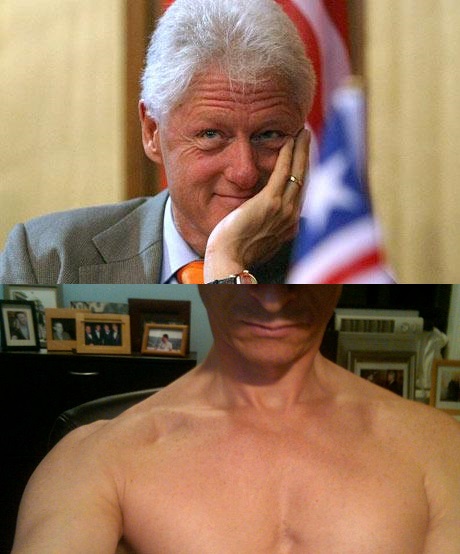
Let’s Be Clear: President Clinton’s Conduct Was WORSE Than Anthony Weiner’s

This won’t make some people happy, but it is true.

Who's more unethical? It's no contest.

Who’s more unethical? It’s no contest.

I always feel like Michael Corleone at times like these: just when I think I am finally through with having to point out the miserable ethics record of Bill Clinton, he (or his shameless supporters) puuuull me back …

The New York Post is reporting that…

“Bill and Hillary Clinton are angry with efforts by mayoral hopeful Anthony Weiner and his campaign to compare his Internet sexcapades — and his wife Huma Abedin’s incredible forgiveness — to the Clintons’ notorious White House saga…’The Clintons are upset with the comparisons that the Weiners seem to be encouraging — that Huma is ‘standing by her man’ the way Hillary did with Bill, which is not what she in fact did,’ said a top state Democrat…’The Clintons are pissed off that Weiner’s campaign is saying that Huma is just like Hillary,’’ said the source. “How dare they compare Huma with Hillary? Hillary was the first lady. Hillary was a senator. She was secretary of state.'”

My reaction to this?

Good!

Karma’s a bitch. Continue reading

Keeping Terrible Secrets

shhhhSomeday I should have an ethics quiz asking which advice columnist is more unethical, Chuck Klosterman, “The Ethicist,” or Emily Yoffe, Slate’s “Dear Prudence.” That horrible exercise is for another day, however. Right now, I am only considering Emily’s latest botch, in which she urged a mother with a guilty conscience to take her terrible secret to her grave.

The secret in question is that the woman asking Emily’s counsel conspired to get pregnant via her gullible, not-ready-to commit boyfriend, who thought she was using birth control. Now it’s 13 years later. She and the double-crossed father are  happily married to other people, in different states, though he “is involved” in his daughter’s life, whom he accepted as his own. Mom never told him what she had done, and he believes that his daughter was an accident, leading him to stay with the family for the child’s first three years.  “Prudence’s” questioner concludes,

“…I had decided that I would go to my grave never telling anyone what I had done. Recently, a friend became pregnant after a one-night stand. Everyone assumes that was an accident, but she confided in me that she had been seeking out sex with the purpose of getting pregnant. I was so relieved to meet someone else who planned an “accidental” pregnancy that it made me wonder if I should open up about my secret. But I’m afraid if I told Ben it might change the way he interacted with Holly. My questions are: Am I some kind of monster for getting pregnant on the sly? And should I come clean, and if so, who should know?”

What? The reply to this should take about 20 seconds of thought to answer:

  • You’re relieved that one of your friends is a lying, betraying fraud? Don’t turn your back on her; I’m warning you.
  • Of course you should tell “Ben,” since he’s the one whose life was turned upside down by your selfish perfidy and deception.
  • “It might change the way he interacted with Holly,” eh? You mean “he might not send quite so much money to you to take care of Holly,” don’t you? Too bad. This is your doing, your lie, and your fault. “I don’t like the potential consequences of telling the truth” is not a justification to keep lying.
  • Yes, indeed you are some kind of monster. What you did was despicable, cowardly, cruel and wrong. Ben might be a prince about it (“Ah, that’s all water under the bridge now! The important thing is that we have our beautiful little girl, and nothing else matters!”), or he might call his lawyer. That’s his choice, and he has an absolute right to have the facts to make it his choice.

Emily, however, reasons otherwise. Don’t tell him, she counsels…

  • “Your act doesn’t make you a monster…” Yes, it really does. Didn’t we establish this in “An Officer and a Gentleman”?
  • “…nor do I think there’s any benefit to enlightening everyone now.”  That’s Ben’s call. The Golden Rule says that he’d want to know that he was tricked, and has been living a lie for over a decade. I sure would. I like to know just how trustworthy the people I associate with really are.
  • “Both you and Ben rose to the occasion and neither of you would express regret that you’re parents to Holly.” Consequentialism! So what? What if she were a rebellious, hateful, crack-addicted thief? The fact that thing turned out all right doesn’t justify the lie or keeping it hidden now.
  • “…At this late date, however, your coming clean would only cast a shadow over your character.” A character that richly deserves such a shadow.
  • “You are deeply remorseful for what sounds like a singular act of substantial deceit.”  What difference does it make that it’s a single act? A single act is enough. And this wasn’t “deceit.” This was a lie.
  • “There’s nothing to be gained by telling your husband and making him uneasy about your essential honesty.” I’d say one’s husband has the right to know the character of who he’s married to. 
  • “You and your friend are also hardly the only women to deliberately get pregnant without letting the man in on your plan, as objectionable as that behavior is.” Oh, that’s terrific, Emily. The old “you’re not the first” rationalization, a particularly dumb variation on “everybody does it.” The conduct is horribly wrong, and the first person to do it is no worse than the 2,342nd.

Gee, I wonder what Chuck would say.

________________________________________

Facts: Slate

The Kaitlyn Hunt Affair: Upon Further Review…

This may not have been Juliet and Juliet after all...

This may not have been Juliet and Juliet after all…

As happens all too often with these viral ethics stories, the facts in the Kaitlyn Hunt case as represented in the first accounts appear to be wrong. Kaitlyn did not first become involved with her girlfriend when both were minors. According to an arrest affidavit , Kaitlyn and her girlfriend began dating in November 2012 when the younger girl was 14 and Kaitlyn was already 18.

Sorry, but that changes everything. Unless one is ready to assert as fact that lesbian relationships in which an adult, however young, becomes involved with a child are less dangerous and potentially damaging than heterosexual ones, Kaitlyn broke a law that is legitimate and sensible as it applies to her, and that law should be enforced. A 14- year old is not capable of meaningful or legal consent, and the opportunity for older, more experienced teens to exploit their inexperience, innocence and deference to older peers is significant and a genuine source of parental—and legal, and societal— concern. If the law permitted an 18/14 year-old sexual relationship between female teens, it would be difficult to explain why 18/12  year-old sexual relationships were materially different, and that being so, legal prohibition on 18-year-old young men seducing 12-year-old girls would be difficult to maintain. Continue reading

A Party Of Portmans, Of Cynics, Of Losers, Or No Party At All

GOP-ButtonThe just released GOP post mortem on the 2012 election is either wishy-washy, cynical, ambiguous or confused, depending on your level of charity. Personally, I would call it useless, as any internal assessment is likely to be when an organization knows that it will be dissected by unfriendly critics and used against them by outright enemies. It is also depressing.

In its essence, the report is about “messaging,” a.k.a marketing, a.k.a. “making people like what you’re peddling by not really letting them know the truth about it.” Undeniably, the Democrats have been better at this in recent years, as passing Obamacare without ever explaining what was in it either to the public or the legislators voting for it, running in 2008 as the tonic for all of George W. Bush’s supposed assaults on human and Constitutional rights and then pretty much adopting all of them and a couple more, like drone strikes, and perhaps most of all, making “transparency” a centerpiece of the 2008 campaign and then delivering a governing style that is anything but. “Messaging” to political parties means “lying” to the so-called “low information voter,” and no doubt about it, the Democrats were better at lying—not necessarily more prolific at it, now, but better—than Republicans in 2012

They must be so proud.

Thus the post mortem lurches between vague appeals to messaging and disturbing assertions that principle and integrity are just too darn risky in 2013 America. For example, the report notes that Republicans were tarred as the party of the rich–hardly a new label, based on those 1920’s political cartoons I have on file, but apparently more Americans don’t like rich people, and would rather be poor people who take the rich people’s money, or something…the report isn’t quite clear on why being rich in America is now somehow a bad thing. The report, therefore, seems to suggest a range of alternatives: Continue reading