A Young Ex-Actress Is In Crisis: Is The Media Capable Of Kindness? Are We?

Yesterday I flagged an independent film, a black satire, that tells the tale of a decent man who is sent into a homicidal rampage when the cruelty of the culture and especially the media overcomes him. I’m not to that point—yet—but the callousness of the national media in response to what it feels is consumer demand is oppressive.

I am going to omit names, graphics or links here, because I do not want to feed the phenomenon I am decrying. Continue reading

Early Ethics Alarms 2014 Award: The Corporate Asshole Of The Year Is….Comcast

Yeah, just try getting Comcast to fix your service issues, and you may find out exactly what it cares about, when you get your severance paycheck...just ask Conal O"Roarke.

Yeah, just try getting Comcast to fix your service issues, and you may find out exactly what it cares about when you get your severance paycheck…just ask Conal O”Roarke.

I don’t want to spoil the suspense or anything, but when a company gives a customer horrible service, keeps botching its attempts to address it, and then calls the customer’s employer about the persistence of his complaints, getting him fired as a direct result, attention, as Mrs. Willy Loman memorably said, must be paid.

Here is the whole awful story, as first described in Consumerist.

Conal O’Rourke  subscribed to Comcast in early 2013.  The company charged him, he says, for set-top boxes that hadn’t been activated; some of his bills were not being delivered as well, because they had his name wrong on the account. He met with a Comcast rep in May who said all would be resolved. It wasn’t. The problems got worse. In addition to still being charged for unactivated devices in his house, Comcast charged him twice for an additional  modem he did not have.

He decided to to cancel his service from these bozos in Oct. 2013,  but says a Comcast rep convinced him that the billing issues would be resolved and that he would get free DVR service and The Movie Channel for three months as compensation. I’ve been there, with DirecTV…except that my satellite service actually did what it said it would. Not Comcast, apparently. It sent Conal O’Rourke about a dozen pieces of equipment that he never ordered and didn’t want–DVRs, modem, standard boxes other stuff—and billed him $1,820 for it. Continue reading

“Borderism” And The Ethics Of Circulating Stupid Ideas

"Certainly sir! We'd be honored to publish your opinion piece in the Washington Post! We welcome new ideas, whatever they may be!"

“Certainly sir! We’d be honored to publish your opinion piece in the Washington Post! We welcome new ideas, whatever they may be!”

For some reason I’m not certain I’d be happy to discover, some editor at the Washington Post thinks what our world needs at this disturbing moment in time is a new form of injustice to address, one that most of us never considered an injustice at all. Thus that helpful editor decided to give a megaphone to someone named , whom, we are told, is chief information officer of an NGO in Guatemala that promotes local governance in developing countries. This is itself interesting, because it provides a hint regarding why it is that developing countries have such a hard time developing. For Mr. , by the evidence of his opinion piece, deemed worthy of publication in a prestigious newspaper, is bats.

Essentially, his essay “Losing the Birth Lottery” asserts that life is unfair, so the only ethical thing to do is to make life chaotic and unfair. feels that it’s really, really mean that the United States doesn’t guarantee the same rights of U.S. citizens to every human being on earth, and insists that its refusing to do so is the moral equivalent of racism. He helpfully suggests the term “borderism” as the name for this heinous attitude, and writes:

“One could certainly argue that racial discrimination is worse than borderism because it excludes people from opportunities within their own countries. But how much worse? Many aspiring immigrants are born into nations where jobs are nonexistent, corruption is rife and indiscriminate violence plagues daily life. Being legally segregated into poverty and tyranny because of one’s ancestry is a cruel fate, regardless whether it’s because of race or citizenship.”

Continue reading

Matt Williams’ Blues: Consequentialism, Hindsight Bias, And Moral Luck

zimmermann

As I wrote last year about this time, the baseball play-offs make us unethical. Managers make decisions that either work or back-fire, and feed the toxic human tendency toward  consequentialism thusly: when they work, the decisions werecorrect; when they don’t, the manager was an idiot, and the choicee were obviously wrong. As with judging the ethics of an act, what happens after a baseball decision is made is irrelevant to whether it was a good decision when it was made.  This is almost impossible to keep firmly in mind. Our logic rebels at the idea that an ethical act can have horrendous consequences, or that the right tactical decision can result in defeat. But that’s life, as my father was fond of saying.

Hindsight bias further pushes us to confuse the making of a decision with its consequences. It is, not surprisingly, much easier to make a strong case that a decision was the wrong one after all the results are in. This, of course, is unfair to the decision-maker, who didn’t have the data the critics do when he or she acted. On the other hand, sometimes the reason the decision was the wrong one is that it was wrong, and the fact that the results were bad just support that verdict.

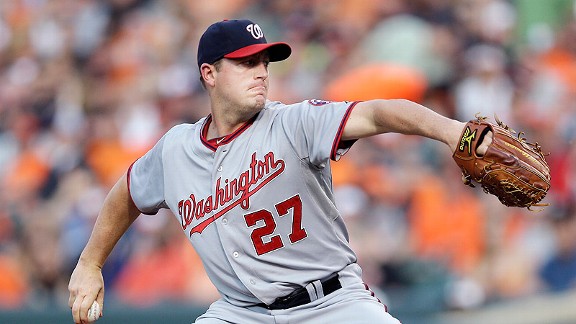
This morning, indeed since last night, Washington D.C. baseball fans and sportswriters have been wrestling this conundrum. The Washington Nationals, widely believed to be the strongest National League team in the post season, and quite possibly the favorites to win the World Series, find themselves down 0-2 in the best of five National League Division Series after a grueling, 18 inning loss to the San Francisco Giants, who didn’t even win their own division. The way the game went into extra innings will be debated for months if the Nats fail to rally and win the series. Nats starting pitcher Justin Zimmermann, who had pitched a no-hitter in his last outing, had been almost as good this time, pitching his team within one out of a 1-0 win that would have evened the series. He had dominated Giants hitters in every way, and had not shown any signs of weakening or, as they say in the game, “losing his stuff.” In the old days, that is, as recently as 20 years ago, a pitcher on a run like this would finish the game unless he had a stroke on the mound. Now, MLB managers are trained to be ready to go to their ninth inning specialist, the so-called closer, at any hint of trouble or even without it, and they almost always do.

As a reflex action, it makes no sense a lot of the time, other than “everybody does it.” A pitcher whom you know is pitching well is a known quantity, while a pitcher newly arrived to the game, whatever his skills, is not.  If the choice is between a starter who is not just doing OK but rather mowing down batters like Samson jaw-boning the Philistines, and bringing in a new arm, logic would dictate that the latter is the greater risk.

Nats manager Matt Williams acknowledged that Zimmerman was “in the zone” by not lifting him to begin the ninth, and was rewarded with two quick outs. When he walked his first batter of the game, however, on his magic 100th pitch (they count pitches now, and 100 is the number at which pitchers supposedly turn into pumpkins), and Williams lifted him, calling on closer Drew Storen. Continue reading

Note To Ethics Dunce Norman Lear: That’s Not “Reverse Racism,” Norman. That’s Just Racism.

Norman Lear, Ethics Meathead..

Norman Lear, Ethics Meathead…

On what has become racism Friday for some reason, I read with annoyance excerpts from Norman Lear‘s new autobiography. The relentlessly liberal ( and smugly so) TV writer, producer/director and liberal activist who created “All in the Family,” “Maude,” Sanford and Son,” and People for the American Way, tells this tale:

“Mike Evans, the actor who played Lionel, the son of George Jefferson on All in the Family, wanted to write as well as act, and I suggested he take a crack at the Good Times pilot script. He brought in Eric Monte, a black writer he wished to team up with. Eric (who later sued me, Jerry Perenchio, Tandem and CBS for something like $185 million) came from the Cabrini-Green housing project in Chicago, so we settled the James and Florida Evans family there. [Editor’s note: The suit was settled for $1 million.] I was charmed by Eric Monte and, having worked for years with Mike, liked him a lot, too. A number of black writers worked with us through the years, but thus far none had created a show. Mike and Eric now had the opportunity to be the first.

They blew it creatively with a poor copycat of a script. But even though what they wrote was a far cry from what we shot, we did not seek to change their credit as the sole co-creators. I could be confessing to a bit of inverse racism here when I admit that it even pleased me to see them credited and paid. That would not have happened, at least not gratuitously, if they were white.”

I have news for Lear: that’s straight up racial bias, also known as racism. He is admitting that he gave excessive credit to two writers for a subpar script because they were black. Continue reading

Comment of the Day: “9 Observations On The Boston Herald’s ‘Racist’ Cartoon”

cartooning

In my post on the matter, I called out to Barry Deutsch, a.k.a. Ampersand, an accomplished political cartoonist and blogger who has graced this space in the past, for his professional reaction to the controversy over the Boston Herald’s Jerry Holbert suggesting, in a cartoon about the recent Secret Service debacles, that President Obama would use watermelon-flavored tooth paste. He was kind enough to register a rapid, and typically thoughtful, response.

Here is his Comment of the Day on my post, “9 Observations On The Boston Herald’s “Racist” Cartoon”: Continue reading

9 Observations On The Boston Herald’s “Racist” Cartoon

Obama-Watermelon-1

1. (UPDATE) I’m adding this new #1 right at the beginning—there were originally only 8 observations—because some of the early comments suggest that I over-estimated some of my readers’ scholarship, historical knowledge and/or sensitivity on this issue, so let me be direct:  the reference to any African- American having as affinity to watermelon is about a half-step from calling him or her a nigger, and maybe even closer than that. Clear? This is not a political correctness matter. If the reference is intentional, there can be no debate over whether it is racist or not. It is. The President of the United States should not be subjected to intentional racial slurs.

2. I’m amazed—I just don’t know how this could happen. How could this cartoon make it into print? Cartoonist Jerry Holbert explained that he came up with the idea to use watermelon flavor after finding “kids Colgate watermelon flavor” toothpaste in his bathroom at home. “I was completely naive or innocent to any racial connotations,” Holbert said. “I wasn’t thinking along those lines at all.” Is this possible? In a political cartoonist? On one hand, since the racial connotation is so obvious and so predictably offensive, it seems incredible that a cartoonist for a major daily would dare offer such a cartoon unless he really didn’t perceive the racial stereotype it referenced. On the other, the man is a political cartoonist, not a Japanese soldier who’s been hiding in a cave for decades. How could he not know this? How could his ethics alarms, racial slur alarms, survival alarms not go off?

I don’t get it. Continue reading

Finally There’s Name For The Conduct I’ve Been Calling Unethical For Years…Now Let’s Agree To Stop It

eclipse

That name is “partyism.”

From Harvard Professor Cass Sunstein:

“…party prejudice in the U.S. has jumped, infecting not only politics but also decisions about dating, marriage and hiring. By some measures, “partyism” now exceeds racial prejudice — which helps explain the intensity of some midterm election campaigns. In 1960, 5 percent of Republicans and 4 percent of Democrats said that they would feel “displeased” if their son or daughter married outside their political party. By 2010, those numbers had reached 49 percent and 33 percent. Republicans have been found to like Democrats less than they like people on welfare or gays and lesbians. Democrats dislike Republicans more than they dislike big business.”

Based on what I’ve seen, the fact that Republicans/conservatives  are nearly twice as likely to be “partyists”  as their hated enemies to the left on the political spectrum doesn’t surprise me. Most of the manifestations of the bigotry I’ve seen out in the open and written about here—restaurants that give discounts to praying customers and bars that claim that they will only serve “red voters”—have come from that sector, but 33 percent isn’t anything for liberals to be proud of, either. Over all, the trend is horrible for the country. As I wrote regarding “Mary’s,” the restaurant that favored its religious customers…

“I detest this kind of thing, and so should you, because it is ethically indefensible and un-American to the core….splitting the world into them and us, good guys and bad guys, the virtuous and the reviled. All of “Mary’s” customers are human beings, and that is the only thing that should matter in the United States of America.”

I confess that since I have been observing this phenomenon, I am preconditioned to think the Stanford research that purported to measure it as has validity. Most social science research, especially involving politics, is so skewed by researcher bias and agendas that it is inherently dubious, and perhaps this example is too: I wouldn’t rely on the percentages. Also 1960 would have to be the absolute low water mark in U.S. political passions, after the remarkably non-partisan, unifying two terms of Dwight Eisenhower while the public felt united against a common enemy in the Cold War. I’m guessing the numbers in, say, 1860 would show a sharper divide.

I do think that the intensity of emotion, rising to bigotry, distrust and hate, in the nation’s political polarization is growing, is very alarming, and dangerous to our health and future. I’d like to know more about where it resides. Is the bulk of the bigotry coming from the low-information voter, who uncritically absorbs every campaign smear, bumper sticker insult and Facebook meme as fact—you know, morons? Or are the individuals who would rather die than see their daughters marry men who oppose the family’s favorite party the narrow-minded political junkies who watch only Fox News and listen to Rush, or who cheer Al, Chris, Rachel and the 24-7 conservative-bashers on MSNBC? I’d like to know.

Naturally theories will abound regarding the reasons for this new bigotry. In a general sense, it is pure cognitive dissonance, and can be explained by people today caring more about politics and ideology than they have for quite a while. People care about something when they sense that it matters to their lives, health and welfare, as well as those around them: if political views were regarded as no more important than what baseball team one rooted for, there is no way substantive bigotry would attach to them. With foreign threats looming, the economy weak, nobody certain of the right policies in so many crucial areas and the pettiness, corruption and ineptitude of parties in and out of power, trust has plummeted. When we can’t trust those whom we have given the job of looking out for our welfare, we become worried and scared, as well we should. Then it makes sense to care more about politics. If we care more, and feel strongly about what should be done either out of a lack of sophistication and gullibility (the morons) or from unbalanced self-education (the zealots), then those who proclaim opposing views seem more obnoxious and more threatening, prompting active discrimination. The Stanford study found that “discrimination against the out-group is based more on out-group animus than in-group favoritism.” That figures. But for a nation, it is suicidal.

This nation of ideals gleaned from a diverse population must value trust and belief in what all citizens share more than it embraces passion and anger over what we disagree over. If we cherish the basic principles of democracy, then we must accept, encourage and respect dissent, frank speech, the shocking opinion and the minority view.  We must always keep our minds open to new ideas, different solutions to old problems, and the possibility that we, or the public officials, scholars and pundits we favor, may be wrong on any one topic or issue. If we can’t do that, we doom ourselves and our culture to self-righteousness, doctrine, cant  and rigidity, which block out enlightenment like an eclipse blocks sunlight. Continue reading

Ethics Hero: American League Batting Champion Jose Altuve

Altuve

There was another baseball Ethics Hero who emerged on the last day of the regular season yesterday. File it under “Sportsmanship.”

Houston Astros secondbaseman  Jose Altuve (at less than 5′ 5″, the shortest athlete in a major professional sport) began the day hitting .340, three points ahead of the Tigers’ Victor Martinez, who was at .337. Even with all the new stats and metrics showing that batting average alone is not the best measure of a baseball player’s offensive value, a league batting championship remains the most prestigious of individual titles, putting a player in the record books with the likes of Ty Cobb, Ted Williams, Rogers Hornsby, George Brett, Ichiro Suzuki and Tony Gwynn. It’s still a big deal. If Altuve didn’t play in Houston’s meaningless last game, Martinez would have to go 3-for-3 to pass him, giving the DH a narrow .3407 average compared with Altuve’s .3399. By playing, Altuve would risk lowering his average, providing Martinez with a better chance of passing him.

Many players in the past have sat out their final game or games to “back in” to the batting championship, rather than give the fans a chance to watch a head to head battle injecting some much-needed drama to the expiring season. ESPN blogger David Schoenfield recounts some of those episodes here.

Altuve, however, gave Martinez his shot. He played the whole game, had two hits in his four at-bats, and won the American League batting title the right way—on the field, not on the bench.  (Martinez was hitless in three at bats.)

The conduct, simple as it was, embodied fairness, integrity, courage, respect for an opponent, and most of all, respect for the game.

Sportsmanship lives.

Ethics Hero: Minnesota Twins Pitcher Phil Hughes

Phil Hughes

This is the final day of the regular baseball season, and an appropriate time to salute a major league player who placed principle over cash….even if I disagree with him

Phil Hughes was a bargain pick-up during the off-season for the Twins, a failed pitching phenom for the Yankees widely viewed to be on a fast slope to oblivion. He surprised everyone with a wonderful season for the otherwise woeful Minnesota team this season, potentially setting the all-time strikeout-to-walk ratio record, and began his final start of the campaign needing to throw eight and a third innings to reach 210 and trigger a $500,000 bonus in his contract.He would have made it, too, pitching eight dominant innings against the Diamondbacks and allowing just one run.  Then there was a downpour, with Hughes needing one more out to get the  extra $500,000.

After more than an hour’s rain delay, the game was resumed, but as is the practice in baseball, Hughes did not return to pitch: too long a delay, his arm too cold, too much risk of injury, especially after throwing so many pitches.  Hughes accepted the bad luck without complaint or rancor, saying that “some things aren’t meant to be.” Continue reading