Ethics Dunces: Republicans

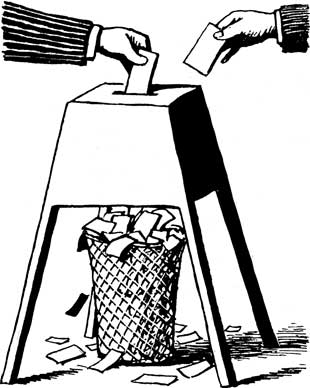
election-fraudIn government, the appearance of impropriety can be as damaging as the reality, and what a terrific, tone-deaf, stupid example Republicans are giving the nation by trying to change the Electoral College system, already highly unpopular (I like it, by the way), by making it worse. The GOP is pursuing a strategy of trying to get the states where it has control of the legislature to change the way those states’ electoral votes are allocated in a Presidential election from winner-take-all (the current system in place in all but two states) to allocation by Congressional district. Such a system would have, just coincidentally I’m sure, given a narrow victory to Mitt Romney if it were in place in all the states that Mitt Romney lost (but none that he won.)

Screams from Democrats that the Republicans are trying to “fix” the election system are a bit disingenuous: an essentially identical system was installed in Maine by a Democratic legislature (as well as in Nebraska by Republicans), and no alarms were sounded then. There is nothing illegal or unconstitutional about it, for state legislatures are charged by Mr. Madison’s masterpiece with deciding how allocating electoral votes should be done. Democrats also did something similar in the wake of the baroque 2000 election result, concocting a scheme, the National Popular Vote Interstate Compact, to undermine the Electoral College by persuading several states to agree to direct electors to vote not for whoever wins the popular vote in the state itself, but for whoever wins the popular vote nationally. Well, waddya know! THAT method would have given Al Gore the Presidency—and what a fun ride it would have been!—from 2000-2004. This is as much an example of trying to rig the results of the previous election as what the Republicans are trying, though it is much, much fairer and ethically defensible on it merits. (Still a bad idea, though.) Continue reading

Unethical Quote of the Week: Former NASA Official Jon Harpold

“Don’t you think it would be better for them to have a happy successful flight and die unexpectedly during entry than to stay on orbit, knowing that there was nothing to be done until the air ran out?”

—–Space Shuttle Columbia mission operations chief Jon Harpold in 2003, talking about the Shuttle crew then in flight, as quoted by former NASA flight director Wayne Hale on his blog this week. Harpold was musing on a hypothetical situation (he thought) where NASA had determined that the Shuttle couldn’t safely return to Earth.

Columbia crew

Days before Columbia disintegrated on re-entry due to a damaged heat shield, NASA officials met to determine whether Columbia was safe to land despite some damage after takeoff. They decided, wrongly, as it turned out, that the Shuttle was safe. In the course of the meeting, Jon Harpold raised the hypothetical dilemma of a doomed Shuttle and an unaware crew.

Hale tells the story to make the point that NASA’s culture at the time was organizationally and ethically flawed. I agree.

Harpold’s position is kind but monstrous. It presumes to withhold the truth from those most effected by it, on the theory that it is better to die suddenly and unexpectedly than to have the opportunity to fight and strive to the end to solve what might be an impossible problem. Nobody should feel that he has the right to make that decision, to give up on life itself, for another who still has the capacity to think and act. This is disrespect for the values of personal liberty and autonomy, both much in the public mind today.

We each must have the right to make our own decisions about our fates, and must always have the information we need to make those decisions as wisely as we can. Those who fear the truth have insufficient reverence for it. Even the worst information may contain the seeds of victory.

I’m not going gentle into that good night, and damn anyone who tries to trick me into doing so out of misplaced kindness.

__________________________________

Facts: Kansas City Star

Graphic: KCNTV

Ethics Alarms attempts to give proper attribution and credit to all sources of facts, analysis and other assistance that go into its blog posts. If you are aware of one I missed, or believe your own work was used in any way without proper attribution, please contact me, Jack Marshall, at  jamproethics@verizon.net.

Comment Overview: “Mutual Destruction At Applebee’s: An Uncharitable Pastor and a Vengeful Waitress Do Each Other In”

This post is approaching an Ethics Alarms record for comments, and as always in the case when my commentary strikes a nerve, almost never on the most serious issues [This earlier post from yesterday, for example, is one that matters, and that I wish would get wider distribution, since I appear to be the only one making these points], the later comments tend to re-iterate the earlier ones, which have already been addressed, and I hate explaining the same thing over and over. Also the trolls have come out to urinate on everything, and I’ve had to ban a few, which I don’t like to do.

Therefore, as I have done before, here is a summary of the thrust of the comments and my replies, as well as over-all observations about the issue and conversation generally. I wish any commenter would read this before repeating what has already been said:

1. Nobody is defending Bell, the cheap and arrogant pastor. Good, but if the update you’ll find at the end is correct, she is considerably less despicable than everyone, including Welch, presumed.

2. One clown, however, wrote an abusive comment accusing me of defending the pastor, insulting my work and character based on that accusation, which made about as much sense as accusing me of being Marie of Rumania. I banned her, and also told her why in intentionally unkind terms. I’m not sorry.

3. It continues to amaze me how many people feel they have to comment on commentary—often in abusive and indignant terms– when they haven’t taken the time to read the post. Unbelievable.

4. I expected some readers to defend the actions of the waitress, but not as many as turned up.

5. I am grateful for the assistance of texagg04, affectionately known as “Tex,” who jumped into the fray late last night when I was trying to deflect attacks left and right. I owe you, bro.

6. Facts:

  • It is not against the law not to leave a tip.
  • It is not against the law even it is a so-called “mandatory tip.”
  • It is not against the law even if the mandatory tip is noted in the menu.
  • It is not legally theft.
  • It is unethical to leave an inadequate tip when the service was at least acceptable, as it apparently was at Applebee’s that fateful day.
  • It is not unethical to leave less than the expected tip if the service was poor.

7. A server, or a server’s colleague, has no right to take any negative action against a diner who unfairly leaves an inadequate tip. That is the restaurant’s choice alone.

8. Applebee’s did nothing wrong whatsoever. The large number of posts asserting that Applebee’s or eating establishments in general mistreat their employees, justifying conduct like the waitress’s web-shaming are manufacturing rationalizations. Even if true, and I have no evidence of that in this instance, that is irrelevant to Chelsea’s duties as an employee, and subsequent misconduct.

9. There is no way to ethically shame the pastor without the participation and approval of the restaurant.

10. There are three  problems with what the waitress did: 1) She worked for Applebee’s, and embarrassed an Applebee’s customer in a manner that involved the restaurant and that directly related to a patron’s visit there. That is employee misconduct, anywhere, no matter what the provocation. 2) She was engaging in vengeance, which is unethical—“tit for tat” conduct which is virtually always wrong.  3) The vigilante punishment was disproportional to the offense,

11. A restaurant does not have to specifically inform employees that taking unilateral action against restaurant patrons is a firing offense. That said, I’d be shocked if the employment manual didn’t include language broad enough to cover this incident. It didn’t have to say, “Don’t web-shame cheap customers.”

12. I think Applebee’s should ban Bell from eating at any of its restaurants. I said that in the post. But that does not mean that it should “show some spine” and endorse an employee unilaterally harming a patron in revenge. She was acting personally, but doing so in a way that reflected on her employers, involved them, and harmed them. No employer should be expected to tolerate that, and those who endorse such conduct are foolish.

13. Dumbest and most irritating ethics-free comment, repeated many times: “If you ever waited tables, you wouldn’t take that position! You don’t know what you’re taking about!” Translation: “I’m biased, because I’m a server, sympathize with servers, and can’t be objective. You can’t analyze this without being biased too.” The underlying ethical issues–vengeance, vigilante action, violation of duties to employers—have nothing to do with waiting tables, and apply the same way in other professions.

14. The expropriation and publication of data on a proprietary document belonging to the diner, Bell, and Applebee’s is per se  unethical conduct. There is no defense for it.

15. A diner does not voluntarily put herself in the public eye by what she writes on a check that is between her and the restaurant.

16. An interesting spin-off was raised by a vengeful waitress who defended Chelsea and said that when she was stiffed on a large bill, she informed the mayor of the town that the diner, a city lawyer, was plotting against the city with his meal companion. Even if he was, servers are professionally obligated to keep the contents of conversations they overhear confidential. If she had done this as a whistle-blower, it is ethically defensible. She did it to get even, which is not a justifiable reason, and the restaurant would be justified in firing her for doing it.

17. Yes, I sometimes have typos and other errors in my replies to comments. As regular readers know, I have them in my posts, too, though I am constantly cleaning them up. The typos in the comments are mostly due to the fact that I answer a lot of them, in addition to the fact that I can’t type or spell. This does not, as one commenter asserted, mean that I did not graduate from the schools I “claim” I did. And what makes you think graduates of those schools  necessarily proof-read any better than I do?

18. As for the web-shaming fans who argue that Chelsea’s act was virtuous because such evil conduct should exposed, and anyone who acts so disgracefully deserves to be held up to disparagement across the globe: None of us should want to live in a society where every mistake we make is at risk to be preserved forever online, warping the opinions that others form of us for the rest of our lives. In Europe, it is called “the right to be forgotten.” The Golden Rule applies, not that Pastor Bell would recognize it. This is a perfect example of the kind of minor lapse–it’s 7 lousy bucks!—that the elephant gun of public shaming should not be used against.

19. Novel (and bad) rationalizations: 1) Because the waiter collected money, he became a co-owner of Applebee’s. Ugh, no. He is the agent of Applebee’s, and still just an employee. 2) The bill wasn’t proprietary, because it wasn’t copyrighted of trademarked. Wrong. “Proprietary” also means “property belonging to someone,” and the someone wasn’t Chelsea. 3) Bell’s comment on the bill slip was directed at the waiter personally, so the retaliation was only personal too. Ridiculous. First, it is unclear that the comment was directed at the waiter at all; I’d say it was directed at the restaurant that mandated the 18%. But even if it was directed at the waiter, it was directed at the waiter in his capacity as an employee, not personally….not that it would justify retaliation even if it was intended personally. 4) Applebee’s has an obligation to support retaliation for “blatant abuse” or an employee being “taken advantage of.” This suggests that every time a waiter is given an unfair tip, the restaurant should support web-shaming. The “blatant abuse” was withholding a seven buck tip—not nice, but “abuse”? This wasn’t even why Chelsea posted the bill—it was what was written on it that outraged her, and that didn’t “take advantage of anyone.” That was just someone being a mega-jerk.

20. This is not a free speech issue.

21. The Applebee’s employee manual has plenty of provisions prohibiting Chelsea’s conduct.

22. If you are tempted to argue, as one commenter did, that my use of an Applebee’s menu as a background on a day when I am getting nothing but comments related to this post suggests that I am endorsing the restaurant or otherwise a shill for it, heed this warning: Don’t. There are some insults I won’t tolerate, and this is one of them. UPDATE (2/2): The Applebee’s menu background was scheduled to be replaced today, but I’m leaving it up in honor of the cognitively damaged commenters, currently numbering two–one banned and one likely to be—who have accused me of shilling for the restaurant.


UPDATE (2/1): Now it appears that the pastor left a tip in cash, and only complained about it on the slip. And that Applebee’s charged her credit card with the tip anyway, meaning that it owes her money. If true, this makes Bell far less of a villain, and also makes her complaint to the restaurant more justifiable. It also makes Welch’s conduct look reckless and unfair, further justifying her dismissal.

Mutual Destruction At Applebee’s: An Uncharitable Pastor and a Vengeful Waitress Do Each Other In

1aloisreceipt

The Combatants!

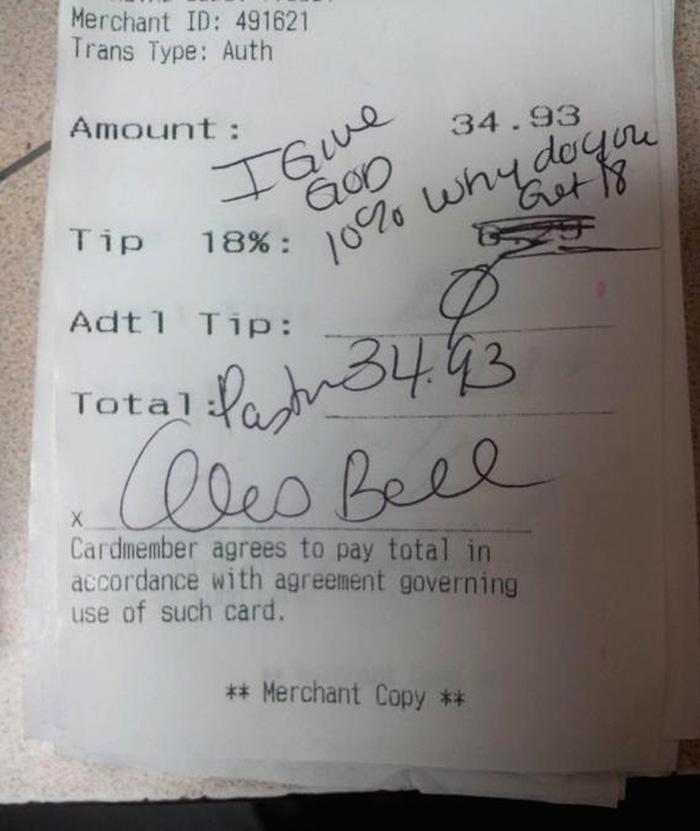
  • Alois Bell, a pastor at Truth in the World Deliverance Ministries Church. Uncharitable, vengeful, arrogant and cheap, she complained about an autotip of 18% added to her Applebee’s check that was triggered by the size of her group. The bill was small, but the group was large. Crossing out the tip amount and replacing it with nada, she scrawled, insufferably, on the bill, “I give 10% to God, why do you get 18?”, thus stiffing the waiter whom the party later said had rendered impeccable service. She also scrawled “pastor” by the bill amount, thus presuming a clergy discount that didn’t (and shouldn’t) exist. After a waitress colleague of the un-tipped waiter posted the bill on Reddit to inspire some well-earned web-shaming, Bell complained to Applebee’s management, successfully getting the waitress fired.

Verdict: Contemptible jerk. She abused her position to claim a discount that she wasn’t entitled to, and punished an innocent server by withholding a fair tip. [This may not be so; see UPDATE at the end] Then she set out to take vengeance on the young woman for exposing her despicable conduct. So much for showing the other cheek. Bell’s conduct was as far from the teachings of Christianity as one can get, at least at an Applebee’s.

  • Chelsea Welch, the now ex-Applebee’s waitress. She posted the obnoxious bill and scrawled comments online, whereupon the pastor was identified by her handwriting, and perhaps her jerkish personality.

Verdict:  Unethical conduct, though provoked. Her colleague was wronged by the cheap pastor, but she forgot she wasn’t free to do as an Applebee’s employee what she might choose to do as a private individual. Applebee’s can’t have its customers worrying about whether real or perceived slights to restaurant staff will land them on various websites to be mocked and vilified. Her actions were irresponsible and a violation of her duties as an employee, even though her anger was certainly justified. And her method of retribution was excessive and unethical too. Continue reading

But What If David Gregory Shot the Pitbull?

Illeagl? Well, it depends. Just WHY are you breaking the law? Is it for GOOD or ILL?

Illegal? Well, it depends. Just WHY are you breaking the law? Is it for GOOD or ILL?

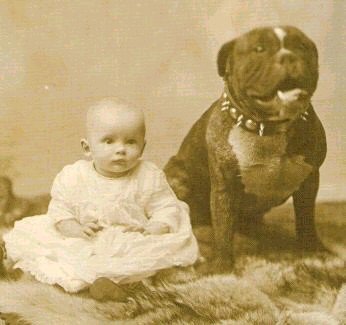
Another hybrid ethics tale has surfaced! Cross pitbulls (or whatever a reporter thinks passes for one) with the gun law debate and the District of Columbia’s refusal to bring charges against David Gregory for breaking its gun laws on national television,  and…bada bing! This (From the Washington Post) :

“The bloody paw prints travel the length of a city block, from a Northwest Washington street corner where police said an 11-year-old was mauled by three pit bulls to the welcome mat at the dogs’ owner’s home. Two days after the attack, in which police said all three dogs were fatally shot, the prints were a reminder of what happened at Eighth and Sheridan streets on Sunday afternoon. Police said a neighbor and an officer shot the pit bulls as they sank their teeth into the boy’s legs, arms, stomach and chest…An uncle of the victim’s said the boy was riding a new Huffy dirt bike with orange rims he had gotten for Christmas. The uncle said his nephew emerged from an alley onto Sheridan Street, where he collided with the pit bulls. D.C. police said the unleashed and unattended dogs attacked the boy before a neighbor who saw it went into his home, got his handgun and fired once, hitting one of the dogs. A D.C. police officer on bicycle patrol heard the shots, and authorities said he shot and killed the other two pit bulls…Of the shooters, the 34-year-old uncle said, “They did the right thing.”

“D.C. police said they are reviewing the incident and have left open the possibility that the neighbor could be charged with violating the District’s gun laws. A police spokesman would not say whether the gun was legally registered. Even if it was, using it on a D.C. street is illegal…”

Some Post readers were appalled that such a heroic action could result in prosecution. Wrote one, indignantly:

“That prosecutors would even consider bringing gun charges against the Northwest D.C. resident who saved an 11-year-old’s life by shooting one of three pit bulls that were brutally mauling the child speaks volumes about the mindless absurdity of the city’s gun laws, to say nothing of the zealous anti-gun sentiment that more broadly permeates officials’ thinking here…If the good Samaritan who acted quickly in this case to save a child possessed his gun unlawfully, police and prosecutors should by all means confiscate it. But contemplating further charges against him is as unconscionable as it is ridiculous.”

No, what’s ridiculous is to have gun laws that are enforced according to the policy that if a citizen does a good thing with his illegal gun, then it’s fine; only bad acts with guns will result in prosecutions. Continue reading

Sandy Hook Massacre Ethics Train Wreck Special: Distortions From The Media, Excuses From The Biased, And A Call For Accountability

The Daily Beast, through the words of columnist David Frum. calls the latest disgraceful example of the news media bending the truth to manipulate public opinion regarding gun control, “The Newtown Heckling Controversy,.” This places that website on this train wreck as a Big Lie player. The classic formula for a Big Lie smear, for those of you who have read your Goebbels followers, is to make a blatantly false assertion, make the target of the unfair accusation deny it, and then treat it as a legitimate “controversy.” There is no controversy here, only liars and those who want to benefit from the lie, because there was no “heckling.” The real news story here is that the United States has not only developed an arrogant and ethics-free media establishment that no longer can tell true from false, it is getting more brazen by the day. There must be accountability.

The incident—or, as journalists who have decided that their jobs are not to report the news but to drive public policy in their favored direction would call it, the opportunity—occurred during the testimony before the Connecticut legislature by a parent of one of the Sandy Hook victims. [Note: I believe strongly that such testimony is itself unethical. Sorry. Legislation should be based on research, analysis, balancing, and objective analysis of what is in the best interests of the the public. There is literally nothing these parents contribute to this process, other than confusion, emotion, and dramatic video footage. They are not experts on guns, violence, the culture, the Constitution or the law. Their position is the epitome of bias. Their opinions are accorded undeserved weight by the media and mush-headed lawmakesr because they have suffered a personal , as if suffering confers sudden wisdom and balanced perspective. I know the practice is virtually routine, but it does no good, a lot of harm, and should be opposed by anyone interested in competent government.] Tearful and distraught, the grief-stricken father, Neil Heslin, said,

” I don’t know how many people have young children or children. But just try putting yourself in the place that I’m in or these other parents that are here. Having a child that you lost. It’s not a good feeling; not a good feeling to look at your child laying in a casket or looking at your child with a bullet wound to the forehead. I ask if there’s anybody in this room that can give me one reason or challenge this question: Why anybody in this room needs to have an, one of these assault-style weapons or military weapons or high-capacity clips.”

He waited, and glanced around the room. Then he said, “Not one person can answer that question!” Whereupon one clear voice with a several  others behind it call out,“The Second Amendment shall not be infringed!”

A moderator then says, “Please no comments while Mr. Heslin is speaking. Or we’ll clear the room. Mr. Heslin, please continue.”

This is what happened..this is what obviously happened. Heslin asked the occupants of the room a question posed as a challenge. Pro-gun advocates did not answer, assuming that despite the ambiguous form of the query—Heslin is not a skilled public speaker—it was a rhetorical question. Apparently Heslin didn’t think it was rhetorical, however, because he waited, as if for a response, and then made a statement that concluded unfairly, inaccurately and misleadingly that nobody in the room “can answer the question.” Predictably, a few then did answer his question, only to get slapped down by the moderator.

The headline writer at the Connecticut Post described this scene—falsely—as “Father of Newtown victim heckled at hearing.” That is a lie. Anyone who watches the video and equivocates in calling it a lie is allowing their judgment to be completely liquified by confirmation bias, or trying to facilitate a deception. Continue reading

Consequentialism, Bias, Moral Luck and Malpractice on PBS’s “Downton Abbey”

downton_abbey

The fourth episode of the PBS sensation “Downton Abbey” provided a clinical examination of how bias of all kinds can rule the most important decisions in our lives, and how moral luck so frequently determines our conclusions about whether those decisions were right, wrong, or really, really wrong. It also shed some light on the  current policy conundrum of how best to consider medical malpractice suits—as a fair and necessary means of rewarding the victims of professional errors, or as a decidedly unfair device that distorts the practice of medicine and inflates its costs without improving treatment.

For those who have not caught the trans-Atlantic mania of following the saga of the Earl of Grantham and his extended family as they try to maintain their life of luxury as members of the landed aristocracy post-World War I, here are the relevant plot points of the most recent episode (in the U.S.; Great Britain is a season ahead of us):

Sybil, the much loved but rebellious daughter of the Earl is staying at the family estate (all right, castle) as she prepares for childbirth. (She and her Irish revolutionary husband Tom are on the lam from British authorities, but never mind that). The Earl naturally wants the best medical care for his daughter, and rejects the long-time family physician, Dr. Clarkson, for the task, because he has made some faulty diagnoses of late that led to all kinds of sorrow in last season’s drama. So the Earl calls in a renowned surgeon to the upper crust who is upper crust himself, Sir Philip Tapsell. (He appears to be an arrogant, pompous jerk, but the show’s writers show him giving sage and well-worded advice to the Earl’s non-Irish revolutionary son-in-law on the delicate matter of his sperm count, so we know he’s not a fraud as well.)

The Earl’s American but far too deferential wife Cora (in case you wondered whatever happened to the cute Elizabeth McGovern from “Ordinary People,” the answer is, “This!”) seeks to rescue Dr. Clarkson from a stinging snub by insisting that he come to Downton Abbey and be present for the childbirth as what we would call a consulting physician to Sir Philip, who doesn’t want one. Two head-strong doctors and hostile doctors looking after the same patient—yes, this will work out well.

Sure enough, Sybil’s pregnancy takes an ominous turn. Her ankles are swollen (“Perhaps she has thick ankles!” huffs Sir Philip, pooh-poohing the symptom. “She does not!” replies loyal Dr. Clarkson), her mental state is confused, and there is protein in her blood. Clarkson concludes that Sybil is toxemic and believes she could suffer eclampsia if she isn’t taken to the hospital immediately for a Caesarian section. Sir Philip dismisses him as a hysteric hack, and insists that Sybil’s pregnancy is normal and fine. Since Caesarians were risky in the 1920’s, often resulting in the deaths of the mother, the baby, or both, he believes Dr. Clarkson is giving irresponsible advice. As critical minutes tick away, Lord Grantham asks Clarkson if he can guarantee that Sybil will survive the ordeal of a Caesarian. “There are no guarantees,” he replies, correctly. Not hearing what he wanted to hear, the worried father turns to Sir Phillip and asks how certain the blue-blood doc is that the operation is unnecessary. “Completely certain,” is the ridiculous reply.

Announcing that certainty is a better bet than equivocation, Lord Grantham decrees that Sybil will remain at the castle to have her child, which she promptly does. All seems to be well, too, with a healthy baby, a beaming mother, a relieved family, and a smugly gloating Sir Phillip. But then Sybil goes into the violent seizures characteristic of eclampsia, and it is too late to save her. She dies. Dr. Clarkson’s diagnosis was correct. The family is devastated; Sir Philip is stunned, Cora is furious at both him and her husband, and the Earl of Grantham is feeling guilty.

Got that?

Cora’s anger, the Earl’s guilt and the vindication of Dr. Clarkson are all the result of a bad-tasting recipe of hindsight bias and moral luck. Sybil might have not gone into convulsions. She might not have survived the Caesarian, in which case Dr. Clarkson would be the one looking incompetent, Sir Phillip would say “I told you so,” and Cora would be furious at a different doctor but the same decision-maker, her husband, who would still be sleeping in the guest room. Continue reading

Bizarro World Ethics in North Carolina

bizarro_world

Also known as “North Carolina”…

The Bizarro planet, occasionally mentioned on “Seinfeld,” was a humorous feature in Superman comics, a cube-shaped planet populated by flawed clones of Superman and Lois Lane. Nothing made sense on the Bizaaro world, since its denizens were sub-cretinous, their traditions absurd, and their logic inverted. They threw away food and ate the plates—that sort of thing, hilarious if you’re a nine-year old boy in 1962.

I sometimes refer to “Bizarro World ethics,” which invokes the principle that it is difficult, if not impossible, to be ethical in a culture where a lack of ethics is the norm, just as behaving normally with Bizarro Supie and Bizarro Lois would be rude and confusing to them. This is the dilemma facing North Carolina, which is apparently trying to devise an ethical way to run a state lottery. That is a hopeless goal. It is like insisting on clean mud-wrestling, non-violent Jason Statham films, or healthy junk food. State-run lotteries are by definition unethical. The states that run them, and almost all do, have traded principle for encouraging and endorsing activities they once declared harmful and criminal, as a cowardly way to acquire revenue without paying the political price of raising taxes.

By doing this, they… Continue reading

Note To Matt Drudge: He’s The President. Show Some Damn Respect

This will be short.

This week a fly was buzzing around the President’s head at a White House event this week, and  photographers got multiple shots of the insect as it lighted briefly on various parts of the President’s face. One comic use of such a photo is, I suppose, to be expected; we all know a fly on President Bush would have been all over the media. But Drudge has used the photos for two days now. (No, I’m not showing it, and I’m not sending Drudge links for being a sophomoric jerk.) It’s not funny. It’s unfair, mean-spirited, rude and disrespectful, and would be for any President.

Cut it out.

The Saga of the Entrepreneural Legal Mentor

"OK, now pay attention. I'll teach you to hunt, but it will cost you..."

“OK, now pay attention. I’ll teach you to hunt, but it will cost you…”

Attorney Kenneth Beck is reeling from a barrage of criticism he has received for placing this ad on Craig’s List:

ARE YOU RECENTLY ADMITTED TO THE BAR, OR AWAITING BAR RESULTS, BUT NEED EXPERIENCE FOR THAT FIRST JOB?

General practice attorney with more than twenty years of experience is willing to train a small number of recently admitted attorneys, or those awaiting bar results. For a monthly fee, you will be able to shadow the experienced attorney, and learn by watching the day to day practice of law. Observe the following types of proceedings, as they occur; Civil Short Calender motion arguments, foreclosure mediation’s, pre-trial conferences, Workers Compensation and Social Security hearings, real estate closings, discovery proceedings and compliance, research and general office operations. …

The unprecedented ad, now pulled, prompted nasty e-mails from his target audience and a lot of ridicule on various legal blogs. Beck hit a nerve, obviously, in fact several: the perceived venality of the profession, the desperate plight of recent law grads in a tight market, the lack of practical training students receive in law school. Some even suggested that the ad rose, or rather fell, to the level of professional misconduct. “Will this kind of revenue producer be censured by the state bar association?”, asked the blog Law and More.

That one is easy: no, because nothing about the ad raises legitimate questions about Black’s trustworthiness or honesty, and there is no clear violation of any existing rules inherent in his proposition. Still, the question lingers: even if this doesn’t nick the Rules of Professional Conduct, is it ethical? Continue reading