The Shock Jocks and the Suicide: A Moral Luck Cautionary Tale

With every action we take, we're rolling the dice...

With every action we take, we’re rolling the dice…

Jacintha Saldanha, a nurse at the King Edward VII hospital in Great Britain, happened to be the staffer on duty when two Australian disc jockeys made a prank call to the hospital ward where the Duchess of Cambridge was staying for treatment of the symptoms of her recently disclosed pregnancy. The DJs, Mel Greig and Michael Christian,  pretended to be the Queen and Prince Charles, and the gullible nurse discussed the royal patient’s condition with them, violating protocol and security.  Three days later, Saldanha, the 46-year-old mother of two, was found dead of an apparent suicide.

Now the disc jockeys are off the air indefinitely, and being pilloried as virtual murderers in some local media as if Saldanha’s death was a predictable and reasonable outcome of their admittedly irresponsible gag. It wasn’t. Presumably the same people screaming for Gaig’s and Christian’s heads would also be doing so if the nurse had been asked, in the fashion of a gentler, dumber era of phone pranks, if she had Prince Albert (tobacco) in a can (“You do? Then for God’s sake, let him out!”) and killed herself in humiliation. This was not a natural outcome of their juvenile routine. This was an unhinged over-reaction that had to have underlying causes far deeper than a practical joke phone call. The shock jocks were the victims of moral luck, the same phenomenon that leaves a tipsy partier who drives home without incident a respected citizen, but turns a driver who is no more intoxicated and  attended the same party into a community pariah because a careless child ran in front of his car. The two drunk drivers were identical in their conduct. One was lucky. The other was not. Continue reading →

Ethics Quiz: Censoring a First Grader’s Poem

No-GodThis is a different kind of ethics quiz, because the question is where the blame for an unethical result lies. The result is clearly wrong, but I am uncertain who or what should be blamed for it.

A first-grade student in North Carolina wrote a Veterans Day poem honoring her grandfather, a Vietnam veteran. She had been selected to read the poem at a November 8 Veterans Day ceremony.   One of the lines was, “He prayed to God for peace, he prayed to God for strength.”

The Horror.

The school forced her to remove the line. Continue reading →

The Perfect Ethics Story: The Dilemma Of The Extra iPads

Your ethical dilemma just arrived!

Your ethical dilemma just arrived!

Now here is an example of a consumer episode in which everyone involved behaved with exemplary ethics, and without hidden agendas. There is no need to draw this out—Consumerist does a great job telling the story, and you should read it here. A quick summary:

  • A woman who ordered one iPad from Best Buy received five.
  • Her e-mail to the store about what she should do was unanswered.
  • Legally, she was within her rights to keep the extra merchandise, but (correctly) worried about possible consequences to the worker who made the shipping error,
  • She consulted the consumer advice maven at Consumerist, who tracked down someone at Best Buy to deal with the problem.
  • Best Buy’s rep contacted the consumer, thanked her for her honesty, and sent her this letter: Continue reading →

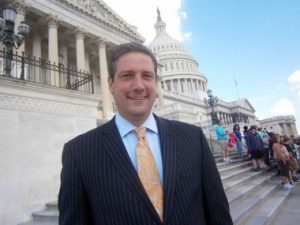
Incompetent Elected Official of the Month: Rep. Tim Ryan (D-Ohio)

Ah, yes, those old football injuries that tighten up and cause you to walk like you're drunk after going to a wedding where nobody drank to excess. Who hasn't been in that situation?

Ah, yes, those old football injuries that tighten up and cause you to walk like you’re drunk after going to a wedding where nobody drank to excess. Who hasn’t been in that situation?

Let’s be clear, now: Rep. Ryan is not politically incompetent, no sireee! He’s no fool; he knew that an arrest for public intoxication in August might be a high hurdle on the route to his re-election, especially since the matter wouldn’t be resolved until after the November 7. So when the rising star of a congressman, seeking election, now safely accomplished, to his sixth term, was arrested in Virginia, Ryan’s staff managed to keep the embarrassing incident out of the papers, cable news broadcasts and political junkie blogs. He had been  stopped by a police officer who observed him staggering along the sidewalk, and Ryan refused to take a Breathalyzer alcohol test as the officer requested, precipitating his arrest. The incident, after all, might have been misunderstood. Can’t have that. Continue reading →

Fair Is Fair: The Times Isn’t Perfect, But It’s Time I Paid For It

nyt-paywallEver since the New York Times instituted its paywall system, which forces you to subscribe to its cyber-version once you use the site more than 20 times in a 30 day period, I have been economizing on my Times use rather than pay its (reasonable) subscription fee. One reason was money; one reason was that I usually don’t have to use the Times more than 20 times a month, with other good news sources out there that charge nothing at all; and a last reason is that the Times annoys me with its hard left-wing bias, well to the left of the Washington Post, which is hardly balanced, and inappropriate, in my view, for the publication that holds itself up as the exemplar of American journalism. The exemplar of American journalism should be objective and non-partisan, damn it, or at least try to be.

I have to admit, however, that even with its biases, the New York Times is still the best news source I know. I get the Post delivered to my door every day, and read the print copy of the Times only when I am on the road. I am always struck at how often a Times story or feature is directly relevant to my work, compared to any of its competition, including the acclaimed publication I read every day. Yesterday I learned that the Times has scheduled yet another round of lay-offs and buy-outs. It is in financial trouble, like all newspapers, and I can no longer justify refusing to do my part to help it survive as long as it can. The Times has given a lot to me, my readers and my field, and what it has provided has come with tangible expenses that are becoming more difficult to cover. The paper drives me crazy sometimes, but it remains a vital resource; it is unfair to focus my disillusionment with the journalistic field at the best of it, much as I would like to see the Times set an even higher standard. Right now, the battle is to allow the Times to maintain the journalistic standard, however flawed, that it sets now.

I just signed up for a cyber-subscription. The Times has earned my support, and with it struggling to keep the print flowing, I can no longer justify taking my 19 free articles a month and giving nothing back in return.

In the Wake Of The BP Disaster, Another Andersonville Trial

Someone has to be held responsible, even if nobody is to blame.

Someone has to be held responsible, even if nobody is to blame.

I don’t know about you, but I was certainly surprised to discover that in the view of the Justice Department, two men I had never heard of, Robert Kaluza and Donald Vidrine, were the ones responsible for the April 20, 2010 explosion of a BP oil rig that caused millions of barrels of oil to leak into the Gulf of Mexico for months, polluting the waters and the shores and causing billions of dollars of damages. That is the clear implication of the decision to prosecute the two rig  supervisors for manslaughter in the deaths of the eleven BP workers who perished in the blast.

Obviously, this makes no sense at all. Other government authorities have treated the BP spill as resulting from a complex series of errors, misjudgments, and regulatory violations on the part of several companies and their management teams. The allocation of responsibilities and damages will take years to unravel. How then can Kaluza and Vidrine, who are accused of disregarding abnormally high pressure readings that according to the government should have alerted them to the danger of a  blowout at BP’s Macondo well, be the ones facing criminal charges and prison time? How can this be fair, just, or even possible?

It isn’t fair or just. It is possible because it is easier to finger the two middle-managers who inherited the flawed well equipment that was a ticking time bomb than to put a whole company, or many companies, behind bars. As the F.B.I. agent investigating the theft of the Declaration of Independence keeps telling Nicholas Cage’s treasure hunter in the Dan Brown rip-off  movie “American Treasure,” “Somebody has to go to jail.” Kaluza and Vidrine may be the designated villains for the BP spill. Their only crime was one of moral luck: they were in the wrong place at the wrong time, the final links in a tangled chain of incompetence, corruption and miscalculations. Continue reading →

Ethics Dunce: Rapper and Hip-Hop Music Mogul Ryan Leslie

I wouldn't mess with this guy. No way.

I wouldn’t mess with this guy, Ryan.  No way. But be my guest…

The real mystery for me in this silly scenario is why the rapper would think he could publicly promise a $1 million reward and not have to make good on it. Any rational theories will be received with pleasure.

Ryan Leslie, who has penned a hit song or two and performs as a hip-hop artist himself, had his laptop and external hard-drive stolen while he was on tour in Cologne, Germany two years ago. Apparently he felt that the demos and songs on the equipment had potential, because he offered $20,000 for the laptop and hard-drive’s return. When that didn’t work, he upped the reward to $1 million. A man named Armin Augstein found the computer while walking his dog in a park not far from where the computer had been taken, and he turned it over to German police. When the man claimed his reward, Leslie refused to hand it over, claiming that Augstein must have been involved in the theft, though police found no evidence supporting that allegation. Continue reading →

What’s Wrong With The “Crews Missile”

Nick Crews, trying tough-love without that tricky “love” part.

I was happily unaware of the e-mail that retired Royal Navy officer Nick Crews sent to his son and two daughters in February, expressing his and his wife’s disappointment in them, until an attorney brought it to my attention during my legal ethics seminar yesterday. Apparently the screed made Crews something of a folk hero in Great Britain. In other news, the Brits elevate jerks to folk heroes just like we do.

Crews decided that he and his wife had reached the end of their ropes with their three adult children’s career and domestic misadventures, so he felt what the kiddies needed was a swift kick in the pants, old school. He wrote all of them a withering e-mail denouncing them as failures and fools. Some samples:

  • “Which of you, with or without a spouse, can support your families, finance your home and provide a pension for your old age? Each of you is well able to earn a comfortable living and provide for your children, yet each of you has contrived to avoid even moderate achievement. Far from your children being able to rely on your provision, they are faced with needing to survive their introduction to life with you as parents.” Continue reading →

Untrustworthy NIH

This is what the horror movie outbreak looked like. The real one? We don’t know.

In Barry Levinson’s (terrific, scary) eco-horror movie “The Bay,” slug-like sea creatures mutated by toxic waste eat their way through the faces and bodies of the residents of a Chesapeake Bay community, as medical authorities carefully keep the story under wraps from the rest of Maryland and the nation. At the National Institutes of Health Clinical Center in Bethesda last year, a different kind of monster bug was on the loose: the antibiotic-resistant bacteria known as Klebsiella pneumoniae.  For six months the bacteria spread, eventually infecting 17  NIH patients, killing at least six of them. Doctors took extraordinary precautions to keep the so-called “superbug” from getting out into the population, but such measures didn’t include telling the city, county or state what was happening, or informing non-physician staff, many of whom were at risk of infection, about the bacteria outbreak. The full story didn’t come to light until August of this year, when NIH researchers published a scientific paper describing the advanced genetic technology they used to trace the outbreak. Continue reading →

Ethics Hero: The Associated Press

BB is not pleased with the AP this day…

A bit more of this kind of thing will have me back on my feet in no time:

The Associated Press has changed its style book to oppose some euphemisms and loaded words. From Politico:

“The online Style Book now says that ‘-phobia,’ ‘an irrational, uncontrollable fear, often a form of mental illness’ should not be used ‘in political or social contexts,’  including ‘homophobia’ and ‘Islamophobia.’ It also calls ‘ethnic cleansing” a ‘euphemism,’ and says the AP ‘does not use “ethnic cleansing” on its own. It must be enclosed in quotes, attributed and explained.’ ‘Ethnic cleansing is a euphemism for pretty violent activities, a phobia is a psychiatric or medical term for a severe mental disorder. Those terms have been used quite a bit in the past, and we don’t feel that’s quite accurate,’ AP Deputy Standards Editor Dave Minthorn told POLITICO. ‘When you break down ‘ethnic cleansing,’ it’s a cover for terrible violent activities. It’s a term we certainly don’t want to propagate,’ Minthorn continued. ‘Homophobia especially — it’s just off the mark. It’s ascribing a mental disability to someone, and suggests a knowledge that we don’t have. It seems inaccurate. Instead, we would use something more neutral: anti-gay, or some such, if we had reason to believe that was the case. We want to be precise and accurate and neutral in our phrasing,’ he said.” Continue reading →