A Radical Suggestion to Foster Tax Fairness

Maybe it should be more. But it is far from "unfair." That 99%, however...

The interminable and depressing negotiations over raising the debt limit have recently featured unseemly demagoguery from the President about making “millionaires and billionaires” pay their “fair share” in taxes. I have no ideological objection to raising tax rates on the richest Americans and even Americans like me; after all, as Willy Sutton pointed out when explaining why he robbed banks, “that’s where the money is,” and we have to pay our bills somehow. The fairness argument, however, is dishonest, and blatantly unfair.

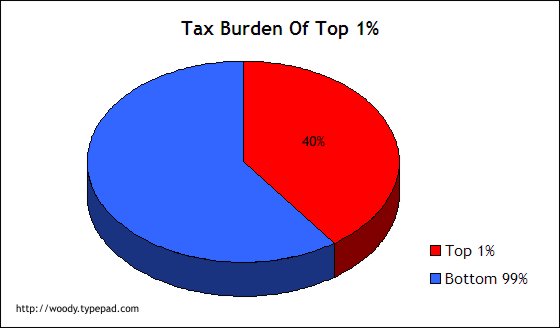
It is unfair because the richest 1% of Americans pay close to 40% of the total tax revenue. Now, that 1% also have a lot of money, but they use a lot of that money to run businesses, create new products and services and hire employees. Maybe they should pay even more, and maybe they get too many tax breaks. To say that paying 40% of the total tax revenue is something to be ashamed of, however, is dishonest. Continue reading

Incompetent Elected Official of the Week: Rep. Sheila Jackson Lee (D-Tex)

“I do not understand what I think is the maligning and maliciousness [toward] this president,” said Rep. Sheila Jackson Lee, a member of the Congressional Black Caucus. “Why is he different? And in my community, that is the question that we raise. In the minority community that is question that is being raised. Why is this president being treated so disrespectfully? Why has the debt limit been raised 60 times? Why did the leader of the Senate continually talk about his job is to bring the president down to make sure he is unelected?”

Unbelievable.

As is often the case, and is especially often the case with Lee, we are faced with the puzzle of deciding whether an irresponsible and unfair statement by an elected official arises out of a conscious exercise in cynical and dirty politics, or because the elected official involved is just dumb as a box of pet rocks. In this case, my guess would be “both.” Continue reading

Eight Glasses of Water and the Climate Change Bullies

Never mind.

A surprising new report announces that the well-established health standard that we should all drink at least eight glasses a day is a myth, with no data to support it.  Moreover, the report says, drinking so much water may actually be harmful.  Meanwhile, widespread acceptance of water and hydration as a health benefit has led directly to the explosion in the use of bottled water, wasting money and creating an environmental crisis with so many discarded plastic containers.

I would hope that such news, and we get these kind of sudden “never mind!” stories with fair regularity, might convince some of the more insulting critics of global warming skeptics to temper their contempt.
The ideologues and conspiracy theorists who refuse to accept that the world is warming—though nobody really knows how much or how long—and that the effect is likely caused by mankind—though nobody can say with certainty that mankind can reverse or stop it—are rightly derided, up to a point. But those who question the astonishing certainty with which some climate change scientists, Al Gore, and a passel of pundits, columnists and bloggers who barely passed high school chemistry claim to know what the effects of global warming will be, even though doing so requires extensive estimates, extrapolations and assumptions, are being no more than prudent, considering how frequently far simpler scientific conclusions have proven to be flawed, exaggerated, or as may be in the case of  the eight glasses of water, just plain wrong. Prudence is especially appropriate when speculative science transmuted into doctrine calls for huge expenditures of scarce resources and the re-ordering of national priorities, effecting nations, commerce, businesses and lives. Continue reading

The Shannon Stone Tragedy Ethics Quiz, Part II

Don't try this if you're not a firefighter

 Many commenters were upset with me for characterizing the tragic death of Shannon Stone, who fell to his death while trying to catch a ball during a Texas Rangers game, as the result of his own bad judgment, suggesting that I was impugning the character of a dead man. (I wasn’t.) That reaction sparks the second Ethics Alarms quiz question relating to the incident.

NBC baseball blogger (and lawyer) Craig Calcaterra put up a post this morning headlined “Idiot nearly falls from the stands chasing a ball at the Home Run Derby”:

“Just days after Shannon Stone died from a fall while reaching for a baseball at a Texas Rangers game, a fan at last night’s Home Run Derby nearly fell out of the outfield stands while lunging for a home run ball hit by Prince Fielder.  He was spared serious injury or death only because his friends grabbed him by his feet, held him and then pulled him back as he dangled over the railing above a concrete deck 20 feet below…His name is Keith Carmickle, and common sense is not his forte. His fall came after he stepped up onto the narrow metal table which abutted the railing — the kind you stand in front of and set your drink on while watching the game — and then, while still standing on it, reached down low to catch the ball as it came in…He missed the ball, but his momentum carried him forward and he fell headfirst over the rail. If it wasn’t for his brother’s and his friends’ quick action, down he would have gone. Despite his idiocy, he (a) escaped this dangerous situation of his own making unscathed; and (b) was allowed to stay at the Derby by security. Both of these factors have been added to the “evidence that there is no God and/or that He is not just and fair” side of the big ledger I keep on my desk and in which I tally the wonder and folly of Humanity as I encounter it…”

Your questions to answer, if you dare: 1) Is it fair for Calcaterra to call Carmickle an idiot, and Stone just a random victim of circumstance? 2) Why or why not? Continue reading

An Ethics Lesson From the All-Star Game

It really is one of the most enduring sports deja vus—every year, sportswriters and fans engage in thousands upon thousands of words of complaint regarding baseball’s annual All-Star Game, the 2011 edition of which will occur tomorrow night in Phoenix. This year was no exception, and as is always the case, no consensus or conclusions were reached, except that everyone agrees that the game is mishandled, mismanaged, unfair and illogical in every possible way.

I have been thinking of the game’s plight as an ethics case study that proves a core truth: you can’t do the right thing if you don’t know your objectives, stakeholders, and how to prioritize them. In the All-Star Game as it has evolved, there are competing interests and stakeholders with no clear agreement regarding which takes priority over the other. It is literally impossible to do be fair: somebody always will be disadvantaged, and because there is no single objective either, utilitarian balancing doesn’t work.

It was not always this way. When the All-Star game was first conceived in 1935, it was intended to raise money for the players’ pension fund, the players then being generally paid little more than grocery clerks.  Since the game had to draw as much of a paying crowd as possible to make money, the rosters and starting line-ups were constructed to include the biggest stars and most popular players. It didn’t matter whether Babe Ruth was off to a great start or not: it wouldn’t be an All-Star Game without him in the starting line-up, so he was the right-fielder. Managers picked the team that they thought would both be the “starriest” and that would give them the best chance to win the game. Continue reading

“Twelve Angry Men,” A Million Angry Fools, and the Jury System

Their defendant was probably guilty too.

Ethics Alarms All-Star Lianne Best sent me this link about a member of the Casey Anthony jury who is going into hiding because of all the hate and criticism being directed at jury members and their controversial verdict. Her plight, which must be shared by other members of the much-maligned jury, highlights the unethical, not to mention ignorant, reaction of the public to the Florida ex-mother’s narrow escape from a murder conviction she almost certainly deserved.

The problem begins with publicity. We may need to re-examine the logic behind broadcasting high-profile cases. The combination of live courtroom feeds and quasi-semi-competent commentary gives viewers the mistaken belief that they are qualified to second guess the jury, and they are not. They are not because the jury is in the courtroom, and the viewers aren’t. The jury and TV watchers see different things; individuals communicate different emotions and reactions in person than they do on camera. There is only one fair and sensible way to answer those on-line instant polls that ask, “Do you think Casey Anthony should be found guilty?”, and that is “I don’t know.”

Most of all, the viewers and pundits are not present in the jury room. Continue reading

Explain to Me Why We Tolerate Illegal Immigration, Again?

Yes, I'm in a rotten mood today! Wanna make something out of it??

My cranky Saturday continues with an issue that I increasingly find bewildering: the tolerance, denial, and enabling by so many Americans of illegal immigration, although its unethical character cannot be denied or argued away. I know why Democrats support it—pure electoral cynicism—and I know why the business community encourages it—greed. What I don’t comprehend is why anyone else with a modicum of logic, fairness, and common sense isn’t confronting both of these self-serving institutions and demanding real enforcement of anti-illegal immigration measures. Instead, we get outrageous legislation like the Maryland Dream Act, which institutionalizes incentives for aliens to defy our laws. Continue reading

Ethics Quiz: Should Shannon Stone’s Family Sue the Texas Rangers?

One Thursday, a 39-year-old firefighter named Shannon Stone leaned over a stadium railing at a Texas Rangers game to catch a ball flipped into the stands by Ranger outfielder Josh Hamilton.  Stone’s son, 6-year old Cooper, was a big Hamilton fan, and the devoted father made an extra effort, catching the ball but falling over the railing down to the concrete 20 feet below. He went into cardiac arrest on the way to the hospital, and died.

The railing where Stone fell is 33 inches, seven inches more that the legally required 26 inches. Why is it that short? So people sitting in the front row can see the game without having to look through the railing. Is it dangerous? Well, it was dangerous this time.

Everyone, naturally, is horrified by the tragedy. The Rangers held a moment of silence for the firefighter at the game last night. Hamilton, who like all major league players has been instructed to toss inning-ending balls and retrieved fouls into the stands for fans to catch as souvenirs, is understandably distraught.

Your Ethics Quiz: Should the Stone family sue the Rangers? Continue reading

Comment of the Day: “New Jersey Lottery Ethics…”

Tom Fuller, who can be perceptive when he isn’t peppering us with the quotations of others (all right, even sometimes when he is) makes a useful distinction in the Comment of the Day, on today’s post about the New Jersey Lottery:

“Don’t get me wrong. I’m no fan of government-sponsored lotteries, and I share all of the concerns about them mentioned above. But a facile slogan like “lotteries are a tax on people who don’t understand math” is, like most facile slogans, too simplistic a way of making the arguments. There are plenty of psychological and economic reasons why even people who understand the math buy lottery tickets that are, quite literally, bad bets. There is lots of research on this; one of the better articles is now 21 years old, but is still cited as a good, brief, and comprehensible overview.”  [You can read it here.]

“Every gamble is a losing bet in the long run; otherwise it wouldn’t be a gamble. The trouble with state-run lotteries is not so much that they exploit those who “don’t get it”; they exploit anyone, even a mathematical genius, who is drawn towards what society generally regards as undesirable actities, thereby sending the same mixed messages as taxes on tobacco and alcohol.”

The Ethics of “No-Body” Murder Prosecutions.

Oh! THERE's the body!!!

Texas lawyer Robert Guest has opined that a Texas jury would have convicted Casey Anthony in a heartbeat, and cites as proof the February conviction of Charles Stobaugh in Denton County. He was accused of killing his  estranged wife, though no body has ever been found at all.

Maybe.  There are a lot of differences in the circumstances of the two cases, not the least is that finding a badly decomposed body with a piece of electrical tape across her mouth has a big advantage over never finding any body at all: at least you are certain that the victim is dead.  Stobuagh, like Anthony, engaged in a pattern of lies and strange statements; for example, he suggested that his wife, who suddenly vanished and stopped using her bank account, credit cards and cell phone, was “playing a prank.”  He also began seeing a new girl friend more or less the moment his wife vanished. I’d say the biggest difference is the presumption of a motive: husbands killing their wives, especially their estranged wives, is a common and well-recognized form of homicide, with a motive that any married person immediately understands. A mother killing her young child, in contrast, is very unusual, and the presumption is that no mother would do it. The Anthony prosecution was more difficult than the prosecution of Stobuagh, even with Caylee’s body. Continue reading