Comment of the Day: “Murder House Ethics and the Validity of Feelings”

"Oh THAT! You would have cared about THAT?"

Tgt, the ghosts of whose earlier argument in series of comments haunted me prompted a revisit to the issue of murder houses and a seller’s obligation to reveal their history to potential buyers, came back with this Comment of the Day, thought-provoking, as usual:

“…I still want to know the line that determines what ethically does and does not need to be disclosed. It was never settled. This post generally boils down to another emotional appeal that something should be done in some cases. I want to know which cases and why those. Otherwise, my argument holds fast. I don’t see multiple murders (the latest clearly having nothing to do with the earlier ones) as being any more relevant than one murder.

“I also believe Jack misrepresented my position on emotion in general. Us rational humanists still mourn our dead, though we try to celebrate their lives more than anything else. While humans are not special in the concept of the Universe, we understand that we are special to ourselves and in our relations with other people. Humanism is about celebrating human life and relationships.

“As for death specifically, I see no need of a grave or burial rites. A dead body is just decomposing flesh. It does not need to be prayed for and cleansed. The person though, the lasting effects they have had on others, the memories of them – these are all important. I cried when a somewhat distant high school friend died in a freak accident at 17. I sent his family flowers on the anniversary of his death for the next 2 years. Why? Because it let his family know that he wasn’t forgotten, that he made an impact on other lives. It let them knew that people cared… people they only knew by name. I cherish the cards they sent in response. Continue reading →

Ethics Train Wreck at the French Open: The Saga of the Over-Eager Ballboy

John McEnroe slams a player for not being an exemplary sportsman. Wait...WHAT?

Sparking a mini-ethics train wreck at the French Open, an overenthusiastic ballboy, thinking a point was over when it was not, ran onto the court in the middle of the tennis match between Andy Murray and Viktor Troicki, forcing a replay on a point that appeared to have been won by Troicki.

Crash!

  • Andy Murray happily accepted his good luck and won the replay. He was wrong. The tradition of tennis, unlike most other sports (but like golf), is for the competitors to be gracious in such situations, as when a player knows that an umpire mistakenly called a good point by his opponent out of bounds. True, these days that tradition is observed less and less frequently. It would still have been the right thing to do, the ethical response.
  • Commenting on the match on The Tennis Channel, John McEnroe criticized Murray for not giving Troicki the point. This may win him the Gall of the Year Award, sports division. Yes, people can change, and it is not strictly hypocritical for one of the most unsportsmanlike players in tennis history to criticize a current player for not being an exemplary sportsman, now that the brat has mellowed and learned the error of his ways. At very least, however, if Mac was going to criticize another player for not doing something he would have never considered when he was competing himself, McEnroe was obligated to admit that he was advocating a standard he didn’t embrace when he had the chance. Continue reading →

Dancing With Thomas Jefferson: How Assholes Make the Law Spoil Life For Everyone

Coming to a place of honor and reflection near you.

On Saturday, the U.S. Park Police forcefully arrested five “Code Pink” protesters under the dome of the Jefferson Memorial for defying a recent Federal Appeals Court ruling that dancing at federal monuments was not constitutionally protected expression.

Perhaps you missed that ruling earlier this month, which was, I presume, made necessary by the realization that a flash mob could break out at any moment at the Lincoln Memorial or the Alamo. That was not the threat in 2008, however, when Mary Oberwetter was arrested, also at the Thomas Jefferson Memorial, for hoofing to celebrate Thomas Jefferson’s birthday.

She sued the National Park Service for violating her First Amendment rights, and on May 17 the U.S. Court of Appeals for the D.C. Circuit held that the Jefferson Memorial should have a “solemn atmosphere” and that dancing, silent or otherwise, was an inappropriate form of expression there. The appellate judges concurred with the lower court that the memorial is “not a public forum,” and thus demonstrators must first obtain a  permit. Demonstrations that require permits in the Park Service’s National Capital region are defined as

“…picketing, speechmaking, marching, holding vigils or religious services and all other like forms of conduct which involve the communication or expression of views or grievances, engaged in by one or more persons, the conduct of which has the effect, intent or propensity to draw a crowd or onlookers. [The] term does not include casual park use by visitors or tourists which does not have an intent or propensity to attract a crowd or onlookers.”

The Appellate Court wrote: Continue reading →

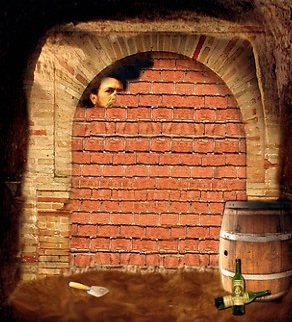
Murder House Ethics and the Validity of Feelings

We last visited the issue of the ethical selling of murder houses in February, when  the Jon Benet Ramsey house went on sale. I opined that even though Colorado doesn’t have a legal requirement that a seller must reveal the history of the house as long as it has no structural implications, there is an ethical obligation to let prospective buyers know about house-related events that might cause them to reconsider their decision to buy it:

“The truth is still this: there is something about the $2,300,000 house that makes it undesirable to a lot of prospects, and that means that even if the law doesn’t require the seller to tell interested house-hunters the story of the little dead girl in the basement, fairness and the Golden Rule do.”

The debate over this issue was unexpectedly intense. Ethics Alarms’ resident rational humanist “tgt” objected strenuously, writing,

“I don’t see how you can avoid the slippery slope question. Your basis is 50% of the population having a desire. Is that the cutoff? I think over 50% of people would prefer to live in a house where there hasn’t been child abuse. Go back a few years, and I bet a significant portion of the population would prefer to live in a house that had never had black occupants. Back in today’s world, more than 50% of the population doesn’t want to live in a haunted house. If a previous tenant thought the house was haunted, does the complete nonexistence of ghosts make not mentioning this a material representation? If an event is uncommon, does a realtor need to take a poll before deciding what is material and what isn’t?”

Karl Penny, however, bolstered my position:

“…the question is, does the realtor have an ethical obligation to fully reveal the history of this house. Well, the funny thing about behaving ethically is, it often requires us to act in ways that are not in our own immediate best interest… this may give a potential buyer a leverage point to negotiate a lower price for the house, to the detriment of the realtor, who could end up taking a lower commission as a result. No surprise, then, that the realtor would love to find a reason not to opt for full disclosure. But, if that realtor successfully conceals the house’s history from an actual buyer, one who would not have bought had they known otherwise? The realtor had a simple, human duty to disclose, even if it cost him money (and, yes, even if it cost me money, were I the realtor)….Jack’s right: this is Golden Rule time. If I am willing to treat with someone else in a way that I would not want anyone to treat with me, is that logically consistent (much less ethically consistent)? And would any of us want to live in the resulting society should everyone behave in that fashion?”

Now another house with a Hitchcock-worthy past is on the market: 9337 Columbia Boulevard in Silver Spring, Maryland, a state that also doesn’t require its realtors to disclose when a house has been the scene of a murder…or, in this case, three murders in the last decade. Continue reading →

From Hero to Idol: Congratulations, Scotty McCreery!

Way back in March, long before the 2011 edition of American Idol had winnowed its hopeful singers down to the final thirteen, 17-year-old Scotty McCreery earned an Ethics Hero here by bravely taking responsibility for the mistreatment of another contestant in the group segment of the audition process at a time when the judges seemed to be in the mood to make someone pay for it. The incident has been forgotten, but it showed Scott to be a young man of unusual integrity and courage. Little did Ethics Alarms realize  that he was also the singer to beat, and nobody beat him. Last night, he was crowned the American Idol.

Fame and fortune changes people, as we all know, and too often for the worse. Still, McCreery’s prospects of holding on to his core values look strong, because his character looks strong, and everyone, whether or not they follow American Idol and whether or not they groove to Scotty’s milieu, Country-Western music, should applaud the entry of a talented and ethical young man into the popular culture.

Congratulations, Scotty. In March we knew you were good; we didn’t know you were this good.

What Competent Leaders Do: A Checklist

While we are on the topic of leadership (in the wake of Harold Camping’s failure to act like a responsibility one), here are  highlights from “Inside CRM’s list of 101 Common Sense Rules for Leaders. 

The list is specifically targeted at managers, but the principles have broad application to all kind of leadership. If only Harold had given as much study to these as he did to his Bible. President Obama should give them some consideration, however. It’s not too late.

…
Meeting Deadlines

11. Only promise what you can realistically deliver. Don’t create deadlines that you know you can’t meet. By only promising what you know you can do, you’ll be able to finish on time.

12. Set clear goals. Once you know what you need to accomplish, it helps to know how and when you want to do it. Put your goals down on paper and make sure everyone on your team gets a copy.

13. Organize a team. … Pick a team that has the right skills to carry out the job.

14. Delegate tasks. Spread work among your employees in a way that doesn’t leave anyone overburdened while also allowing the project work smoothly.
…
16. Keep communication open. Keeping everyone in touch with the status of the project is key to making sure it’s completed on time.

17. Do it right the first time. Planning ahead will help prevent you from delivering a substandard product. Having to redo something for a client costs money, and, more than likely, future business opportunities Continue reading →

“ARRGHHHHHHHHH!!!!” Is This Wrong?

"I'd be so very appreciative if you resolved not to contact me again!"

Some years ago, a person in my household who shall not be named made the mistake of buying some drugs off the internet. Now, with ever-increasing frequency, we receive calls from illicit on-line pharmacies. all hours of the day, sometimes one after the other. Telling them not to call doesn’t work; telling them we are going to report them doesn’t work. I have warned the callers of dire consequences to future callers, and now have to find some actual consequences to inflict.

My new practice, when they reveal who they are and their purpose, is to  give a blood-curdling, high-pitched scream directly into the phone, as loud as I can make it. I am certain this is startling (I have a great scream), and I hope it is painful. I would not be sorry to learn that it bursts an eardrum or seven.  Plan B…an airhorn.

Is this unethical?

“Everybody Beat A Dead Horse Day” Ethics

Cartoonist Jeff Hibbert's conception of Muhammad

I was stunned to discover that “Everybody Draw Muhammad Day,” last year’s mass warped exercise in going out of the way to insult the religious beliefs of fine, upstanding, moral Muslims world-wide,  is supposed to be an annual event. I would have thought that the justifiable abuse heaped on serial Islam-provoker Rev. Terry Jones would have shown the organizers of EDMD the error of their ways (which I correctly pointed out to them here, and here). But no. The self-styled defenders of the undoubted right to use freedom of expression recklessly and badly still claimed to be standing up for the sullied rights of  the “South Park” creators, who last year had their show censored by cowardly and hypocritical “Comedy Central” suits after a threat by some Muslim nut-jobs. For their part, Trey Parker and Matt Stone have happily moved on to the more profitable work of making fun of Mormons on Broadway, because they won’t kill you. Continue reading →

Justice? Michigan Prosecutors Say Davontae Sanford Can’t Get There From Here

Davontae Sanford is 18 and in prison. He was 14  when he confessed to shooting and killing four people in a drug house, but now Davontae says he confessed in order to please police.

Vincent Smothers is a professional hit man already convicted of eight murders. He now says that he killed the four victims Sanford took the rap for. There doesn’t appear to be any reason for Smothers to lie about it: the hit man  is not known for his compassion toward others. Smothers even waived his attorney-client privilege with former attorney Gabi Silver so  Silver could testify on Davontae Sanford’s behalf, and say under penalty of perjury that Smothers told her he was responsible for  the killings, and that Sanford didn’t help him.

Prosecutors, however, are trying to block Silver’s testimony, which could free a wrongly imprisoned teen, arguing that it would be hearsay. While Sanford’s attorney, Kim McGinnis, says she has done everything in her power to convince Smothers to testify himself, he refuses, leaving it up to her.

Continue reading →

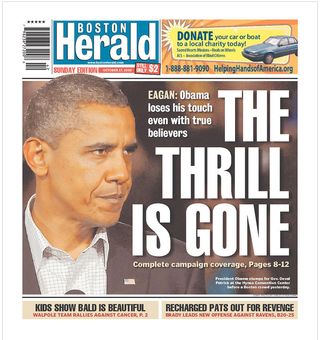
Abuse of Power and Press Intimidation At The White House

"Hey, Herald! Get with the program!"

In response to a complaint by the Boston Herald about the limited access its staff would have to President Obama during his visit to Boston,  Matt Lehrich, an Obama aide, attributed the treatment to the White House’s objections to a front page opinion article by former Massachusetts Governor Mitt Romney in which he attacked the administration’s job-creation record. “I think that raises a fair question about whether the paper is unbiased in its coverage of the president’s visits,”  Lehrich told the Herald in an email.

And maybe it does. Then again, there is a mountain of evidence that hundreds of media outlets, including four of the five major TV news organizations, the New York Times, The Washington Post, and many others, are also biased in their coverage of everything this president does–favorably. Apparently the White House, which has already disgraced itself by repeatedly attacking the one critical network by name for the state offense of not falling into line, can’t abide the fact that some print journalists are as prone to be critical of him as Chris Matthews is likely to get tingles up his leg every time Obama opens his mouth. Their response? Make it harder for the unfavorably biased journalists to cover the news. Continue reading →