The Great Norwalk Kindergarten Heist

The Tanya McDonald controversy

A homeless woman is facing 20 years in prison if she is convicted of stealing over $15,000 of Norwalk, Conn. taxpayer funds. The details of her crime are controversial: she lied about her residence to get her child into what she believed was a better school system, but one that, as non-resident, she was not entitled to use. The details also create a tangled mess of law, justice, ethics, fairness, compassion, public policy, finances, class and education.

Let’s try to unravel it, shall we? Continue reading →

Mother’s Day Reflections On A Wonderful Mother With Flawed Ethics

My mom and Ma Barker had some things in common.

I am spending this Mothers Day in mourning, as today is the first time I have had to experience the holiday without a mother. My mom died earlier this year, as I mentioned here at the time, and she has been buried for less than a month. My mother used to be a regular feature of my ethics seminars, as I would reference her whenever I talked about the so-called “Mom Test,” one of the three famous ethics tests that are useful to set off sluggish ethics alarms, the other two being the Gut Test (“Does this feel wrong?”) and the New York Times Test (“Would I be willing to see my conduct on the front page of the New York Times?”). The “Mom Test” is whether you could tell your mother about your ethically-dubious conduct without hesitation or shame, and I often told my classes that with some mothers, like my own, this test didn’t work very well. “My mother,” I would explain, “has the ethics of Ma Barker.” I was only partially kidding. Continue reading →

Ethics Hero: Washington Post Columnist Carolyn Hax

I’m breaking some precedent here: I don’t usually pick Ethics Heroes based upon writing alone, and I don’t usually reprint long sections from someone else’s column. But relationship advice columnist Carolyn Hax has long displayed a brilliant feel for ethical analysis, and expresses it sharply and entertainingly to the great benefit of her readers. Good general readership ethical analysis is all too rare, and she deserves accolades.

Today she provided as clear and as deft a lesson in how responsibility, honesty, fairness, bias and accountability work as I can imagine, while chiding a man who wants to rescue a younger woman from the relationship he didn’t have the guts to pursue herself. It shows her at her best, and is impeccable ethics as well. Brava!

Here is the inquiry and Hax’s response: Continue reading →

In Search of Accountability, Fairness, Justice and a Champion: the Unending Persecution of Anthony Graves

Job would pity Anthony Graves

Governments and other bureaucracies are capable of unimaginable callousness, stupidity, and wrongful conduct, allowing individual fools to multiply their power to harm exponentially, and then to see an inhuman computer-driven monstrosity run amuck as everyone denies responsibility. You could not devise a better example of this process than what Texas is doing to Anthony Graves.

He is an innocent man convicted of murder in 1994 who was released last October after spending 18 years in prison, condemned to death. He had been convicted with fabricated evidence and coached testimony employed against him by former Burleson County District Attorney Charles Siberia, and a state investigation got a Texas judge to set Graves free. But the maw of Texas bureaucracy wasn’t through ruining his life. Continue reading →

From First Amendment Outrage to Ethics Hypothetical: The Westboro Baptist Church vs. Brandon, Miss. Hoax

"Never mind!"

Bulletin: The story about how citizens and law enforcement personnel in Brandon, Miss. foiled the efforts of Fred Phelps’ homophobic Westboro Baptist Church to disrupt the funeral of a serviceman killed in Afghanistan never happened. The source of the hoax is unclear, but an enterprising Stars and Stripes blogger investigated and has determined that it never happened. The Church was never even in Brandon.

I detest fake web stories and the people who create them, as you probably know. The public is  confused enough by reality without having falsehoods, fabrications and hoaxes added to its database. Luckily, this is not a news site, but an ethics site, and my commentary about those who applauded this tale of a community conspiring to rob a group of their U.S. Supreme Court confirmed constitutional rights is as valid as when it was widely assumed that the story was real.

The foiling of Fred Phelps’ gang by “Mississippi Burning” tactics is not only an ethics hypothetical that most people flunked, but also an effective trap to lure the self-righteous into agreeing  that ends justify unethical means as long as the victims of those ends are sufficiently despicable.   This group includes one of the most quoted commentators on the story, who approved of the fictional response by the town and wrote,

“This is a template for how to handle the Westboro people. If lawsuits don’t work, other means will. Whatever it takes to keep them from harassing bereaved military families on the day their fallen loved ones are laid to rest.”

He was wrong then, and he’s wrong now.

Comment of the Day: “The Ethicists, Backing Judge Walker and Gay Marriage, At An Unacceptable Price”

The motion to vacate Judge Walker’s ruling on Proposition 8 has been filed, you can read it here. Since the original post, I have detected some cracks in the formerly near-united front of legal ethicists and journalists deriding Walker’s critics. Some of them are finally, grudgingly, admitting that the Judge might not have handled his potential conflict so well after all, and that the motion is not a frivolous, anti-gay outrage as they originally labelled it.  The most rickety of the rationalizations put forth on Walker’s behalf, advanced by some his most respected defenders, is that he had no obligation to reveal his own sexual orientation by disclosing his domestic arrangement because of its intimate and private nature. Yet the judge voluntarily disclosed it after his decision was in the books, raising a rebuttable presumption that his original silence was to avoid suggestions of conflict, not out of a desire for privacy.

First time commenter Jada adds her Comment of the Day to the discussion: Continue reading →

Geronimo Ethics

"GERONI-"--no, I'm sorry. Let's see...uh..."

Somewhere, I sometimes suspect, there is a mega-computer that scans all news, media, films, TV, video games and pop music offerings, alerting various minority groups to fresh new opportunities to manufacture complaints based on victim-posturing and absurd political correctness. The thought has passed through my brain once again, as I see reports such as the one that appeared in the Washington Post this morning, describing how Native American advocates are offended that the codename for the military operation that killed Osama bin Laden was “Geronimo,” named after the iconic Apache warrior.

A codename, as the term implies, is a word or name intended to stand for something other than its actual meaning and historical significance. Ergo, the Manhattan Project was not a plan to drop New York City on Japan. Many codenames have had absolutely no relationship to their military meanings; what is important is that they not be too hard to remember or too easy for enemies to figure out. The mission to get bin Laden could have been named “Meat Loaf,” “Lindsay” or “Charlie Sheen,” all of whom would have been honored and amused, presumably. The military picked “Geronimo.” Continue reading →

The Conclusion to “Texas Cheerleading Ethics: Cheer Your Rapist” (And You’re Not Going To Like It)

"Give me an R! A! P! I! S! T!---RAPIST!!!"

Back in November, Ethics Alarms reported the awful story of the Silsbee, Texas High school cheerleader, identified only as “H.S.”,who was kicked off her cheerleading squad for violating “the Cheerleader Code of Ethics” after she refused to cheer at a game for the player who, it was later determined, had sexually assaulted her. She stood silent in mute protest, and when her parents sued the school, the Fifth U.S. Circuit Court of Appeals ruled that H.S.’s silent protest was not protected speech under the First Amendment, meaning that she could be disciplined for violating the cheerleading conduct code.

Now the Supreme Court has turned down the case, refusing to review it, meaning not only that H.S. loses, but also that her parents have to pay court costs and legal defenses to the tune of $45,000.

This is a perfect example of the distinction between the law, justice, and ethics. Continue reading →

Ethics Dunce: Steelers Running Back Rashard Mendenhall

Translation: "I am an Ethics Dunce."

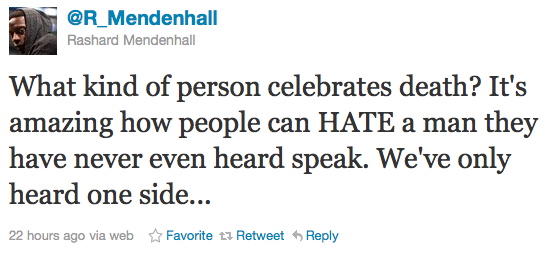
Twitter is a wonderful invention; it used to require a blog to efficiently alert the world to one’s intellectual, logical and ethical deficiencies.  Now NFL star Rashard Mendenhall is using 140 characters to accomplish the same task, and doing a bang-up job of it, I must say.

Mendenhall has his employers, the Pittsburgh Steelers—not to mention his agent—scrambling to do damage control after the athlete emitted a series of provocative tweets in response to the death of Osama bin Laden. My personal favorite:

“What kind of person celebrates death? It’s amazing how people can HATE a man they have never even heard speak. We’ve only heard one side…” Continue reading →

Parental Responsibility, Child Exploitation, and Billboard Ethics

Here’s a rule of thumb: Don’t give the rights to reproduce your child’s photograph to a photographer or ad agency unless you are prepared to accept however it is used, and certain that your child will not be harmed or embarrassed as a result.

Is that so hard?

Tricia Fraser has sued Life Always and Majella Cares Heroic Media, an anti-abortion group, claiming it used her daughter’s picture in “a racist, controversial advertising campaign” that is “defamatory, unauthorized, and offensive,” posting the 4-year-old girl’s photo on a giant billboard by the Holland Tunnel and another in Florida.

Nice try. But there is nothing racist about the campaign, and nothing defamatory about using her daughter’s photo in it.  Continue reading →