From “The Ethics Incompleteness Principle” Files: Memphis, Tennessee’s Confederate Statues

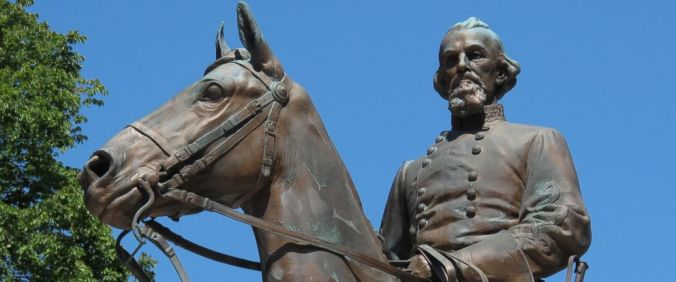
A better application of the Ethics Incompleteness Principle would be difficult to find than the decision by Memphis, Tennessee to remove a huge monument to Jefferson Davis, the president of the Confederacy, and an even larger heroic equestrian statue (above) of Nathan Bedford Forrest, swashbuckling Confederate general and (allegedly) the first Grand Wizard of the Ku Klux Klan,  from two public parks.

As we have discussed here in great detail, I am unalterably opposed to the current mania among our Left-leaning friends and neighbors  of tearing down statues, monuments and memorials honoring  past historical figures because their lives, beliefs and character do not comport with current day standards or political norms.  This primitive exercise in historical censorship has been especially focused on famous and notable figures from the Confederacy, although recent efforts have targeted George Washington, Thomas Jefferson, Andrew Jackson and even Theodore Roosevelt. Of the attacks on memorials to Confederate figures, I wrote,

[ Union veterans]  didn’t think of the former Confederates as traitors, or racists, or slavery advocates. They, like the Union veterans, were just men of their times, caught up in a great political and human rights conflict that came too fast and too furiously for any of them to manage. They were caught in the same, violent maelstrom, and knew it even 50 years earlier. Soldiers on both side wrote how they admired the courage of the enemy combatants they were killing, because they knew they were, in all the ways that mattered, just like them. It was the Golden Rule.  After the war, these soldiers who had faced death at the hands of these same generals, officers and troops, did not begrudge them the honor of their statues and memorials, nor their families pride in the bravery of their loved ones.

Yet now,  self-righteous social justice censors who never took up arms for any cause and in many cases never would, employ their pitifully inadequate knowledge of history to proclaim all the Civil War’s combatants on the losing side as racists and traitors, and decree that they should be hidden from future generations in shame. We have honored men and women for the good that they represent, not the mistakes, sins and misconduct that are usually the product of the times and values in which they lived. In doing so, we leave clues, memories, controversies, differing views, and stories for new generations to consider and better understand their own culture and society, and how it came to be what it is.

Those who want to tear down monuments to the imperfect, whether they know it or not, are impeding knowledge, perspective, wisdom, and understanding. They want only one view of history, because they will only tolerate one that advances their ideology and values—just as the Americans of the past believed in their values. Foolishly, I suppose, they trusted future generations to act on their own ethical enlightenment without corrupting the historical record.

I feel strongly about this, as the tone of that post, far from my first on the subject, shows.

But… Continue reading

The New York Times’ “Lessons From A Year Talking Race”: Not Fake News, Just Divisive And Misleading Propaganda

“Over the past year, we have hosted weekly live conversations about race and ethnicity on Facebook, tackling topics that ranged from black royalty to Latino baseball players to Asian-American slurs. RaceNYT, as we call the segment, is an extension of the crucial coverage on race — in America and beyond — that appears in The New York Times. We see it as a chance not only to explore important stories of race and what they mean to society, but also to give you, our readers and viewers, a chance to join the conversation.

These subjects are not always easy to talk about. Why, for instance, is affordable housing built mostly in poor, heavily minority areas? What are the terms about race that make us uncomfortable? And what do the United States and major institutions like universities owe the descendants of the enslaved people they profited from?

We explored these issues and more with a wide range of guests, including political strategists, filmmakers, academics and Times viewers. Here are five takeaways from the show…”

Thus spake the New York Times, online a couple of days ago, and in today’s print edition. What are stated as “takeaways” are, however, the product of confirmation bias, dubious assumptions, and efforts at political manipulation. For example…

Like racial minorities in the United States, Indigenous Australians are often relegated to the fringe of society, Craig Quartermaine, an Aboriginal television reporter and comedian, told us. “We’re window dressing,” he said.

Why this is unethical: Comparing the problems of Indigenous Australians to “racial minorities in the United States” is unsupportable. A comparison with indigenous North American populations would arguably be valid.

Madeline Vann reached out to us, wondering how she should handle the racially offensive remarks she was hearing in her community. She is a white freelance writer in Virginia.

Why this is unethical: Uh-uh. Ethics foul. You can’t tar a community like that without giving concrete examples. I live in Virginia: I almost never hear any “racially offensive remarks.” The New York Times core audience is the same group that believes it is “racially offensive” to object to NFL players using stadium time to issue half-baked protests they can’t articulate during the national anthem. The Times’ supposedly open inquiry on race begins with the assumption that the nation is racist. That’s called a bias. What kind of remarks are you talking about Madeline? How many, how often and from how many people?

“The first year of the Trump presidency has been marked by a vast racial chasm where perspectives often exist in different worlds.”

Why this is unethical: Wow, all that division in such a short time! This statement is deceitful. The reason there is a vast racial chasm is because the previous administration had eight years to put it there, and the because the news media fully committed to the project. The Congressional Black Caucus boycotted the Trump Inauguration, because part of the campaign strategy against him was to declare he was a racist, and that anyone who voted for him was a racist. That was a strategy developed into an art form to protect Barack Obama from legitimate criticism, and keep his loyal African American base angry and afraid.

Trayvon Martin’s death at the hands of a “white Hispanic” was politicized by Obama and the CDC to widen that “chasm,” and it occurred midway through the Obama years. In 2012, Joe Biden said that the Republicans wanted to put blacks “back in chains.” Black Lives Matter wasn’t a creature of the Trump administration. Black college students didn’t start demanding “safe spaces” without whites and special privileges after Trump’s election: they did it before. The historical airbrushing madness to use slavery to justify erasing any references to the confederacy was an Obama era phenomenon that has extended into Trump’s administration. The Oscars were bullied into making race a criteria for artistic honors during Obama’s administration.

The more I read that quote, the more misleading and intentionally dishonest it seems.

The Muslim-American activists Aber Kawas and Dalia Mogahed told us how they felt last month when the authorities quickly described an attack by a Muslim man in Manhattan as terrorism, while that term was never officially applied to a white man who fatally shot more than 50 people in Las Vegas weeks earlier.

“Pretty much we define terror attacks as something that’s done by a Muslim,” Ms. Kawas said. Continue reading

Morning Ethics Warm-Up, 12/23/2017: Robots And “Star Wars” And Whiskers On Kittens

Good Morning!

1 When Darth Vader cuts off Luke’s hand, that’s not news. When Mark Hamill bites the hand that feeds him…In recent interview, Mark Hamill, the one-trick pony, one-role actor who had been playing cameo parts on SyFy cable channel movies because he wasn’t enough of a draw to put in “Sharknado 6,” criticized how director Rian Johnson had him play Luke Skywalker in “Star Wars: The Last Jedi.” “He’s not my Luke Skywalker,” said Hamill in a recent interview, who originated the part four decades ago, when he had a career.

This is astounding ingratitude, and shows a lack of professionalism that suggests it wasn’t only limited range that strangled Hamill’s non-“Star Wars” prospects. The movie is still in theaters. The fact that he is in the latest trilogy at all is a gift. If he wants to knock the film in about ten years or so when he’s doing Fishin’ Magician informercials on cable and his comments get him 12 and a half minutes of fame on TMZ, that’s fine, but right now, he has an ethical obligation to the studio and his fellow artists to do everything he can to make the “Star Wars” geeks want to see the film.

You know Luke—can I call you Luke?—most of those other actors aren’t as lucky as you were, and don’t have a cushy guaranteed lifetime income from a single surprise hit that easily could have ended up on the second half of drive-in double features.

May the Force slap some sense into you.

2. Update: Governor Kasich is an idiot. But I bet you knew that. Yup, John Kasich signed into law that Ohio bill that made it illegal to abort a fetus diagnosed with Down Syndrome. This law is going to be struck down as unconstitutional, and it makes no sense. Signing it into law displays a bad combination of incompetence and cowardice.

BOY, that was a horrible crew of Republicans who all were thinking about Donald Trump, “Well, at least I know I can beat THIS guy!” I know many people like me, including some moderate Democrats, who were rooting for Kasich because he seemed preferable to having another Bush, the theocracy craving Mike Huckabee, the corrupt Chris Christie, weird Rand Paul, diabolical Ted Cruz, not-ready-for-prime- time Marco Rubio, dumb-as-a-box-of-whoopie-cushions Ben Carson, scary Carly Fiorina, or, as the alternative, the venal, inept and frighteningly ambitious Hillary Clinton. No, he’s a conservative hack with an honest face. This proves it. Continue reading

Comment of the Day: “I’m Curious: Do Women—Any Women, A Lot Of Women, Adult Women, Rational Women—Think This Times Column Makes Sense? (Because It Doesn’t)”

(This is sort of what Juliet has in mind, I think...)

Juliet Macur’s column in the New York Times calling for what was essentially Old Testament Biblical vengeance against one of the more recently accused sexual harassers disturbed me greatly, and the resulting Ethics Alarms post reflected my reaction.  Steve-O-in NJ picked up the baton, and the result was this, his Comment of the Day on the post, I’m Curious: Do Women—Any Women, A Lot Of Women, Adult Women, Rational Women—Think This Times Column Makes Sense? (Because It Doesn’t):

The principle that those who do wrong should not be allowed to profit from their wrongs is not without basis in either ethics or the law. It is that principle which gave rise to the “Son of Sam” laws that allow suits against convicted criminals by their victims or the victims’ families if they receive assets from the sale of their stories. It is also that principle that sometimes leads to “Son of Sam” clauses being worked into plea agreements, whereby any profits made from the sale of a pleading wise guy or terrorist’s story goes to the government. Much more than that, and you run into First Amendment problems. It’s also a given that courts can order restitution to victims as part of a sentence or as part of a plea deal.

However, as pointed out above, all of these legal principles involve, presumably, a wrongdoer who has either had his day in court or decided to forego his day in court in the hopes of better terms. Even in an employment or other civil setting, an accused wrongdoer is not without rights. A company who not only terminated an accused harasser but stripped him of his pension and whatever other assets came with the position, all without so much as an investigation, would almost unquestionably find itself on the wrong end of a lawsuit, and could conceivably lose, which is why a lot of those situations resolve with a more favorable deal. In this case, the accused is choosing to walk away before it even comes to that, and cash out.

Juliet Macur is looking for blood, or the equivalent. I know the feeling, we all know the feeling, and writers and sports entertainers the world over know how to exploit that feeling very well. That’s why thrillers almost always end with the initial wrongdoer dead and WWE kayfabe angles always end with the heel badly injured and humiliated. We all have that urge to jump to revenge, that snap reaction of “why that blankety-blank, I’ll teach him!” Continue reading

I’m Curious: Do Women—Any Women, A Lot Of Women, Adult Women, Rational Women—Think This Times Column Makes Sense? (Because It Doesn’t)

Jerry Richardson (above), the 81-year-old original owner of the Carolina Panthers in the NFL,  has decided that rather than ride out the sexual harassment allegations  recently reported  by Sports Illustrated, the wisest (and most lucrative course) will be to sell the team after this season. His profit will be somewhere in the billions, not that he isn’t a billionaire already.

New York Times sportswriter Juliet Macur is grievously offended by this, writing,

“Here’s what would make more sense: For Richardson to announce that the proceeds of the sale — or even just a couple hundred million? — would be donated to the women he harassed…[Many men] have been chased from the top of their professions for disgusting behavior involving women they worked with. They are suddenly pariahs, their reputations destroyed. But they remain very rich men, and their families, for generations, will be able to live off the financial rewards they collected while perpetuating these offenses….Richardson, who made his fortune in the fast-food industry, might be the richest of all the men accused in the #MeToo movement so far. Perhaps it’s appropriate, in a legal sense, that he is able to sell his company and walk off the stage. But it doesn’t seem morally fair that he should benefit so richly from it.”

This is pure, unadulterated emotionalism and indignation unfiltered by thought or coherent societal values. If these are the kinds of ethical arguments—and it is an ethical argument–major information sources are going to publish as worthy of being injected into public discourse, we might as well tear up the laws, forswear ethical systems, embrace passion, anger, vengeance and the rest as our sole tools to govern human affairs, and resign ourselves to chaos. Continue reading

The Unprepared Judicial Nominee [Updated]


Matthew S.] Petersen, a lawyer serving on the Federal Election Commission, was one of five President Trump judicial nominees to be questioned by the Senate Judiciary Committee last week. Senator John N. Kennedy, a Republican from Louisiana, subjected Petersen to questions regarding basic litigation law, such as the Daubert standard, which has to do with qualifying expert witness testimony, the definition of a motion in limine, and several other bits of information a junior litigator would have to have in his memory banks. The potential judge told the Senator that he had never tried a case or argued a motion in court. He said he last read the Federal Rules of evidence in law school. “I understand that the path that many successful district court judges have taken has been a different one than I’ve taken,” Petersen said.

Naturally, being a Trump nominee, Petersen is being widely mocked in the news media and by Democrats. Some legal experts have been more sympathetic, like Judge Wayne R. Andersen, who was a federal judge in the Northern District of Illinois for nearly 20 years. He told reporters  that there was a continuing debate within the legal profession about the qualifications required of a trial judge, saying, “Anyone who steps to the federal bench lacks a huge amount of federal experience necessary to do the job,” and that Senator Kennedy’s questions, while fair, “would eliminate 80 percent of the nation’s lawyers and many of the most talented lawyers.”

Lawyer/Blogger John Hinderaker wrote in part,

The lawyers who have the most thorough understanding of substantive areas of the law–real estate, taxes, corporate governance and so on–are generally not litigators. Do we really want to say that all of these non-litigators–the majority of lawyers–are unfit to be trial judges?…does it mean that one of my non-litigator partners would be disqualified from such an appointment, no matter how good a lawyer he or she might be? I don’t think so.

… Newly-appointed judges attend “judge school,” where they are taught the finer points of the rules of evidence….Most lawyers who are appointed to the bench in both federal and state courts have backgrounds in litigation. No doubt that is appropriate. However, it is by no means rare for non-litigator lawyers to be appointed, or win election, to the bench. In my opinion, that is a good thing. I don’t see why a minority of lawyers–litigators–should have a monopoly on the bench. I don’t know whether Matthew Petersen will make a good judge or not. But in my view, he doesn’t deserve to be ridiculed because his highly-successful law career has been conducted outside of the courtroom.

I agree; he shouldn’t be ridiculed for that. Continue reading

The Democrats Are Apparently Determined To Be The Asshole Party, And They Should Be Called On It

The questions by Democratic Congressman Luis Gutierrez  during Deputy AG Rod Rosenstein’s hearing today mark him as far worse than a mere Ethics Dunce. It even exceeds the outrageous disrespect of President Obama displayed by GOP Congressman Joe Wilson when he shouted out “You Lie!” during a State of the Union address. Guiterrez—who opposes the rule of law and advocates open borders, just to put his principles and priorities in context— has been emboldened by the divisive and destructive abuse of the President by Reps. John Lewis, Maxine Waters and Frederica Wilson, among others (including Hillary Clinton), and more recently by the irresponsible and dishonest demand by Senator Gillibrand that the President resign for unproven, non-criminal conduct that took place, if at all, long before he was elected President, and that voters ratified by virtue of electing him.

Mostly, however, Guiterrez was moved to disgrace his office and the House of Representatives because he is an asshole—there’s no other word for it—who knows that his party will not discipline him, as it should,  for this most disgusting display of unprofessional conduct and hate-mongering. Continue reading

Welcome To The Slippery Slope! Fordham’s Coffee Shop Bigotry

A recent episode at Fordham illustrates quite effectively the way American society could unravel as a result of a Supreme Court decision supporting the Masterpeice Cakeshop’s claim that its faith-based objection to same sex marriage should justify restricting service to some customers.

Rodrigue’s Coffee House is an off-campus coffee shop run by a student club at Fordham University.

The shop has a “Safer Space Policy” that reads…

“Rodrigue’s strives to be a safer space on Fordham’s campus. For these reasons, consider the following:

Do not make assumptions about someone’s gender, sexuality, race, class, or experiences. Be aware of your own identity, while being considerate of the personhood of your peers. Be mindful of the ways in which your words and actions impact others. Be aware of the boundaries of other’s space, physical or otherwise, and respect their consent. No racism – No sexism – No homophobia. If you feel that someone has transgressed this policy, we want you to feel comfortable confronting them or approaching a member behind the counter, who is available as a resource to assist you.”

This is Authentic Frontier Gibberish and first degree virtue signalling, and could be fairly translated as “We are pompous and oppressive social justice warriors who are intolerant of the views, statements, or opinions of anyone who does not share our rigid and undeniably correct ideology. We hereby declare our right to ostracize such non-conforming individuals on the basis of what we, in our sole discretion, consider hate speech. Fear us.”

Fordham College Republicans visited the coffee shop wearing MAGA hats. Sure, they did this to provoke a response, knowing what the likely reaction would be, much like a gay couple deliberately asking for a wedding cake at a Christian bakery.  Memorialized in the video above, the president of the club didn’t disappoint, and angrily ordered the College Republicans to leave the premises.

“This is a community standard—you are wearing hats that completely violate safe space policy. You have to take it off or you have to go…I am protecting my customers,” the president said. Note that she was “protecting” his customers from exposure to the thrice-removed (initials, the phrase “Make America Great Again” which is benign on its face, and its association with the Trump campaign) message on a cap.

“We are your customers, we bought something,” one of the young Republicans replied.

“I don’t want people like you supporting this club… no one here wants people like you supporting our club,” the president answered. “I am giving you five minutes….You are threatening the integrity of our club. This is a community standard—you are wearing hats that completely violate safe space policy. You have to take it off or you have to go.”

When one of the students then asked her to explain what she thinks the MAGA hat stands for, to which she shouted, “Fascism, Nazis! You have three minutes.”

Legally, of course, this conduct is distinguishable from the conduct of the same-sex marriage decrying cakeshop owner. There is no law prohibiting a proprietor from behaving like a vile, intolerant, rude, bigoted asshole, just basic standards of decency.  Nor is there a law protecting conservatives from invidious discrimination in public accommodations based on passively displayed political beliefs, although if this kind of thing starts proliferating, there will be.

However, the toxic effects on the culture by the two examples of intolerance and disdain for other citizens and human beings is exactly the same. Each is similarly mean-spirited, each is based on excessive self-righteousness, and each equally harms society, and the nation by elevating tribalism to standard practice. The theory of the coffee shop proprietor, I suppose—that the mere presence of a hat with initials on it is “unsafe” —-is marginally more outrageous and idiotic than the baker’s claim that selling a cake for a wedding he will not attend, is not invited to, that will never impose on his consciousness once the customers walk out the door unless his cake turns out to be poisoned, and that will take place whether he provides the cake or not,  is a burden on his religious faith. Marginally. They both constitute  unethical mistreatment of other human beings who deserve better, and breaches of the Golden Rule. That in both cases the victims of the unethical conduct may have intentionally presented themselves to be abused does not mitigate the abuse.

I might as well state the obvious, that the members of the intolerant club operating the shop are 100% behind the cause of forcing the cakemaker to sell the gay couple a wedding cake, but believe it is fair and just to refuse to sell Republicans a muffin.

Sometimes I am embarrassed that I even have to write a post. This is one of those times.

If higher education is manufacturing future citizens who think and act like the club president running the coffee shop, then higher education is doing the nation more harm than good.

Comment Of The Day #4: “Back To The Bigoted Baker: It’s Complicated…More Than I Thought”

Ryan Harkins’ Comment of the Day, the fourth on the post about the Great Cake Controversy ,responds to #3, by Extradimensional Cephalopod.

The four COTD’s cover a great deal of legal and ethical territory and if not the full spectrum of positions on this difficult topic. Ryan’s three predecessors can be read here:

After you read #4, I’ll ask you which of the COTDs come closest to your own opinion. If the answer is “none of them,” by all means try for #5!

Here is  Ryan Harkins’ Comment of the Day on the post Back To The Bigoted Baker: It’s Complicated…More Than I Thought:

EC,

I hate to answer for the baker, so I hope you don’ mind if I respond with how I would answer.

What if I walked into the shop and asked for a wedding cake for no reason at all? Nobody’s getting married; I just want the cake. Is it against his religion to make that style of cake for anything other than weddings?

It would not be against my religion, no.

One thing I want to point out about your line of inquiry here is that you are divorcing the mechanical action of making a cake from the purpose of making a cake. A cake is a cake, and apart from any purpose, it remains a cake with no further meaning than a configuration of confectionery molecules. But the purpose for making the cake defines the context. If you wanted me to bake you a cake so you could bury it in your backyard, I wouldn’t have any religious objections to that, but I would certainly object to having the fruits of my labor just thrown away. Just as I would object if you wanted me to write you a book so could use the pages of the book as toilet paper.

The purpose of making a wedding cake is for it to be displayed and consumed at a wedding. If you aren’t going to use the cake for a wedding, ontologically speaking, could it even be a wedding cake?

Do I have to show him a marriage license?

I wouldn’t require that. My general standpoint would be to take people at their word. That being said, if I knew you and you were known for pranks, were opposed to marriage in general, and nothing I knew about your recent activities hinted at a wedding, I might want some actual proof that a wedding was occurring.

I’m an atheist; will he refuse to acknowledge my marriage because you can’t have marriage without a god? Does only the Christian deity count for a “real” marriage?

Since I’m Catholic, I’ll just toss out what the Catholic Church teaches about marriage. Marriage is universal. Historically, marriage permeates pretty much every culture. Marriage is an institution that has, for the most part, united a man and his wife to the children they bear together. Marriage does not require a profession of faith, because it is a foundational institution of mankind. That is why eating, drinking, and shelter don’t require a profession of faith. They are also foundational aspects of the human condition. So, there is no objection to two atheists marrying.

Where the religious context comes into view is with the nature of that marriage. Catholics profess that Jesus elevated the institution of marriage to a sacrament. This means that a valid marriage between baptized individuals cannot be dissolved save by the death of one of the two parties. But that does not mean every marriage is sacramental. If one of the two parties is not baptized, the marriage is still a valid marriage, but it is not a sacramental marriage. Thus it could be dissolved, and either party would be free to re-marry.

A funny oddity of terminology crops up in Catholic teaching. Since a valid, sacramental marriage cannot be dissolved, but since parties can licitly separate for serious reasons (abuse, abandonment, adultery, addiction), a Catholic can be married and divorced at the same time…

I would argue that the artistic quality of the cake has nothing to do with who is getting married, or if there’s even a marriage at all–at least, as far as religion is concerned.

I agree with you to a certain extent, here. The artistic quality is its own concern. It is the teleological purpose of the cake that is the true contention. So that raises a question: if I bake a cake that I do not intend to be used at a wedding, but looks just like a cake that I do intend to be used at a wedding, is it a wedding cake? To use some technical terms, there is the essence of a thing, and there are the accidents of a thing. The essence of a thing is what is essential to a thing being that thing; accidents are just features that particular thing has that are not essential to a thing being that thing. The essence of a chair is something to sit on. Accidents of a chair are having one leg, or three, or four, having a back, not having a back, etc. So what is the essence of a wedding cake, and what are the accidents of a wedding cake? I think the only essential difference between a wedding cake and a non-wedding cake is the intent for which the cake is made. The only part I waffle on is the cake-topper…

On a separate note, I assert that religion ultimately must be subordinate to the law of the land.

I’m uncomfortable with how you phrase this, so let me toss out what I think about this, and let me know if it does or doesn’t conform with what you’re thinking. Continue reading

Comment Of The Day #3: “Back To The Bigoted Baker: It’s Complicated…More Than I Thought”

And now there are FOUR Comments of the Day on the post about the Great Cake Controversy. This is a record number for a single Ethics Alarms post. It is a true ethics conflict: which should have priority in a pluralistic society, the right of all citizens to be treated equally under the law, and to have the government ensure their right to the pursuit of happiness, or the individual right to act and live in concert with one’s sincerely held religious beliefs, and to not be forced into expressive speech, part of the right to liberty? This part of the controversy doesn’t even include the ethical question of whether either party should have allowed this to be come a legal dispute.

When I post the fourth COTD, with was a response to #3, I’ll include links to the other three and include a poll for readers to register their opinion regarding which comes closer to their own view

Here is Extradimensional Cephalopod’s  Comment of the Day on the post Back To The Bigoted Baker: It’s Complicated…More Than I Thought:

There’s an obvious question here (well, several) that occurs to me: What if I walked into the shop and asked for a wedding cake for no reason at all? Nobody’s getting married; I just want the cake. Is it against his religion to make that style of cake for anything other than weddings? Do I have to show him a marriage license? I’m an atheist; will he refuse to acknowledge my marriage because you can’t have marriage without a god? Does only the Christian deity count for a “real” marriage?

I would argue that the artistic quality of the cake has nothing to do with who is getting married, or if there’s even a marriage at all–at least, as far as religion is concerned. If I asked someone to draw me a picture of a bird, they don’t have to know anything about me in order to make it. Their art doesn’t have anything to do with me, and they are not expressing any objectionable ideas. They’re not endorsing me in any way by taking me on as a customer. Therefore, this isn’t like refusing to make a swastika cake. This is like refusing to sell a cake to Nazis. (Yes, Nazis should be able to buy cake like anyone else. Preventing them from doing so is just bullying, and won’t teach them anything except more hate. How will they learn how to appreciate different people if only other Nazis talk to them?) Continue reading