Latest Ethics Notes On The Hillary Clinton E-Mail Scandal Ethics Train Wreck, Part 2

Continuing from Part 1…
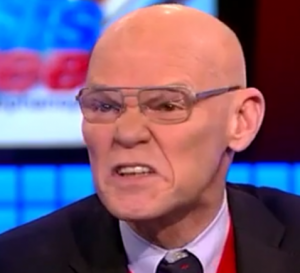
I swear, I didn't pick this photo to make James Carville look crazy or nasty. This is really what he looked like today...

I swear, I didn’t pick this photo to make James Carville look crazy or nasty. This is really what he looked like today…

5. The uproar over Clinton’s private server use and possible security breaches being investigated further with FBI inquiries into the newly uncovered Huma Abedin e-mails seems oddly out of proportion to its substance, at this point. The violent reaction of Democrats and Clinton’s campaign is more suspicious than the information itself. The immediate default to accusations of political and professional misconduct is itself unfair and unethical, and reminds those who are open to being reminded of the Clinton habit of bullying and threatening adversaries, including honorable ones. Just as Trump cannot seem to help himself from lashing out disproportionately at every affront real or imagined, the current over-reaction is itself disturbing. There are too many bullies and thugs in the Clinton camp.

6. Next to Harry Reid, the most publicized accuser of Comey has been Richard Painter, a law professor at the University of Minnesota and the chief ethics lawyer in the George W. Bush White House from 2005 to 2007. He has filed a Hatch Act complaint against Comey with the federal Office of Special Counsel and Office of Government Ethics. As with Reid’s accusation, his is unjustified. Unlike Reid, Painter is intelligent, informed and honorable, and I can only speculate why he has jumped the rails like this. Painter argued in a New York Times op-ed on Sunday that Comey’s intent can be inferred from the absence of a good reason for sending the letter.

Huh? He had a good reason, and as a lawyer and ethics expert, it should be obvious. He didn’t want to be accused of lying to Congress, or to believe that he was lying to Congress. That’s an excellent reason. There are others. “Absent extraordinary circumstances that might justify it, a public communication about a pending F.B.I. investigation involving a candidate that is made on the eve of an election is . . . very likely to be a violation of the Hatch Act and a misuse of an official position,” Painter claims. Okay, but there were extraordinary circumstances. Public distrust of law enforcement institutions is at a dangerous, all-time high. Every decision is attacked as corrupt or politically motivated by one party or the other. The particularly volatile  situation of a Presidential candidate being investigated by the FBI was greatly exacerbated by the Attorney General allowing herself to be pulled into an inappropriate and improper meeting with the husband of the candidate under investigation shortly before a decision whether to prosecute was due–I’d call that an “extraordinary circumstance.” Comey has been trying to restore the integrity of the Justice Department, which Holder and Lynch, along with President Obama, has allowed to be seriously soiled. He may or may not have made the right choice, but for Painter to file a complaint alleging intentional political bias based on his actions alone is irresponsible. Writes Jonathan Turley, also a law professor of note, and one who does a better job avoid partisan bias than Painter does:

“Comey was between the horns of a dilemma. He could be accused of acts of commission in making the disclosure or omission in withholding the disclosure in an election year. Quite frankly, I found Painter’s justification for his filing remarkably speculative. He admits that he has no evidence to suggest that Comey wants to influence the election or favors either candidate. Intent is key under the Hatch investigations.  You can disagree with the timing of Comey’s disclosure, but that is not a matter for the Hatch Act or even an ethical charge in my view.”

“Or even an ethical charge.” Bingo. And those are harsh words from the usually excessively mild Turley.

I’m not sure what’s going on with Painter, whose opinions I have followed for years. I have followed him, and even argued with him occasionally, on the excellent legal ethics blog, the Legal Ethics Forum, where he is a contributor. If he is a Republican, he’s either a disillusioned one or a strange sub-species. Most of his posts tilt leftward, and they are almost all political in nature, in sharp contrast to everyone else. He obviously has no respect for the Republicans in Congress, and is as vehemently anti-Trump as I am. Unlike me, apparently, he seems to have allowed his rational contempt for Trump lead him to a damaging bias in favor of Hillary Clinton. Ethics complaints should not be used as a political weapon. Continue reading →
Halloween Ethics Meets Campus Ethics Meets The First Amendment, And Stupidly, Too

costume-lunching

I didn’t want to write about this, as I am having to defend too many jerks of late,but multiple readers have flagged it, and besides, there hasn’t been a good Halloween costume controversy this year. This one isn’t good, but it will have to do.

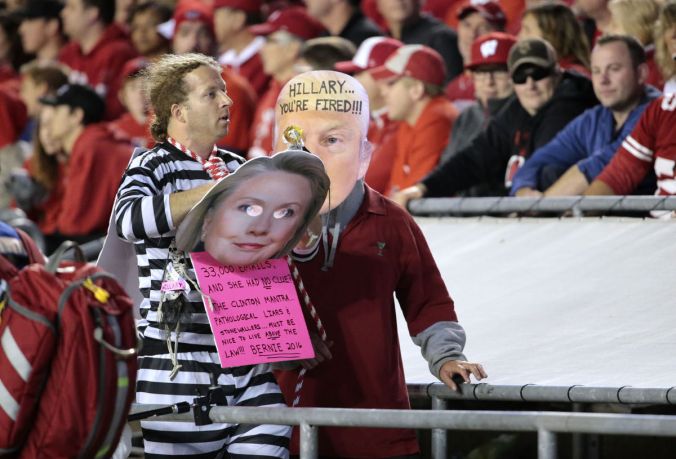
During the University of Wisconsin football home game against Nebraska, one fan in faux prison garb wore a mask of Democratic presidential nominee Hillary Clinton over his face, and a mask of Obama on the back of his head, as another person wearing a mask of Republican nominee Donald Trump held the end of a noose that was looped around the Hillary/Obama individual’s neck.

Key points:

1. It was Halloween weekend. Costumes were not out of place.

2. It was a two person costume, and an incoherent one that would support multiple interpretations. Was it an attack on Trump, accusing him of being racist or wanting to harm Hillary? Was it an endorsement of Trump, arguing that Hillary should be punished? Was it intended to evoke lynching imagery? Was it saying that Hillary was the equivalent of Obama? A sign worn by Hillary/Obama, which nobody who wasn’t close up could read, concluded, “Bernie 2016.”

3. This was unequivocally political speech, whatever it was supposed to mean.

4. The University has some discretion to forbid expression and conduct at a sporting event that risk creating violence or that are objectively uncivil .

5. Anyone who uses lynching imagery in public, in any connection to a back public figure, or any African American at all, is an asshole at best. This is a public event intended to be entertaining and a family-friendly activity. Using it for political theater is obnoxious. The civil place for this costume, if anywhere, was in front of the stadium, on the sidewalk. Continue reading →

Latest Ethics Notes On The Hillary Clinton E-Mail Scandal Ethics Train Wreck, Part I

train-wreck-air

[The first example of an Ethics Train Wreck or ETW (Ethics Alarms Definition: Ethics train wrecks are chains of unethical conduct created by a central unethical action. As the event becomes more complex and involves more participants, it becomes increasingly difficult to sort out right from wrong, and all parties who become involved with the episode in any way are at risk of engaging in unethical conduct themselves, intentionally or inadvertently.) that spawned a second ETW, or sub-train wreck to a train wreck, was the Trayvon Martin-George Zimmerman ETW, which has launched  several (Ferguson, Freddie Gray). I am now forced to designate the Hillary Clinton E-Mail Scandal, previously just a prominent car, perhaps even the engine, on the Hillary Clinton Presidential Candidacy Ethics Train Wreck, as an ETA itself. Since the revelation of the letter FBI director Comey sent to Congress explaining that the investigation into possible Clinton criminal wrongdoing regarding her reckless handling of official State Department communications was no longer to be considered “completed,” passengers have been leaping onto this rampaging juggernaut like there was free Halloween candy on board. I have no choice. In what I fear will be just the first of many, this post will sort out the latest developments.]

1. The word that best expresses the reaction of the Clinton campaign, its media allies and Hillary’s supporters is fury. The emotion in this context resembles the moment in every action film when the super-villain or evil mastermind who was sure that victory was his suddenly discovers that through an amazing confluence of factors, he’s going to lose after all. This comparison is not flattering to Hillary, her minions and her corrupted, but it is apt. They really believe that they deserve to get away with years of unethical and incompetent conduct and more than a year of lying about it, and go into election day with it all a distant memory, sure to be spun as just another conservative “nothingburger” …until the next time.

If there is anything worse than unethical practitioners of politics, it is smug and arrogant ones. To some extent I resent being led so forcefully to schadenfreude, but still, this crew so deserves its present pain!  They also deserve to have voters go into their booths November 8 still uncertain of just how dishonest and corrupt Hillary Clinton is, wondering if, as with Richard Nixon in 1972 (Hillary is this generation’s Nixon, except that he was more skilled, and she has the gender card to play), there are more ugly shoes to drop.

I have written this before and recently, but it bears repeating: Hillary Clinton has nobody to blame for this crisis but herself. She could have played by the rules; she could have turned everything over to State immediately, including the mysterious 30,000 “personal” emails; she could have admitted misconduct and ignorance; she could have been honest to journalists and the public. If she had done these things, the entire episode would have been negated before 2015 was out. Being angry at James Comey makes as much sense as Trump being angry at his various sexual assault accusers, and it is just as much an indication of base character.

2. The news media’s taking the cue from the Clinton campaign and reporting this as a James Comey/ FBI story is yet more proof of news media bias and its efforts to assist Clinton. Comey was cheered by Democrats (and accused of conspiring to clear Hillary by Republicans) for not recommending an indictment of Clinton when the investigation was first closed. We have since learned that his decision was very unpopular among his subordinates. The argument that the same man is now showing political bias against Clinton makes no sense.

Here is the most unethical headline yet in the “Let’s smear Comey for Hillary” division. The New York Times. this morning, on the front page, proclaims: “James Comey Role Recalls Hoover’s F.B.I., Fairly or Not.”

Who’s “recalling”? Nobody who remembers Hoover’s FBI and isn’t trying to impugn Comey unfairly would make this comparison. This is a cognitive dissonance attack, despicably seeking to link Comey to the infamously racist, extorting, power-abusing founder of the FBI. Continue reading →

Ethics Hero: The Daily Commercial’s Editorial Board

dailt-comm

The Daily Commercial, a local paper serving Leesburg, Florida, issued a striking editorial apology for its biased coverage of the Presidential race.

In an open letter titled “The media, the election and bias,” the editors apologized to its readers and observed that the paper “hasn’t done enough to mitigate the anti-Trump wave in the pages of this paper….You deserve a more balanced approach to the coverage of elections and other weighty issues.”

The editorial says in part… Continue reading →

James Comey’s Ethical Conflict

twopaths2

We now know that James Comey’s decision to inform Congress that the Clinton e-mail investigation had been re-opened (If I hear one more Clinton spinner  tells me that no case is ever “closed,” even one that is “completed,” I am going to run naked through the Safeway, screaming dirty limericks in pig latin. Be warned.) was “against Justice Department policy,” specifically the policy of “not acting in such a way as could influence an upcoming election.” Comey understood he was violating these guidelines, sources tell us,but felt he was obligated to do so because he had promised members of Congress he would inform them of any further developments related to Clinton’s email server misuse. Thus he sent a letter to F.B.I. employees after alerting Congress of the (possible) new evidence that necessitated re-opening the investigation. In the letter,  Comey acknowledged that his actions were unprecedented, but explained that…

I feel an obligation to do so given that I testified repeatedly in recent months that our investigation was completed. I also think it would be misleading to the American people were we not to supplement the record. At the same time, however, given that we don’t know the significance of this newly discovered collection of emails, I don’t want to create a misleading impression. In trying to strike that balance, in a brief letter and in the middle of an election season, there is significant risk of being misunderstood, but I wanted you to hear directly from me about it.

According to the Washington Post,  Comey was also concerned that the discovery of the emails would be leaked to the media after he briefed a team of investigators about them, causing the  F.B.I. to be accused of a coverup to benefit Clinton.

Some ethics conclusions:

1. Comey’s actions are consistent with an understanding of the Ethics Incompleteness Principle, which is often discussed on Ethics Alarms:

“The human language is not sufficiently precise to define a rule that will work in every instance. There are always anomalies on the periphery of every normative system, no matter how sound or well articulated. If one responds to an anomaly by trying to amend the rule or system to accommodate it, the integrity of the rule or system is disturbed, and perhaps ruined. Yet if one stubbornly applies the rule or system without amendment to the anomaly anyway, one may reach an absurd conclusion or an unjust result. The Ethics Incompleteness Principle suggests that when a system or rule doesn’t seem to work well when applied to an unexpected or unusual situation, the wise response is to abandon the system or rule—in that one anomalous case only— and use  basic ethics principles and analysis to find the best solution. Then return to the system and rules as they were, without altering them to make the treatment of the anomalous situation “consistent.”

Assuming that the “policy” is a sensible and ethical one to begin with (though it isn’t), this was an anomalous case. The FBI, and Comey personally, were rightly under intense criticism for their handling of the investigation. Among other puzzling decisions, Clinton’s aides were given immunity for no apparent reason; Clinton’s interview was neither videoed nor under oath; and Cheryl Mills, who was directly involved in the private server fiasco, was allowed to serve as Clinton’s lawyer when she was questioned. The policy was designed to protect the Justice Department and its component from suspicions of bias and partisan complicity, and the inept handling of the investigation  had already created those suspicions. When such a policy appears likely to have the opposite effect that it was established for, the rational and ethical approach is to make an exception, which is what Comey did.

2. This was courageous. Continue reading →

Sanctioned Race And Gender Bias In Tort Compensation?

For its next witness, the defense calls the distinguished  forensic economist...

“For its next witness, the defense calls the distinguished forensic economist…”

I was going to make this an ethics quiz, but there really is only one answer. The practice is ethically indefensible, and noxious too. The only question is how and why it is still occurring.

One reason may be that not enough people know about it. I certainly didn’t. Kudos to the Washington Post for shining light on a terrible, and terribly unethical, practice.

The American tort system frequently uses race and gender statistics to calculate the damages victims or their families should receive in compensation after someone is catastrophically injured or killed by another individual’s negligence or misconduct. Experts are allowed to testify regarding what a particular victim might have achieved and earned during their lives, were they not dead, or brain-damaged, or paralyzed. Race and gender are among the factors allowed into that calculation.

Writes the Post:

As a result, white and male victims often receive larger awards than people of color and women in similar cases, according to more than two dozen lawyers and forensic economists, the experts who make the calculations. These differences largely derive from projections of  how much more money individuals would have earned over their lifetimes had they not been injured – projections that take into account average earnings and employment levels by race and gender.

Continue reading →

Ethics Dunce: The Smithsonian Institution

anita-hill

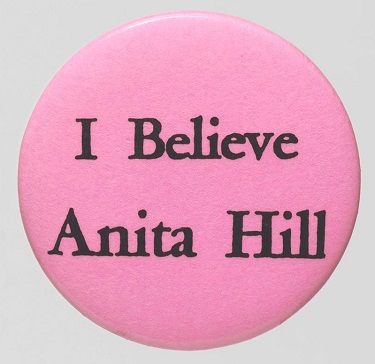
The new Smithsonian Institution’s National Museum of African American History and Culture is intended to celebrate the two aspects of African American influence on the nation mentioned in the title, and that includes honoring  influential and historically significant African American leaders. Among the figures ignored by the museum’s displays is Associate Justice Clarence Thomas, only the second black member of the Supreme Court. The museum does, however, celebrate the “heroism” of his last-minute accuser at Thomas’s confirmation hearings, law professor Anita Hill.

This is another and particularly sad reflection of the petty partisan bias and lack of integrity demonstrated by the Obama Administration at so many levels. It is stuffed with so many intractable ideologues, and often incompetent ideologues, that objectivity, respect and fairness are frequently too great an effort to muster. The museum honors Hill, who was recruited as a last ditch effort by Democrats to block President George H.W. Bush’s nomination of a black conservative judge to the Supreme Court and whose accusations of sexual harassment were never verified except by the confirmation bias of Democrats and Thomas’s enemies. It chose to snubThomas, which all involved had to know would be seen as an insult to the Justice, and a calculated one.

By all logic and reason, Hill should be, at best, a footnote to a Thomas display. Mean-spirited bias from the empowered Left under Obama has extended even to museum curating, which should be non-partisan. Continue reading →

Trending On Ethics Alarms…

trending

….this post, from July, now the all-time most viewed and shared Ethics Alarms post ever, and this post, from May.

Gee, I wonder why?

I only wish this post, from last September, was as well distributed, but I’m going to keep linking to it until it is, or until it’s moot.

Don’t Feel Too Bad, Americans: Ethics Alarms Aren’t Ringing In Canada, North Korea Or Japan, Either

It’s an International Ethics Dunce parade!

donald-trump-humane-society

1. Ontario, Canada

The Windsor-Essex County Humane Society in Ontario thought it would be really clever to use the Donald Trump phrase that many believe disqualify him to be President in an ad to adopt kitty-cats. It featured a photo of Trump and said, “You don’t have to be a star to grab a pussy … cat.”

Amazing. Not one person in the chain of custody of this—I would say obviously, but when so many people miss it, I guess it’s not—offensive ad had an ethics alarm sound.  Nobody had the sense, prudence or guts to say,

“Uh, guys? Hello? You do realize that this is using a phrase describing sexual assault while alluding to the one who used it to describe sexual assault? You do realize that “pussy” alluding to female genitalia is vulgar and uncivil, right? No? Here, let me explain it to you…or hwo about this: there is no way this won’t spark criticism. Is that what you want?”

Sure enough,  the ad promoting cat adoptions this week for $50, was taken down shortly after it appeared this week.

The society offered a pathetic apology. Melanie Coulter, executive director of the humane society, “explained” it was an attempt to make light of the U.S election campaign, though it also “made light” of sexual assault, contemptuous attitudes toward women,  and obscene rhetoric.

“We are obviously sorry if people are offended by the ad — that wasn’t our attempt in the least,” Coulter said. “Our attempt was to find homes for cats that need them.” She also added that the shelter took in more than a hundred cats in the last week.

For the record, the rationalizations here are…

3. Consequentialism, or  “It Worked Out for the Best”

13. The Saint’s Excuse: “It’s for a good cause”

19A The Insidious Confession, or “It wasn’t the best choice.”

It also suggests that I need to add “We meant well” to the list as a sub-rationalization to #13.

****

contest-winner

2. Kuroishi, Japan

Continue reading →

From The Ethics Alarms Mailbag: Is The Current Photo Of Trump In The Site Background Unfair?

trump-1A reader asks,

“Earlier you admonished yourself for using unattractive photos of Hillary Clinton to illustrate various posts and in the blog wallpaper, and pledged to stop the practice, Now you have a serene photo of Mrs. Clinton, but a shot of Trump that looks like he’s in the middle of uttering an obscenity. Isn’t this a double standard?”

Answer: Nope. Not in my view. At this point, that photo fairly and accurately portrays Trump’s conduct in the campaign, which is ugly, assaultive, and a direct reflection on his character. Hillary Clinton’s public demeanor has always been dignified and appropriate for a Presidential candidate, so photographs that captured her in millisecond-long poses with her eyes crossed or looking demonic were both unkind and misleading. The photo you refer to is an accurate depiction of Trump’s demeanor and temperament, especially of late. That is Donald Trump.