Unethical Tweet Of The Month: The Despicable Howard Dean

howarddean-tweet

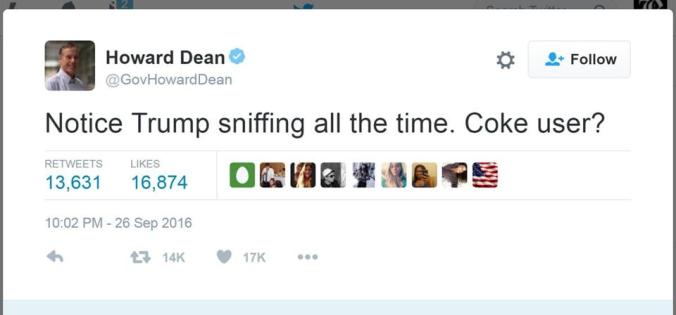
What can you say about this kind of slimy, unethical innuendo from a former Democratic Party chair? How hateful and uncivil the brand of politics and partisan nastiness that it symbolizes and advances? That it represents gutter political smearing at its worst and most unforgivable? That a party with any dignity and sense of decency would demand an apology and a retraction or cut ties with such a shameless creep? That someone who would do this has never heard of the Golden Rule, much less follows it?

The only remaining question is whether this ugly tweet allows Dean to surpass  or merely  Harry Reid as the most loathsome individual on the political scene, edging past the disgraced Debbie Wasserman Schultz.

I’m trying to think of a similarly ethically irredeemable Republican. Chris Christie hasn’t sunk to this level; Newt Gingrich is close, but he wouldn’t do this. Ironically, the only one I can think of is…Donald Trump.

Presidential Debate Ethics: The “Have Your One Of Your Adversary’s Husband’s Former Mistresses Sit In The Front Row” Tactic [UPDATED]

"Hi, Hillary! I'm back! Where's Bill sitting?"

“Hi, Hillary! I’m back! Where’s Bill sitting?”

It is being reported that Donald Trump has arranged to have Gennifer Flowers, Bill Clinton’s paramour from the years before his election, sit in the front row of the audience for Monday’s Presidential debate. If true, the objective is obviously to unnerve Hillary.

I hope it is just pre-debate psychological warfare, and that even Donald Trump has more class and couth than to actually do it. What am I saying? The man  has neither, nor any respect for basic decency or fairness, either.  Trump’s capacity to fall below even my low expectations regarding decent and professional conduct continues to amaze.

What adjectives describe this vile tactic of a Master Troll? Let’s see: Continue reading

Comment of the Day: “A Daughter Sues Her Parents For Being Assholes. Good.”

growth-sequence

Having just returned from an eight-day (and partially laptop-less) speaking tour  that has me about ten posts behind, it was nice to have Steve-O-in-NJ deliver a textbook Comment of the Day, expanding on the original post with relevant and useful observations about photography -obsessed parents and photography ethics.

I do object from an ethical standpoint to his tit-for-tat endorsing last line.

Here is his good and thoughtful work in response to the post, “A Daughter Sues Her Parents For Being Assholes. Good.”

What are the ethics of taking 500 pictures of your child? I wish that I could say that the ethics of taking large numbers of pictures are always the same but they are not. I am in the middle of a two-week vacation and I have been taking a large number of pictures. I see absolutely nothing wrong with shooting a large number of pictures during an air show, particularly where the opportunity to get a particular shot is very limited. I see absolutely nothing wrong with taking a large number of pictures at a place like Colonial Williamsburg, where the actors are deliberately dressed up in costumes designed to attract attention. The same ethics generally applies to any event where there are costumed individuals who are seeking attention. The same ethics probably apply to sporting events. Of course the shooting of inanimate objects like in a museum is perfectly all right, subject to whatever policies the institution puts in place and makes known. Continue reading

A Daughter Sues Her Parents For Being Assholes. Good.

photo

An 18-year-old Austrian woman is suing her parents for continually posting embarrassing childhood photos of her on Facebook without her consent. Since 2009, she alleges, they have willfully humiliated her by constantly posting intimate images from her childhood—about 500 to date. Among them are potty training photos and pictures of her having her diapers changed.

The abused daughter told reporters, “They knew no shame and no limit – and didn’t care whether it was a picture of me sitting on the toilet or lying naked in my cot – every stage was photographed and then made public.” Her parents have  700 Facebook friends.

The technical term for them is “cruel and merciless assholes.”

They have refused to delete the photos, with her father arguing that since he took the photos he has the right to publish them to the world.

Oh, what does the law have to do with this? If the parents had any decency, and sense of fairness, respect and caring, the law wouldn’t have to be involved in any way.  Their daughter feels humiliated, as most of us would be, by having such photos published. There is no ethical principle under which publishing photographs (or videos) of anyone that were taken without consent when the subject objects or one knows or should know that he or should would object can be justified. This controversy, if ethical parents were involved, would be settled with a simple exchange:

Her: “Please don’t put anymore of those photos on Facebook, and take down the ones that are up now. They are embarrassing.”

Them: “OK!”

How hard is that? I know it’s hard for parents to resist posting photos of their adorable infants and toddlers while they are too young to protest, but the protest should be presumed. The Golden Rule rules, and I go further: this is an absolute. Children should not have their lifetime privacy scarred by parents selfishly indulging themselves by treating their children like pets. Children should be able to trust their parents to respect their sensibilities and vulnerabilities, and not to sacrifice them for cheap Facebook “likes.”  Obviously, many of them can’t.

Continue reading

Ethics Hypothetical: Rules, Compassion, Integrity, Fairness, And A Looming Race Card

clock2

[The hypothetical is inspired by two recent events I witnessed in the past week.]

Preface: The state requires new bar admittees to take a one-day course covering the basics of practicing law in the jurisdiction—how the courts work, special procedural rules, unique aspects of local practice, horror stories, the works. They must complete the course or they can’t be certified, and the court-ordered series of lectures and presentations is held only once a month.

A company runs the mandatory curriculum under contract to the state, and is required to confirm in writing to the courts that its requirement have been fulfilled. One key requirement is that every attendee must be present for every minute of the presentations, except for brief emergencies, like using the rest rooms. The course administrators carefully monitor attendance. The published description of the course directs that once the course begins, theoretically at 9 am sharp, no late-comers will be admitted.

As you might imagine, missing the session can be quite a hardship, as participants often live and work in other jurisdictions.

The Event: It is 9:08 am on the day of the program, and the introductory video that begins the orientation is almost finished. It consists of interviews with members of the bar about the benefits of practicing in the state, the importance of ethical practice, etc: to say it is not substantive is an understatement. Literally nothing that is said and shown in the video is anything but boilerplate.

A young man, sweating profusely, bursts in the door, looking unhappy and desperate. “I’m sorry I’m sorry!” he babbles. He says that he had to drive up from a neighboring state and had an accident. “Can I still get in?” he pleads.

The male staffer responsible for the session chats briefly with an associate. The program was late starting, and this late arrival will miss nothing if he goes in now. “All right,” the honcho says as the young man heaves a sigh of relief. “I shouldn’t do this, but you haven’t missed anything.” As he goes into the auditorium, one can here the opening remarks of the first speaker, a judge. It is now 9:12 am, and another young man bursts through the door on a dead run. “My crazy cabbie’s been driving me all over the city for an hour!” he shouts. “I flew in last night from Arizona! Please, please, don’t make me do this again…I barely was able to afford this trip.” The administrator is wondering if he had seen the previous guy go into the auditorium. He’s heard this judge’s spiel many times: all that has been missed, to be honest, are a few (lame) jokes. “All right, all right, get in there quick!” he tells the new supplicant. “I’ll finish your paperwork during the break!” The kid looks like he’s going to cry, he’s so relieved.

I’m there, watching this (I’m on the program) and say to the administrator, “I bet this happens every time.” He says, “It does. I know that nobody misses anything that isn’t in the printed materials until 9:15, so it’s a hard stop after that.”

And another late arrival bursts through the door. It’s a bit after 9:14. The staffer has just told me that the final final deadline is 9:15, and it’s not that yet. This poor guy is bleeding through his pants,  has a big bruise on his face, and is saying something about a bicycle accident. By the time he gets himself settled—he is told that there is no time to clean up—it’s past 9:16. He starts toward the auditorium door as the other staffer says, “OK, that’s IT,” and starts to take the registration materials and lists away….just a very stressed young African-American woman enters, in plenty of time to see the bicycle rider, who is white, enter the auditorium. I can hear the judge through the open door. He’s still telling jokes, longer this time than usual.

Issues and Observations

1. The young woman was not admitted, and told that she had to come back another month. She too was from out of state. She also had a legitimate-sounding excuse.

  • Was that fair to her?
  • Should it have mattered that the program had not yet reached a serious stage?
  • She was told that 15 minutes was the absolute, unwaivable deadline. That was true, but it was not the deadline the company was contracted and pledged to enforce. That deadline was 9:00 am.

2. Should the explanations used by the latecomers play any part in the decision to allow them in? Why? Continue reading

Thanks For The Memories, Greta Friedman: This Encore’s For You!

kiss

I was puzzled about why an old 2012 Ethics Alarms post was suddenly getting heavy traffic today, and until I read that GretaFriedman had died. She was the nurse famously kissed by a never-identified celebrating sailor on V-J Day, frozen in history forever thanks to a now iconic  Life magazine photograph.  I had written about Greta, that moment, and the determination of a lot of tunnel-visioned feminists and sexual-terrorists to turn what was a beautiful thing into something ugly and sinister in the distorted world they see through their shit-tinted glasses. The post was called “The Times Square Kiss, and Feminist Blogs’ Fanatic Crime Against Joy.”

I’m always a bit nervous when I go back and read old posts I’ve forgotten about; I’m afraid I won’t agree with them, but thankfully, I usually do. I do in this case. In fact, I really like the post, and am proud of it. On the theory that most current Ethics Alarms readers haven’t seen it before, I’m reposting today, in honor of Greta:

The blog posts at issue make me angry. Usually it is silly to be angry about mere opinions, I know. However, the opinion registered by “Lori” on the blog Feministing, taking her cue from another feminist blogger, is a symptom, a symptom of the scourge of pernicious, political-correctness zealots, who refuse to recognize the important distinctions between malice and human beings being human, and seek to wipe out that distinction by distortion, sophistry, historical revisionism and bullying. Continue reading

Jacoby Ellsbury, Catcher’s Interference, And The Perplexing Ethics Problem Of “Using A Shield As A Sword”

interference

I led two legal ethics seminars for the Oregon State Bar yesterday. For some reason the issue of “using a shield as a sword ” kept coming up.

“Using a shield as a sword” is when lawyers game the ethics rules. Many local bar associations include a pledge within their creeds promising not to intentionally use the ethics rules as a tactical weapon; still, it’s not an enforceable promise. Examples are limited only by a lawyer’s devious ingenuity, but they usual involve one side creating a conflict of interest for the opposing firm or lawyer that will force the lawyer to withdraw from the case. One ploy: a lawyer recruits a key expert witness specifically because she was once a client of the the lawyer on the other side, making it impossible for her to be impeached on the witness stand by that lawyer because he would have confidential information about her that he would be bound to keep secret, even while being required to represent his current client by ripping her credibility to shreds.

What does this have to do with Yankee centerfielder Jacoby Ellsbury? Well, Ellsbury is in the process of shattering an obscure baseball record: number of times reached base on catcher’s interference during a season. Catcher’s interference refers to instances in which a catcher makes any contact with a batter or his bat during a pitch. Usually, this involves the batter’s bat hitting the catcher’s glove, as in the photo above. When that happens, a player is awarded first base. The rule is based on fairness and  designed to protect the batter, but apparently Ellsbury has perfected the weird practice of using it as an offensive weapon.

Jacoby Ellsbury became the single-season record holder in catcher’s interference calls  in July with his ninth instance  getting rewarded for it. The record was formerly held by Roberto Kelly, who did this eight times in 1992.  Since breaking the record, Ellsbury has gotten catcher’s interference called three more times, for a current total of 11 with almost a month  left to the season. He is also second all-time in catcher’s interference with 23. The career record belongs to Pete Rose with 29; since Rose is baseball’s all-time leader in games played and career at bats, we would expect him to hold this record. No one else in baseball history has more than 18. Ellsbury is only five catcher’s interferences shy of Rose’s mark, and has done it in less than a third of the at bats. Continue reading

Ethics Quiz: Ad Hominem Or Not?

I frequently find myself correcting commenters who accuse me of ad hominem attack when I diagnose their problem, based on their arguments as jerkism or mental deficiency. (I recently found one legal blogger who actually states that if a commenter uses the term incorrectly, the comment will be rejected). Ad hominem is an argument fallacy that holds that if a messenger is flawed, his or her argument can’t be valid. It’s a cheap debate tactic, and unethical. If I conclude, however, that your argument is so idiotic that it could only be devised by an  idiot and thus designate you as one in so many words (because you have a right to know), that’s not ad hominem.

African-American pastor Mark Burns is a rafter-shaking speaker and an unusual and useful advocate for Donald Trump. He has been on cable news segments frequently, and even spoke at the GOP Convention. Being black, he is obviously roundly detested by those who regard Trump as a bigot, indeed by those who just dislike Trump generally. This almost certainly includes journalists on CNN, a Hillary stronghold.

A member of the black fraternity Kappa Alpha Psi alerted CNN that  Burns had claimed to have been a member,  but there was no record to support it. This set CNN on a quest to check all of Burns’ credentials and biography items, and it found that he had other dubious claims. Confronted on the air by (also African-American) CNN reporter Victor Blackwell with these discrepancies, Burns stuttered, humina-huminaed, protested, lied (his web site bio had been “manipulated” in some way, he said—the Weiner Excuse: “I’ve been hacked!”), and finally stormed out of the interview, which is to say, he ran.

Mark Burns is a Trump ally and supporter of note because he is a black pastor. He is still a black pastor. He makes a case for why blacks should support Doonald Trump. That case does not in any way rely on his military record or where he went to school, or, for that matter, how well he responds to having his honesty and integrity challenged on TV.

Your Ethics Alarms Ethics Quiz of the Day is...

“Was CNN’s attack on Pastor Burns fair and responsible, or..

Was it an unethical ad hominem attack designed to discredit a Donald Trump ally?”

Continue reading

Curse You, Political Correctness Bullies! Now You’re Forcing Me To Defend Lena Dunham!

Dunham2

A downside of running an ethics blog is that you have to defend really disgusting people from time to time: Harry Reid, Bill Clinton, Donald Trump…and now Lena Dunham. In fact, this story rescued the “Girls” creator from a different post here, as she recently had to apologize for an online newsletter rant that attacked the character of NFL star Odell Beckham Jr. and attributed various sexist attitudes to him based purely on the fact that he showed no interest in her when they were seated together at a recent function. ( Legitimate reasons why he may have ignored her: he had other things on his mind, she’s not his type, she’s a professional jerk, she’s Lena Dunham).

Before I have to defend Dunham, who is an awful person based on available evidence, let me make a few observations. One is that fame in the 21st Century can expose the unsavory and unethical nature of the famous far more than it did in pre-social media days. This is part of Donald Trump’s plight. Another is that Twitter and social media are literally traps for jerks, and it is amazing that so many of them keep getting caught, even with the bodies of previous trap-ees littering the immediate landscape. Finally, I wonder if there are still publicists around in the tradition of my late friend, Bob McElwaine. and if there are, why doesn’t Lena hire one to save her from herself? Bob was a Hollywood Golden Age publicist who saw his job as keeping the fact that his clients were jerks secret. He was great at it: his major client was Danny Kaye, a truly vile, troubled and nasty individual whose public persona was exactly the opposite.

All right, enough stalling.

For some reason, this Dunham tweet from five years ago surfaced, and has led a social media lynch mob to attack Dunham as being a racist…

Dunham tweet

Pop quiz: What exactly is it about the tweet that makes it racist?

The answer is “Nothing.” Racism requires attributing negative features or conduct to an individual or group based solely on racial bias and prejudice. It is not racism to base conclusions on statistical reality. Interestingly, most of the attacks on the tweet claim that the tweet is anti-Asian. It is racist to attribute virtuous qualities, like a reluctance to rape, to a race? Wow! Apparently the tweet is being condemned as a slur on Asian manhood. Since when is it manly to rape someone? Silly me: I assumed that Dunham was referring to well-documented  cultural support of respect for women, law-abiding conduct and other ethical virtues in Asian-American families.

Or is the complaint that by assuming an Asian-American is less of a threat than a male of another race, Dunham was by extension saying that other races were more of a threat? This would most fairly interpreted as an anti-white slur, however, since whites make up almost 75% of the population of convicted rapists. I thought anti-white bigotry was OK in political correctness circles! Continue reading

Ethics Observations On The Financial Massacre Of The Aurora Massacre Plaintiffs

James Holmes’s 2012 attack on the Century Aurora 16 movie theater showing “The Dark Knight Rises” killed 12 people and wounded 70 others. Many of the survivors and relatives of those killed sued Cinemark, the theater’s owner, in state and federal court, arguing that lax security was the cause of the attack. Cinemark’s defense was that the shooting was unforeseeable. Two suits went forward, one in state court and one in federal court, with different plaintiffs. Cinemark prevailed in both. After the recent jury verdict for Cinemark in the state court case this summer, the company had sought nearly $700,000 from the victims under the “loser pays” Colorado law, which directs that the winning side in a civil case is entitled to recover its legal costs from the losing side. This is the predominant system in England and Europe. The litigation costs of Cinemark in the federal case are likely to be more than $700,000, maybe a lot more.

What’s going on here (the best question to begin any ethics inquiry)? Well…

1. The law suits were a terrible idea. This was the result, in part, of the increasingly popular ideological virus in our society that is slowly reprogramming previously functioning brains to believe that nobody should have to pay for their misfortunes, and that somebody with deeper pocket and more resources should always be obligated to pay instead. This is increasingly a staple of leftist thought: the government, insurance companies, corporations, people with more money, all of them should be potentially on the hook when misfortune strikes others, because that’s fair.

2. It’s not fair, though.  It is profoundly un-American and unethical.

If those parties have caused the damage, or had the power and responsibility to mitigate it, or promised to pay for it, then there are ethical arguments to support them paying some or all of the expenses. But if something terrible happens to you, those people should have no more obligation to be accountable for your harm than you should have responsibility for taking care of them. That’s not the message sent by the culture though. Lawyers love the message that if you are harmed, somebody else can be found to ease your pain. They love it, because they can share in the bounty if a lawsuit seeking damages prevails, and this attitude guarantees more lawsuits. Continue reading