Latest Ethics Notes On The Hillary Clinton E-Mail Scandal Ethics Train Wreck, Part 2

Continuing from Part 1…
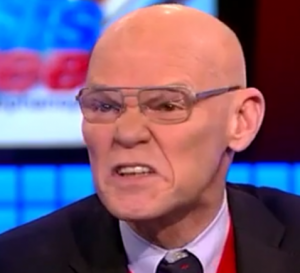
I swear, I didn't pick this photo to make James Carville look crazy or nasty. This is really what he looked like today...

I swear, I didn’t pick this photo to make James Carville look crazy or nasty. This is really what he looked like today…

5. The uproar over Clinton’s private server use and possible security breaches being investigated further with FBI inquiries into the newly uncovered Huma Abedin e-mails seems oddly out of proportion to its substance, at this point. The violent reaction of Democrats and Clinton’s campaign is more suspicious than the information itself. The immediate default to accusations of political and professional misconduct is itself unfair and unethical, and reminds those who are open to being reminded of the Clinton habit of bullying and threatening adversaries, including honorable ones. Just as Trump cannot seem to help himself from lashing out disproportionately at every affront real or imagined, the current over-reaction is itself disturbing. There are too many bullies and thugs in the Clinton camp.

6. Next to Harry Reid, the most publicized accuser of Comey has been Richard Painter, a law professor at the University of Minnesota and the chief ethics lawyer in the George W. Bush White House from 2005 to 2007. He has filed a Hatch Act complaint against Comey with the federal Office of Special Counsel and Office of Government Ethics. As with Reid’s accusation, his is unjustified. Unlike Reid, Painter is intelligent, informed and honorable, and I can only speculate why he has jumped the rails like this. Painter argued in a New York Times op-ed on Sunday that Comey’s intent can be inferred from the absence of a good reason for sending the letter.

Huh? He had a good reason, and as a lawyer and ethics expert, it should be obvious. He didn’t want to be accused of lying to Congress, or to believe that he was lying to Congress. That’s an excellent reason. There are others. “Absent extraordinary circumstances that might justify it, a public communication about a pending F.B.I. investigation involving a candidate that is made on the eve of an election is . . . very likely to be a violation of the Hatch Act and a misuse of an official position,” Painter claims. Okay, but there were extraordinary circumstances. Public distrust of law enforcement institutions is at a dangerous, all-time high. Every decision is attacked as corrupt or politically motivated by one party or the other. The particularly volatile  situation of a Presidential candidate being investigated by the FBI was greatly exacerbated by the Attorney General allowing herself to be pulled into an inappropriate and improper meeting with the husband of the candidate under investigation shortly before a decision whether to prosecute was due–I’d call that an “extraordinary circumstance.” Comey has been trying to restore the integrity of the Justice Department, which Holder and Lynch, along with President Obama, has allowed to be seriously soiled. He may or may not have made the right choice, but for Painter to file a complaint alleging intentional political bias based on his actions alone is irresponsible. Writes Jonathan Turley, also a law professor of note, and one who does a better job avoid partisan bias than Painter does:

“Comey was between the horns of a dilemma. He could be accused of acts of commission in making the disclosure or omission in withholding the disclosure in an election year. Quite frankly, I found Painter’s justification for his filing remarkably speculative. He admits that he has no evidence to suggest that Comey wants to influence the election or favors either candidate. Intent is key under the Hatch investigations.  You can disagree with the timing of Comey’s disclosure, but that is not a matter for the Hatch Act or even an ethical charge in my view.”

“Or even an ethical charge.” Bingo. And those are harsh words from the usually excessively mild Turley.

I’m not sure what’s going on with Painter, whose opinions I have followed for years. I have followed him, and even argued with him occasionally, on the excellent legal ethics blog, the Legal Ethics Forum, where he is a contributor. If he is a Republican, he’s either a disillusioned one or a strange sub-species. Most of his posts tilt leftward, and they are almost all political in nature, in sharp contrast to everyone else. He obviously has no respect for the Republicans in Congress, and is as vehemently anti-Trump as I am. Unlike me, apparently, he seems to have allowed his rational contempt for Trump lead him to a damaging bias in favor of Hillary Clinton. Ethics complaints should not be used as a political weapon. Continue reading

Latest Ethics Notes On The Hillary Clinton E-Mail Scandal Ethics Train Wreck, Part I

train-wreck-air

[The first example of an Ethics Train Wreck or ETW (Ethics Alarms Definition: Ethics train wrecks are chains of unethical conduct created by a central unethical action. As the event becomes more complex and involves more participants, it becomes increasingly difficult to sort out right from wrong, and all parties who become involved with the episode in any way are at risk of engaging in unethical conduct themselves, intentionally or inadvertently.) that spawned a second ETW, or sub-train wreck to a train wreck, was the Trayvon Martin-George Zimmerman ETW, which has launched  several (Ferguson, Freddie Gray). I am now forced to designate the Hillary Clinton E-Mail Scandal, previously just a prominent car, perhaps even the engine, on the Hillary Clinton Presidential Candidacy Ethics Train Wreck, as an ETA itself. Since the revelation of the letter FBI director Comey sent to Congress explaining that the investigation into possible Clinton criminal wrongdoing regarding her reckless handling of official State Department communications was no longer to be considered “completed,” passengers have been leaping onto this rampaging juggernaut like there was free Halloween candy on board. I have no choice. In what I fear will be just the first of many, this post will sort out the latest developments.]

1. The word that best expresses the reaction of the Clinton campaign, its media allies and Hillary’s supporters is fury. The emotion in this context resembles the moment in every action film when the super-villain or evil mastermind who was sure that victory was his suddenly discovers that through an amazing confluence of factors, he’s going to lose after all. This comparison is not flattering to Hillary, her minions and her corrupted, but it is apt. They really believe that they deserve to get away with years of unethical and incompetent conduct and more than a year of lying about it, and go into election day with it all a distant memory, sure to be spun as just another conservative “nothingburger” …until the next time.

If there is anything worse than unethical practitioners of politics, it is smug and arrogant ones. To some extent I resent being led so forcefully to schadenfreude, but still, this crew so deserves its present pain!  They also deserve to have voters go into their booths November 8 still uncertain of just how dishonest and corrupt Hillary Clinton is, wondering if, as with Richard Nixon in 1972 (Hillary is this generation’s Nixon, except that he was more skilled, and she has the gender card to play), there are more ugly shoes to drop.

I have written this before and recently, but it bears repeating: Hillary Clinton has nobody to blame for this crisis but herself. She could have played by the rules; she could have turned everything over to State immediately, including the mysterious 30,000 “personal” emails; she could have admitted misconduct and ignorance; she could have been honest to journalists and the public. If she had done these things, the entire episode would have been negated before 2015 was out. Being angry at James Comey makes as much sense as Trump being angry at his various sexual assault accusers, and it is just as much an indication of base character.

2. The news media’s taking the cue from the Clinton campaign and reporting this as a James Comey/ FBI story is yet more proof of news media bias and its efforts to assist Clinton. Comey was cheered by Democrats (and accused of conspiring to clear Hillary by Republicans) for not recommending an indictment of Clinton when the investigation was first closed. We have since learned that his decision was very unpopular among his subordinates. The argument that the same man is now showing political bias against Clinton makes no sense.

Here is the most unethical headline yet in the “Let’s smear Comey for Hillary” division. The New York Times. this morning, on the front page, proclaims: “James Comey Role Recalls Hoover’s F.B.I., Fairly or Not.”

Who’s “recalling”? Nobody who remembers Hoover’s FBI and isn’t trying to impugn Comey unfairly would make this comparison. This is a cognitive dissonance attack, despicably seeking to link Comey to the infamously racist, extorting, power-abusing founder of the FBI. Continue reading

James Comey’s Ethical Conflict

twopaths2

We now know that James Comey’s decision to inform Congress that the Clinton e-mail investigation had been re-opened (If I hear one more Clinton spinner  tells me that no case is ever “closed,” even one that is “completed,” I am going to run naked through the Safeway, screaming dirty limericks in pig latin. Be warned.) was “against Justice Department policy,” specifically the policy of “not acting in such a way as could influence an upcoming election.” Comey understood he was violating these guidelines, sources tell us,but felt he was obligated to do so because he had promised members of Congress he would inform them of any further developments related to Clinton’s email server misuse. Thus he sent a letter to F.B.I. employees after alerting Congress of the (possible) new evidence that necessitated re-opening the investigation. In the letter,  Comey acknowledged that his actions were unprecedented, but explained that…

I feel an obligation to do so given that I testified repeatedly in recent months that our investigation was completed. I also think it would be misleading to the American people were we not to supplement the record. At the same time, however, given that we don’t know the significance of this newly discovered collection of emails, I don’t want to create a misleading impression. In trying to strike that balance, in a brief letter and in the middle of an election season, there is significant risk of being misunderstood, but I wanted you to hear directly from me about it.

According to the Washington Post,  Comey was also concerned that the discovery of the emails would be leaked to the media after he briefed a team of investigators about them, causing the  F.B.I. to be accused of a coverup to benefit Clinton.

Some ethics conclusions:

1. Comey’s actions are consistent with an understanding of the Ethics Incompleteness Principle, which is often discussed on Ethics Alarms:

The human language is not sufficiently precise to define a rule that will work in every instance. There are always anomalies on the periphery of every normative system, no matter how sound or well articulated. If one responds to an anomaly by trying to amend the rule or system to accommodate it, the integrity of the rule or system is disturbed, and perhaps ruined. Yet if one stubbornly applies the rule or system without amendment to the anomaly anyway, one may reach an absurd conclusion or an unjust result. The Ethics Incompleteness Principle suggests that when a system or rule doesn’t seem to work well when applied to an unexpected or unusual situation, the wise response is to abandon the system or rule—in that one anomalous case only— and use  basic ethics principles and analysis to find the best solution. Then return to the system and rules as they were, without altering them to make the treatment of the anomalous situation “consistent.”

Assuming that the “policy” is a sensible and ethical one to begin with (though it isn’t), this was an anomalous case. The FBI, and Comey personally, were rightly under intense criticism for their handling of the investigation. Among other puzzling decisions, Clinton’s aides were given immunity for no apparent reason; Clinton’s interview was neither videoed nor under oath; and Cheryl Mills, who was directly involved in the private server fiasco, was allowed to serve as Clinton’s lawyer when she was questioned. The policy was designed to protect the Justice Department and its component from suspicions of bias and partisan complicity, and the inept handling of the investigation  had already created those suspicions. When such a policy appears likely to have the opposite effect that it was established for, the rational and ethical approach is to make an exception, which is what Comey did.

2. This was courageous. Continue reading

Of Bundys, Trump, Wikileaks, Rebellion—You Know, The Whole 2016 Election Thing

jury-nullThe jigsaw puzzle of an existential national crisis, a real one, are assembling sufficiently so an image can be distinguished. It is uglier than I imagined.

1. Item:  The Bundy Brothers were acquitted. This was pure jury nullification, because they were guilty as hell. It might be an aberration, but I fear it is not. The jury is a fractal of democracy, and when juries start finding lawbreakers innocent, they are sending a message that those in power ignore at their peril. They say “We don’t like or respect you or your laws, and you better change, or else.” The complete class, regional and ideological estrangement from the Federal government this decision represents shows how completely Barack Obama has divided the nation, and portend a long, long, difficult and, one can only hope non-violent recovery, if some competent leaders emerge who can handle it. As trust in our institutions have collapsed with accelerating speed over the last decade, civility has deteriorated and authorities have increasingly threatened the basic Constitutional rights of citizens while extending privileges to non-citizens for political motives, the connective tissue of our society has been frayed to the snapping point. Responsible leadership, objective  and rational citizens must not shrug this verdict off as just a bunch of gun nuts and cowboys throwing a tantrum.

2. Item: Donald Trump keeps saying that the election is “rigged.” This is beyond irresponsible, in isolation not more irresponsible than what Trump has said about other things, but the timing and sheer intensity of this drumbeat from him is truly horrible….and also likely to be effective.  Continue reading

Exploring Double Standards In The 2016 Election, A Hypothetical Thought Experiment For Ethics Alarms Readers

fake-huma

While the news media has been almost totally focused on Donald Trump’s misogyny, alreday well-established long  but somehow decisively important once it was in full display from the video of a private exchange from 11 years ago, revelations about his opponent’s character and modes of operation have also been trickling out into view, and receiving far less attention from either journalists or voters.

They have also exposed many of Clinton’s lies. For example, after posturing about Trump’s birtherism and claiming that his defense that Clinton led the way in 2008 with planting conspiracy theories to otherize Obama, this  ugly email, surfaced from the 2008 Clinton campaign, including John Podesta and Paul Begala on the distribution list. It strongly suggest that an attack on Obama’s religion and citizenship was part of the strategy to defeat him, as well as using his alleged use of illegal drugs and support for gay adoption as ammunition.

The 2013 Goldman-Sachs speeches that Clinton received $675,000 to give to the investment companies have turned up, thanks to Wikileaks. More revealed files from the FBI have cast suspicion on the process whereby Clinton was cleared of criminal misconduct in her irregular handling of official e-mails.

Other documents have indicated that the federal government, “supported by tax dollars,” as the Wall Street Journal puts it, was working as an extension of the Clinton campaign. The State Department seems to have coordinated with her staff to blunt the email scandal, and the Justice Department kept her team informed about developments in the court case.

Clinton’s State Department, as documents obtained under the Freedom of Information Act show, also facilitated Clinton’s use of her official influence to provide special favors to Clinton Foundation donors. For example, in one  series of 2010 emails, a senior aide to Hillary  Clinton asked a foundation official to let her know which groups offering assistance with the Haitian earthquake relief were “FOB” (Friends of Bill) or “WJC VIPs” (William Jefferson Clinton VIPs).

The leaks show “that the press is in Mrs. Clinton’s pocket,” writes Kimberly Strassle at the WSJ.  Donna Brazile, now DNC chair, sent the exact wording of a CNN town hall question to Hillary ahead of a scheduled debate.  Other journalists gave the Clinton campaign the power to veto which quotes were used from interviews, helped facilitate press events, and offered advice to her campaign.

Less surprising but arguably more damaging if the average voter knew, the various leaks, e-mails and speeches reveal a candidate with little integrity and few core principles, an opportunistic policy Janus who constantly changes her position to maximize political gain. She told an audience that she believes in giving the voters one position while holding different ones, and has taken such dual positions on banks; international policies, trade, illegal immigration, energy, and more. Though many of the leaked e-mails reveal views of her staff that are only attributed to Hillary, it is likely that the voluminous discussions among Clinton’s advisors about  what false rhetoric she should use to recruit “the Red Army,” also called “the base of the Democratic Party.” are not inconsistent with her own attitudes.

All of this, and more is on the way, does not show an individual with Donald Trump’s repulsive narcissism and contempt for a full half of the world’s population, but does show Clinton to be, like Trump, untrustworthy, dishonest, corrupt, ruthless, and shameless. Unlike Trump, it reveals an individual addicted to showing the public a completely different political being than she really is.

Strassle concludes her summary by saying that “Voters might not know any of this, because while both presidential candidates have plenty to answer for, the press has focused solely on taking out Mr. Trump. And the press is doing a diligent job of it.”

So I wonder…what if, rather than requiring explanation, analysis, extrapolation, and connecting the dots, and without being marred by over-reaching and biased exaggerations of already damaging evidence by right-wing, Hillary-hating zealots, visual and audible smoking gun proof of Clinton’s lies, false poses and corruption was exposed to the nation?

I now present this hypothetical as a thought experiment: Continue reading

The New York Times Proves Why Journalists Can’t Be Trusted To “Fact-Check” Since They Don’t Know What A Lie Is

jaccuse2

Ugh.

I finally grabbed a barf bag and read the New York Times attack piece from the weekend titled “A Week of Whoppers.” Silly me: Donald Trump lies so often that I simply took it on faith that the Times would have no trouble finding real and substantive lies to expose from The Donald. Instead, what I found were a few genuine lies of no great significance lumpod with statements that were obviously not meant literally, off-the-cuff remarks that any objective listener would assume were just generalizations, self-evident hyperbole, or opinion. None rose to the level of outright attempts to deceive on the magnitude of “I never sent or received classified material,” or “wiped? Like with a cloth?”

Needless to say, but I’ll still say it, none came within a Washington mile of lies like “I did not have sex with that woman,”  which is one Hillary Clinton attempted to facilitate. It is depressing that any reporter, editor or reader would find the analysis that all 31 of these alleged “lies by Trump were “lies” fair, rational or convincing. Alexander Burns and Maggie Haberman prove themselves to be partisan hacks with this weak piece of anti-Trump hype. The statements flagged here are so clearly the result of a concerted anti-Trump bias that editors must have assumed that few would actually read them, and just take the headline and sheer size of the feature as proof that the Times had legitimately proven massive dishonesty.

And it had: its own.

Here are all 31 alleged Trump “lies,” with the Ethics Alarms verdicts on each. Continue reading

The Word For The Notes On Hillary Clinton’s FBI Interview—And Everything Related To It—Is “Pathetic”

Hillaryshrug

Pathetic, adj.: arousing pity, especially through vulnerability or sadness.
Synonyms: pitiful, pitiable, piteous, moving, touching, poignant, plaintive, distressing, upsetting, heartbreaking, heart-rending, harrowing, wretched, forlorn

This is the word that constantly came to mind and heart as I explored the FBI’s notes (you can too, here) regarding Hillary Clinton’s decisive—at least in terms of saving her from prosecution—interview with the FBI. Everything about them arouses pity–for her, for us, for the nation. Let us count the ways.

1. Over at MSNBC, “Meet the Press” host Chuck Todd, a fully committed operative of the Democratic Party, like most of his colleagues, and like them committed through his partisan bias to saving America from Donald Trump, was overcome with an attack of objectivity.  “It bothers me as an American citizen,” he said,  that the FBI didn’t record Hillary’s interview, and left Americans to ponder merely notes taken by one agent as the public tries to assess who it may be electing President in November. “Are you kidding me?!” Todd cried. “We’re releasing notes?!”

We’re releasing notes. It’s pitiable to see one of many prominent journalists who have tried so, so hard for eight years to paper over, minimize and otherwise shrug off the constant, near complete incompetence of the Obama Administration and every agency under it to be suddenly stung by the realization that this has consequences—for trust, for truth, for belief that the government isn’t actively engaged in suppressing it. Pathetic.

2. Some of you will recall that I was collecting the various partisan reactions to  FBI director James Comey’s statement announcing that the FBI would not be recommending Clinton’s indictment to ultimately gauge which party’s reaction was more ridiculous, irresponsible, dishonest and foolish. Democrats were claiming that Comey’s report, despite showing that Clinton had lied outright about her use of the private e-mails server, and that her recklessness had endangered U.S. intelligence, exonerated Hillary. Republicans were claiming that Comey’s statement and the decision not to prosecute was indefensible. I was waiting to learn what Hillary had said in her interview, as I assumed that it would have to be released before the election. To reveal a closely guarded Ethics Alarms secret, I was prepared to declare Republicans the “winner” of the competition, as obviously idiotic as it is to say that a report declaring Clinton incompetent and dishonest could possibly “exonerate” her. Reading the notes, however, and considering the fact that the F.B.I. only has these notes to show us, I am back to, as Bobby Fisher would say, square one. Which is pathetic.

3.  Why? Well, we have just learned that  Clinton had her server “wiped”  after the New York Times, on March 3, 2015, broke the story of the server system’s existence. At the same time, she and her surrogates were telling the news media and us, “I want the public to see my email,” even as she directed her henchmen to destroy it. The FBI knew this, yet still found Clinton’s actions just negligent, and not criminal. Five months later–back in those halcyon days when she actually held press conferences— she feigned ignorance when Fox News’s Ed Henry asked, “Did you wipe the server?” saying, “Like with a cloth or something?” Now we know, vie the FBI notes , that she had the server emptied using a sophisticated software program, BleachBit, that is designed to make purged e-mails virtually unrecoverable, and indeed several thousand of hers were successfully destroyed. Clinton got away with this, her supporters don’t think it matters, and the FBI apparently minimized these efforts to obstruct justice. Pathetic.
Continue reading

Hillary’s New Tactic: When Caught Lying, Resort To Gibberish

Yesterday in Washington, D.C., Hillary Clinton took questions at a meeting of the National Association of Black Journalists and National Association of Hispanic Journalists. She was asked by NBC’s Kristen Welker to explain her jaw-dropping lie on Fox News Sunday a week ago, when she claimed  that FBI Director James B. Comey had said all of her statements had been “truthful,” when anyone who heard Comey’s public statement or Congressional testimony could see that he actually stated that her public statements—for more than a year—were not true. Incredibly, Clinton had no coherent or credible answer for this, though she had to know—didn’t she?—that the question would be asked.

Her answer began with this:

“I may have short-circuited it, and for that I will try to clarify.”

On “The Honeymooners,” Ralph Kramden (Jackie Gleason) used to stutter out, when confronted with his own whopper or otherwise trapped, “Huminahuminahumina…” “Short-circuited” is as meaningful as that. It’s gibberish, but just as obviously means “you caught me lying through my teeth, and I don’t have a good explanation.” Ralph, however, was a humble, none-too-bright bus driver, and not running for President, so the standards in his case can be relaxed a bit.

(Please also note Clinton’s equivocal “might.” )

Ralph always followed  “huminahuminahumina…” with facial expressions and body language showing silent humiliation, and then an abject apology. Hillary, being Hillary, just started lying again. The AP fact-checked her response, and determined that she had trotted out the same shifting, mendacious assertions we have heard so many time before. Concluded the Washington Post’s Chris Cillizza, 

Er, what? What Clinton appears to be saying is that Comey said that everything she said to the FBI was truthful (he did) and since she said publicly exactly what she said to the FBI, therefore everything she said was truthful.

Oh, so that’s what “short-circuited” means! Continue reading

Jumbo, Ethics Dunce, Kaboom And Unethical Quote Of The Month: Hillary’s Jaw-Dropping Lie To Chris Wallace

hillary and Wallace

“Director Comey said my answers were truthful, and what I’ve said is consistent with what I have told the American people, that there were decisions discussed and made to classify retroactively certain of the emails.”

—-Hillary Clinton to Chris Wallace on Fox News Sunday, asserting that what was demonstrably false was true, regarding a public statement by Comey that can be Googled and watched on YouTube instantly.

My reaction when I saw that: KABOOM! The top of my head blew right off, bounced off the ceiling and knocked over the lamp. Wallace asked Clinton directly about what she had been saying to the public about her e-mails since May of 2015: that she did nothing wrong, that her private, secret e-mail server was approved by the State Department, that she never received or sent a classified e-mail…okay, that didn’t work, that she never knowingly sent a classified e-mail…wait, wait, that she never sent or received an  e-mail that was marked classified. Comey, in his televised, live statement announcing his decision not to recommend prosecution for Clinton, directly contradicted her.

In his careful statement Comey said,

“Although we did not find clear evidence that Secretary Clinton or her colleagues intended to violate laws governing the handling of classified information, there is evidence that they were extremely careless in their handling of very sensitive, highly classified information.,,,seven e-mail chains concern matters that were classified at the Top Secret/Special Access Program level when they were sent and received. These chains involved Secretary Clinton both sending e-mails about those matters and receiving e-mails from others about the same matters. …There is evidence to support a conclusion that any reasonable person in Secretary Clinton’s position, or in the position of those government employees with whom she was corresponding about these matters, should have known that an unclassified system was no place for that conversation…even if information is not marked ‘classified’ in an e-mail, participants who know or should know that the subject matter is classified are still obligated to protect it.”

There is no way that an individual of normal facility with the English language can listen to or read that statement and conclude that Comey was saying that Hillary’s answers to questions about the e-mails to the American public and the news media–for over a year!–were truthful, as in “full of truth.” A technical argument can be made, if one wishes, that  Comey didn’t say that Clinton lied, because maybe she is an idiot and incompetent, and didn’t know or understand what “any reasonable person in Secretary Clinton’s position” should have known and understood, leading to her factually false (and constantly evolving as more facts where uncovered) explanations over months and months. Continue reading

Prelude: Intent, Gross Negligence, And “Extremely Careless”

falling bowling ball

By now I intended to have published a thorough essay deciding the question of whether conservatives, and their claims that James Comey was part of a Justice Department conspiracy to save Hillary from indictment, were more unethical that Clinton supporters in the news media and elsewhere pronouncing her “exonerated” because she’s not facing trial. Alas, pressing matters have intervened, but no matter: I will present it soon. Meanwhile, however, allow me to clean up a relevant controversy.

Much of the mockery of Comey’s explanation of the FBI’s recommendation, since accepted with a big “Whew!” by Loretta Lynch, arises from his assertion that while Hillary’s handling of classified information was “extremely careless,” it did not arise to the standard of “gross negligence” specified in the relevant statute. Too many pundits and commentators to mention have snorted at this, arguing that there is no practical difference. Comey did not help, when he was asked the question in his Congressional testimony, by explaining the difference as one of enforcement: in a century, he said, no conduct similar to Clinton’s has ever been found to meet the “gross negligent” standard sufficiently to warrant prosecution. Attorney General Lynch, when she was asked the same question by Rep. Jim Sensenbrenner (R-Wis), just repeated how she accepted the recommendations of Comey not to indict Clinton.

There is a difference, however. I don’t know why neither Comey nor Lynch could articulate it, but it exists, and I will now make it clear.

For this analogy I owe thanks to a D.C. lawyer, ethics expert and law professor friend of long-standing with whom I was recently discussing the Clinton matter. He has a gift for  analogies, and said this…

“Intent, is when you drop a bowling ball out of an office building window, aiming so that it will kill somebody by falling on the victim’s  head.”

“Gross negligence is when you toss a bowling ball out of an office building window without looking in order to get rid of it, knowing full well that it is mid-day and very likely to fall on someone’s head.”

“AH HA!” I interrupted. “Then ‘extreme  carelessness’ is when you toss the bowling ball out of an office building window without looking, in order to get rid of it, because it’s 3 AM and you mistakenly/ignorantly/ stupidly  assume nobody will be walking on the sidewalk at that time of night!”

“Exactly!” he said.

More to come…