
“It’s A Wonderful Life” Ethics, Part 3

Here is the final installment of the Ethics Alarms overview of the ethical issues raised in Frank Capra’s classic. Some of the comments on Parts 1 and 2 have suggested that my analysis is unduly critical. Nothing could be further from the truth. I love the movie, and have already said that I find it ethically inspiring. Noting that characters act unethically in a movie about ethics is no more criticism than pointing out that people in horror movies never just leave when things start getting weird (as I would). I know that their actions drive the plot and are necessary. This is, however, how an ethicist watches a movie with as many ethical choices as “It’s A Wonderful Life.” I can’t help it.

Now back to George, Mary, and Bedford Falls:

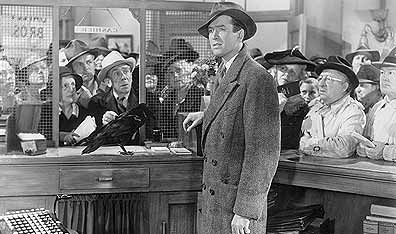
11. Uncle Billy screws up as we knew he would

11.  Christmas Eve arrives in Bedford Falls, and Uncle Billy manages to forget that he left the week’s deposits in the newspaper he gave to Mr. Potter. Thus more than $8,000 is missing on the same day that the bank examiner is in town. Why is Uncle Billy still working for the Savings and Loan? He’s working there because George, like his father, is putting family loyalty over fiduciary responsibility.  Potter, of course, is a thief; by keeping the lost money to trap George, he’s committing a felony, and an unnecessary one. As a board member on the Savings and Loan, Billy’s carelessness and George’s negligence in entrusting him with the bank’s funds would support charges of misfeasance. Mr. Potter, had he played fair, might have triumphed over George legitimately, and no Christmas miracle or guardian angel could have saved him. But this is the inherent weakness and fatal flaw of the habitually unethical: since they don’t shrink from using unethical devices, they often ignore ethical ways to achieve the same objectives that would be more effective.

12. George folds under pressure Continue reading
“It’s A Wonderful Life” Ethics, Part 2 (of 3)

When we last saw George Bailey, he was defending his father’s dubious loan practices. In this, Part 2 of the three installments of  “It’s A Wonderful Life” Ethics, we take the saga up the fateful Christmas Eve when George Bailey meets his guardian angel.

6. George’s Fork in the Road

George Bailey’s decision to give up his plans to go to college to save the Savings and Loan is clearly not motivated by his personal dedication to the institution; he doesn’t like the place. He says so over and over again. He admires his father’s motivations for starting it. Had Potter not sparked his resentment with his nasty comments about George’s late father, George would have been out the door. But his passionate speech in rebuttal of Potter’s words put him on the spot: after those sentiments, turning down the Board’s appointment of him to be the new operating manager of the S&L would have made George a hypocrite in his own eyes, and rendered his passion  laughable. If George had integrity, then he had to accept the appointment.

It is one of the most interesting ethical moments in the film, because it represents a realistically complex ethical decision. George does what he does for selfish reasons as well as altruistic ones, and irrational reasons as well as considered ones. He wants to respect himself; he fears what might happen to his family and the community if Potter becomes the only financial power in town, and knows he will feel guilty if the consequences are bad. He feels like not staying will be taking Potter’s side over his father’s—completely irrational, since his father had given his blessing to George’s college plans, and wasn’t alive to be harmed by whatever he chose to do anyway. A large proportion of George’s decision seems to be motivated by non-ethical considerations, for he doesn’t like Potter—even hates him, perhaps—and wants to stick it to the old tycoon by foiling his victory. There are few ethical decisions in real life that are made purely on the basis of ethics, and Capra makes George’s decision wonderfully impure. Continue reading

Outrageous Corporate Conduct 2011: Transocean’s Unconscionable Bonuses

"Sure, but other than THAT: great night at the theater, right?"

I believe that much of the time the corporate sector is unfairly treated by the media, politicians, and the public. Part of this conviction arises from my experience working at the U.S. Chamber of Commerce, directly under its current president when he was a rising young Turk. I dealt with corporate executives every day, and got to see the challenges of big business from their side. Most of the time, they struck me as genuinely concerned about workers, communities, fairness, while believing, of course, that an unfettered private sector was in the economic interest of everyone.

Increasingly, however, I see corporate behavior that is so arrogant, so transparently greedy, so contemptuous of the public’s intelligence, so blatantly, obnoxiously wrong that I wonder if it was all a dream. There was AIG, accepting billions from American taxpayers to save it from the consequences of its own fiduciary crimes, immediately spending some of it on lush retreats and parties for its executives. There were the leaders of Goldman Sachs, telling gape-jawed U.S. Senators that, no, they didn’t see anything unethical about selling their trusted clients investment products so awful that the company made money betting on their failure. There are the U.S. banks, hoarding their money and refusing to refinance mortgages that were unconscionable to begin with,  preferring to make the nation’s economic problems worse by foreclosing on families’ homes rather than making a good faith effort to undo a human and social catastrophe that was substantially of their own making.

Now comes the news that Transocean Ltd., owner of the Deepwater Horizon oil rig, has announced that it is giving millions of dollars in bonuses to its executives after “the best year in safety performance in our company’s history.”  Which seems perfectly reasonable, unless you want to make a big deal over that one little Gulf oil spill incident last April…you know, the one that began when a Transocean oil rig exploded, killing eleven people including nine Transocean employees. Continue reading

Texas Lawyers And Sex: Not Horny, Just Wise

"Now about my fee...."

Texas lawyers have voted down a proposed ethics rule that specifically condemned attorneys having intimate relations with their clients. Naturally, the media will represent the decision as the predictable reaction of a bunch of high-rolling, fun-loving Texas legal horn-dogs to people trying to spoil the perks of their job; even the legal media has settled on a misleading headline:  “Texas lawyers reject ban on sex with clients.” But Texas lawyers don’t think that sex with clients is ethical, or want it to be ethical. Like the attorneys in many other states, they just think having a rule on this topic is bad idea. And they are right. Continue reading

The Sanford Bishop Saga: Pondering the Ethical Implications of Another Congressional Black Caucus Scholarship Cheat

At this point, anyone who is surprised to learn that a member of the Congressional Black Caucus has been caught violating basic principles of ethics has not been paying attention. The Caucus has systematically corrupted itself by excusing blatant misconduct by its members for so long, reasoning—wrongly—that it is more important for black members of Congress to show loyalty and solidarity with their race than to be role models and honest public servants. Sadly, it would be newsworthy to learn that there is a CBC member who is passionate about holding public servants to a high level of trustworthiness. There apparently are no such members, however. If there were some, they would have resigned from an organization that reflexively defends black Representatives who abuse their power, position and trust (thus endorsing unethical conduct) and cries racism when anyone outside the Caucus, including the House Ethics Committee, criticizes the obvious.

Perhaps this is why the revelation that Rep. Stanford Bishop (D-GA.) distributed scholarship funds intended for needy students in his district to family members and political cronies received so little media attention. Continue reading

Ethics Quote of the Month: Rep. Eddie Bernice Johnson

“I did not have an ethical alarm go off.”

Dallas Congresswoman Eddie Bernice Johnson, explaining (but not really) how she managed to give  23 of the Congressional Black Caucus Foundation scholarships Johnson has awarded since 2005 to two grandsons from Austin, two great-nephews from Plano, and two children of her top aide, despite explicit rules prohibiting nepotism, and requiring the scholarship to go to needy recipients in her own district, which none of these recipients were.

But thanks for the plug, Congresswoman! (It is “ethics alarm,” however, not “ethical alarm.”) Continue reading

Unscrupulous Rep. Johnson, Lying Through Her Teeth

Which is the more unethical conduct for a U.S. Congresswoman: handing out non-profit money to relatives and friends, or lying about it so flagrantly that it insults the intelligence of everyone within earshot? It’s a tough call. Luckily, we really don’t have to decide in the case of Rep. Eddie Bernice Johnson (D-Texas), because she’s done both. Continue reading

Defining Fiscal Irresponsibility Down and the $578M School

The shocking thing about the new $578 million school complex recently unveiled in Los Angeles, other than its obscene price tag, is that it was a one-day news story, and a minor one at that. There are no demonstrations; Fox News isn’t screaming about it. One education blog blandly asked, “Some view the school and its deluxe amenities as a showpiece for the community, while others view it as a waste of taxpayer money. What do you think?”

“What do you think???” WHAT DO YOU THINK???

The Robert F. Kennedy Community School is a showpiece for the community, all right: it shows that the community is run by irresponsible, incompetent officials, and that the community’s taxpayers are the human equivalent of sheep. Continue reading

Ethics, Ethics, Everywhere…

Stories with ethical implications are popping up everywhere, in many fields. I’m running hard to keep up; if you want to join the race, here are some recent developments and notes:

  • A prominent Harvard professor and respected researcher just retracted a major paper and has been put on leave, as an investigation showed irregularities in his methods and results. “This retraction creates a quandary for those of us in the field about whether other results are to be trusted as well, especially since there are other papers currently being reconsidered by other journals as well,’’ wrote one scientist. “If scientists can’t trust published papers, the whole process breaks down.’’
  • A Wisconsin lawyer bought a farm from his own client in a bankruptcy matter, a classic conflict of interest. The lawyer’s defense was amusing: since his license had been suspended, he no longer had a fiduciary duty to his now former client. The court canceled the sale. The story is on the Legal Profession Blog.

Ethics and Irony: the Postman Rings Twice for ACORN

“The Postman Always Rings Twice,” James M. Cain’s novel that is better known as a 1946 film noir classic starring Lana Turner and John Garfield, has a famous ironic twist. The story’s hapless drifter narrator escapes punishment for a murder he helped commit, but gets executed anyway for a death that was really an accident. Cosmic justice is done, if not legal justice. It turns out that the postman rang twice for ACORN, the Association of Community Organizations for Reform Now, too. Continue reading