Will President Obama’s New Leadership Model Cripple U.S. Management Competence For Decades?

America in ruins

 It seems to be a distinct possibility.

The President of the United States is the culture’s most powerful, visible and influential leader. Like it of not, he is also a role model for leadership and management across society. He has the most responsibility, the largest organization to oversee, and the most vital interests at stake. The management and leadership techniques he uses necessarily set a standard others, especially young, inexperienced, aspiring leaders and management, will be encouraged to emulate.

What are they learning? To begin with, they are learning to accept a startlingly low standard for “confidence.”

The President has now issued two statements that he has “confidence” in the Secret Service. The assessment has special significance because the health and safety, the very lives, of the President, his wife, his young children and his staff is in the Secret Service’s hands, and the agency would seem to have demonstrated beyond all doubt that it is incapable of meeting any reasonable expectations or trust. We know that the agents are barely trained, and that they lack professionalism and self discipline. We know that agents availed themselves of prostitutes in South America, and got drunk on duty in Amsterdam. We know that  a gunman fired at least seven bullets that struck the upstairs residence of the White House in 2011, aided by a botched Secret Service response, and that just this month a deranged fence-jumper got into the residence and was running amuck before he was stopped.

The Service’s statement on that incident was jaw-dropping, saying agents “showed tremendous restraint and discipline in dealing with” an intruder who could have had a bomb or deadly intent. How could this President, any President, any leader, any manager, have “confidence” in a security force under these circumstances, with its own management displaying such a bizarre attitude?

Well, I don’t know. It’s a brand new paradigm, the most lassez faire, gentle, kind,empathetic and understanding, hands-off, no-fault, no standards, no accountability leadership style I have ever seen at any management level higher than a lemonade stand. I’m sure many members of the public, especially those who goof off at their jobs, steal supplies, file fake reports, arrive to work stoned, never finish assigned tasks and think they have a right to keep their jobs and paychecks no matter how useless they are, would love to have Obama as a boss. Such a boss would express confidence in the most obviously inept and untrustworthy employee imaginable, and apparently mean it. And never, never fire him. Continue reading
Theater Ethics: The Big Daddy Affair

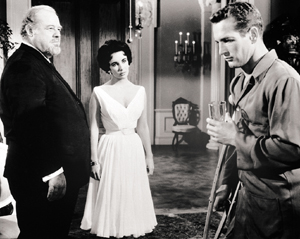
"Yes, why DON'T you want to make love to a young Liz Taylor, Brick? I've been wondering about that myself..."

“Yes, why DON’T you want to make love to a young Liz Taylor, Brick? I’ve been wondering about that myself…”

It is convenient when the perspectives of my longtime dual personas as a stage director and an ethicist are simultaneously relevant, so I couldn’t pass up this juicy story.

From the LGBT blog of the LA Weekly:

A Southern California production of the Tennessee Williams classic “Cat On a Hot Tin Roof” was canceled today after a homophobic outburst in the audience led to a physical confrontation, the firing of an actor, and an apparent cast revolt….the Repertory East Playhouse… announced in a statement today that the run of the play was “suspended” …as a result of “cast members leaving the show with no time to adequately re-cast their parts … “[A] man in the audience was allegedly drunk and heckling the performers during Saturday night’s performance….The heckling had been building up, …with whistling and cat-calling aimed at the character Maggie, as if the heckler and his friend “were at a strip club.”….at the moment Brick is asked why he rejected a kiss from Maggie….the heckler called out something like, “Because he’s a fag,” according to the director. At that point the actor playing Big Daddy, John Lacy, went into the audience to confront the man…”

“It was almost like he [Big Daddy] was still in character,” another actor told the LA Weekly blogger, Dennis Romero. He and a third actor then left the stage, and helped subdue the drunken audience member and his friend. Apparently the audience applauded the scene—does this remind anyone else of “My Favorite Year”?—and the play continued. Said a cast member: “The rest of the play has more resonance than ever.”

The theater fired Lacy after the show.  Anton Troy, the actor playing Brick who had been heckled, then announced on Facebook that he was quitting the production in protest, saying in part, “I will not support homophobia or an establishment that doesn’t support its talent. Hate in any form is not something I choose to subscribe to. John is a seasoned professional and an honorable man. It should never escalate to a point where the talent has to handle an unruly drunk in the audience themselves regardless of the outcome. Producers dropped the ball..”

Other actors quit the production as well, and the entire run, which was to have included a tour, was cancelled.

Wowsers.

Here are some ethics observations: Continue reading

Ethics Dunces: Paula Deen and “Uncle Bubba”

uncle-bubba-s-oyster

Like breaking up via text message and telling your spouse you want a divorce in an e-mail, here’s a crummy use of technology that we should hope doesn’t catch on.

Uncle Bubba’s Seafood & Oyster House, a restaurant owned by Paula Deen and her younger brother, Earl W. “Bubba” Hiers Jr., told all of its employees that the place was going out of business on its Facebook page, and that was all. The message:

“Since its opening in 2004, Uncle Bubba’s Oyster House has been a destination for residents and tourists in Savannah, offering the region’s freshest seafood and oysters. However, the restaurant’s owner and operator, Bubba Heirs, has made the decision to close the restaurant in order to explore development options for the waterfront property on which the restaurant is located. At this point, no specific plans have been announced and a range of uses are under consideration in order realize the highest and best use for the property.The closing is effective today, Thursday, April 3, 2014. Employees will be provided with severance based on position and tenure with the restaurant. All effort will be made to find employees comparable employment with other Savannah restaurant organizations.”

Yechh.

Cruel, rude, impersonal, cowardly. Also callous, lazy and inefficient: how many employees were told by third parties about the announcement?

Well, at least Paula’s not a racist. I wonder if the Food Network fired Paula via Facebook? I’m pretty sure it didn’t.

_____________________

Pointer: Evil HR Lady

Facts: CBS

Martin Bashir Resigns From MSNBC

You can read details here.

Well, It's about time.

Well, It’s about time.

It has been about two weeks since MSNBC talking head Martin Bashir said, on the air, not spontaneously but reading from a script, that Sarah Palin deserved to have someone shit in her mouth. I have previously commented on the incident and its aftermath here, here, here and here, which is more than Bashir is worth.

Briefly…

  • Bashir should have been fired. That would have asserted that MCNBC had standards of civility and professionalism. This suggests it has none, at least when a conservative is the one being abused on the air.
  • He should have been fired immediately. Late is sometimes better than never, but it is also significant when a network, faced with an employee who engages in objectively outrageous conduct that doesn’t merely cross the line, but pole vaults across it, appears to be pondering, as in, “Hmmmm. How bad is it, really, when a host suggests that someone hold down a former vice-presidential candidate and defecate in her mouth? Tough one! What’s your take, Lou?”
  • Bashir’s producer and editor should have been disciplined, if not fired as well.  Continue reading

Scapegoating Ethics

Scapegoat

Meet Rick Eckstein. He understands. Really.

As it does predictably and constantly, the daily drip-drip-drama of baseball has given us another ethics quandary to ponder, arising in the context of the sport but with far more significant applications. The issue: is it ethical for an organization to deal with a crisis by firing someone for symbolic value, rather than for cause?

I have written about this traditional phenomenon in baseball before, but the current example is far less defensible on either tactical or public relations grounds. Last season, the Washington Nationals accumulated the best record in the sport, and though they flopped in the play-offs, were almost unanimously expected to be strong pennant contenders in 2013 by baseball prognosticators and more importantly, their fans. So far, at least, those expectations have been dashed. The season is almost two-thirds done, and the Nationals have been uninspiring at best. They have won fewer games than they have lost, and are trailing the Atlanta Braves by an alarming margin. Their pitching has been worse than expected, and their offense has been atrocious.

As is often the case in baseball when teams have a disappointing season after a good one, there is no obvious way to fix the problems mid-season, other than to hope the players start playing better. Unlike the other major team sports, baseball team performance is notoriously quirky, just like the game they play. Excellent players have down years frequently (though not the same players, or they would no longer be considered excellent). Team chemistry evaporates; the ball bounces funny ways. In the case of the Nationals, the most obvious problem has been a flood of sub-par years from almost all the starting position players, with an unhealthy serving of injuries.

The team’s response to its frustration and, really, lack of any substantive way to address it was to fire the team’s batting coach, Rick Eckstein, last week. Continue reading

Fair and Unfair Facebook Post Firings

frustrated-at-workWhen is it fair for an employer to fire an employee for the contents of a personal Facebook post?

  • When the post harms the business, impugns the integrity of its staff or business practices, or otherwise affects the reputation of the company in the community.
  • When the post indicates that the poster lied to a superior.
  • When the post raises legitimate doubts about the poster’s fitness for a job, either in the minds of potential client and customers, or in the judgment of employers.
  • When the post is sufficiently  disreputable and offensive to the community at large that it raises the question of whether any company that hires or has such an individual in a position of authority can or should be trusted.
  • When the post shows poor judgement of such a degree that it reaches signature significance, and legitimately causes an employer to doubt the stability, sanity, or trustworthiness of the poster. Continue reading

Lindsay Stone Scores A Jumbo: The “I Didn’t Intend To Do What I Did When I Intentionally Did What I Did” Excuse

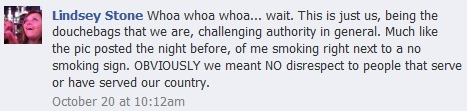
I have to give Lindsay Stone credit. You will seldom see as pure an example of an outrageous denial of the undeniable in a public apology as the one she just authored. Brava! And good luck with the job hunt.

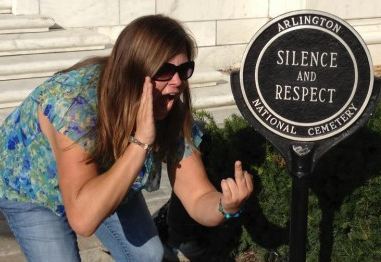
Stone, who is an idiot, and her friend, who is an idiot whose name has yet to be tracked down by the media, collaborated on a photo showing Stone giving an upturned middle finger to the Tomb of the Unknown Soldier, while yelling something by the sign there that says “Silence and Respect.” The photograph was posted on Stone’s Facebook page and naturally went viral. Thousands of protesters bombarded the website of their employer, Living Independently Forever, with demands that the two be fired. Today, they were.

Before the inevitable axe fell (more on that in a bit), Stone posted this remarkable explanation:

Continue reading

The Ethical Firing That Never Happened: Penn State’s Blindness Continues

...and you still don't get it.

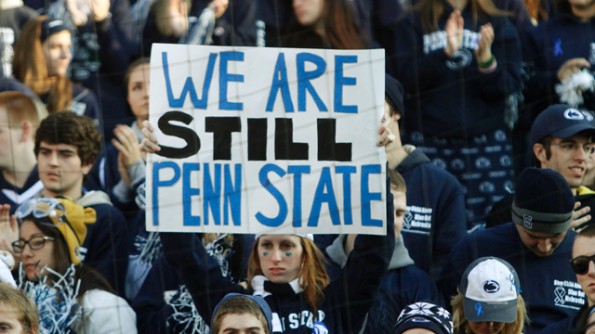
Penn State didn’t think that allowing a probable sexual predator to continue to abuse kids was a firing offense, and still doesn’t.

Incredibly, Joe Paterno is still receiving his full salary. He was not fired, as all newsmedia reported, and the University, having released a deceitful and carefully worded misleading announcement in November, allowed that falsehood to be circulated and believed, even as students were rioting on campus against Joe Pa’s “dismissal.”

“The Board of Trustees and Graham Spanier have decided that, effective immediately, Dr. Spanier is no longer president of the University,” the announcement had stated. “Additionally, the board determined that it is in the best interest of the University for Joe Paterno to no longer serve as head football coach, effective immediately.

But it never said that Paterno was fired. Now, finally, the University’s sick subterfuge is coming to light. Continue reading

Romney, Firing, Leadership, and Ethics Bob’s Lament

Yes, yes, firing people is one thing Donald Trump does well too. Shut up.

Ethics Bob Stone sent in a comment late last night that I replied to, but that I think deserves more discussion, on several points. Responding to my Ethics Hero designation for Ron Paul for coming to his adversary’s defense over Romney’s now infamous remark about firing people, Bob wrote:

“…I think Romney’s “I like to fire people”–even taken IN context–displays an inner heartlessness. I know about creative destruction, and I myself have taken actions to lay off people, and even fired a couple face-to-face. I did what needed to be done. No apologies.

“But did I like it? I HATED it.

“Romney’s comment seems of a kind with his strapping the family dog on his car roof for a 500-mi trip, or his advocacy of breaking up families to deport the parent or child who’s illegal. Gingrich was right.”

There are several issues here, some minor. Continue reading

Teachers Unions: Not Unethical, Just Uninterested in the Public Welfare

His union is competent; it's just that he isn't

Public unions and their Democratic supporters (and supported) are not going to have much luck winning the public relations battle with Republicans as long as teachers unions are front and center. Teachers unions are not— I repeat not-–primarily concerned with the welfare of schoolchildren, or the public, or the deficit, or even education. Their priority is the welfare of their membership, and if any of those other stakeholders have to take it on the chin to make sure that the teachers have good salaries, benefits and iron-clad job security, well, that’s just the way of the world.

This doesn’t make teachers unions unethical any more than lawyers are unethical to represent their clients. But it does mean that any time a teacher’s union official claims to be concerned with anything but his members, he or she is lying through their teeth. And that is unethical. Continue reading