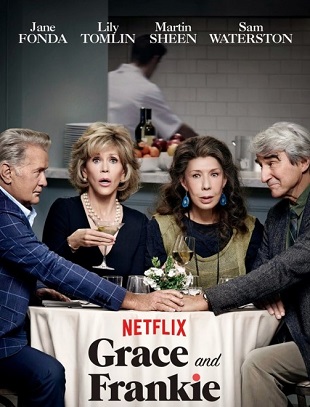
“Grace And Frankie” Ethics

“Grace And Frankie”Grace_and_Frankie_Season_1_poster_9 is a mostly fun Netflix series featuring Jane Fonda (as creepily “Death Becomes Her”- like,  70-going on 40-looking Grace Hanson) and Lilly Tomlin (Frankie Bergstein, an old, adorable hippie) as an odd couple of septuagenarians  brought together when their respective lawyer husbands, Robert ( Martin Sheen, looking very old) and Sol (Sam Waterson) declare that they have been carrying on a 20 year gay love affair. It’s now Season Two, both couples are divorced but friendly, and Robert and Sol are preparing an elaborate wedding.

Ah, but at the end of last season, cleaning out their old house and being soaked in photos, regrets and fond memories, Sol and Frankie had one last sexual fling (they had a kid: this was not unprecedented). The final episode saw Sol in anguish, feeling like he had betrayed the love of his life (that is, Robert) and not knowing how or whether to confess that he cheated with his former wife.

As Season Two gets underway, Robert has a heart attack, so the wedding is much reduced in grandeur with him still recuperating. Frankie officiates, having received her legal authority to do so over the internet. All is romantic bliss until Sol, after Robert, now recovered has prepared a romantic dinner and they have belatedly exchanged rings, can’t hold his terrible secret back any longer. He tells Robert about his one-night stand. [As he should. Everyone else in the extended family knows about his dilemma, and Robert and Grace’s children urge him to never reveal a secret that can only cause unhappiness. Sol, correctly, asserts that he can’t begin a marriage with secrets and lies. For better or worse, he has to come clean.]

And Robert throws him out! Continue reading

Presenting Ethics Alarms’ 67th Rationalization: The Underwood Maneuver or “That’s In The Past”

HOUSE-OF-CARDS

The latest addition to the Ethics Alarms Rationalization List is #50 A, The Underwood Maneuver, or “That’s in the past.” It is a sub-rationalization of #50, The Apathy Defense, or “Nobody Cares,” and the 67th dishonest, illogical or otherwise ethics-busting excuse for wrongful conduct on the list.

This rationalization has the honor of being named for a President, though a fictional and sinister one: Frank Underwood, the devious, psychopathic, lying and murdering Chief Executive, played by Kevin Spacey, who leads the den of thieves and blackguards who populate the fictional Washington, D.C. in the Netflix drama, “House of Cards.” I owe the series my gratitude for reminding me of this classic rationalization, which is a favorite not only of  President Underwood and his Lady Macbeth-like First Lady, but also—just coincidentally—of Bill and Hillary Clinton. Indeed, Hillary’s current campaign is built on it.

The Underwood Maneuver is versatile. Frank’s favorite use of it is when he is seeking assistance from one of the gazillion elected officials, appointees and other whom he has lied to or metaphorically stabbed in the back. “Why should I trust you now, when you betrayed me?” these poor souls are always asking. “Oh, but that was in the past!” says Frank, in his gentle South Carolina accent. “This is now. We need each other now. What’s done is done. Let’s move forward.” Continue reading

On the Importance Of Christmas To The Culture And Our Nation : An Ethics Alarms Guide

christmas-hero-H

I don’t know what perverted instinct it is that has persuaded colleges and schools to make their campuses a Christmas-free experience. Nor can I get into the scrimy and misguided minds of people like Roselle Park New Jersey Councilwoman Charlene Storey, who resigned over the city council’s decision to call its Christmas tree lighting a Christmas Tree Lighting, pouting that this wasn’t “inclusive,” or the  CNN goon who dictated the bizarre policy that the Christmas Party shot up by the husband-wife Muslim terrorists had to be called a “Holiday Party.”  Christmas, as the cultural tradition it evolved to be, is about inclusion, and if someone feels excluded, they are excluding themselves.  Is it the name that is so forbidding? Well, too bad. That’s its name, not “holiday.” Arbor Day is a holiday. Christmas is a state of mind. [The Ethics Alarms Christmas posts are here.]

Many years ago, I lost a friend over a workplace dispute on this topic, when a colleague and fellow executive at a large Washington foundation threw a fit of indignation over the designation of the headquarters party as a Christmas party, and the gift exchange (yes, it was stupid) as “Christmas Elves.” Marcia was Jewish, and a militant unionist, pro-abortion, feminist, all-liberal all-the-time activist of considerable power and passion. She cowed our pusillanimous, spineless executive to re-name the party a “holiday party” and the gift giving “Holiday Pixies,” whatever the hell they are.

I told Marcia straight out that she was wrong, and that people like her were harming the culture. Christmas practiced in the workplace, streets, schools and the rest is a cultural holiday of immense value to everyone open enough to experience it, and I told her to read “A Christmas Carol” again. Dickens got it, Scrooge got it, and there was no reason that the time of year culturally assigned by tradition to re-establish our best instincts of love, kindness, gratitude, empathy, charity and generosity should be attacked, shunned or avoided as any kind of religious indoctrination or “government endorsement of religion.”  Jews, Muslims, atheists and Mayans who take part in a secular Christmas and all of its traditions—including the Christmas carols and the Christian traditions of the star, the manger and the rest, lose nothing, and gain a great deal. Christmas is supposed to bring everyone in a society together after the conflicts of the past years have pulled them apart, What could possibly be objectionable to that? What could be more important than that, especially in these especially divisive times? How could it possibly be responsible, sensible or ethical to try to sabotage such a benign, healing, joyful tradition and weaken it in our culture, when we need it most?

I liked and respected Marcia, but I deplore the negative and corrosive effect people like her have had on Christmas, and as a result, the strength of American community. I told her so too, and that was the end of that friendship. Killing America’s strong embrace of Christmas is a terrible, damaging, self-destructive activity, but it us well underway. I wrote about how the process was advancing here, and re-reading what I wrote, I can only see the phenomenon deepening, and hardening like Scrooge’s pre-ghost heart. Then I said…

Christmas just feels half-hearted, uncertain, unenthusiastic now. Forced. Dying.

It was a season culminating in a day in which a whole culture, or most of it, engaged in loving deeds, celebrated ethical values, thought the best of their neighbors and species, and tried to make each other happy and hopeful, and perhaps reverent and whimsical too.  I think it was a healthy phenomenon, and I think we will be the worse for its demise. All of us…even those who have worked so diligently and self-righteously to bring it to this diminished state.

Resuscitating and revitalizing Christmas in our nation’s heart will take more than three ghosts, and will require overcoming political correctness maniacs, victim-mongers and cultural bullies; a timid and dim-witted media, and spineless management everywhere. It is still worth fighting for.

More than five years ago, Ethics Alarms laid out a battle plan to resist the anti-Christmas crush, which this year is already underway. Nobody was reading the blog then; more are now. Here is the post: Continue reading

Ethics Hero: Washington Nationals Star Bryce Harper

Bryce Harper

The knock on Bryce Harper, the Nationals’ 22 year-old burgeoning superstar who will soon be named the 2015 NL MVP, is that he’s immature, cocky, and self-destructive. But he seems to have proven himself to be far less so than the same sportswriters who have so often leveled such doubts about his character. This is good news for the Nationals and their fans, and also for suckers like me, who believe that baseball stars have an obligation to be good role models.

I wrote here about the late September, mid-game dugout fight between Harper and Jonathan Papelbon, a late season acquisition by the Nats whose arrival as a new bullpen ace coincided with team’s collapse in the National League East race. Post hoc ergo propter hoc being as seductive a logical fallacy as it is, Nats fans and, less excusably, the D.C. sports press blamed much of the Nats failure on the ex-Phillies, ex-Red Sox closer, along with manager Matt Williams, who was fired immediately after the regular season. Papelbon was also blamed for the fight, which is fair: he started it.

I noted in a follow-up post: Continue reading

What Do We Do About Steve Rannazzisi?

Comedian Steve Rannazzisi is in the midst of his 7th seasons starring on the popular TV show,“The League;” he has a one-hour special coming up on Comedy Central, and is increasingly in demand for commercial endorsements. How did he distinguish himself among the large pack of similarly young, edgy stand-up comics? Well, he’s good—but them a lot of them are good. He is, however, the only one who has a harrowing tale of being a survivor of the 9/11/2001 Twin Towers attack. For more than a decade he has been telling interviewers about his narrow escape, how he was working at Merrill Lynch’s offices on the 54th floor of the South Tower when the first plane struck the North Tower, and how he rushed  out of the building and into the street just before the second hijacked  plane slammed into the tower he just left. That was an epiphanal moment for Rannazzisi, he has said, and realizing that every second of life was precious and that he was saved for something more important than pushing paper, Rannazzisi quit his conventional day job to pursue a career as a comic.

That back story made Rannazzisi seem uniquely human, appealing, and on a mission. It wouldn’t have boosted his career if he didn’t have the talent to capitalize on it, but he did. To some extent, all of his success has been built on the foundation of the Twin Towers’ fall, so his fans and employers have a dilemma to face: he was lying. The New York Times checked out his account, and determined that the comedian had been working in Midtown on 9-11, never was employed by Merrill Lynch (which had no offices in either tower), and has been lying all these years. This week, Rannazzisi confessed and apologized, saying in part,

“I was not at the Trade Center on that day. I don’t know why I said this. This was inexcusable. I am truly, truly sorry….For many years, more than anything.I have wished that, with silence, I could somehow erase a story told by an immature young man. It only made me more ashamed. How could I tell my children to be honest when I hadn’t come clean about this? It was profoundly disrespectful to those who perished and those who lost loved ones. The stupidity and guilt I have felt for many years has not abated. It was an early taste of having a public persona, and I made a terrible mistake. All I can ask is for forgiveness.”

(Excellent apology: Level One on the Apology Scale.)

Now what? Continue reading

Ethics Dunce (and Ethics Hero REVOKED): Sen. Ted Cruz

revoked

Uh-uh, Senator. You can’t have it both ways, not on Ethics Alarms. You can’t be gracious and forgiving and then turn around a couple days later and say what your red meat supporters want to hear. I call that an “Al Gore,” who gave a magnanimous and statesman-like speech conceding after the Supreme Court stopped the 2000 Florida recount, and then slammed the legitimacy of his defeat ever after.

Ethics Alarms gave the Republican rabblerouser an Ethics Hero designation for coming to pundit Mark Halperin’s defense when he was being pilloried all over the media for a demeaning interview of Cruz based on the assumption that he needed to prove that he was really Hispanic. After Halperin was battered into apologizing, Cruz said, in part,

“Mark Halperin is a serious and fair-minded journalist. Today he kindly issued an apology for some silly questions he asked me in an interview. The apology was unnecessary — no offense was taken, nor, I believe, intended — but is certainly appreciated.”

That was classy, and also apparently, a ploy and insincere.In comments about the episode to the conservative IJReview at an  American Conservative Union event, Senator Cruz essentially recycled the same Halperin critic complaints that his earlier comments were supposed to deflect, saying,

“Imagine if [Halperin] had asked Obama these same questions? He would have been run out of the industry.”

But no offense was taken, right, Ted?

Not cool, not kind, and definitely not consistent. The fact that he is absolutely correct about the double standard is beside the point. Cruz couldn’t help himself. He knew the right way to act (that is, his ethics alarms work and he can follow the Golden Rule), but he didn’t have the self-restraint or integrity to resist taking a shot at Halperin anyway. Now we know what he really thinks, and now we know that what he said initially was just a smart politician taking a high road that he didn’t want to be on.

Got it.

Fool me once, Ted…

Ethics Hero REVOKED

Ethics Hero: Sen. Ted Cruz

[UPDATE: Sen Cruz’s Ethics Hero designation has been REVOKED by Ethics Alarms. Details here.]

One of the Republican party’s most demonized  conservative politicians, Tea Party idol and Presidential candidate Sen. Ted Cruz of Texas, just challenged his progressive critics to concede that he has the character of a President, at least.

Cruz stood by politely as familiar TV pundit Mark Halperin cross-examined him on Bloomberg TV as if the Cuban-American was suspected of being born in Kenya. The demeaning interview (to both Cruz and Halperin, who disgraced himself) consisted of  Halperin pressing the Republican firebrand to prove his Hispanic bona fides with  cringe-worthy questions about his favorite Cuban food and what his tastes in Hispanic music were. (A Hispanic journalist quipped that Halperin had Cruz confused with Ricky Ricardo.) It all came to a nauseating climax when Halperin said: “I want to give you the opportunity to directly welcome your colleague Sen. Sanders to the race, and I’d like you to do it, if you would, en español.

The fiasco of an interview took a while to register (apparently nobody watches Bloomberg), but when it did, Halperin was excoriated left, right, and center, called a racist, called a fool, called biased against Cruz and determined to trap him into a “Gotcha!” Mostly he was called an inept and unprofessional interviewer, and Halperin, who is playing talking head somewhere that actually has viewers almost every  day, had to issue an attempted career-salvaging apology.

Ted Cruz surprised everyone by coming to Halperin’s rescue. He wrote: Continue reading

Ethic Quiz: Is Eva Kor An Ethics Hero, Or An Ethics Dunce?

Kissed by a murderous Nazi. Yum.

Kissed by a murderous Nazi. Yum.

81-year-old Holocaust survivor Eva Kor recounted her memories of being one of Dr. Josef Mengele’s human guinea pigs  in a letter to Oskar Groening, a former member of the SS at Auschwitz-Birkenau who is on trial in Germany for 300,000 counts of accessory to murder:

In May 1944, when we were taken to Auschwitz, my name was Eva Mozes. My family and I were part of the Hungarian transport. My family included my father Alexander Mozes, 44 years old; my mother Jaffa Mozes, 38 years old; my older sister Edit, 14 years old; my middle sister Aliz, 12 years old; and my twin sister, Miriam, 10 years old. Within thirty minutes after arriving on the selection platform, Miriam and I were ripped apart from our family forever. Only she and I survived, because we were used in experiments conducted by .

Within half an hour we became part of a group of twin girls aged two to sixteen: thirteen sets of little girls and one mother. We were taken to a processing center where they cut our hair short and took our clothes away. That evening they returned them with a red cross at the backs. Then they lined us up for tattooing. When my turn came, I decided to cause them as much trouble as a ten year-old could. Two Nazis and two women prisoners restrained me with all their force. They began by heating a needle. When the needle got hot, they dipped it into ink and burned into my left arm, dot by dot, the capital letter A-7063. Miriam became A-7064…

For the next two weeks I only have one clear memory: I was crawling on the floor because I could no longer walk. I was crawling to reach a faucet with water because they did not even give us water anymore.

In 1984, Kor founded CANDLES (Children of Auschwitz Nazi Deadly Lab Experiments Survivors), in an effort to locate other surviving Mengele twins; and in 1995 she opened the CANDLES Holocaust Museum and Education Center in Terra Haute, Indiana. She calls herself a “forgiveness advocate,” teaching children:

1. Never give up on yourself or your dreams. I did not know how to survive Auschwitz, but I was determined to do it. Here I am 70 years later because I never gave up.

2. Treat people with respect and fairness to eliminate prejudice from your life.

3. Forgive your worst enemy and forgive anybody who [h]as ever hurt you. I forgave the Nazis and I forgave everybody who hurt me.

Kor is one of the Holocaust survivors testifying at Groening’s trial. On its first day, Groening told the court that  “it is beyond question that I am morally complicit. This moral guilt I acknowledge here, before the victims, with regret and humility.”  Kor told him, “I appreciate the fact that you are willing to come here and face us.” She offered the defendant her hand, and he took it, brought her into a near embrace, and kissed her on the cheek. 

Your Ethics Alarms Ethics Quiz as this week ends is…

Is Eva Kor an Ethics Hero, or an Ethics Dunce?

Continue reading

Brian Williams Ethics Train Wreck Update: David Brooks’ Ethics Confusion

Huh?

Huh?

David Brooks’ New York Times op-ed column decrying the widespread criticism of Brian Williams’ serial lying show us that Brooks himself is frighteningly confused regarding such basic ethical values as accountability, trust, trustworthiness and accountability. That’s good to know, don’t you think? Now the question is why anyone in their right mind would care what such an ethically muddled political and cultural analyst thinks about anything.

Yesterday, the Washington Post revealed yet another example of Williams’ fabulism: his bizarre story about roaming gangs at the local Ritz Carlton in the wake of New Orleans’ devastation by Katrina. Never mind, argues Brooks: the problem isn’t with Williams, it’s with his critics.

Brooks’ New Times column begins with a strange, exaggerated and unethically inclusive first paragraph about how  fame drives people to wrongdoing. “The desire for even more admiration races ahead. Career success never really satisfies. Public love always leaves you hungry,” he writes. “Always?” Who is he talking about, himself? The famous people being described here are emotionally and spiritually unhealthy famous people–addicts to fame, narcissists, desperate hostages to celebrity. I have no doubt that Williams fits that description,  but many prominent, accomplished and celebrated people do not. They are known as “trustworthy.” Having impugned many thousands of well-adjusted pubic figures past and present to lay the groundwork for an “everybody does it” defense of Williams (EDI is running neck and neck with the other favorite rationalization being used by Williams enablers: “It’s not the worst thing.”), Brooks attacks anyone not famous who resents being lied to:

“The barbaric part is the way we respond to scandal these days. When somebody violates a public trust, we try to purge and ostracize him. A sort of coliseum culture takes over, leaving no place for mercy. By now, the script is familiar: Some famous person does something wrong. The Internet, the most impersonal of mediums, erupts with contempt and mockery. The offender issues a paltry half-apology, which only inflames the public more. The pounding cry for resignation builds until capitulation comes. Public passion is spent and the spotlight moves on.”

This paragraph is astounding, and embarrassing too. Someone violates a public trust, and the public has the audacity not to trust him any more! What barbarism! Is Brooks even passing familiar with the concept of accountability? Not on the evidence of this drivel, he isn’t. An honorable man or woman in a position of trust who so publicly disgraced himself as Brooks has should immediately and voluntarily resign. Once, long ago, that was the natural, traditional, expected and required response to such a scandal, but this was in the days when celebrity and power was not so frequently accompanied by greed. Williams is paid about ten millions dollars a year, and that’s apparently too much to give up merely to demonstrate integrity, remorse and acceptance of responsibility for wrongdoing, especially when there are allies like Brooks out there ready to shift the blame.

There would be no need to purge someone who has proven themselves untrustworthy in a high position of trust if the individual would be accountable and courageous and purge himself, as he (or she—I’m looking at you, Kathleen Sibelius) is obligated to do. How can Brooks not understand this? The offender offers a “paltry apology,” and Brooks blames the public for correctly concluding that such an offender doesn’t understand the seriousness of what he did, isn’t really sorry, and will do it again. So the “pounding cry for resignation builds until capitulation comes.” Yes, David, that’s the way it’s supposed to work. This isn’t barbarism. This is civilization. This is enforcing standards. This is ethics, this is accountability.

Brooks doesn’t comprehend any of it, apparently:

“I do think we’d all be better off if we reacted to these sorts of scandals in a different way. The civic fabric would be stronger if, instead of trying to sever relationships with those who have done wrong, we tried to repair them, if we tried forgiveness instead of exiling.”

We’d all be better off if we let people who lie to us stay in the position that will allow them to keep lying to us? Continue reading

Wanetta Gibson, The Limits Of Forgiveness, And The Most Unethical Facebook Friend Request Ever

"Come on. Let's hang out. I'm more mature now."

“Come on. Let’s hang out. I’m more mature now.”

Brian Banks, the once-promising high school athlete whose life was upended by a classmate’s false rape accusation that sent him to prison for five years, is now  back on his feet, working for the National Football League, and, by the evidence of his recent profile in the New York Daily News, impressively beyond anger and bitterness. He does tell a stunning story, however, of a day in 2011 when he received an unexpected Facebook friend request from Wanetta Gibson, the woman who, for no apparent reason, did this terrible thing to him. Banks says that she wrote…

“I was hoping we could let bygones be bygones. I was immature back in the day, but I’m much more mature now. Let’s hang out. I’d love to see you. I’ve seen your picture on Facebook. You look real good. I would love to hook up.”

I’ve been trying to think up a fanciful equivalent for this “I know I tried to wreck your life, now will you please let me back into it?” request. Would it be John Hinckley Jr. asking President Ronald Reagan for a job? Edward Snowden replying to an NSA RFP? Maybe V. Stiviano asking Donald Sterling for a job recommendation? I’m not sure any of them would be as bad. “Let bygones be bygones.” Among other things, what an insult this is. How stupid does Gibson think her victim is?

Then there is this chilling statement: I was immature back in the day, but I’m much more mature now.” Translation:  “Yes, now I’m a fully mature vicious sociopath. Don’t you want to renew our relationship?”

These are the situations where someone inevitably argues that Americans believe in redemption, and when I inevitably respond, “You are out of your friggin’ mind.” Some people, not many, but some, are bad to the bone, and the social pressure to forgive the worst of the worst—Did you read the words “I’m sorry” anywhere in that request?—is a trap, set up by those who won’t have to live with the consequences of another betrayal of trust.

Banks, of course, rejected Gibson’s overtures.

Two years later, she recanted her withdrawal of her rape accusation.