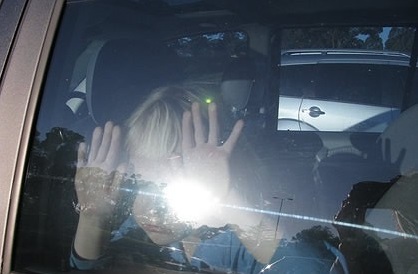
Ethics Alarms Encore: “Ethics Quiz: Four Young Children Locked In A Hot Car” (July 31, 2014)


[ I’m a mess today; exhausted, distracted, sad. I’m mad at myself about it too, but you can’t reason away or rationalize away grief. Everything makes me think about my little dog. It’s 85 degrees; gee, is it too hot to walk…oh. Right. I feel like a nap: Hey Rugby, want to…oh. Of course. Silly me. Then that TV commercial comes on with the Jack Russell in the car letting his ears blow in the breeze, smiling. Rugby did that. Crap.


So, lazy though it may be, I’m going to put up an old post of interest, an Ethics Quiz. We’re heading into the “locking kids—and dogs—in hot cars” season, so here’s a post about that topic from five years ago.]

______________________________

Mom and mom advocate Lenore Skenazy writes the Free Range Kids blog, which I have to remember to check out regularly. She is the source of today’s Ethics Quiz, which she obviously believes has an easy answer. We shall see.

Charnae Mosley, 27, was arrested by Atlanta police and charged with four counts of reckless conduct after leaving her four children, aged 6, 4, 2, and 1, inside of her SUV with the windows rolled up and the car locked.  It was 90 degrees in Atlanta that day. The children had been baking there for least 16 minutes while their mother did some shopping. A citizen noticed the children alone in the vehicle and reported the children abandoned.

Skenazy believes that the arrest is excessive—that the mother made a mistake, but that compassion is called for, not prosecution:

“[T]he mom needs to be told that cars heat up quickly and on a hot summer day this can, indeed, be dangerous. She does not need to be hauled off to jail and informed that even if she makes bail, she will not be allowed to have contact with her children…No one is suggesting that it is a good idea to keep kids in a hot, locked car with no a.c. and the windows up. But if that is what the mom did, how about showing some compassion for how hard it is to shop with four young kids, rather than making her life infinitely more difficult and despairing?The kids were fine. They look adorable and well cared for. Rather than criminalizing a bad parenting decision (if that’s what this was), how about telling the mom not to do it again?”

Do you agree with her? Here is your Ethics Alarms Ethics Quiz of the day:

Was it cruel, unfair, unsympathetic or unkind for Atlanta police to arrest Mosely for leaving her four young children locked in a hot car? Continue reading

In Maryland, Tempting Moral Luck And The Barn Door Phenomenon In A Free Range Kids Ethics Conflict

Lyon Sisters

Just months after suburban Maryland parents Danielle and Alexander Meitiv were cited by Montgomery County’s Child Protective Services for “unsubstantiated neglect” for allowing their children Rafi, 10, and Dvora, 6, to walk home from a park close to home, the defiant parents let their kids to do it again. Again, someone called 911 (anonymously), and again the children were picked up by police.

This time, the police took the Meitiv children to Child Protective Services headquarters and for some reason didn’t tell the parents, who, naturally enough, freaked out. Five and a half hours later the agitated children and frantic parents  were reunited. You can read about the initial incident from the mother’s perspective here; and obviously Lenore Skanazy is in full battle array on her “Free Range Kids Blog.” Columnists everywhere are rushing to their keyboards to write columns like this one, by the Washington Post’s Petula Devorak, titled “Why Are We Criminalizing Childhood Independence?”

The ethics of this issue are more complicated than simplistic “We used to walk around freely all the time when we were kids and it was more dangerous then than now” reminiscences are equipped to explore.

Analyzing this ethics conflict (“when two or more ethical principles are in opposition”)  screams out for the useful starting point for ethics analysis:

What’s going on here?

Before I answer, let’s get a couple of ethics verdicts out of the way: Continue reading

The Free Range Mom, Bias, and the Perils Of Blind Loyalty

About  the blind leading the blind---not only is it dangerous, it looks ridiculous to those who can see.

About the blind leading the blind—not only is it dangerous, it looks ridiculous to those who can see.

One of my favorite bloggers just fell into the blind loyalty trap. I’m sympathetic, but this is something that those who accept the responsibility of  teaching us important lessons and clarifying difficult issues must avoid at all costs. Bias makes us stupid, and blind loyalty breeds bias like carrion breeds maggots. It pains me to see Lenore Skenazy, author of the Free Range Kids blog, undermine her credibility like this.

She titled her post Horrible Editorial Chides Mom for Not Predicting Unpredictable Crime. In it, she takes the side of a mother who left her four-year-old son in an unlocked, running van while she picked up her daughter at a northeast school. Someone was drove her van off with her son in it, and subsequently crashed. The boy was unhurt. Under the circumstances, there is nothing horrible about the editorial, which uses the incident—even Skenazy agrees that the mother’s conduct was “dumb”—to caution parents about leaving children in cars. This is the editorial that aroused Skenazy to defend the indefensible:

“A Calgary mom has no doubt learned her lesson. The woman recently left her four-year-old son in her unlocked, running van while she picked up her daughter at a northeast school. The mother said she was gone about six minutes, and when she came out, someone was stealing her van with her son in it.

Fortunately, the incident ended well, with the child unhurt after the thief crashed the van, and the suspect was taken into custody.…charges of child endangerment need to be pressed to set an example, because no matter how often these types of things occur, other parents continue to leave their kids in similar situations. It takes just a few minutes to get your child out of a vehicle and bring him or her along with you on whatever errand needs running. Sure, it’s more convenient just to leave a child in the car and do the errand, unencumbered. However, child safety should trump inconvenience every time. Better a few extra minutes lost bundling a little one in and out of a vehicle than a lifetime of regret and what-ifs.”

The rationalizations in Skenazy’s defense begin with the title of her post, which is dishonest and in her own words, “dumb.” She is using moral luck as a defense, arguing that the sequence of events as they unfolded were merely unfortunate, and the mother just as easily could have returned to her van and car with nothing amiss. The odds favor nothing bad happening in six minutes; on the other hand, the odds of nothing bad happening are much better if a child isn’t in an unlocked vehicle with the engine running at all. Continue reading

Phtography Ethics, Parenting Ethics, Face-stomping Ethics

no photographs

Item:

“A 32-year-old city resident was arrested for allegedly stomping on the face of a college student who was taking pictures at a Liberty Heights park on Tuesday afternoon. Victoria M. Torres, of 211 William St., was taken into custody for assaulting a 22-year-old student who was taking snapshots for a “photography class project” near the water park in Van Horn Park, Springfield police spokesman Sgt. John Delaney said.”

The student was taking photos of Torres’s young daughter, among other subjects.

More…

“Torres approached the photographer and “demanded in a threatening manner” that she delete any pictures containing images of her children, according to Delaney. The student, who wasn’t publicly identified by police, tried to avoid a confrontation and started to leave the park.”As she was walking out, the outraged female came over and punched her twice in the face, grabbed her by the hair and pulled her to the ground,” Delaney said. Torres then “kicked the victim and stomped her face” after the photographer had fallen to the ground, Delaney said.Torres also tried to take the woman’s camera and equipment, valued at about $4,000. Torres grabbed hold of the camera strap in effort to pull the camera from the student’s neck, Delaney said.”

Let’s stipulate that stomping on the student’s face…indeed, stomping on faces generally, is per se unethical. Now that this is settled, did the t mother have a legitimate objection? Was the student behaving ethically?

Yes, and no. Continue reading

Ethics Quiz: Four Young Children Locked In A Hot Car

kid-in-hot-car

Mom and mom advocate Lenore Skenazy writes the Free Range Kids blog, which I have to remember to check out regularly. She is the source of today’s Ethics Quiz, which she obviously believes has an easy answer. We shall see.

Charnae Mosley, 27, was arrested by Atlanta police and charged with four counts of reckless conduct after leaving her four children, aged 6, 4, 2, and 1, inside of her SUV with the windows rolled up and the car locked.  It was 90 degrees in Atlanta that day. The children had been baking there for least 16 minutes while their mother did some shopping. A citizen noticed the children alone in the vehicle and reported the children abandoned.

Skenazy believes that the arrest is excessive—that the mother made a mistake, but that compassion is called for, not prosecution:

“[T]he mom needs to be told that cars heat up quickly and on a hot summer day this can, indeed, be dangerous. She does not need to be hauled off to jail and informed that even if she makes bail, she will not be allowed to have contact with her children…No one is suggesting that it is a good idea to keep kids in a hot, locked car with no a.c. and the windows up. But if that is what the mom did, how about showing some compassion for how hard it is to shop with four young kids, rather than making her life infinitely more difficult and despairing?The kids were fine. They look adorable and well cared for. Rather than criminalizing a bad parenting decision (if that’s what this was), how about telling the mom not to do it again?”

Do you agree with her? Here is your Ethics Alarms Ethics Quiz of the day:

Was it cruel, unfair, unsympathetic or unkind for Atlanta police to arrest Mosely for leaving her four young children locked in a hot car?

I am an admirer of Lenore Skenazy, but her pro-mother bias led her seriously astray this time. I think she is applying rationalizations, consequentialism and dubious, indeed dangerous reasoning to let this mother off a hook that she deserves to stay on. In her post, she even suggests that the car’s air conditioning was on, though there is no reason to believe that it was based on the reports. If the A-C was on, that changes the situation: I very much doubt that a mother would be charged with leaving four children in a locked, hot car if the car was not, in fact, hot. (One report states that the SUV windows were open, but that wouldn’t support the charges. If the windows were open, then Mosely left her children alone in public, which is a different form of child endangerment, but still dangerous. For the purpose of the quiz, I am assuming that the windows were shut, and that the air conditioning was not on. So does Skenazy.)

Let’s look at Lenore’s analysis errors:

  • She notes that the children were “fine.” What if they hadn’t been fine? That wouldn’t change what Mosely had done in any way, and what she did was irresponsible, dangerous and potentially deadly. Sixteen minutes, scientists tell us, is more than enough time for temperatures in a closed car to rise sufficiently high to cause heat stroke. Mosely, and obviously her children, were lucky—this is classic moral luck—and that shouldn’t be allowed to diminish the seriousness of what she did. (Aside: I just realized that to find that link, I made the same Google search that Justin Ross Harris made before leaving his infant son to die in his own hot vehicle, which has added to the circumstantial evidence causing him to be charged with murder.)
  •  The rationalizations peeking through Slenazy’s excuses for the mother’s conduct are quite a crowd. Along with #3. Consequentialism, or  “It Worked Out for the Best,” there is #19. The Perfection Diversion: “Nobody’s Perfect!” or “Everybody makes mistakes,” it’s twin, #20, The “Just one mistake!” Fantasy, #22. The Comparative Virtue Excuse: “There are worse things,” #25. The Coercion Myth: “I have no choice,”  #27. The Victim’s Distortion, #30. The Prospective Repeal: “It’s a bad law/stupid rule,” and #33. The Management Shrug: “Don’t sweat the small stuff!” There are probably some more, but that’s plenty.
  • If Skenazy believes that the “it was just a mistake” explanation should protect the mother from prosecution here, presumably she would make the same argument if all four kids (or just one) died. A lot of prosecutors feel the same way. I don’t.
  • If Mosley did this once, she may well have done it before, and is a risk to do it again. The best way to teach her not to do it again is, at very least, to scare her, inconvenience her, publicly embarrass her, and use the legal system to show how serious her wrongful conduct was, and how seriously society regards it. There is no guarantee that a lecture from a cop wouldn’t have just produced just an eye-rolling “Whatever…my kids were just fine, and I know how to take care of them” reaction, a repeat of the conduct, and eventually, a tragedy….followed, of course, by public accusations that the police were negligent and abandoned four children to the care of a dangerously reckless and incompetent mother.
  • I’m sorry, Lenore, but this-“How about showing some compassion for how hard it is to shop with four young kids, rather than making her life infinitely more difficult and despairing?” —makes me want to scream. How about not having more children that you can take care of safely? How about recognizing that your children’s safety comes first, with no exceptions, ever? How about meeting the minimum level of parenting competence, and not remaining ignorant about conduct that has been well publicized as cruel and potentially fatal to dogs, not to mention young children? In this case, compassion is a zero-sum game: compassion for the mother means showing none for her children.

When ethics fails, the law steps in. Too many children die every year from this tragic mistake that arises from distracted parenting, ignorance, and poorly aligned priorities. Prosecuting parents like this one for non-fatal incidents is exactly how the law serves as a societal tool to increase public awareness and encourage better conduct. It is in the best interests of Mosely’s four children as well as the children of every parent who reads about or hears her story to prosecute her to the full extent of the law.

_______________________________

Pointer and Source: Free Range Kids

Facts: Yahoo!, WSB