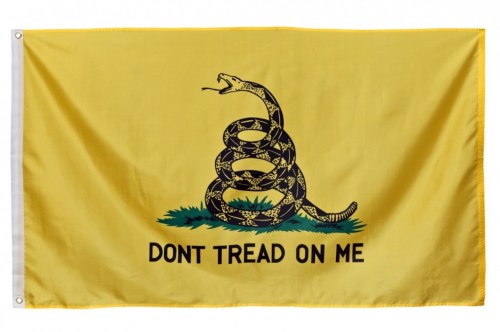
On the Volokh Conspiracy, now featured on the Washington Post website, Prof. Volokh applies his First Amendment expertise to a recent EEOC decision which ruled that a complaint from an African-American that a fellow worker who repeatedly wore a cap with the famous “Don’t Tread On Me” insignia from the Gadsden flag may have created a hostile work environment at the federal agency both worked for. The Equal Employment Opportunity Commission called for further investigation, including an interview of the cap-owner’s intention in wearing the symbol, concluding,
“In light of the ambiguity in the current meaning of this symbol, we find that Complainant’s claim must be investigated to determine the specific context in which C1 displayed the symbol in the workplace. In so finding, we are not prejudging the merits of Complainant’s complaint. Instead, we are precluding a procedural dismissal that would deprive us of evidence that would illuminate the meaning conveyed by C1’s display of the symbol.”
Observations:
1. Now this is the slippery slope. Because murderous racist Dylan Roof posed with the Confederate flag, a tipping point was reached that resulted in the symbol and the flag being effectively and in some respects officially banned. The EEOC had already ruled the wearing a Confederate flag T-shirt constituted racial harassment,. Now the banning of historically significant symbols is threatening to spread to a flag that had no relationship to race whatsoever, in large part because of who has chosen to display it.
2. There is a whole website devoted to the Gadsden flag, from which we learn that…
- It first appeared in October of 1775, as the British were occupying Boston and the desperate Continental Army was dug in in nearby Cambridge, lacking sufficient arms and ammunition. In October, a merchant ship returning to Philadelphia from a voyage to England brought private letters to the Second Continental Congress informing it that England was sending two cargo ships to America loaded with arms and gunpowder for the British troops.
- Congress decided Washington’s troops’ plight required that those ships and their cargo be captured. It authorized the creation of a Continental Navy, then only four vessels, to take the ships. Congress also authorized the mustering of five companies of Marines. Some of the Marines enlisting that month in Philadelphia carried drums painted yellow, emblazoned with a rattlesnake with thirteen rattles, coiled and ready to strike, accompanied by the motto “Don’t Tread on Me.”
- That same December, a citizen calling himself “An American Guesser,” anonymously wrote to the Pennsylvania Journal, saying in part:
“I observed on one of the drums belonging to the marines now raising, there was painted a Rattle-Snake, with this modest motto under it, ‘Don’t tread on me.’ As I know it is the custom to have some device on the arms of every country, I supposed this may have been intended for the arms of America…the Rattle-Snake is found in no other quarter of the world besides America….She never begins an attack, nor, when once engaged, ever surrenders: She is therefore an emblem of magnanimity and true courage. … she never wounds ’till she has generously given notice, even to her enemy, and cautioned him against the danger of treading on her..
I confess I was wholly at a loss what to make of the rattles, ’till I went back and counted them and found them just thirteen, exactly the number of the Colonies united in America; and I recollected too that this was the only part of the Snake which increased in numbers. …Tis curious and amazing to observe how distinct and independent of each other the rattles of this animal are, and yet how firmly they are united together, so as never to be separated but by breaking them to pieces. One of those rattles singly, is incapable of producing sound, but the ringing of thirteen together, is sufficient to alarm the boldest man living.”
It is generally agreed that the writer was really Benjamin Franklin. Ben had a hand in the design of the flag, since the first use of a rattlesnake to represent the colonies was his own “Join or die” cartoon,
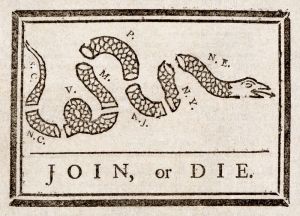
…published years earlier. Continue reading →
 Ethics Alarms