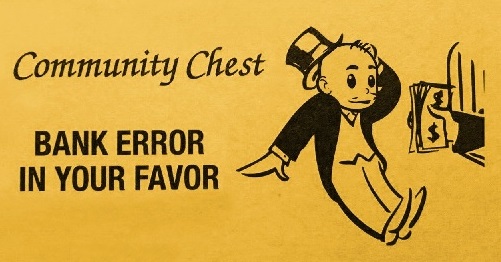
An inquirer who doesn’t understand a lot—games, fantasy, reality, ethics, childhood—wrote “The Ethicist” (that’s “Prof. Appiah” to his friends) to settle a family dispute. He likes to play Monopoly with his family, but he has removed the card above from the “Community Chest” deck because he believes it is unethical. When that bank makes an error in your favor, you must give the money back, not spend it on Reading Railroad, he explains. The card teaches bad conduct.
Well, Prof. Appiah sagely points out, so does Monopoly, which encourages you to employ cut-throat tactics to drive your friends into bankruptcy. I would add that Risk teaches you to seek to take over the world by military force, Stratego encourages assassination, and poker requires lying. Even Scrabble includes approved cheating: if you can put down a fake word and not get challenged for it, that’s just good gamesmanship.
“The Ethicist” suggests that rather than burning the card, it would suffice to have a brief comment from a parent about how of course real life has different rules than games, and that when you’re not playing Monopoly, giving back the $200 is the ethical and civilized choice.
Personally, as a long-time games-lover, I find it useful to think of games as a fantasy, parallel universes, each with its own laws, rules and tradition, like Bizarro World. What is right in one won’t make sense in another, including the real world. I thought everyone understood that.
I guess not!








 Ethics Alarms